
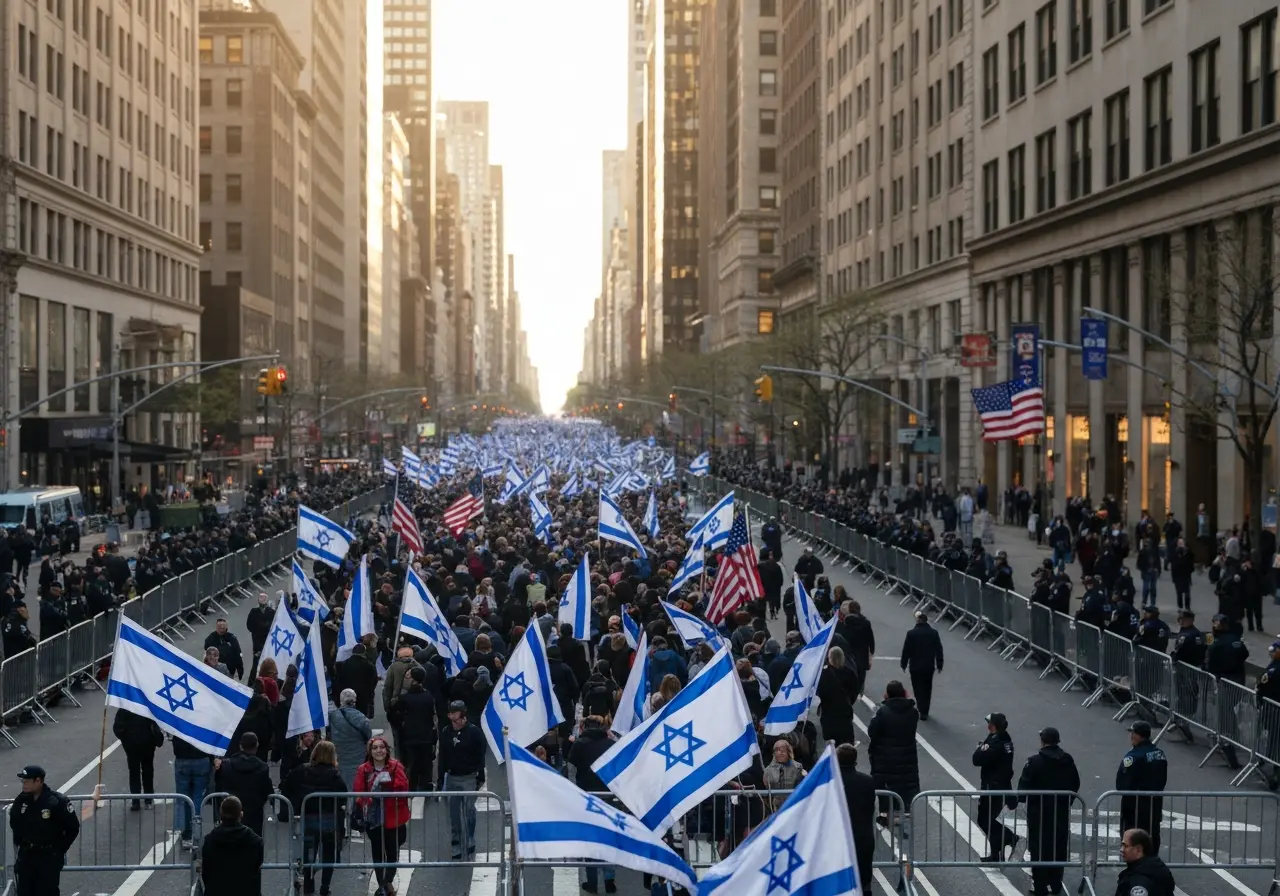
More than 50,000 people marched up Manhattan’s Fifth Avenue for New York’s Israel Day parade on Sunday, and the city’s mayor was not among them. Zohran Mamdani’s absence made him the first New York City mayor to boycott the event since it began in 1965, a six-decade streak broken during his first spring in office.
The more telling picture stood on the reviewing stand. Governor Kathy Hochul, Senate Minority Leader Chuck Schumer and most of the state’s Democratic leadership turned out in force, marching the same route a mayor of their own party had decided to skip.
A Boycott Without Precedent Since 1965
Mamdani, a Democratic Socialist who became the city’s first Muslim mayor when he took office in January, never hid the decision. He said during last year’s campaign that he would not walk in the parade, and he repeated the position when reporters pressed him days before the event.
“I said on the campaign trail that I wouldn’t be attending the parade, and I’ve made my views on the Israeli government abundantly clear,” the mayor said. He is a longtime supporter of the Boycott, Divestment and Sanctions movement (BDS, a campaign that opposes economic and cultural normalization with Israel), and he has been a sharp critic of Israel’s military campaign in Gaza. Two weeks before the march, his office released a video commemorating the Nakba, the Arabic term for the displacement of an estimated 700,000 Palestinians during the 1948 war.
The mayor has tried to hold two positions at once. He says Israel has a right to exist, though not as a state that grants Jewish citizens a privileged status, and he has pledged to protect Jewish New Yorkers and fund the city’s Office to Combat Antisemitism. He also vowed tight security for Sunday’s march, and the Israel Day on Fifth organizers publicly thanked City Hall for the smooth handling of preparations.
The State’s Democratic Leaders Marched in His Place
Where the mayor stayed home, the rest of the party showed up. The reviewing stand in Midtown read like a roll call of New York’s Democratic power structure, and several of them addressed the crowd before stepping onto the avenue.
- Governor Kathy Hochul, who opened the event from the stage
- Senate Minority Leader Chuck Schumer, who gave podium remarks
- Attorney General Letitia James and state Comptroller Tom DiNapoli
- City Council Speaker Julie Menin and City Comptroller Mark Levine
- Former mayors Eric Adams and Michael Bloomberg, who both attended
“Today we march in defiance and also to stand up for the values that defined New York State since its very beginning,” Hochul told the crowd. The optics were hard to miss. A first-term mayor faced a wall of senior figures from his own party, all of them choosing to be photographed at an event he had chosen to avoid.
That gap is the part of Sunday that outlasts the confetti. For decades the parade was a routine stop where the mayor, the governor and the senator stood shoulder to shoulder. This year the Democratic establishment used the same stretch of pavement to draw a line between itself and its newest star.
Two Buffer-Zone Laws, One Pointed Contrast
Hochul did not only march. Seated at a desk on the stage, flanked by elected officials and Jewish communal leaders, she signed a statewide law creating a 50-foot security buffer around houses of worship, a move timed to land on the morning of the parade. The new measure makes it a class B misdemeanor to block access to a place of worship and extends protection to synagogues, mosques, yeshivas, Jewish community centers and religious schools.
The signing carried a message aimed squarely at City Hall. A narrower city version of the same idea passed in New York without the mayor’s signature, and was watered down after Mamdani raised concerns about its reach. The contrast between the two laws was the subtext of the whole morning.
| Feature | State buffer-zone law | City buffer-zone measure |
|---|---|---|
| Signed by | Gov. Kathy Hochul, on the parade stage | Became law without the mayor’s signature |
| Protected radius | 50 feet around entrances | Narrower, scaled back after mayoral pushback |
| Reach | Statewide, all houses of worship | City limits only |
| Penalty | Class B misdemeanor to block access | Reduced enforcement provisions |
Civil liberties groups were not on the stage. “This law risks chilling activism at a time when the voices of New Yorkers are more needed than ever,” said Donna Lieberman, executive director of the New York Civil Liberties Union (NYCLU), warning that broad buffer rules could be used against peaceful protest. You can read the framework of New York’s statewide houses of worship security law on the governor’s official site.
A Bigger Knesset Delegation and an Unannounced Far Right
Israel sent more lawmakers than usual. Knesset Speaker Amir Ohana led a bipartisan delegation of Israeli legislators, a roster organizers said was larger than in past years, partly in response to the mayor’s stance and a rise in antisemitic incidents around the city. Ohana accused Mamdani of “fueling the flames of hatred” with his absence.
The delegation also included two figures whose presence was not flagged in advance. Far-right Finance Minister Bezalel Smotrich and Heritage Minister Amichay Eliyahu of the Otzma Yehudit party joined the march, even though the Jewish Community Relations Council of New York (JCRC, the communal body that organizes the parade) said beforehand it did not know which Israeli officials would attend, and the Israeli consulate’s list of expected participants did not name either minister.
Their attendance handed critics an opening, and it echoed a similar flashpoint at Jerusalem Day’s flag march in Israel, where hard-right participation has repeatedly turned a celebration into a confrontation. Along Fifth Avenue, a small group of left-wing Israelis protested the coalition ministers’ role, holding signs that read, “The only hope: a shared Israeli-Palestinian future.” There were no anti-Zionist counter-protesters anywhere along the route.
Record Turnout and a Show of Force
For all the political crosscurrents, the parade itself was a festival. The route stayed peaceful from start to finish, with police lining Fifth Avenue and children stopping to give officers fist bumps and handmade thank-you notes.
A Record Six-Decade Turnout
The JCRC estimated that more than 50,000 people marched, with thousands more watching from the sidewalks, one of the highest turnouts in the event’s history. The day school contingent was the largest single bloc, and the mood leaned heavily patriotic, with marchers draping themselves in both Israeli and American flags under the theme “Proud Americans, Proud Zionists.”
- 50,000+ marchers, among the largest crowds in the parade’s six-decade run
- 1965 the year the parade was first held, and the last time before Sunday a sitting mayor did not break with it
- 2 former mayors, Eric Adams and Michael Bloomberg, who walked the route
The tone of the procession had shifted from recent years. In 2024 and 2025 the march centered on the hostages seized during the October 7, 2023, Hamas-led attack. With those captives now home, marchers this year carried flags bearing the faces of Israeli soldiers killed since the war began.
Allies Beyond the Jewish Community
The crowd was not only Jewish. A Muslim delegation led by pro-Israel Sheikh Musa Drammeh marched, a group from Chinatown performed a Dragon Dance, and a Jewish learning program brought two camels up from a Rhode Island farm for spectators and officers to photograph. Eric Goldstein, chief executive of the UJA-Federation of New York and a sponsor of the event, framed the turnout as a response to mounting pressure.
This parade used to be a simpler time where we would march apolitically to acknowledge and celebrate the extraordinary achievements of this tiny, young nation. We are increasingly isolated and targeted for being Jews. That said, today and every day, we must be proud, we must be public, we must come together.
Goldstein, who heads one of the city’s largest Jewish philanthropic groups, had been blunter days earlier, calling the mayor’s boycott “simply the latest in a pattern of demonizing anti-Israel rhetoric and actions” in an open letter.
What the Absence Signals for a Divided Party
New York holds the largest Jewish community outside Israel, which is exactly why the empty space where the mayor usually walks carried so much weight. The march unfolded against a backdrop of attacks on Jewish sites and a tracked rise in antisemitic incidents that groups like the Anti-Defamation League’s hate-crime monitoring have documented across the country.
Practically, the boycott changed nothing on the ground. The parade went off without a hitch, the security held, and activists from the EndJewHatred group even mocked the mayor by carrying cardboard cutouts of him posing with Israeli flags. The symbolism is the durable part. One of the party’s most prominent younger leaders now stands on the opposite side of a question that his governor, his senator and two former mayors answered by lacing up and walking.
If the rift stays this visible, every future Israel Day on Fifth becomes a headcount of who marches and who stays home. If the mayor and his party find a way to lower the temperature, Sunday reads as a one-time break in a 60-year habit rather than the start of a permanent split.
