
NEWS
The Ramses Exchange Fire Exposed Egypt’s Network Chokepoint
A July 2025 fire at Cairo’s Ramses Exchange killed four workers, dropped national internet to 44 percent, and froze payments that still run through one hub.

A fire at Cairo’s Ramses Exchange on July 7, 2025, killed four Telecom Egypt workers and cut national internet traffic to 62 percent of normal. Private mobile networks that rent space in that building went first, and the next day’s stock session did not open.
The blaze started in seventh-floor halls used by other operators inside a state-owned downtown hub. NetBlocks, the internet observatory, later read national connectivity at 44 percent of ordinary levels, with banking and mobile payments among the services hit.
Four Engineers Died in a Hall Built for Other Operators
Health Ministry figures put the toll at 4 dead and 27 injured, with the injured taken to nearby hospitals. Telecom Egypt said the four were staff who died on duty. Civil defence recovered the bodies the same night.
ICT Minister Amr Talaat cut short a trip abroad, walked the site with Telecom Egypt chief executive Mohamed Nasr, and then visited the injured. Nasr told him the fire began in a hall on the floor that hosts other telecom operators, in separate rooms for each company, and then jumped floors.
The fire initially broke out in a hall on the floor hosting telecom operators, each housed in separate halls, before spreading to other levels due to its intensity. The halls containing Telecom Egypt’s equipment are fitted with advanced self-extinguishing systems, which were unfortunately overwhelmed by the magnitude of the fire.
Mohamed Nasr, CEO and managing director of Telecom Egypt, briefing ICT Minister Amr Talaat
Talaat said those self-extinguishing systems were overwhelmed by the size of the fire. Public Prosecution teams later inspected an 11-story main block and an adjoining six-story international-calls building, seized cameras, and ordered engineering and fire-safety reviews. Officials pointed to an electrical fault and to cable ducts that mix data lines with power, which let flames travel between rooms. No final public finding named a single cause.
The National Telecommunications Regulatory Authority said the same evening that the fire was under control, with cooling still underway, and that fixed internet traffic had been rerouted to the Roada Exchange. It pledged restoration within 24 hours and said emergency numbers still worked. Other accounts described jammed ambulance and police lines, and the Health Ministry published backup contacts. Cairo airport saw delayed departures until the Civil Aviation Ministry said times were back on the morning of July 8.
NetBlocks logged the first national drop while smoke was still over Ramses Street.
⚠️ Confirmed: A major internet disruption has been registered in #Egypt; network data show national connectivity at 62% of ordinary levels amid reports of a fire at Ramses Exchange, a key telecoms datacenter 🧯📉 pic.twitter.com/M3xpGZf1IH
— NetBlocks (@netblocks) July 7, 2025
THE WEEK THE HUB WENT DARK
- July 7, 2025: Fire starts about 5:25 p.m. in a seventh-floor operator hall at Ramses Exchange. National connectivity falls to 62 percent, then 44 percent. Four staff die.
- July 8, 2025: Talaat inspects the site and says Ramses will stay out of service for several days. The Egyptian Exchange cancels the trading session. The Central Bank raises the in-branch cash cap.
- July 9, 2025: NetBlocks says the network is still degraded some 48 hours after the fire. Banks say digital channels are returning.
- July 10, 2025: NTRA orders free data for users. Ministers order cash for families. A smaller fire on the same site is put out the same day.
- July 14, 2025: Vodafone Egypt tells customers that fixed internet is back and that speed will improve gradually, a week after the hall burned.
That week is the record the restoration pledges have to beat. Talaat said on July 8 that services would come back within 24 hours through other exchanges. Vodafone was still posting apologies on July 14.
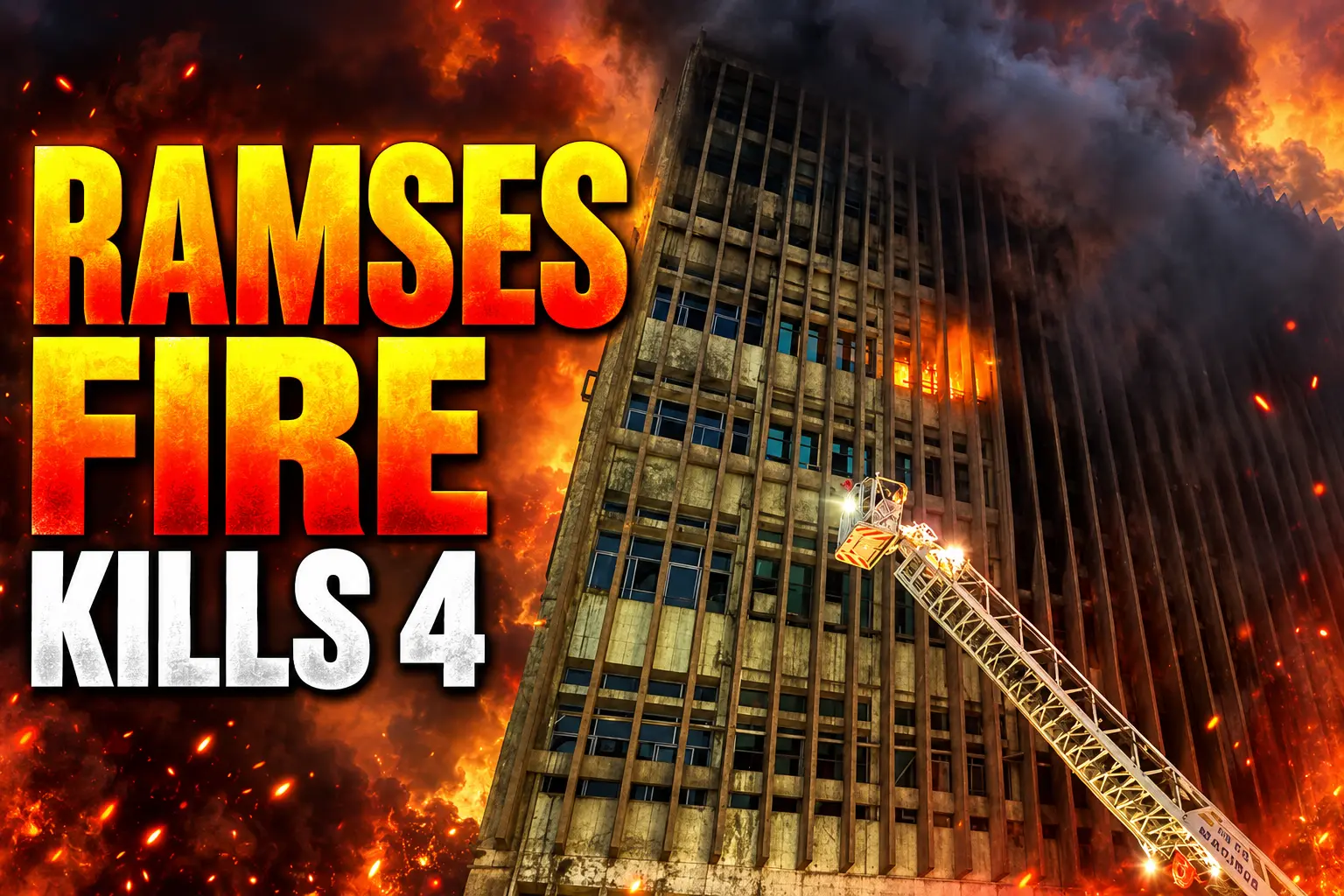
Ramses Still Carries the Country’s Interconnects
Ramses Exchange sits at 26 Ramses Street, a short walk from the old train station district. It is Telecom Egypt’s main downtown wire center, a meet-me point for domestic links, a landing for international circuits hauled in from Alexandria, and the home of the Cairo Internet Exchange, where Egyptian networks peer with one another.
Talaat dismissed claims that Egypt depends on a single exchange. He said Ramses would stay offline for days and that traffic had already moved to other sites. He has also described Ramses as handling about 40 percent of the country’s telecom traffic. Both things can be true at once: the map has more than one building, and a large share of live interconnects still ran through this one.
No other Egyptian data center matches Ramses in the mix of jobs it holds, a point critics pressed after the fire. The building is a switch, a colocation hall that private operators rent, a place where networks hand traffic to one another, and a hub for international calls. When power was cut for firefighting, those functions went together.
WHERE OFFICIALS AND ENGINEERS SPLIT
- Talaat’s line: Egypt does not rely on one telephone exchange, and other sites took the load while Ramses was dark.
- The lease map: Mohamed al-Maghraby, an electrical engineer who works on network security in the private sector, said Orange and Etisalat run about 80 percent of their operations through Ramses.
- The meter: NetBlocks read the whole country at 44 percent of normal traffic the same night, including banking and mobile payments.
A former senior Telecom Egypt official said the physical lines, exchanges, and switches belong to the state company, which is majority-owned by the government. Private operators may build their own plant under their licenses, yet they lease capacity because it is cheaper. The same official said firms are expected to rent spare path and a crisis reserve, and that they often skimp on that extra capacity. NTRA is both the referee and the overseer of a market in which the state is also the wholesaler.
Why Orange Lost Almost All of Its Traffic
Orange’s connectivity collapsed to 2 percent of its usual level. Etisalat held about 10 percent. Vodafone ran at 69 percent. TE Data, Telecom Egypt’s own internet arm, stayed between 82 percent and 91 percent. The split matches who had gear in the hall that burned and who had more of their own path around it.
HOW FAR EACH NETWORK FELL
| Operator | Share of usual connectivity | What the split shows |
|---|---|---|
| Orange | 2% | Hardest hit; Maghraby puts about 80% of its operations on Ramses |
| Etisalat | 10% | Same heavy lease of the downtown hub |
| Vodafone | 69% | Hurt, with more path still standing |
| TE Data | 82% to 91% | The incumbent’s own retail arm held up best |
NTRA said fixed internet and mobile voice and data were partly hit at all three private mobile companies because interconnection circuits in the building failed. Those circuits are the pipes that let a Vodafone call reach an Orange phone, and that let home broadband leave a neighborhood exchange for the rest of the world. When they burn, a company can still have radio towers up and still have nowhere to send the traffic.
That is why a fire in one hall became a national event. TE Data could fall back on the owner’s wider plant. Orange and Etisalat, if Maghraby’s figures hold, had most of their live work sitting in the same downtown rooms. The 24-hour repair clock NTRA announced was a circuit-reroute clock, not a rebuild of Ramses. Talaat was clear that the exchange itself would stay out for days.
InstaPay, ATMs, and a Halted Stock Session
The second blow was money. Egypt has spent years pushing cards, wallets, and instant transfers. Those tools still ride the same leased circuits that burned. InstaPay, the Central Bank of Egypt’s instant-transfer app, stopped. Mobile wallets run by the operators stopped with them. ATMs in malls and outside branches went dark. Banque Misr and the National Bank of Egypt apologized for cash machines and online banking.
The Central Bank raised the in-branch cash withdrawal limit from EGP 250,000 to EGP 500,000 and told banks to expect queues on July 8. Some branches ran longer hours. The Electricity Ministry told prepaid-meter customers to pay in cash at shops, and it asked Fawry, the bill-pay network, to keep desks open later, because phone apps could not top up meters.
WHAT WENT DOWN WITH THE EXCHANGE
- Instant payments: InstaPay and operator wallets could not move money while the interconnects were down.
- Cash machines: ATMs that need a live bank link failed, which is why the Central Bank lifted the branch cash cap.
- The bourse: The Egyptian Exchange canceled the July 8 session after connectivity failed, even though EGX and the Misr clearing house said their own settlement links stayed up on backup paths.
- Home power credit: Prepaid electricity meters that recharge over the phone could not take payment until cash desks stepped in.
- Flights: Some Cairo International departures slipped until the aviation ministry said schedules were normal on Tuesday morning.
EGX chairman Ahmed El Sheikh described the halt as a precaution so that prices and orders would be fair, not as a failure inside the exchange’s own machines. Trading resumed on July 9. The point still stands: a hall fire in Ramses was enough to take a full session off the calendar.
A Cairo resident told Al-Ahram Weekly the unpaid detail that makes the outage concrete. The prepaid electricity meter at home could not be recharged because the phone apps were dead. That is the digital stack meeting a seventh-floor cable tray.
The Building That Once Turned Egypt Off
The same address already had a place in internet history. In January 2011, during the uprising, Egypt’s international links went dark. Engineers who later mapped that shutdown described 26 Ramses Street as the focal point, an imposing exchange where fiber from the main network companies could be powered down. Telecom Egypt owns nearly all of the country’s long-distance fiber. Other providers lease it. A small number of licensed physical paths into the country made a national cut possible then.
July 2025 was not an order from the cabinet. It was heat, an electrical fault, and cable ducts with no fire stop that could hold. The design is cousin to 2011 anyway. If most peering, most operator interconnects, and a thick slice of international backhaul still meet in one downtown pile, an accident and a shutdown use the same door. Talaat’s backup map showed that traffic can be steered to Roada and other exchanges. Orange at 2 percent showed how much of the private market had not paid for a full copy of that door.
The 2019 train-station fire, which killed at least 25 people, was only a few kilometers away. That disaster was about a different system. The lesson that traveled is simpler. Cairo still keeps national machines in old central buildings, and when they burn, the rest of the country finds out in the same hour.
Families Received EGP 1.1 Million After the Fire
President Abdel Fattah El-Sisi ordered cash for the dead and the injured and a committee on the cause. On July 10, Talaat and Social Solidarity Minister Maya Morsy instructed EGP 1.1 million to the families of each of the four Telecom Egypt staff who died, about $22,000 at the time, and EGP 175,000 to each injured person.
THE PAYOUTS AFTER RAMSES
- Each family: EGP 1 million from Telecom Egypt and EGP 100,000 from Social Solidarity, which is the EGP 1.1 million total.
- Each injured worker: EGP 150,000 from Telecom Egypt and EGP 25,000 from Social Solidarity, which is EGP 175,000.
- Mobile users: NTRA ordered 1 GB of free internet for affected customers.
- Home lines: 10 GB free on the affected fixed line, or 5 GB on a mobile line if the home service was the one that failed.
Telecom Egypt told the stock market that buildings and gear hit by the fire were fully insured. NTRA said customers would be compensated under its rules, then put numbers on that promise two days later. Vodafone, in public posts, said it would pay affected customers once the package was set.
A limited fire broke out again at Ramses on July 10. Civil defence put it out before it spread. Many home lines were still poor that week. The second flame, small as it was, was a reminder that the site was still hot and still loaded with damaged plant.
The outage also fed a longer argument about capped data. Users who already fight monthly caps treated a national drop to 44 percent as proof the network is too tight to meter so hard. That fight did not start on July 7. The fire only made the ceiling visible.
By July 14, Vodafone was telling customers that fixed internet had returned and that quality would rise in stages. That is a more honest clock than the first 24-hour pledge. The interconnects can be steered. The hall that burned was still the hall too many networks had rented, and four engineers did not leave it in time.
Frequently Asked Questions
How Many People Were Killed in the Ramses Exchange Fire?
The Health Ministry said four Telecom Egypt employees died and 27 people were taken to hospitals, including Coptic Hospital, Sidnawy, Al Mounira, Helal, and Demerdash University Hospital. Spokesman Hossam Abdel Ghaffar said most injuries were smoke inhalation and first-degree burns, and that some people were treated at the scene without a hospital transfer. Civil defence recovered the four bodies from the building on the night of the fire.
What Free Data Did NTRA Order After the Ramses Fire?
On July 10, 2025, NTRA told every operator to credit affected mobile users with 1 GB of free data and affected home-internet users with 10 GB on the damaged line. If the fixed line was still unusable, the household could take 5 GB on a mobile line instead. That package was separate from the cash paid to the four families and the injured staff.
Did the Ramses Fire Stop Trading on the Egyptian Exchange?
Yes. EGX canceled the Tuesday, July 8, 2025 session after the fire wrecked connectivity in Cairo. EGX and Misr for Central Clearing, Depository and Registry said backup links between them kept working and that Monday’s settlements still closed on time. Chairman Ahmed El Sheikh called the halt a precaution so that all brokers would face the same conditions. The market sat again on Wednesday, July 9.
Was There Another Fire at Ramses Exchange After July 7?
Yes. Civil defence put out a limited fire at Ramses Telephone Exchange on July 10, 2025, three days after the deadly blaze, and said it did not reach other floors. President El-Sisi had already ordered a special committee on the first fire. Prime Minister Mostafa Madbouly told the cabinet that services through the exchange had to return to normal quality as fast as possible.

Cook Hands Democrats the House as Crypto’s Bill Stays Dead

Wicker’s Broken Bed Was the Short Story’s Punch Line

Nvidia’s $500 Billion Financing Plan Draws a $180 Sell

Maserati Bets the Grecale V6 Can Fill Porsche’s Gap

EV Cable Theft Follows the Old Railway Copper Playbook

Aramco Crash Kills 14 Two Days After Oil Restart

Salah Captained Egypt to Their First World Cup Win

Zelda’s 40th Switch 2 Ships Without a Zelda Game

Apple Labor Day Deals Hide June’s Memory Price Hike

Palworld 1.0.4 Adds Palpedia Search After the 1.0 Launch
-
 BUSINESS4 months ago
Aramco Crash Kills 14 Two Days After Oil Restart
-
 NEWS5 months ago
Salah Captained Egypt to Their First World Cup Win
-
 GAMING2 months ago
Zelda’s 40th Switch 2 Ships Without a Zelda Game
-
 NEWS2 months ago
Apple Labor Day Deals Hide June’s Memory Price Hike
-

 NEWS4 months ago
El Niño Puts Israel’s Needed Winter Rain on a Flood Clock
-
 GAMING2 months ago
Palworld 1.0.4 Adds Palpedia Search After the 1.0 Launch
-

 BUSINESS9 months ago
BAE’s 60-Year Saudi Franchise Now Runs Through Taif
-

 NEWS4 months ago
Saudi Visa Routes Split Nigerian Travelers Into Two Speeds