
BUSINESS
Riyadh and Abu Dhabi Patch Yemen While Europe Loses Its Corridor
A Houthi-driven Saudi-UAE thaw papers over the Yemen rupture that broke Europe’s single Gulf corridor, pushing Oman ports and separate EU pacts.

On 29 September 2026, UAE Vice President Sheikh Mansour bin Zayed sat with Saudi Crown Prince Mohammed bin Salman in Riyadh, the first senior Emirati visit since the Yemen rupture. The Saudi Press Agency said they reviewed brotherly ties and regional events, with Defence Minister Prince Khalid bin Salman in the room.
The meeting followed weeks of Houthi strikes on Saudi tankers, oil sites, airports and the capital, after the group took the Red Sea coast from Saudi-backed units. Europe still has to work with two Gulf systems that spent January shooting at each other’s clients.
Europe Opened Abu Dhabi Talks 19 Days Before Mukalla
On 11 December 2025, Mediterranean commissioner Dubravka Šuica stood in Abu Dhabi with Lana Nusseibeh, the UAE minister of state for political affairs, and launched Strategic Partnership Agreement talks with the Emirates. High Representative Kaja Kallas said the pact would help “promote peace and regional stability, from humanitarian aid for Gaza to addressing the conflict in Sudan.” Šuica listed digital work, artificial intelligence, connectivity, energy and the green transition as shared tasks.
That launch sat on a 2022 EU Gulf strategy, the 2024 EU-GCC summit in Brussels, and a July 2025 Council mandate to open separate pacts with all six GCC states. Free-trade talks with the UAE had already started in May 2025. Nineteen days later, Saudi warplanes hit the Yemeni port of Mukalla.
Riyadh called the UAE’s role in a southern offensive “highly dangerous” and said any threat to Saudi national security was a “red line.” Yemen’s Presidential Leadership Council chief, Rashad al-Alimi, cancelled a joint defence deal with Abu Dhabi and gave Emirati forces 24 hours to leave. The UAE defence ministry said it would end “the remaining counterterrorism personnel in Yemen of its own volition.”
Brussels had just treated Abu Dhabi as a pillar of a Gulf-wide agenda. The Mukalla strike showed the two richest GCC states could turn on each other inside the same month. The silent battle for Gulf supremacy was already running through capital, minerals and clients before those jets flew.
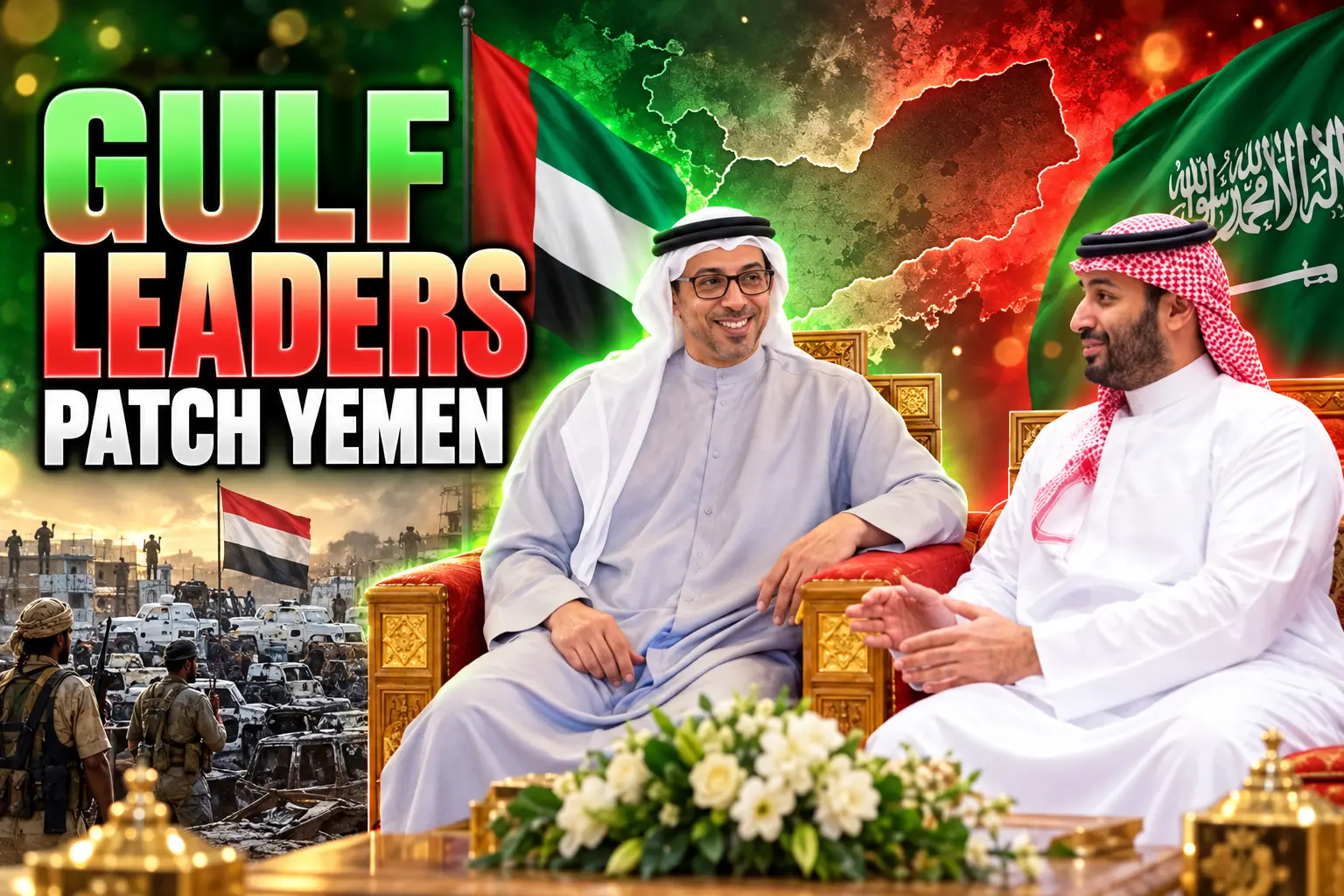
How the STC Offensive Collapsed
Luca Nevola, then ACLED’s senior analyst for Yemen and the Gulf, later described two sudden reversals in control in the south, packed into roughly one month, inside the camp of Yemen’s internationally recognised government.
THE SOUTH, DECEMBER TO JANUARY
- Early December 2025: Pro-Southern Transitional Council forces push inland from al-Mukalla, take Hadramawt, then seize al-Ghayda, the capital of al-Mahra, and press into Shabwa and Abyan.
- 30 December 2025: Saudi aircraft strike al-Mukalla port, accusing Abu Dhabi of backing the STC. Al-Alimi calls for an Emirati pullout and declares a state of emergency.
- 2 to 4 January 2026: The Saudi-backed Nation’s Shield Forces retake Hadramawt and al-Mahra with Saudi airpower.
- 7 January 2026: Aden falls. STC territorial holdings collapse. STC leader Aydarus al-Zubaydi skips scheduled talks in Riyadh, is dismissed from the Presidential Leadership Council, and is referred for treason. The UAE completes its withdrawal from Yemen, including Socotra and Perim.
- 9 to 10 January 2026: The STC delegation in Riyadh announces the body is dissolved. A large Aden demonstration still rallies for the southern cause.
The UAE-backed camp had been the dominant bloc inside the council, with the Security Belt and Elite Forces behind the STC, Tariq Saleh on the west coast, and Abu Zaraa al-Mahrami leading the Southern Giants Brigades. Saudi clients included the Islah party in Marib, Hadramawt tribal groups, and the Nation’s Shield units funded in 2023 as a pro-unity counterweight.
Nevola wrote that Abu Dhabi lost sway over Aden and al-Mukalla, yet Saleh and al-Mahrami still held the west coast and a role against the Houthis. STC offices inside Yemen stayed open. The southern grievance did not vanish with the Riyadh announcement.
A Thaw Built for the Houthis
The split did not freeze in January. In late April 2026, three weeks after a U.S. and Israeli cease-fire with Iran took hold, the UAE left OPEC on two days’ notice. Over the summer, reports of delayed Saudi transfers into UAE accounts circulated. Abu Dhabi was absent from the 14-member maritime defence alliance Saudi Arabia launched in late July to guard Red Sea shipping, and from the Mecca joint defence pact Riyadh signed with Turkey and Pakistan in early August.
On 21 July, the same day Houthi-Saudi coexistence deteriorated after a Houthi delegation attended the funeral of Iran’s late supreme leader, senior Saudi and Emirati officials put out matching lines on historic ties. Turki Al-Sheikh, an adviser to the Saudi royal court, posted a relaxed photograph of Khalid bin Salman and Mansour bin Zayed. They met again on 21 September. The 29 September session with Mohammed bin Salman was the public peak of that sequence.
The military reason sat on the coast. After the UAE pulled support in January, Emirati-backed groups on the west coast could not hold. In early September the Houthis took Mokha and set themselves on the shore of Bab el-Mandeb, then hit Saudi tankers and infrastructure and declared a maritime blockade on Saudi ships. Kristian Coates Ulrichsen, a Baker Institute fellow writing for the Arab Gulf States Institute, read the Riyadh meetings as a way to show a common front.
The UAE can play a significant role even without getting involved militarily.
Kristian Coates Ulrichsen, Baker Institute fellow
He judged it unlikely that the UAE would send troops back into Yemen, and likely that Riyadh wanted Emirati networks aligned rather than competing while Houthi pressure rose. Joyce Karam, a veteran Middle East editor, wrote that the Mansour visit signalled a wish at the highest level to repair ties, with security arrangements first and Hormuz routes in the same frame as Yemen.
The louder problem is the strait. Once Houthis sat on Mokha, the cost of keeping the Yemen file frozen exceeded the cost of putting Mansour in a Riyadh reception room.
Oman Sits Outside Both Chokepoints
Cinzia Bianco, a visiting fellow at the European Council on Foreign Relations, argued in January that the rupture was larger than Yemen and larger than the Red Sea, and that it ran through Israel. She also wrote that Saudi-Emirati tension made progress on the India-Middle East-Europe Economic Corridor land route, which links Israel, Jordan, Saudi Arabia and the UAE, unlikely.
1/ Read my @ecfr analysis of the big Saudi-UAE rupture. Yemen was the spark, as Riyadh really felt the Emiratis were taking them for a ride. But this is much bigger than Yemen. Even bigger than the Red Sea. It is about Israel.
👉 Full piece: https://t.co/CX2ooJy5uK— Dr. Cinzia Bianco (@Cinzia_Bianco) January 13, 2026
IMEC was unveiled at the G20 in September 2023 by India, the United States, Saudi Arabia, the UAE, France, Germany, Italy and the European Union as a shipping, rail, power and data spine from India to Europe. The original Middle East artery still assumed a UAE-to-Haifa logic that the January split, and the wars around Israel and the Red Sea, have left politically jammed.
THE IMEC SPINE AND THE OMAN BYPASS
| Node | Chokepoint exposure | What 2026 showed |
|---|---|---|
| Original IMEC land route (UAE, Saudi Arabia, Jordan, Israel) | Levant war and Red Sea politics | Land-route progress stalled after the rupture |
| Oman ports (Sohar, Salalah, Duqm) | Outside Hormuz and Bab al-Mandab | 143 million tons of cargo in 2025 |
| Saudi Red Sea ports (Jeddah, Neom) | Houthi missiles and the loss of Mokha | Named as the corridor backbone, now under fire |
An Atlantic Council study by Afaq Hussain and Maisoon H. Kafafy found that a wider IMEC network with nodes in Oman, Saudi Arabia, Egypt and Syria could replace roughly 60 percent of the container traffic that moves through the Strait of Hormuz, and that connected networks through those nodes could unlock upward of $330 billion in trade. Oman, they wrote, is a maritime gateway outside Hormuz and Bab al-Mandab, with three deepwater ports, and is operationally ready once rail and port links finish.
That is the European de-risking path Bianco already flagged in earlier work on Saudi policy: give IMEC players a way around a Saudi-UAE quarrel instead of waiting for the quarrel to end. Muscat can talk to Tehran when other GCC capitals cannot. The Oman lateral does not need a family photograph in Riyadh to load a ship.
Sudan and Israel Stay Off the Photo
The 29 September session was about Yemen and the Red Sea. Several other files that drove the 2025 split were not closed by a reception-line phrase about brotherly relations.
FILES THE PHOTO DOES NOT SETTLE
- Sudan: On 3 September 2026 a UN fact-finding mission said it had grounds to believe a network involving people and firms in the UAE, Chad, Libya and Somalia had supplied the Rapid Support Forces with weapons, kit, logistics, training and foreign staff, including up to 2,000 Colombian contractors. The RSF took El Fasher in October 2025. The UAE’s Geneva mission repeated that it has not backed the RSF militarily and said it remains open to dialogue with the mission. Riyadh has tilted toward Sudan’s regular army.
- Israel: Bianco’s January line was that the rupture was about Israel. The UAE sits in the Abraham Accords. Saudi normalisation has stayed slow. The IMEC land spine still runs through that gap.
- West-coast proxies: Tariq Saleh and al-Mahrami kept territory and anti-Houthi roles after the STC’s collapse. Nevola noted they may still carry Emirati influence even while they sit closer to Riyadh’s unity line.
- Reconstruction cash: Bianco’s January advice to Europeans was to match funds with parties that can govern, and to avoid projects built mainly for political leverage. That test gets harder when Riyadh and Abu Dhabi are bidding, not pooling.
Kallas named Sudan as a shared EU-UAE task on the day SPA talks opened. The UN file on the RSF is why that sentence still has a cost. Europeans who want Red Sea insurance cannot treat the Horn as a side quest.
Why Bilateral Deals Now Outrun the GCC Script
The EU’s own paper trail had already moved off a single GCC desk. The July 2025 mandate was country by country. Šuica’s December tour was built to open those tracks one capital at a time. The Mukalla crisis then made a bloc script look slow.
EUROPE’S WEIGHT IN THE TWO CAPITALS
- Saudi goods trade: An EU factsheet on the kingdom says the bloc was Saudi Arabia’s second-largest trade partner in 2025, with €67 billion in goods trade, and its top investor.
- People in the UAE: About 200,000 EU citizens live there, and 26 of 27 EU member states keep embassies in the country.
- Pact design: The planned SPA with Saudi Arabia lists security, transport, resilient trade corridors, critical raw materials, energy, digital work and AI as fields for deeper ties, alongside the UAE track already opened in Abu Dhabi.
Bianco told Europeans to pursue balance, not neutrality: talk to each monarchy on its own terms, put more European weight into Red Sea security, back an Oman branch of IMEC as a hedge, and tie reconstruction money to governance that can last. The 29 September thaw does not cancel that list. It confirms why the list exists. A handshake that appears when Houthis reach Mokha is not a planning assumption Europe can take to a bank.
Red Sea patrols, port calls and insurance for European cargo still have to be built with whoever actually holds the coast. That may be Saudi airpower one month and an Emirati-linked west-coast force the next. Separate pacts at least let Brussels move in one capital when the other is frozen.
The 2015 Camp Was Already Hollow
Saudi Arabia and the UAE were the two heaviest members of the Arab coalition that entered Yemen in March 2015 against the Houthis. By 2019 the UAE had left the front line, and Saudi- and Emirati-backed groups had already fought in Aden. The 2022 truce then froze a war that both still tried to shape through clients.
December 2025 turned that client war into a Saudi air campaign against an Emirati-linked supply line. January 2026 then stripped the south of the very formations that had, in 2015, helped push the Houthis out of Aden. Ulrichsen’s point is blunt: those west-coast units lost Emirati support after the pullout and could not stop the march to Mokha.
Mansour’s visit put the two defence files in one room. Mokha is still on the Houthi side of the strait. Europe’s SPA talks with Abu Dhabi and Riyadh continue on separate tracks.

Cook Hands Democrats the House as Crypto’s Bill Stays Dead

Wicker’s Broken Bed Was the Short Story’s Punch Line

Nvidia’s $500 Billion Financing Plan Draws a $180 Sell

Maserati Bets the Grecale V6 Can Fill Porsche’s Gap

EV Cable Theft Follows the Old Railway Copper Playbook

Aramco Crash Kills 14 Two Days After Oil Restart

Salah Captained Egypt to Their First World Cup Win

Zelda’s 40th Switch 2 Ships Without a Zelda Game

Apple Labor Day Deals Hide June’s Memory Price Hike

El Niño Puts Israel’s Needed Winter Rain on a Flood Clock
-
 BUSINESS4 months ago
Aramco Crash Kills 14 Two Days After Oil Restart
-
 NEWS5 months ago
Salah Captained Egypt to Their First World Cup Win
-
 GAMING2 months ago
Zelda’s 40th Switch 2 Ships Without a Zelda Game
-
 NEWS2 months ago
Apple Labor Day Deals Hide June’s Memory Price Hike
-
 NEWS4 months ago
El Niño Puts Israel’s Needed Winter Rain on a Flood Clock
-

 GAMING2 months ago
Palworld 1.0.4 Adds Palpedia Search After the 1.0 Launch
-
 BUSINESS8 months ago
BAE’s 60-Year Saudi Franchise Now Runs Through Taif
-

 BUSINESS8 months ago
Egypt Bets EGP 638 Billion Can Open Sinai to Investors