
BUSINESS
A Jordanian Bank Put the Al-Haq Solar Plant Online
Cairo Amman Bank financed Jordan’s 50 MW Al-Haq solar plant in Ma’an, which is now feeding the grid while renewables still supply about 27 percent of electricity.

Cairo Amman Bank’s 50 MW Al-Haq solar plant in Ma’an has been selling power to Jordan’s grid since November 30, 2025. The ceremony in Amman sold a homegrown clean-energy win. The name on the loan is the part that changes how the plant reads.
Masader Al-Haq Solar Energy Company, the project firm, went commercial after National Electric Power Company tests and a NEPCO approval dated that November day. Alternative Energy Projects Company, the Kuwaiti developer behind the site, later posted the first production numbers. Jordan’s renewable share of electricity is still about 27 percent.
Cairo Amman Bank Financed the 50 MW Plant
The press copy from the December 8, 2025 event at the Four Seasons Hotel in Amman named ministers, regulators and the Kuwaiti ambassador. It did not lead with the lender. Cairo Amman Bank had already signed, on September 24, 2024, a build-own-operate deal with Masader Al Haq Energy Consulting Services Company and NEPCO.
The bank said this was the first local Jordanian bank to finance a project of this size for a Jordanian company, and that the loan sat inside the Central Bank of Jordan’s green-finance push. No party published the dinar amount. The structure is the tell: a Jordanian lender, a Jordanian project company, and the state buyer on the same page, rather than a foreign development bank writing the whole ticket.
THE LOAN AND THE SWITCH-ON
- September 24, 2024: Cairo Amman Bank, Masader Al Haq Energy Consulting Services and NEPCO sign the build-own-operate financing agreement.
- November 30, 2025: NEPCO grants commercial operation approval after technical tests.
- December 8, 2025: Amani Al-Azzam, secretary general of the Ministry of Energy and Mineral Resources, attends the Amman ceremony for Minister Saleh Al-Kharabsheh.
- January 4, 2026: The bank publishes the commercial-operation notice with the 50 MW and 60.50 MW figures.
- March 30, 2026: AEPCo posts the first four months of metered output.
That sequence is why the plant matters to other Jordanian lenders. The Central Bank of Jordan’s Green Finance Strategy through 2028 asks the sector to lift green lending by 30 percent against a 2023 baseline. A 50 MW desert plant that a local bank can hold on its own books is the product that strategy is supposed to produce.
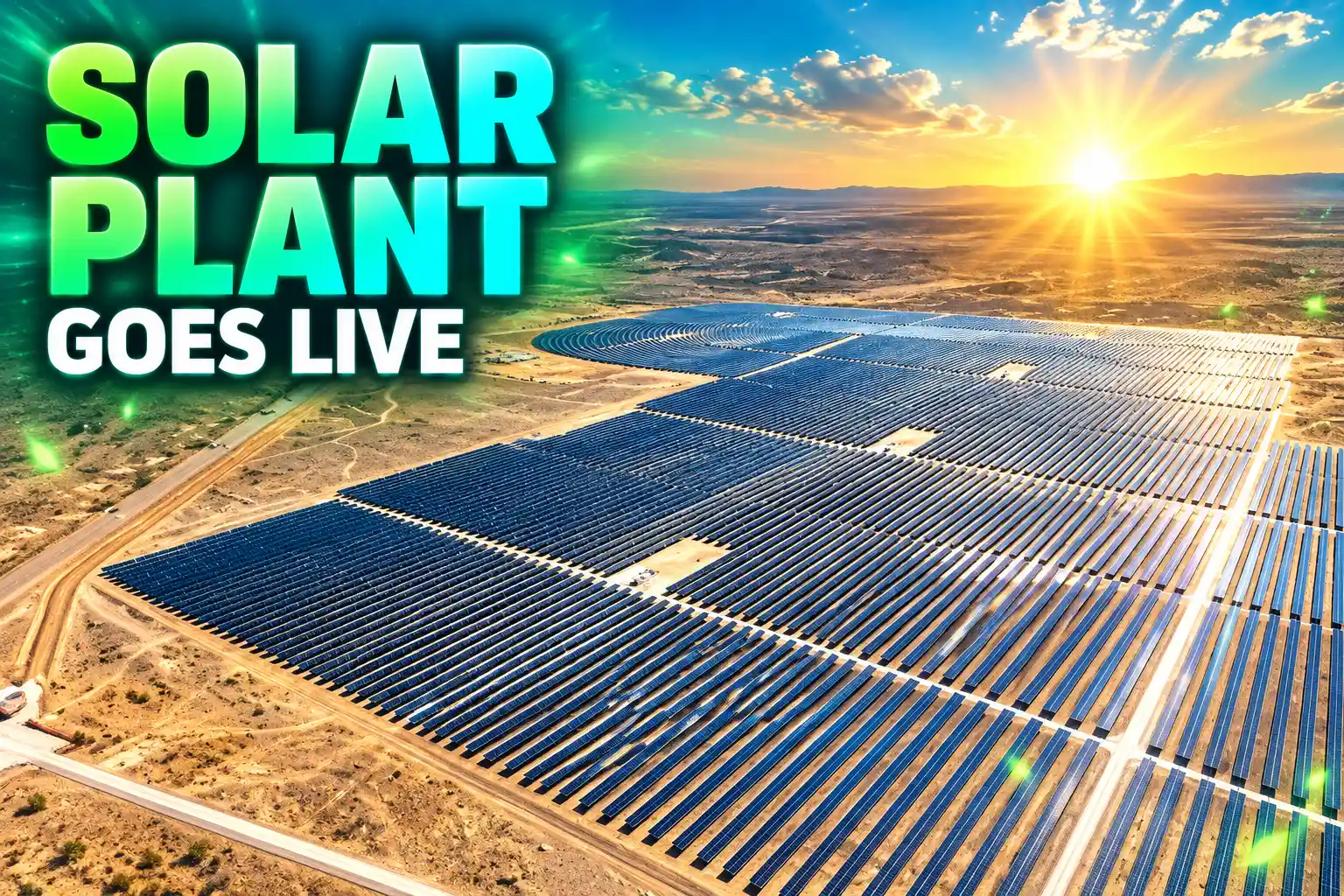
52.3 Gigawatt-Hours in the First Four Months
Cairo Amman Bank’s January 4, 2026 notice put a full-year envelope on the site: operational capacity of 50 MW, a maximum of 60.50 MW, and more than 160 million kilowatt-hours a year, enough for about 15,000 homes. It also claimed about 103,000 tons of carbon dioxide avoided each year.
WHAT THE PLANT IS SAID TO DELIVER
| Item | Figure | Whose number |
|---|---|---|
| Operational capacity | 50 MW | Cairo Amman Bank |
| Maximum capacity | 60.50 MW | Cairo Amman Bank |
| Annual output (claim) | More than 160 million kWh | Cairo Amman Bank |
| Homes (claim) | About 15,000 | Cairo Amman Bank |
| Annual CO2 avoided (claim) | About 103,000 tons | Cairo Amman Bank |
| First four months of output | 52.3 GWh | AEPCo, March 30, 2026 |
| CO2 avoided in those four months | About 26,145 tonnes | AEPCo, March 30, 2026 |
AEPCo said the site generated 52.3 gigawatt-hours in four months after the November 30, 2025 commercial date. Four months is one third of a year. One third of 160 million kilowatt-hours is about 53.3 million, so the metered figure sits close to the bank’s annual claim rather than below it.
The same notices advertise an advanced panel-cleaning system that the sponsors call the only one of its kind in Jordan, built for desert dust. That is the operating detail that will decide whether 160 million kilowatt-hours is a brochure number or a year-in, year-out result. Soiling in Ma’an is not a side issue. It is the difference between a 50 MW nameplate and a 50 MW plant that actually fills the line.
The Developer Keeps Its Head Office in Kuwait
AEPCo describes itself as a Kuwaiti company that develops, builds and runs renewable assets across MENA. Its own site lists a Kuwait head office in Sharq and a Jordan office on Suleiman Al Nabulsi Street in Amman. The Kuwaiti ambassador sat in the Amman ballroom on December 8, 2025. That is not a secret, and it is not how the ceremony copy was written.
The project is distinguished by its comprehensive national character, as all phases, from design and construction to operation, were carried out entirely by Jordanian expertise. As such, it represents the first project of this scale to be implemented by a local bank (Cairo Amman Bank) and a local main contractor.
Cairo Amman Bank, commercial operation notice, January 4, 2026
Those two facts can sit together. Jordanian crews can design, pour and operate a plant whose developer is registered in Kuwait and whose debt sits at Cairo Amman Bank. The ceremony language flattened that stack into “Jordanian expertise and resources.” The bank’s version is more precise, because it names the contractor and the lender and leaves the developer’s passport out of the slogan.
Masader Al-Haq is the vehicle that owns and runs the arrays under the build-own-operate contract. AEPCo is the platform that put the project on its own news list and posted the 52.3 gigawatt-hour meter reading. Anyone tracing who gets paid when NEPCO takes the power has to hold both names.
Ma’an Is Already Jordan’s Solar Corridor
Ma’an is not a new pin on the map. Southern Jordan has the irradiation, the land and the 400 kV kit that large solar needs, and NEPCO has been nursing that backbone for years. In December 2025, NEPCO’s managing director toured the 400 kV Ma’an substation after crews worked on busbar instability that shows up in high winds. The Al-Haq plant plugs into a corridor that already carries a lot of midday solar.
That is also why a 50 MW addition is easy to oversell. IRENA capacity statistics, as carried in regional energy briefings of the 2026 edition, put Jordan’s renewable fleet at 514 MW in 2016 and near 2.84 gigawatts in 2024 and 2025, a plateau after the 2018 to 2021 burst. Fifty megawatts is less than 2 percent of that stock. The plant is a real generator. It is not a new chapter in installed capacity.
Ma’an still gets a local return the national figures miss. The sponsors say they are training men and women from the governorate to run and supervise the site. If that roster holds, the plant’s payroll is a thicker story than its share of gigawatts.
Why 50 Megawatts Barely Moves the National Mix
Energy Minister Saleh Al-Kharabsheh has been repeating the same scoreboard: renewables supply about 27 percent of electricity, the 2025 to 2035 strategy aims for 40 percent, and an optimistic path reaches 50 percent by 2035. On October 1, 2026, NEPCO put more flesh on the rest of the stack.
JORDAN’S 2026 GENERATION MIX
| Source | Share |
|---|---|
| Imported and local natural gas | About 55 percent |
| Solar and wind | About 27 percent |
| Oil shale | About 15 percent |
NEPCO also said the transmission system holds about 4,400 MW of conventional plant and more than 1,500 MW of renewables. Peak demand in 2025, in figures NEPCO and the energy ministry have circulated, hit 4.80 GW, up 17.1 percent, while grid supply rose 3 percent to 23.41 TWh. A 50 MW solar block does not fix a peak that moved that far in one year.
NEPCO’s own books are the other constraint. Operating losses were JD351 million ($495 million) in 2025. The IMF has projected JD573 million ($808 million) for 2026. Expensive power-purchase contracts, imported gas and a grid that still dumps solar when the lines are full all sit inside that hole. After a 2021 outage, NEPCO slowed new renewable connections. An EBRD-backed northern substation is supposed to cut about 300 gigawatt-hours a year of curtailment by 2028. Until storage and those wires show up, another desert plant is a better political picture than a better system.
A 100 MW Factory Plant Was Signed Three Days Later
Three days after the Al-Haq ceremony, the ministry put a larger solar file on the table. On December 11, 2025, NEPCO and Al-Shams Specialized Company, under the Amman Chamber of Industry, signed for a 100 MW solar plant for factories, with NEPCO to build a 400 kV switchyard and line. That project is about industrial bills, not a ribbon. It is also twice Al-Haq’s operational rating.
The rest of the 2025 to 2035 strategy is still paper and tenders. IMF program documents circulating in 2026 list a 200 MW photovoltaic request for expressions of interest, a 100 MW wind tender, and 100 MW of batteries to be tendered before October 2027, plus pumped hydro. In September 2026 the Cabinet advanced draft rules on connecting renewables and storage. Those rules were still out for comment, not in force.
WHAT STILL HAS TO LAND FOR THE MIX TO MOVE
- Factory solar: The 100 MW Al-Shams plant for Amman Chamber of Industry factories, with new 400 kV works by NEPCO.
- New utility solar: A 200 MW photovoltaic request for expressions of interest under the energy strategy.
- Wind: A planned 100 MW wind tender.
- Batteries: 100 MW of battery storage to be tendered before October 2027.
- Connection rules: The September 2026 draft on storage, self-generation and extra capacity, still not law.
Al-Haq is already in commercial operation. The 27 percent share has not jumped with it. Cairo Amman Bank has a performing 50 MW asset in Ma’an, AEPCo has four months of meter data that match the annual claim, and the next test is whether Jordanian lenders will fund the storage and factory plants that decide if that power is used or spilled.
Frequently Asked Questions
When did the Al-Haq solar plant start commercial operation?
NEPCO’s commercial operation approval took effect on November 30, 2025, a Sunday, and the project company said the plant began running that day after the tests closed. The public ceremony in Amman followed on December 8, 2025, and Cairo Amman Bank issued its own notice on January 4, 2026.
Who financed the Al-Haq solar plant in Ma’an?
Cairo Amman Bank is the main financier under a build-own-operate contract signed on September 24, 2024 with Masader Al Haq Energy Consulting Services Company and NEPCO as a third party. The bank tied the loan to the Central Bank of Jordan’s green-finance policy. The dinar size of the facility has not been disclosed.
How much electricity can the Al-Haq plant generate in a year?
Cairo Amman Bank says more than 160 million kilowatt-hours a year, enough for about 15,000 homes, and about 103,000 tons of carbon dioxide avoided. The bank also equates that carbon figure to planting 1.7 million trees or taking 22,000 vehicles off Jordan’s roads. Those last two comparisons are the sponsors’ own, not a ministry audit.
What is a build-own-operate solar contract in Jordan?
Under the Al-Haq deal, the project company builds, owns and operates the plant and sells power into the national system rather than handing the asset to the state at commissioning. NEPCO signed the 2024 financing agreement alongside the bank and the project company, which is the offtake and grid path that makes a local-bank 50 MW plant bankable.

Cook Hands Democrats the House as Crypto’s Bill Stays Dead

Wicker’s Broken Bed Was the Short Story’s Punch Line

Nvidia’s $500 Billion Financing Plan Draws a $180 Sell

Maserati Bets the Grecale V6 Can Fill Porsche’s Gap

EV Cable Theft Follows the Old Railway Copper Playbook

Aramco Crash Kills 14 Two Days After Oil Restart

Salah Captained Egypt to Their First World Cup Win

Zelda’s 40th Switch 2 Ships Without a Zelda Game

Apple Labor Day Deals Hide June’s Memory Price Hike

Palworld 1.0.4 Adds Palpedia Search After the 1.0 Launch
-
 BUSINESS4 months ago
Aramco Crash Kills 14 Two Days After Oil Restart
-
 NEWS5 months ago
Salah Captained Egypt to Their First World Cup Win
-
 GAMING2 months ago
Zelda’s 40th Switch 2 Ships Without a Zelda Game
-
 NEWS2 months ago
Apple Labor Day Deals Hide June’s Memory Price Hike
-

 NEWS4 months ago
El Niño Puts Israel’s Needed Winter Rain on a Flood Clock
-
 GAMING2 months ago
Palworld 1.0.4 Adds Palpedia Search After the 1.0 Launch
-

 BUSINESS9 months ago
BAE’s 60-Year Saudi Franchise Now Runs Through Taif
-

 BUSINESS8 months ago
Egypt Bets EGP 638 Billion Can Open Sinai to Investors