
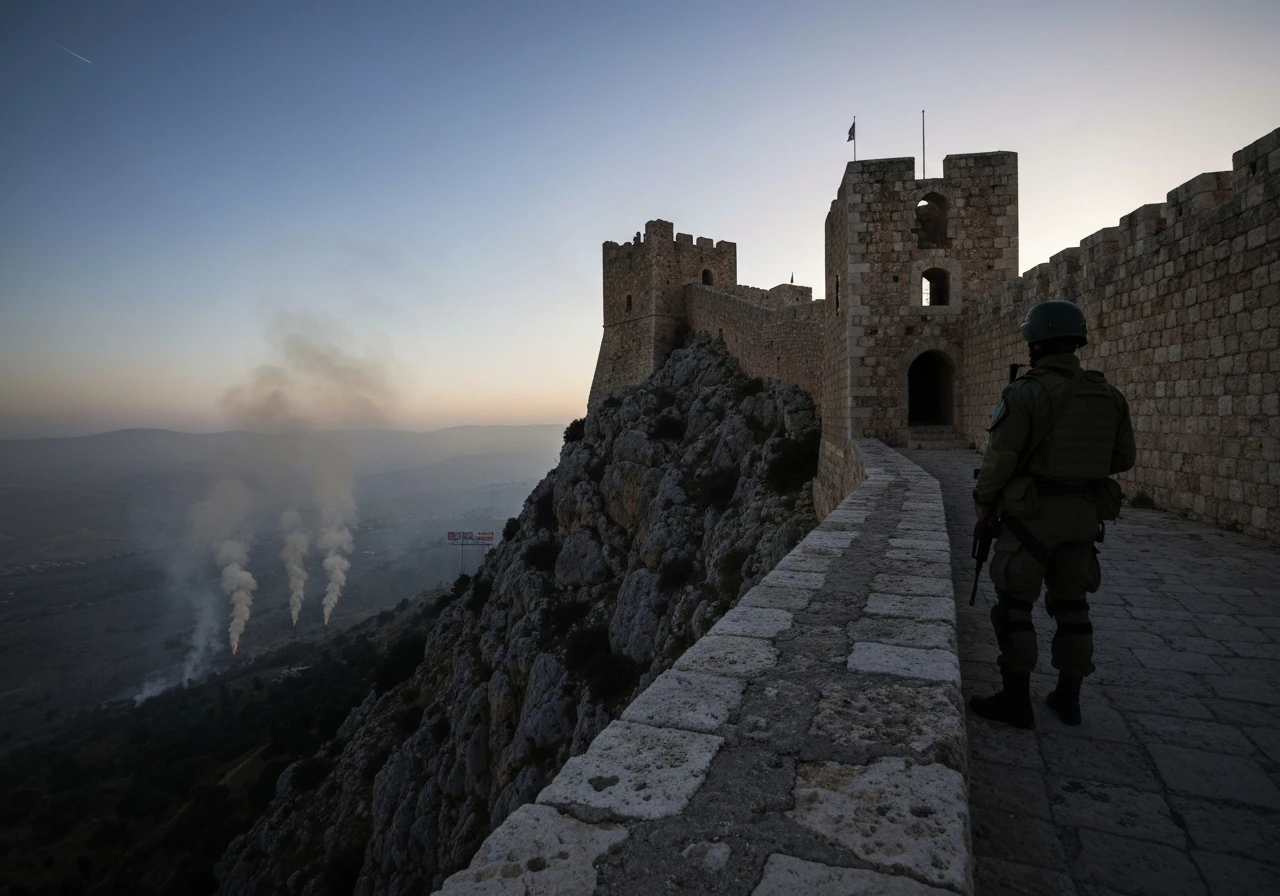
Israeli soldiers raised their flag over Beaufort Castle in southern Lebanon on Sunday, and Prime Minister Benjamin Netanyahu called it a turning point in the war against Hezbollah. The last time Israel held the 900-year-old hilltop fortress, it stayed for 18 years and pulled out in 2000 under fire.
Now the same army is back on the same ridge, fighting the same enemy with newer weapons. Inside Israel, military commentators are already asking whether anyone remembers how the previous occupation ended.
Beaufort Castle Has Changed Hands Before
The fortress sits about nine miles from Israel’s northern border, on a hill that overlooks much of southern Lebanon. Whoever holds it can watch movement across a wide stretch of the south. That is why armies keep fighting for a building first raised by Crusaders in the 12th century.
Israel knows the position well. It seized the castle in 1982 while driving Yasser Arafat’s Palestine Liberation Organization (PLO, the armed Palestinian movement then based in Lebanon) out of the south. It kept the hilltop as an anchor of a self-declared security zone, with a military outpost built beside the medieval walls. Both the PLO and a young Hezbollah shelled the garrison for years before Israel withdrew from the whole zone in 2000.
The site carries protected status. UNESCO (the United Nations Educational, Scientific and Cultural Organization) placed Lebanon’s southern castles under provisional enhanced protection in late 2024, the highest shield against military use under the 1954 Hague Convention. The fortress also appears on Lebanon’s medieval castles on UNESCO’s tentative World Heritage list.
The short version of how this hilltop has moved between hands:
- 12th century: Crusaders build the stone fortress on the ridge above the Litani valley.
- 1982: Israel captures it from the PLO during its invasion of Lebanon.
- 1982 to 2000: Israel holds the position inside its security zone, under steady guerrilla fire.
- 2000: Israel withdraws from southern Lebanon, abandoning the outpost.
- Late 2024: UNESCO grants the castle enhanced heritage protection.
- May 31, 2026: Israeli troops retake the hill in their deepest push in a generation.
What Netanyahu Ordered Across Two Days
The flag-raising came on a Sunday. By Monday the war had moved north to the capital. Netanyahu ordered fresh strikes on Beirut’s southern suburbs, the densely packed Dahiyeh district where Hezbollah draws its deepest support. Residents clogged the exit roads after the evacuation warning went out.
“There will be no situation in which Hezbollah attacks our cities and our citizens, and its terrorist headquarters in Beirut, in Dahiyeh, will remain out of bounds,” Netanyahu said.
The ground campaign had been widening for days before the castle fell. Israel warned hundreds of thousands of people to leave their homes, including the entire coastal city of Tyre. It also reported one soldier killed by a Hezbollah drone near the captured ridge. On the hilltop itself, Netanyahu struck a triumphant note: “We’ve returned to Beaufort united, determined, and stronger than ever.”
That return sits on contested legal ground. By targeting the area around a site UNESCO lists as protected, Israel reopened a fight over heritage as well as territory; the agency’s enhanced-protection rule bars such places from military use, and Lebanese officials have called the operation an attack on protected culture.
A Million People Displaced and Counting
Strip away the symbolism of the castle, and the scale of the offensive shows up in the human numbers. They are the part of this story that does not echo a tidy 1982 anniversary; they are simply large.
- More than one million people have been forced from their homes across Lebanon since the fighting reignited in early March.
- More than 3,400 people have been killed and over 10,000 wounded in strikes since March 2, by local counts.
- Roughly 2,000 square kilometers, close to a fifth of Lebanon, now sit under Israeli control.
- 26 years have passed since Israeli troops last stood on the Beaufort ridge.
Israel says it intends to hold a slice of the south for the long term, part of its declared plan to keep a buffer zone in southern Lebanon stretching toward the Litani River.
The Drones That Set 2026 Apart From 1982
The danger in celebrating a return to old ground is the assumption that the old playbook still works. Hezbollah is not the lightly armed force that harassed the security zone in the 1990s, and the weapon worrying Israeli officers now did not exist back then.
The group is launching dozens of small drones a day, many of them guided by fiber-optic cables that cannot be jammed. That tactic has let Hezbollah hit Israeli convoys and positions with precision while the troops occupy fixed, visible ground. A former Israeli defense official has gone further, warning that Hezbollah drones could eventually reach deeper into Israel, toward Tel Aviv and Jerusalem.
Amos Harel, the veteran military analyst at Haaretz, warned that the nostalgia around the flag-raising buried the harder question of how to stop those drones. He cut to the memory Israel keeps skipping over:
Almost no one is talking about what happened and what we lost there the last time.
His point is that Hezbollah disrupted life across a large stretch of northern Israel and is costing the army deaths and wounded every week, even after losing its top commanders and much of its arsenal in the 2024 offensive. The group rebuilt during the long truce that followed, and it changed how it fights. Holding a famous hilltop does not answer the drone problem; it offers the drones a clearer target.
Two Occupations, One Hilltop
Set the two Israeli deployments side by side and the rhyme is hard to miss, along with the one variable that has shifted decisively.
| Dimension | 1982 to 2000 | 2026 |
|---|---|---|
| Trigger | Invasion to expel the PLO | Escalation after the US-Israel war on Iran |
| Territory held | Self-declared security zone in the south | About a fifth of Lebanon |
| Main adversary | PLO, then a rising Hezbollah | A rebuilt Hezbollah |
| Signature threat | Roadside ambushes and guerrilla raids | Fiber-optic guided drones |
| How it stands | Unilateral withdrawal under fire | Ongoing, with no exit defined |
Andreas Krieg, a security expert at King’s College London, argues the strategy is self-defeating. “Israel is stuck in permacrisis and war with no end in sight,” he told Al Jazeera. Occupying Lebanese land, he added, “is a recipe to strengthen Hezbollah in the eyes of many Lebanese as the only force able to stop Israel’s encroachments on Lebanon’s territory.”
Krieg also noted the squeeze Netanyahu faces from his own ally in Washington, which wants the Lebanon front quieted while it pursues a far bigger deal.
Why the Lebanon Front Threatens the Iran Deal
The castle is a local prize. The reason the world is watching sits hundreds of miles east, in the stalled negotiations between Washington and Tehran.
Iran Wants One Ceasefire, Not Three
Iran has tied the wars together. A Washington-brokered ceasefire took effect in mid-April, but Israel has kept striking and Hezbollah has kept firing back. After the new round of Israeli attacks, Iran said it was suspending its part in indirect talks with the United States, according to Tasnim, the news agency linked to the Islamic Revolutionary Guard Corps.
Foreign Minister Abbas Araghchi spelled out Tehran’s position on the platform X. The truce, he wrote, “is unequivocally a ceasefire on all fronts, including in Lebanon. Its violation on one front is a violation of the ceasefire on all fronts.” Parliamentary speaker Mohammad Baqer Qalibaf, a lead negotiator, added a warning: “Every choice has a price, and the bill comes due.”
Washington Rejects the Linkage
The United States refuses to fold Lebanon into the Iran file. Negotiators have been trying to reconcile a US framework with an Iranian counter-proposal, with the White House focused on reopening the Strait of Hormuz to bring down global energy prices. President Donald Trump said he had spoken with Netanyahu, and indirectly with Hezbollah, and that “Israel will not attack them, and they will not attack Israel.”
The fighting has not paused for the diplomacy. US Central Command (CENTCOM, the US military command for the Middle East) said it carried out self-defense strikes over the weekend against Iranian radar and drone command centers and downed two Iranian drones aimed at ships. Iran fired two ballistic missiles at US forces in Kuwait early Monday, which CENTCOM said were immediately defeated. The whole arrangement, including how the Lebanon truce became bound to the Strait of Hormuz and oil prices, now hangs on whether the strikes stop.
If Washington can trade calm in Beirut for movement on Hormuz, the wider war may yet wind down. If the strikes on Dahiyeh keep coming, Iran has already shown it will treat the Lebanese front as the entire table, and the deal everyone keeps calling close slips further out of reach.
