
Egypt shipped 160,000 tons of food products in 3,900 consignments to 184 countries during the week of August 1 to 7, 2026. The National Food Safety Authority’s 29th weekly report for the year recorded 1,333 exporting companies moving about 683 product types, with vegetables and fruits dominating the volume.
The numbers look routine. They sit inside a longer climb that has turned Egypt into a steady supplier for both nearby crisis markets and distant high-value buyers.
What Left the Ports That Week
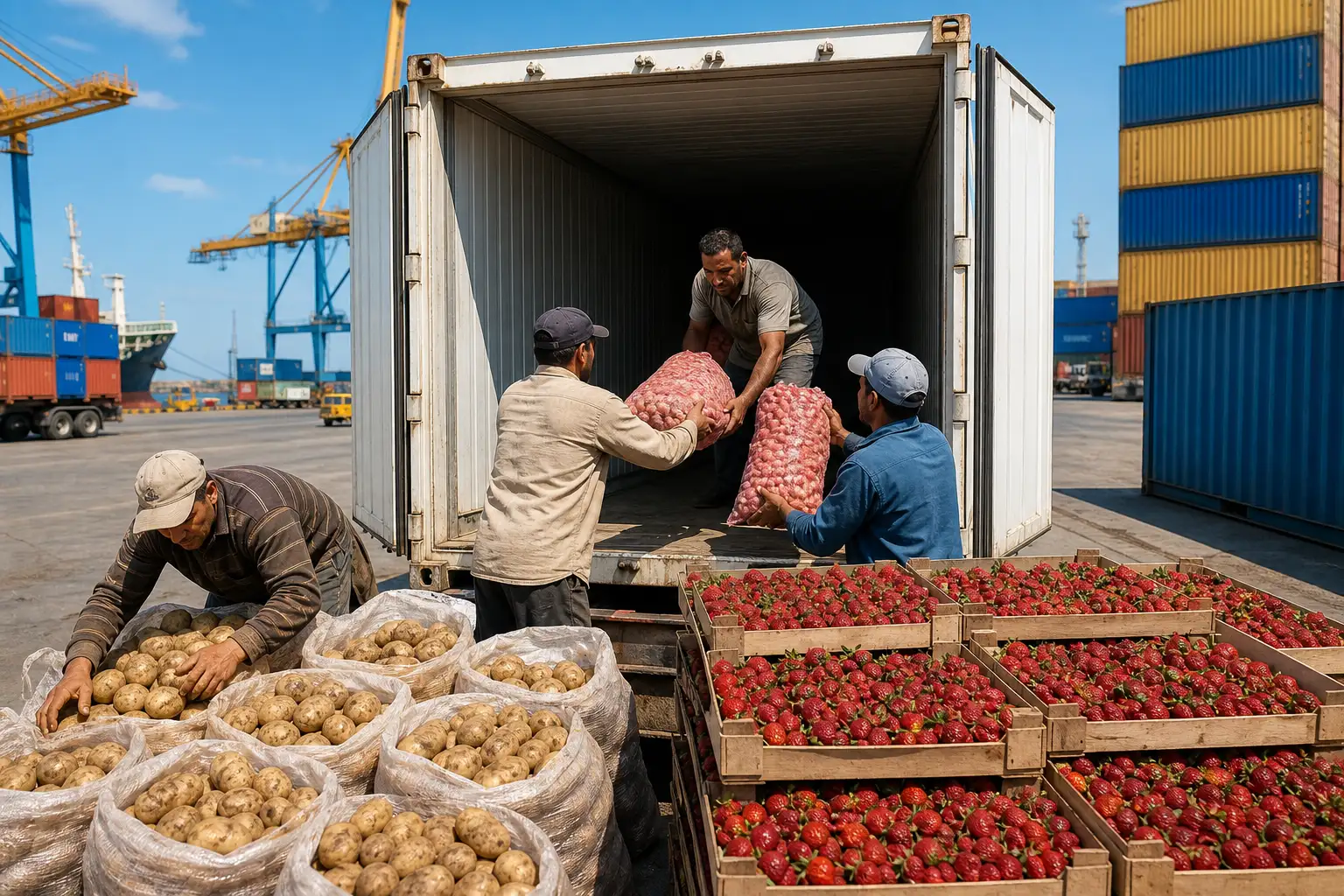
Vegetables and tubers made up the biggest share. Forty-four vegetable types totaled 46,000 tons. Potatoes led at 17,000 tons, onions followed at 11,000 tons, and various beans added 5,000 tons. Fruits contributed 33 types and 31,000 tons. Strawberries topped that list at 11,000 tons; citrus fruits and mangoes each supplied 6,000 tons. Preserved vegetable and fruit preparations rounded out the mix.
| Category | Volume (tons) | Top items |
|---|---|---|
| Vegetables & tubers | 46,000 | Potatoes 17,000; onions 11,000; beans 5,000 |
| Fruits | 31,000 | Strawberries 11,000; citrus 6,000; mangoes 6,000 |
| Total food exports | 160,000 | 683 product types |
The NFSA also issued 1,110 health certificates that week so consignments could clear foreign controls. Factory inspectors made 140 visits; ten new establishments registered and seven more finished compliance steps.
- 3,900 export consignments handled by 1,333 companies
- 184 destination countries
- 1,110 health certificates released
- Alexandria, Damietta and Safaga as the busiest exit points
These weekly snapshots have become regular. Earlier 2026 reports showed similar bands of 165,000 tons or higher peaks near 280,000 tons in spring, confirming the machinery runs continuously.
Alexandria Led the Exit Lanes
Alexandria Port cleared the most export consignments at 688. Damietta followed with 582 and Safaga with 510. The same three ports dominate Egypt’s food trade year after year because they sit on both Mediterranean and Red Sea routes and handle reefer containers efficiently.
Stats from the week
- 688 export consignments through Alexandria
- 582 through Damietta
- 510 through Safaga
- 1,695 import consignments totaling 204,000 tons arrived in parallel
Damietta’s food traffic adds to Damietta Port’s recent operational demands that already include energy cargoes. The dual load keeps the berths busy and the cold chain active.
Sudan Took the Largest Share
Sudan ranked first among the 184 importers that week. The Netherlands, Saudi Arabia, the United States and Jordan followed. Sudan’s position is consistent across recent weekly reports; conflict has damaged local production and raised demand for Egyptian staples and fresh produce. Egypt’s own large-scale food movements, including Egypt’s large-scale food aid convoys, sit in the same regional logistics network.
European and Gulf buyers pull the higher-value fruit and vegetable lines. Strawberries and citrus move readily into the Netherlands and other EU markets once NFSA certificates and plant-quarantine codes are in place. The United States appears on both the export destination list and the import supplier list, reflecting two-way bulk trade in oils, grains and specialty items.
The Climb Behind One Ordinary Week
Food industry exports hit a record $3.771 billion in the first half of 2026, up 10.5 percent from $3.414 billion a year earlier, according to the Food Export Council. Frozen strawberries alone generated $489 million, up 8 percent. Soft-drink concentrates and edible oils also advanced. Arab markets took about $1.74 billion (46 percent of the total); the EU took $852 million, up 15.4 percent.
Broader agricultural exports passed 6.2 million tons by early August 2026. Citrus led at 2.3 million tons. Fresh potatoes stood at roughly 918,000 tons, sweet potatoes above 235,000 tons, grapes near 180,000 tons and onions at 155,000 tons. Minister of Agriculture Alaa Farouk pointed to coding, traceability and new market openings in Africa, Asia and the Americas.
Those potato numbers sit against a longer baseline. Egypt shipped over 1 million tonnes of fresh potatoes in 2025 from a crop of about 7 million tonnes, becoming Russia’s top supplier at roughly 67 percent of that market’s potato imports by value. EU rules eased in 2025, lowering inspection friction. Cold storage now stretches the winter crop toward year-end shipments.
X discussion around the 6.2 million-ton figure noted that the pace sat below the 6.5 million tons reported at a similar point in 2025, with potatoes, onions and beans softer while citrus carried more of the load. The weekly food numbers still show potatoes and strawberries moving in volume, suggesting category rotation rather than collapse.
| Metric | Figure | Period |
|---|---|---|
| Food industry export value | $3.771 billion | H1 2026 |
| YoY growth | 10.5% | H1 2026 vs H1 2025 |
| Frozen strawberries | $489 million | H1 2026 |
| Agri export volume YTD | 6.2 million tons | Early August 2026 |
| Citrus YTD | 2.3 million tons | Early August 2026 |
The H1 value record appears in the same data set that logged the record $3.771 billion in food industry exports. Volume and value do not always move together; higher-value processed lines and better market access can lift earnings even when some fresh-vegetable tonnages ease.
The Safety Layer That Keeps Markets Open
NFSA certificates and farm-to-port controls are the quiet enabler. A European Commission inspection mission in October 2025 recorded a drop in the rejection rate of Egyptian agricultural exports inside the EU from 15 percent to 2.1 percent. The mission praised risk-based sampling, pesticide-residue monitoring and coordination among NFSA, plant quarantine and residue labs.
The NFSA has become a regional model in implementing the risk analysis approach and in ensuring rapid response to emerging food safety concerns.
That assessment came from the European Commission delegation after visits to farms and packing houses covering oranges, strawberries and other crops. Lower rejections translate directly into fewer blocked containers and steadier contracts with EU buyers who appear in every weekly top-five list.
The same system issues the health certificates that cleared 1,110 consignments in the first week of August. Without it the 184-country reach would shrink.
Imports Ran in Parallel
While 160,000 tons left, 204,000 tons of food arrived in 1,695 consignments from 87 countries. The United States led suppliers, followed by Indonesia, Russia, Brazil and China. Soybeans, wheat and oils dominated the inbound list. Alexandria again handled the most import consignments (519), then Port Said (267) and Cairo International Airport (264).
Egypt remains a large grain importer even as it exports high-value produce. U.S. agricultural trade figures with Egypt show the two-way pattern clearly: American bulk commodities move in while Egyptian specialty fruits and vegetables move out. The net effect on foreign exchange depends on the price mix, not the raw tonnage balance.
Customs released 1,172 consignments under temporary procedures and 520 under rapid-release rules. Precautionary detentions hit 221 incoming lots; seven rejected consignments were re-exported to keep port yards clear.
Companies and Capacity Keep Expanding
The 1,333 exporting companies active that week include both large packers and smaller growers who now meet coding and residual-testing rules. New registrations and completed compliance files show the base is still widening. Storage and strategic-commodity teams inspected 91 establishments in the same period.
Three crop cycles plus cold storage give Egyptian potatoes, onions and strawberries multi-month shipping windows that European and Asian buyers value. Red Sea and Mediterranean ports let the same shipper reach the Gulf, Europe, Africa and Asia without double-handling.
The week of August 1-7 simply ran the existing system at normal speed. 160,000 tons left, certificates cleared, Sudan and the Netherlands took their usual places, and the ports stayed full. That steady rhythm, more than any single record, is what has locked Egypt into global produce calendars.
Frequently Asked Questions
Which products led Egypt’s food exports in the first week of August 2026?
Potatoes led vegetables at 17,000 tons, followed by onions at 11,000 tons. Strawberries led fruits at 11,000 tons, with citrus and mangoes at 6,000 tons each. These rankings match the longer pattern in which potatoes and frozen strawberries generate both volume and high export value.
Why does Sudan often rank as Egypt’s top food importer?
Conflict has cut Sudanese domestic production and raised prices, so Egyptian staples and fresh produce fill the gap through established overland and Red Sea routes. Weekly NFSA lists have placed Sudan first or near the top repeatedly in 2026.
How large are Egypt’s annual potato exports?
Egypt exported more than 1 million tonnes of fresh potatoes in 2025 from a roughly 7 million-tonne crop and became Russia’s leading supplier. By early August 2026 fresh-potato shipments already stood near 918,000 tons for the year.
What was the value of Egypt’s food industry exports in the first half of 2026?
The Food Export Council reported a record $3.771 billion, up 10.5 percent from the same period in 2025. Frozen strawberries alone contributed $489 million.
What role do NFSA health certificates play?
The certificates confirm that consignments meet destination safety rules. In the week of August 1-7 the authority issued 1,110 of them, enabling clearance at foreign borders and supporting the drop in EU rejection rates recorded in 2025.
