
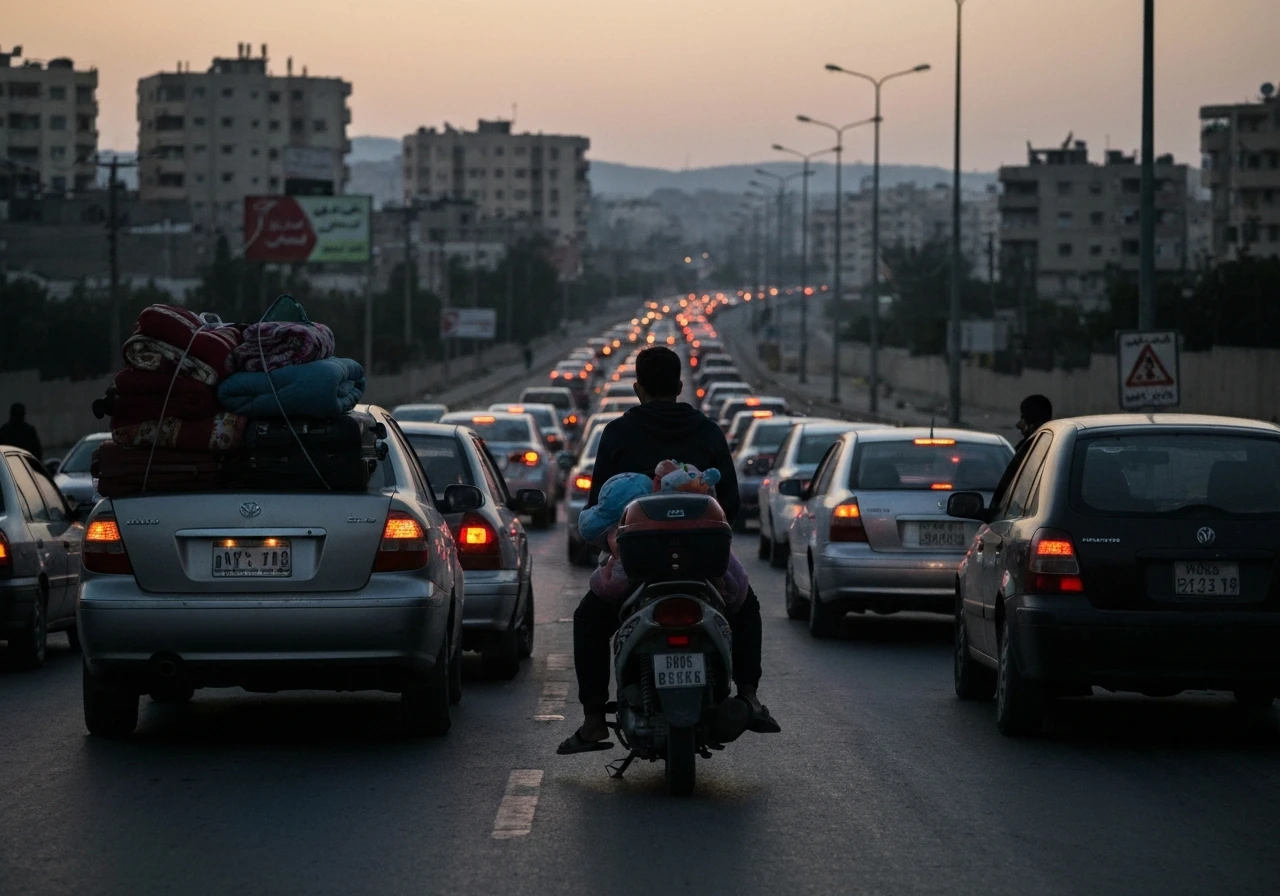
Israel ordered air strikes on the southern suburbs of Beirut on Monday, the clearest sign yet that the restraint Washington spent six weeks engineering around Lebanon’s capital has collapsed. Prime Minister Benjamin Netanyahu and Defence Minister Israel Katz directed the military to hit what they called “terror targets” in Dahieh, the dense Hezbollah stronghold south of the city, citing repeated violations of an April truce. Within minutes, roads out of the suburbs jammed with families fleeing toward the mountains.
The strike order reads as a Lebanon story. Its more dangerous reading runs through Tehran, where Iran’s foreign minister has warned that any blow against Hezbollah counts as a breach of the broader ceasefire that has frozen the US-Iran war since April. That single sentence is what turns a local escalation into a regional one.
Netanyahu’s Dahieh Order Reopens a Front Washington Wanted Frozen
In a joint statement issued Monday morning, Netanyahu and Katz said they had ordered the strikes “following the Hezbollah terrorist organisation’s repeated and ongoing violations of the ceasefire in Lebanon and its attacks against our civilians and cities.” They offered no target list and set no timetable.
Katz framed the decision as a direct trade. “The Dahieh in Beirut is no different from the communities in northern Israel,” he said. “If there is no calm in the north, there will be no calm in Beirut.” The message tied the fate of a Lebanese neighbourhood of several hundred thousand people to rocket fire landing across the border.
The Israeli military issued no formal evacuation notices, the step that normally precedes its aerial attacks. Residents did not wait for one. Cars packed with suitcases, blankets and several generations of one family inched through gridlock, with parents balancing children on scooters as they pushed out of the suburbs.
What makes the order striking is how sharply it breaks from recent practice. Israel had struck Beirut only twice since the Lebanon ceasefire took effect on 16 April, most recently the previous Thursday. Reporting throughout the spring described the White House leaning on Israel to keep its capital strikes rare, precisely to protect the diplomacy it was running in parallel. On Monday that brake came off.
How the Beirut Order Loops Back to the US-Iran Standoff
The reason the Dahieh decision matters beyond Lebanon sits in Tehran’s read of the wider war. Iran, Hezbollah’s main backer for decades, has insisted from the start that the ceasefire it reached with Washington cannot be carved up front by front.
Foreign Minister Abbas Araqchi restated that position on Monday, hours after the strike order.
The ceasefire between Iran and the US is unequivocally a ceasefire on all fronts, including in Lebanon. Its violation on one front is a violation of the ceasefire on all fronts.
That is the tripwire. The US-Iran truce, brokered through Pakistani mediation in April, halted a war that had killed Iran’s supreme leader, Ali Khamenei, in a late-February Israeli strike and dragged the region to the edge. American officials have argued Lebanon was always a separate track, mediated by the State Department and announced on 16 April. Tehran rejects that distinction. So every Israeli bomb that falls on Dahieh becomes, in Iran’s telling, a reason to walk away from a far bigger deal that Washington has not yet closed.
US Secretary of State Marco Rubio spent Sunday trying to hold the line. He floated a plan for “gradual de-escalation” to Netanyahu and Lebanese President Joseph Aoun, proposing that Lebanon press Hezbollah to halt its attacks first, with Israel agreeing to refrain from escalation in Beirut in return. By Monday morning, the strike order had overtaken the proposal.
Two Ceasefires, One Tripwire
The confusion at the centre of this crisis is that two separate truces are being treated as one by some parties and as wholly distinct by others. Their terms, mediators and scope diverge, which is exactly why a strike on Beirut can ripple outward to a negotiating table meant to wind down a war with Iran.
| Feature | US-Iran ceasefire | Lebanon ceasefire |
|---|---|---|
| Announced | 8 April, extended indefinitely 21 April | 16 April, later extended 45 days |
| Mediator | Pakistan | United States (State Department) |
| Covers Lebanon? | Iran says yes; US and Israel say no | Yes, but routinely violated by both sides |
| Status on 1 June | Holding but unresolved; talks ongoing | Effectively breaking down |
Trump has stated publicly that Lebanon was not part of the agreement Pakistan brokered, and that Hezbollah would still have to be dealt with. Iran reads the same set of facts in reverse. With the underlying US-Iran deal still unsigned and proposals shuttling through intermediaries, the ambiguity is not academic; it is the gap a wider war could pour back through.
Beaufort Castle and the Push Across the Litani
The Beirut order did not arrive in isolation. It followed a weekend in which Israeli ground forces reached their deepest point inside Lebanon in 26 years, capturing the 900-year-old Beaufort Castle on a ridge overlooking the Litani river. Israeli officials cast the seizure as both symbolic and strategic, arguing the high ground gives their troops a commanding view across southern Lebanon and into the Galilee.
The advance matters because the Litani had served for months as a de facto boundary for the ground campaign. Crossing it signals that the operation Netanyahu first described in March is widening rather than winding down. The sequence of the past three months reads as steady expansion:
- 2 March: Hezbollah fires rockets into northern Israel, reopening the front after the killing of Iran’s supreme leader; Israel answers with air strikes across Lebanon.
- 16 March: Israeli ground operations begin in the south, eventually deploying five divisions.
- 24 March: Katz announces Israel will demolish border villages and occupy southern Lebanon up to the Litani.
- 31 May: Israeli troops capture Beaufort Castle and cross the Litani, the deepest incursion since the late 1990s.
Even with those gains, Hezbollah has kept up cross-border fire while pulling back from advancing troops. On Monday the Israeli military said it intercepted several drones and projectiles, with no injuries reported, while Hezbollah said it had targeted Israeli forces near Yahmar al-Shaqif and fired a salvo at military infrastructure in northern Israel. One Israeli soldier was killed in combat in the south, reportedly in a drone attack.
The Civilian Ledger Behind the Front Lines
Beneath the diplomatic chess sits a humanitarian collapse that the strike order threatens to deepen. The numbers have moved fast since the war reopened on 2 March, and they are the reason war fatigue is spreading well beyond Hezbollah’s strongholds.
Counting the Dead on Both Sides
At least 3,412 people have been killed in Lebanon since the start of the war, according to the country’s health ministry, which does not separate combatants from civilians. Israel says 24 of its soldiers and four civilians have died over the same period. On Monday alone, Lebanon’s state news agency reported two men killed in a strike on the village of Zebdine and five more killed overnight in nearby Kfar Sir.
A Million Displaced in Weeks
The displacement has outpaced anything Lebanon saw in the previous round of fighting. According to United Nations reporting on the Lebanon emergency, the crisis pushed the country to a “breaking point” within weeks. The figures behind that phrase are stark:
- 1.2 million people displaced, more than a sixth of Lebanon’s population, per UN humanitarian estimates.
- 40,000 homes destroyed in the south, with most bridges below the Litani knocked out.
- 14 percent of Lebanese territory covered by Israeli evacuation and displacement orders, according to the UN human rights office briefing on Lebanon.
Aid agencies have moved to match the scale. The International Organization for Migration has airlifted emergency relief and issued appeals as roughly a million people remain displaced, detail laid out in its Lebanon displacement response and funding appeal. Lebanese Prime Minister Nawaf Salam accused Israel over the weekend of pursuing a “scorched-earth” policy.
Washington Talks Proceed as Beirut Braces
A round of Lebanon-Israel talks is still set to take place in Washington this week, even as the capital empties. A senior Lebanese official told the BBC the government is leaning on US mediation to curb Israeli operations and prevent further civilian deaths. “We don’t have another choice,” the official said. “We have to go to the negotiation and put on the table that we want a ceasefire.”
The political ground in Lebanon is shifting underneath those talks. Hezbollah retains deep support in Dahieh and the south, yet criticism is mounting across the country that its decision to fire in support of Iran dragged Lebanon back into a war it could not afford. Aoun tried to advance Rubio’s de-escalation idea, but Parliament Speaker Nabih Berri, who said he could “guarantee” Hezbollah’s commitment to a truce, put the onus on Israel to stop shooting first. The diplomacy, in other words, is stuck on who moves first while the strikes continue. Background on where the wider negotiations stand is collected in the UK Parliament research briefing on the US-Iran ceasefire and nuclear talks.
If the Beirut strikes stay narrow and the Washington round produces even a partial pause, the US-Iran track may survive the week intact. If Dahieh burns and Tehran treats it as the all-fronts breach Araqchi described, the larger deal Washington has been chasing for two months could be the next thing to break.
