
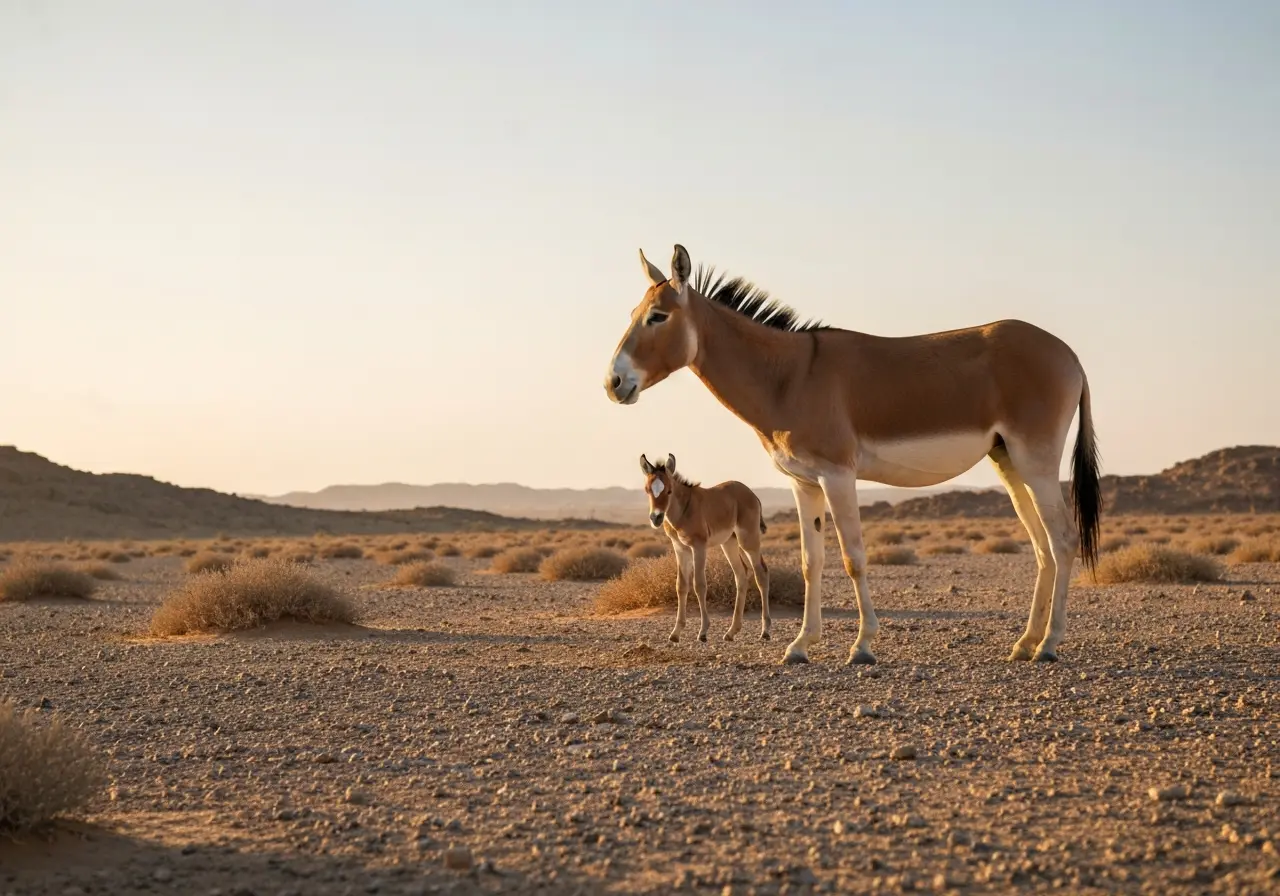
A male onager, one of the world’s rarest wild asses, is the first of its species born in Saudi Arabia in more than 100 years. He arrived in June 2025 at the Prince Mohammed bin Salman Royal Reserve in the kingdom’s northwest, and the reserve held the news for a full year before announcing it, because close to half of all onager foals die before their first birthday.
The kingdom’s entire breeding stock traces back to seven animals trucked in from a reserve in Jordan. Saudi conservationists have watched this exact sequence play out before in the same deserts, with a different species, and how that earlier story ended is the reason this single foal carries so much weight.
A Foal That Took a Year to Announce
The reserve recorded the birth in June 2025 but waited until June 1, 2026 to make it public. The delay was deliberate. A newborn onager’s first twelve months are its most dangerous stretch, with survival rates that managers put at no higher than 50 percent, so announcing a birth before that milestone risks celebrating an animal that never reaches its first birthday.
Equus hemionus, the onager, is a fast, lean relative of the horse and the donkey that once ranged widely across the Arabian Peninsula before being wiped out of these deserts in the early 1900s. The foal is the first free-ranging member of his kind seen in the country since, and the reserve describes him as proof the reintroduction has moved from release to reproduction.
Two more onager births are expected this winter. If those foals arrive and clear their own first year, the kingdom shifts from a single symbolic birth toward something closer to a breeding group, the threshold that separates a one-off event from a working reintroduction.
The Oryx Playbook Saudi Arabia Is Running Again
Saudi conservationists are not improvising here. The country has run a program like this once before, and that earlier effort became one of the most cited recovery stories in modern conservation. The Arabian oryx, a white desert antelope, was hunted out of the wild by 1972, when the last free-living animals were killed or captured.
What came next set the template. Captive oryx from private collections and an international “World Herd” were bred back up in numbers, and Saudi releases at the fenced Mahazat Al-Sayd Protected Area began in 1990. The International Union for Conservation of Nature (IUCN, the body that maintains the global Red List of threatened species) moved the oryx from extinct in the wild to endangered in 1986, then down to vulnerable in 2011, the first time it had ever lowered a species’ threat level after a wild extinction. The onager is now entering the early, fragile opening of that same arc.
| Attribute | Arabian oryx | Persian onager |
|---|---|---|
| Lost from the wild | 1972 | Early 1900s |
| Route back | Captive World Herd, released from 1990 | Founders translocated from Jordan, 2024 |
| Current IUCN status | Vulnerable (downgraded 2011) | Critically Endangered (2025) |
| Milestone at the reserve | 60 reintroduced, 15th calf born | First surviving foal, June 2025 |
Why One Birth Doesn’t Save a Herd
A herd founded on a handful of animals carries a built-in weakness: inbreeding. With so few founders to start from, every new birth narrows the gene pool a little further unless fresh bloodlines keep arriving, and that is the logistics race the reserve is now running behind the scenes.
Seven Persian onagers were translocated in April 2024 from the Royal Society for the Conservation of Nature’s Shaumari Reserve in Jordan, the move that created the kingdom’s first wild population in over a century. A new female is now in quarantine and due to join the group later this year, the next deposit into a very shallow genetic bank.
The longer plan is to split the animals into two separate breeding herds rather than keep them as one. Two groups guard against a single disease outbreak or accident wiping out the whole project at once, and they let managers move animals back and forth to keep bloodlines from collapsing into one another.
None of this happens quickly. Building a stable population from imports can run for decades, and every animal that arrives has to clear quarantine before it ever touches the open reserve. The working order looks like this:
- Bring founder stock over from Jordan’s established Shaumari herd.
- Add a new female to widen the gene pool, after quarantine clears her to join.
- Split the animals into two herds to spread disease and accident risk.
- Trade animals between the herds over time to keep the genetics varied.
Eleven Species Back, Twelve to Go
The onager is one piece of a far larger restoration effort. The Prince Mohammed bin Salman Royal Reserve spans 24,500 square kilometers across 15 distinct ecosystems, from the Hijaz mountains to the Red Sea coast, and its rewilding program is built to return 23 native species to land they were pushed off generations ago.
Since the program launched in 2022, the reserve says it has reintroduced 11 of its 23 target species. The tally behind that figure shows how much of the work is ordinary, unglamorous animal husbandry rather than headline-grabbing births.
- 60 Arabian oryx, including a 15th calf born by late last year
- 125 sand gazelle
- 22 mountain gazelle
- 14 Nubian ibex
- The onager, the pharaoh eagle owl and the Arabian hare among the other returning species
That track record is why this foal reads as more than a feel-good headline. Saudi Arabia’s earlier reintroduction of the Persian onager put the founder animals on the ground; the first surviving foal is the evidence that the groundwork is starting to pay off. The reserve’s own ReWild Arabia restoration program frames the work as restoring more than half of the kingdom’s terrestrial and marine species within a single protected landscape.
The Global Math Behind a Critically Endangered Listing
Outside Saudi Arabia, the picture is grim. In 2025 the IUCN upgraded the onager to Critically Endangered, its highest risk band before extinction in the wild, in the latest Red List assessment of the subspecies.
Fewer than 600 of the animals remain in the wild, according to the reserve, and the IUCN warns the population could fall by as much as 90 percent within roughly three generations, a window the assessment puts near the middle of this century, driven by climate change, habitat loss and regional instability.
- Fewer than 600 onagers left in the wild, per the reserve
- 90 percent possible decline by 2050, per the IUCN
- Over 100 years since the species roamed free in Saudi Arabia
- 11 of 23 native species reintroduced at the reserve since 2022
That gap between a single hopeful birth and a global decline curve is the whole challenge in one frame. A national first is easy to photograph in an afternoon. A species pulled back from the edge takes generations of imports, quarantines and careful pairings, the same slow grind that eventually moved the oryx off the extinct-in-the-wild list and into a category people stopped panicking about.
For now, the kingdom has one surviving male, a female on the way and two foals expected before spring.
If those winter foals clear their own first year, the reserve can finally split its onagers into the two herds it wants and begin trading bloodlines between them. If they do not, Saudi Arabia’s onager revival still runs through a single quarantine pen and a long road north to Jordan.
Frequently Asked Questions
What Is an Onager?
The onager (Equus hemionus) is a wild ass native to Asia and, historically, the Arabian Peninsula. It is a fast, lean relative of the horse and donkey, built for open desert and known for being notoriously difficult to tame. The animals once ranged across Arabia before being hunted out of the region in the early 1900s.
Where Was the Onager Born in Saudi Arabia?
The male foal was born at the Prince Mohammed bin Salman Royal Reserve in the kingdom’s northwest, a 24,500 square kilometer protected area spanning 15 ecosystems. The reserve runs the rewilding program that brought the founder onagers into the country from Jordan in 2024.
Why Did the Reserve Wait a Year to Announce the Birth?
Because a young onager’s first twelve months are its most dangerous, with survival rates managers put at no higher than 50 percent. Announcing the foal only after he completed a full year meant the reserve was reporting a confirmed survivor rather than a birth that might not last the season.
How Many Onagers Are Left in the Wild?
Fewer than 600 remain in the wild, according to the reserve. The IUCN’s 2025 assessment lists the subspecies as Critically Endangered and warns the population could decline by up to 90 percent by around 2050 if current pressures continue.
Why Is the Onager Critically Endangered?
The IUCN points to climate change, habitat loss and the risk of regional instability as the main threats driving the projected decline. The small size and limited range of remaining wild populations leave the species highly exposed to a single bad drought, disease outbreak or period of unrest.
How Is This Linked to the Arabian Oryx Comeback?
The onager reintroduction follows the same model that revived the Arabian oryx, which was extinct in the wild by 1972 and rebuilt from captive stock before Saudi releases began in 1990. The oryx was later downgraded from extinct in the wild to vulnerable, the kind of long recovery the onager program is now trying to repeat.
