
Colombia became only the second country after the United States to recognize Israeli sovereignty over the Golan Heights on August 10, 2026. The announcement arrived three days after hard-right President Abelardo de la Espriella took office and the same day a 7.4-magnitude earthquake killed at least 111 people in the country’s west.
The foreign ministry framed the plateau, seized from Syria in 1967, as essential to Israel’s defense. The move reverses the hard break with Israel ordered by leftist predecessor Gustavo Petro and opens a clear path for security technology Colombia wants for its own fight against armed groups.
The Barranquilla Handshake Sets the Terms
Israeli Foreign Minister Gideon Sa’ar met de la Espriella in Barranquilla the day before the August 7 inauguration. They agreed on the recognition then. Sa’ar attended the swearing-in.
The Colombian foreign ministry statement on X declared: “The Government of Colombia recognises Israeli sovereignty over this territory, as well as that State’s right to protect itself against external threats.” It added that Israeli control “is an essential component of its national defence.”
Israel is a small country with no strategic depth. Defensible borders are essential to ensuring the continued existence of the Jewish people in our historic homeland.
Sa’ar wrote those words when he Saar thanked de la Espriella on X for the “historic decision.” He praised the new president’s leadership and commitment to Israeli security and said he would push more countries to join the United States and Colombia. The Cancillería post drew millions of views and sharp local replies that the timing, amid body recovery from the quake, showed misplaced priorities.
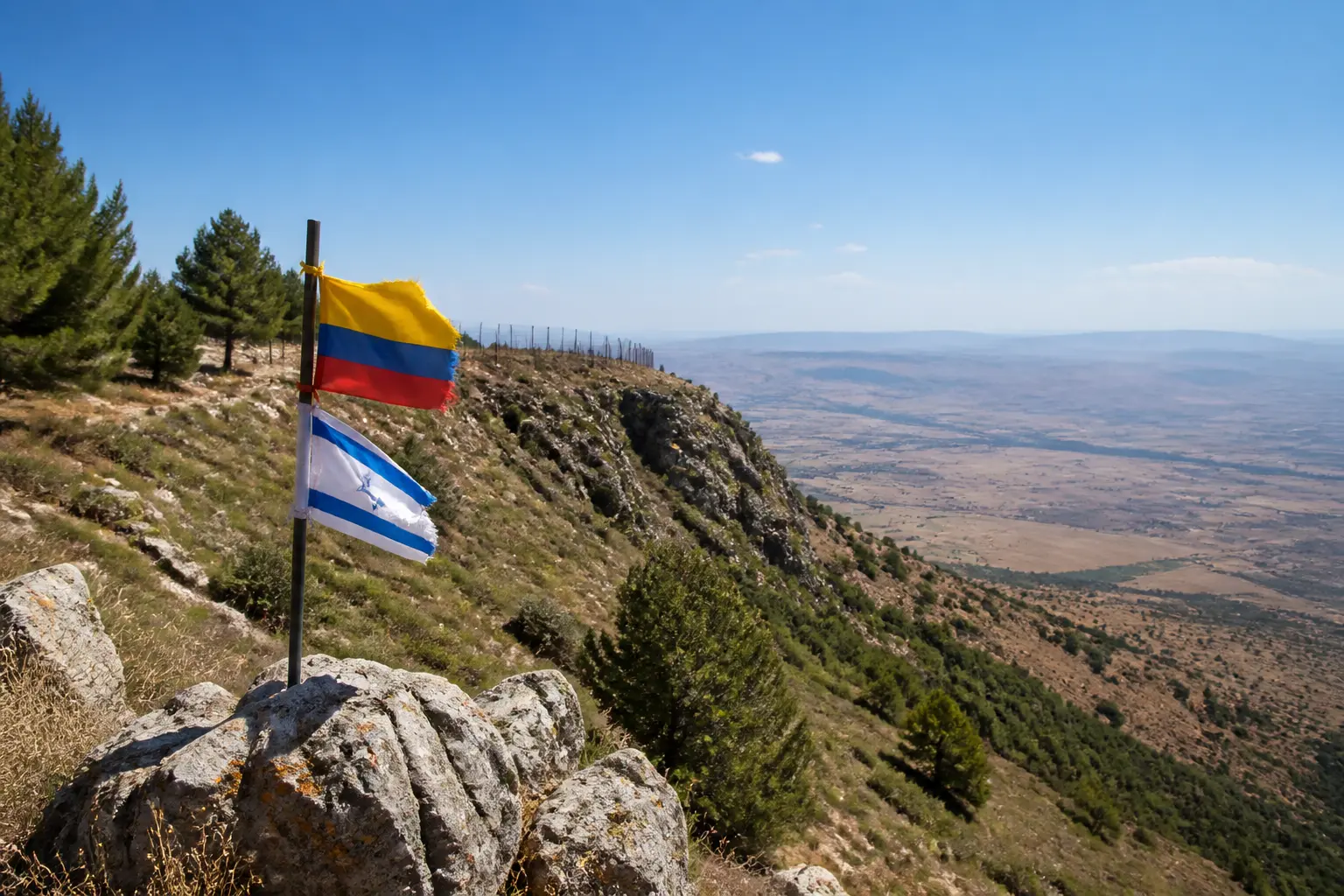
Why the New President Moved in Days
De la Espriella campaigned on tight ties with the United States and Israel as tools against Colombia’s guerrillas, cartels and illegal armed groups. Israeli systems already sit in Colombian inventories: Galil rifles, Spike missiles, Kfir jets and air-defense packages. The diplomatic freeze under Petro cut fresh access.
Restoring full relations, lifting visa barriers, withdrawing from South Africa’s ICJ case against Israel, and opening an embassy in Jerusalem all featured in the incoming platform. The Golan nod costs Bogotá little in practical terms. It signals reliability to Jerusalem and Washington and accelerates the tech and intelligence pipeline the new government wants for domestic security.
Political scientist Alberto Spektorowski at Tel Aviv University noted that cooperation on organized crime, narcotics and state security can deepen quickly once the political channel reopens. Everything connected to state security, he said, will involve extensive collaboration with Israel.
Golan Facts After Assad’s Fall
Israel captured the 1,200-square-kilometer plateau in the 1967 Six-Day War and applied Israeli law in 1981. The United Nations still treats it as Syrian territory under occupation. UNSC Resolution 497 called the 1981 move null and void.
The United States under President Donald Trump issued the 2019 US proclamation on Golan sovereignty, citing Iranian and Hezbollah threats from southern Syria. No other country followed until Colombia.
After Bashar al-Assad’s regime collapsed in December 2024, Israeli forces moved into the UNDOF buffer zone, seized Syrian positions and took the Mount Hermon peak. Netanyahu called the step temporary for border security. More than a year later the expanded footprint remains. A new observation point overlooking three countries now draws visitors on the Israeli side of the heights.
- Water: The Golan supplies roughly one-third of Israel’s water.
- Height: It dominates the Galilee and approaches to Damascus.
- Settlements: More than 25,000 Israelis live in communities established since 1967.
- Buffer: Post-2024 advances pushed Israeli lines deeper into former Syrian positions.
Those ground facts make fresh diplomatic recognition easier to defend in Jerusalem even as most capitals reject it.
The Full U-Turn From Petro’s Break
Gustavo Petro severed diplomatic relations in May 2024 over Israel’s Gaza campaign, halted arms imports and joined the ICJ genocide case. Coal exports to Israel stopped. De la Espriella’s team has moved in the opposite direction on every front.
- Full restoration of diplomatic relations and ambassador appointments
- Withdrawal from South Africa’s ICJ case
- Pledge to open a Colombian embassy in Jerusalem rather than Tel Aviv
- Renewed access to Israeli weapons, drones and artificial intelligence
- Explicit framing of Israel as a partner against Colombia’s internal threats
Sa’ar’s Foreign Ministry has labeled 2026 the “Year of Latin America.” The Colombia reset is the sharpest single gain so far.
Winners and Losers Around the Table
| Party | Immediate Gain or Loss | Longer Stake |
|---|---|---|
| Israel / Sa’ar | Second formal recognition; Latin America opening | More capitals may follow if security pitch lands |
| De la Espriella government | Security tech pipeline; US and Israeli goodwill | Domestic optics hit from quake-day timing |
| Syria (post-Assad) | Further erosion of claim in practice | Harder to reverse expanded Israeli lines |
| Petro-era policy | Full reverse on Israel file | Leftist Latin alignment weakened |
| United Nations consensus | Still majority view of occupation | Second break after US raises future fracture risk |
Local voices on X focused on the earthquake more than the map. Several high-engagement replies called the announcement tone-deaf while rescue teams still pulled bodies from rubble. That crowd reaction does not reverse the policy, but it colors the first week of the new presidency.
What the Nod Changes
On the ground in the Golan the recognition alters little. Israeli law already applies. Settlements continue. The expanded buffer after Assad’s fall is enforced by troops, not foreign statements. Earlier cross-border strike dynamics from the Golan and routine border security incidents along the Golan line will continue under the same operational logic.
Diplomatically the list of recognizing states now reads United States and Colombia. Sa’ar has said he will keep working for more. For Bogotá the practical return is hardware, training and intelligence that fit the new government’s harder line on armed groups. Whether that bargain delivers measurable results against cartels and residual guerrillas will be measured in Colombian valleys, not on the Syrian escarpment.
The Golan claim itself remains rejected by the United Nations and nearly every other capital. Yet the second recognition, timed to a rightward Latin American shift and an expanded Israeli military reality, makes the old consensus slightly harder to restore.
Frequently Asked Questions
Which countries recognize Israeli sovereignty over the Golan Heights?
Only the United States (since the March 2019 Trump proclamation) and Colombia (since August 10, 2026) formally recognize Israeli sovereignty. Every other UN member state continues to regard the territory as Syrian land under Israeli occupation.
When did Israel capture the Golan Heights and apply its law?
Israel seized the plateau from Syria during the June 1967 Six-Day War. The Knesset passed the Golan Heights Law on December 14, 1981, extending Israeli law, jurisdiction and administration to the area in a step widely described as annexation.
What is the United Nations position on the Golan Heights?
The UN Security Council, in Resolution 497 of 1981, declared the Israeli law “null and void and without international legal effect.” Successive secretaries-general, including António Guterres as recently as July 2026, have restated that the Golan remains Syrian territory under occupation.
Why does Israel say the Golan is essential to its defense?
The elevated plateau provides observation and artillery dominance over northern Israel and denies hostile forces a high ground for attacks. Israeli officials also cite water resources that feed the Sea of Galilee and the lack of strategic depth in the country’s narrow geography.
How many Israeli settlers live in the Golan Heights?
As of the late 2010s the Israeli settler population exceeded 25,000 across multiple communities established after 1967. The number has continued to grow under successive Israeli governments.
