
China has locked in its place as Egypt’s top clean-energy partner through cheap finance, fast construction and technology transfer under the Belt and Road Initiative, industry experts and executives told China Daily. Landmark solar parks, Gulf of Suez wind farms and new storage plants now form an integrated system that also aims to turn Egypt into a regional export base for the Middle East and Africa.
The push coincides with Cairo’s accelerated target of 45 percent renewables in the electricity mix within two years, a sharp jump from roughly 13 percent in 2025.
Landmark Ventures Now Dominate the Map
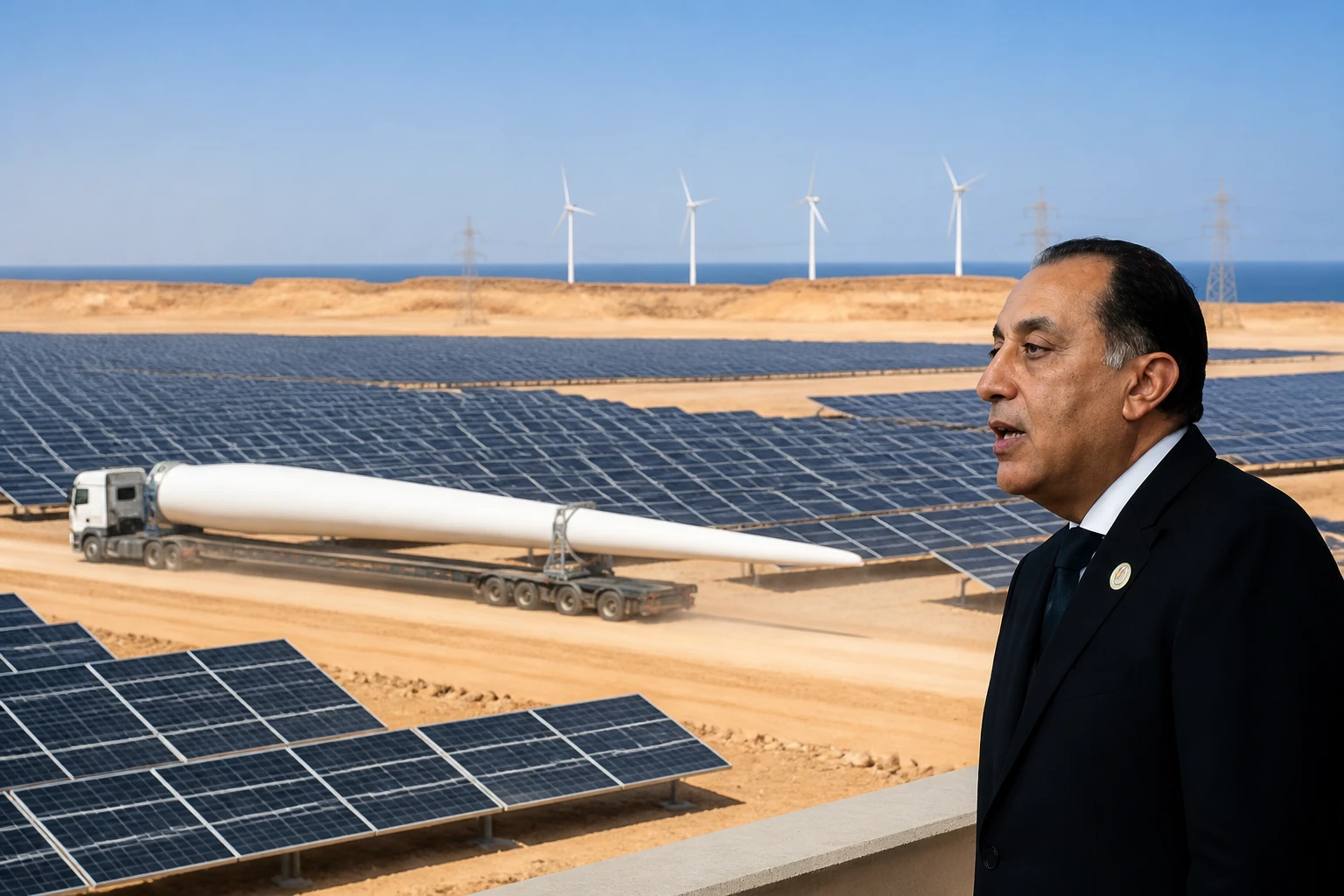
Chinese enterprises supply the bulk of hardware, engineering and capital across Egypt’s biggest renewable sites. Benban Solar Park stands as Africa’s largest solar installation. Wind capacity clusters along the Gulf of Suez. Fresh deals add manufacturing and grid work.
| Project | Capacity / Role | Chinese Link |
|---|---|---|
| Benban Solar Park | ~1.65-1.8 GW solar | Multiple Chinese builders and financiers among developers |
| Sany Gulf of Suez | 2,000 MW wind + first local turbine plant | Sany Renewable Energy MoU with EETC and NREA |
| Obelisk hybrid | 1.1 GW solar + 100 MW/200 MWh storage | Chinese power systems and AI storage; serves 1.6 million households |
| Amunet II | 500 MW wind | Envision Energy with AMEA Power |
| Longi hybrid | 20 MWp solar | Longi Green Energy MoU with United Energy Egypt |
Sany’s package pairs the wind farm with Egypt’s first wind-turbine factory, planned for 2 GW annual turbine plant beside the wind farm. Grid connection for the 2,000 MW project is slated within 23 months of final agreements. The plant itself is targeted for completion two years after contracts close and is designed to serve domestic needs plus exports to neighboring markets.
Blackouts Forced the Faster Clock
Egypt’s electricity demand keeps rising with population growth, urbanization and industrial expansion. The country holds large natural-gas reserves yet suffered shortages and blackouts through 2024. Those outages made diversification urgent.
- ~13 percent renewable share in 2025 (Ember data cited in recent coverage)
- 45 percent target advanced to roughly 2028, two years ahead of the prior 42 percent by 2030 goal
- 105 renewable projects flagged for grid stability after a June presidential review
- Gas still dominates generation; import costs spiked after regional conflict raised energy prices
Lin Boqiang, head of the China Institute for Studies in Energy Policy at Xiamen University, called the alignment a win-win that lets China export green technology while Egypt upgrades industry and talent. Tinhinan El Kadi of the Oxford Department of International Development noted that Egyptian deployment has accelerated through Chinese technology, financing and industrial capacity, shaping both Egypt’s energy future and its ties with other partners.
Factories and Desert Labs Shift the Supply Chain
The second-order move is localization. Sany’s factory and related deals aim to keep more of the value chain inside Egypt. A China-Egypt joint renewable-energy laboratory on Karaman Island in Sohag has already produced Egypt’s first half-cut PV cell and high-efficiency half-cut module under desert conditions. Demonstration projects cover solar power, water purification and solar pumping.
Key transfer steps now underway:
- Wind-turbine manufacturing plant with 2 GW annual capacity and export surplus
- Local content rules under finalization for the renewable sector
- Joint lab R&D tailored to desert heat and dust
- Training of Egyptian technicians alongside Chinese specialists
- Battery and storage systems with thermal management for harsh climates
This mirrors other broader Chinese-Egyptian industrial projects that pair capital with on-the-ground production capacity. China Southern Power Grid is advising on grid modernization so the network can absorb the planned renewable surge without instability.
Storage That Smooths Desert Solar
The recently commissioned Obelisk station is Egypt’s largest integrated solar-plus-storage facility. Scatec reached commercial operation on the first phase of its 1.1 GW Obelisk solar and battery project (561 MW solar plus the full 100 MW/200 MWh battery in phase one; phase two adds another 564 MW). Full output is projected above 3,000 GWh a year under a 25-year USD power-purchase agreement and is expected to cut more than 1.2 million tonnes of CO2e annually. China Daily reported the facility relies entirely on Chinese power systems.
The facility’s artificial intelligence-driven storage system employs advanced thermal management to withstand harsh desert environments, actively responding to grid commands and smoothing out solar fluctuations.
Li Tao, general manager for the Middle East and Africa at Envision Energy, described that setup. Envision has also signed for the Amunet II 500 MW wind project with AMEA Power. Amunet I, already online at 500 MW in Ras Ghareb, was commissioned as Africa’s largest operational wind farm. Kane Xu, senior vice-president of Envision, framed the work as a long-term collaboration built on trust and reliable delivery across the MENA region. Separate reporting has put potential LNG-import savings from Obelisk-scale hybrids in the hundreds of millions of dollars a year.
Hardware Carries Standards and Market Share
China’s leverage rests on scale. According to the International Energy Agency, Chinese firms’ share exceeds 80 percent across solar PV stages (polysilicon, ingots, wafers, cells and modules). BloombergNEF has noted the same companies moving into higher-value EPC, operations and financing packages. That vertical stack embeds Chinese technology and technical standards inside foreign grids.
For Egypt the immediate payoff is speed and industrial depth. For China the payoff is a North African hub that can carry equipment, know-how and standards into wider Middle East and African markets. Other international developers remain active, yet Chinese firms now set much of the tempo and the local manufacturing agenda. Dependence on one supplier base brings concentration risk; the same dependence is delivering turbines, panels and storage faster than earlier partner mixes.
Benban Set the Template Years Ago
Benban’s multi-gigawatt build-out in Aswan already mixed Chinese constructors such as TBEA Sunoasis with European and multilateral finance. That park supplies 2-3 percent of Egypt’s generation capacity in some tallies and proved large desert solar could be banked and built. The current wave adds wind manufacturing, AI storage and explicit grid upgrades so variable renewables can climb toward nearly half the mix.
Longi Green Energy’s 20 MWp hybrid MoU with United Energy Egypt extends the pattern into industrial decarbonization. Cumulative Chinese investment and EPC packages continue to arrive as Cairo finalizes local-content rules and races the two-year clock.
The result is a cleaner power system taking shape under Chinese lead engineering, with Egypt positioning itself as both consumer and future exporter. Grid upgrades and the first turbine factory will decide how much of that ambition stays inside the country rather than remaining a technology import story.
