
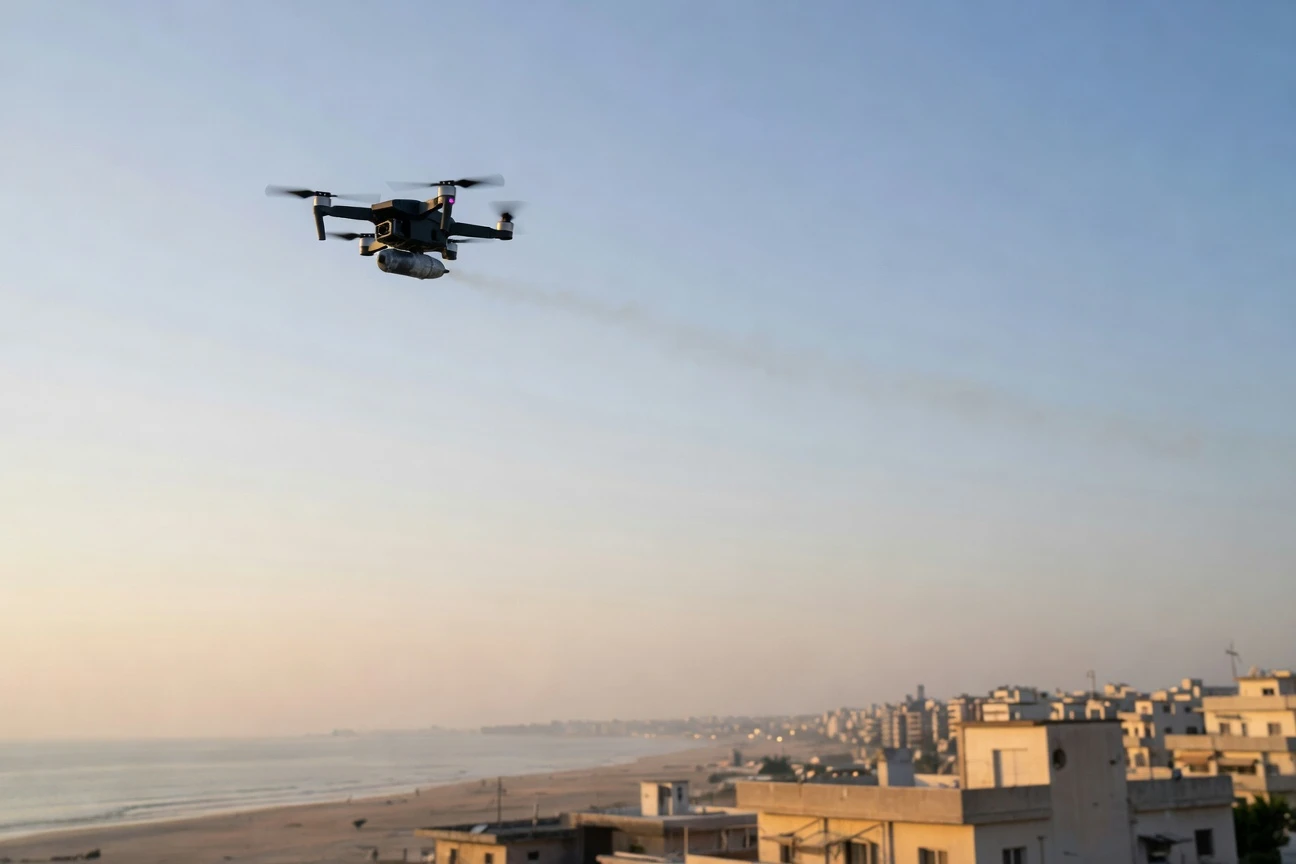
Avigdor Liberman, former defense minister and chairman of the Yisrael Beytenu party, warned the Knesset on Monday that Hezbollah’s explosive drones could soon reach Tel Aviv and Jerusalem. The statement landed after a month of escalating cross-border strikes that killed Sergeant Nehoray Leizer in southern Lebanon and wounded civilians inside Rosh Hanikra.
Liberman blamed what he called an unclear military posture in the North and demanded the government make “real decisions.” Prime Minister Benjamin Netanyahu, in a video statement the same evening, said he had told the IDF to “press the pedal even harder” against Hezbollah, after a long security cabinet sitting.
Liberman Tells the Knesset the Range Map Has Moved
Speaking at a Yisrael Beytenu faction meeting on May 26, the opposition leader framed the drone problem as a clock, not a debate. “Anyone who has not yet understood must understand that it is only a matter of a short time before we see those explosive drones in Tel Aviv and Jerusalem,” he said, according to remarks reported by Israeli outlets covering the closed session.
His career gives the warning weight inside the building. He served as defense minister under Netanyahu from 2016 to 2018, resigning over what he called soft policy toward Hamas, and ran the security file again in the short-lived 2021 government. Three former defense ministers are now actively shaping the security debate from outside the cabinet, and his voice is the loudest of them on the northern file.
The political ask was sharper than the threat assessment. Liberman demanded the cabinet “come to its senses” and stop sacrificing soldiers in the North “without purpose.” He called the current posture treading water, a line aimed at the security cabinet’s pattern of striking Lebanon daily without forcing a strategic outcome. He stopped short of specifying what a decision looks like in operational terms.
A Month of Hits on the Northern Border
The strikes Liberman was responding to have been clustered, not isolated. Israel’s security establishment has documented a steady escalation since late April, and the IDF on May 25 confirmed that Sergeant Leizer, a 19-year-old combat engineer from Eilat, was killed when an explosive drone hit the armored personnel carrier he was driving near Debel in the Bint Jbeil District. A second soldier was seriously wounded in the same incident.
He was the tenth IDF soldier killed in southern Lebanon since the November 2024 ceasefire took hold, a figure that landed in the Knesset on the same day as Liberman’s remarks.
The pattern over the past four weeks runs as follows:
- May 13, the largest drone swarm to date hit a target inside northern Israel in two waves, with the second wave circling the site for several minutes before impact.
- Mid-May, an explosive drone struck a parking lot in Rosh Hanikra, seriously injuring two civilians.
- May 19, a Hezbollah quadcopter hit the border community of Shomera, sending residents into shelters.
- May 25, a UAV impacted a residential home in Metula without casualties.
- May 25, the Debel strike on the armored vehicle in southern Lebanon.
The Alma Research and Education Center report on Hezbollah’s FPV drone threat counts more than 80 explosive drones launched at northern positions in recent weeks. Roughly 15 found their target. Four soldiers and one civilian have been killed in the cycle, with dozens injured.
The Asymmetry Behind a $400 Weapon
What changed is the price of putting a warhead over an Israeli position. Hezbollah’s current drone playbook is built on First Person View quadcopters (FPV, the operator flies through the drone’s onboard camera in real time), many of them converted from Chinese commercial models that cost between $300 and $400 each. Larger fixed-wing variants run up to about $4,000.
Several recent strikes used fiber-optic tethering, a guidance method borrowed directly from the Russia-Ukraine front where it became a dominant lethal factor over the past year. A spool of optical cable plays out behind the drone, carrying video and control signals on glass instead of radio. Standard electronic warfare jammers cannot break the link.
A small drone flying at tree-top altitude also slips under most of Israel’s radar coverage. The Iron Dome system, designed against rockets and larger air-breathing targets, has limited utility against quadcopters that read as clutter to the algorithm. FDD’s May 18 analysis of the FPV campaign flags the small-UAV gap as the most consequential operational vulnerability that has opened during the current cycle.
| Weapon | Unit cost | Effective range | Primary defeat tool |
|---|---|---|---|
| Hezbollah FPV quadcopter | $300 to $400 | Tens of km | Kinetic intercept, jamming (limited vs fiber) |
| Seized Hezbollah fixed-wing variant | Up to $4,000 | About 50 km | Aircraft cannon, MANPADS |
| Tamir interceptor (Iron Dome) | About $50,000 per shot | 4 to 70 km | Defender, not target |
| Iron Beam laser | About $2 per shot, system cost much higher | Up to 7 km, line of sight | Defender, not target |
The ratio of attacker cost to defender cost runs at least 100 to 1 at the cheap end, before counting radar, command, and personnel layers behind every interception attempt.
The 212-Kilometer Question
The southern Lebanon border to Tel Aviv is about 120 kilometers in a straight line. To Jerusalem the air distance is closer to 150 kilometers. None of the FPV models currently confirmed in use against the IDF can fly that far on internal battery, and fiber-optic spools max out long before reaching Haifa.
Liberman’s claim was about trajectory, not present capability. Lebanese security forces in 2024 seized a shipment of about 5,000 drones bound for Hezbollah, including fixed-wing models with stated ranges around 50 kilometers. The group’s pre-war aerial inventory also included longer-range loitering munitions in the Shahed family, originally supplied by Iran, some of which carry published ranges over 1,000 kilometers.
Hezbollah has not used those longer-range systems in the current cycle. The political question Liberman pressed is whether the daily-strike approach is degrading the bench fast enough to keep it that way. Israel’s home front command has not raised the threat posture for the two cities in response to his remarks, and IDF spokespeople have so far framed the warning as a worst-case rather than a near-term forecast.
Netanyahu Hits the Gas, Liberman Calls for a Decision
The prime minister’s response that night used a different verb. “We will hit them, they are shooting drones at us, fiber drones,” he said in the video statement. “What this requires of us now is to increase the blows, to increase the force.” He said the IDF had eliminated more than 600 Hezbollah operatives in the past few weeks and that troops were holding strategic positions beyond the forward defensive line.
IDF Chief of Staff Eyal Zamir has reportedly recommended striking Beirut directly in response to the drone cycle, according to Israeli broadcasters. Finance Minister Bezalel Smotrich and National Security Minister Itamar Ben-Gvir have publicly pushed for hitting Lebanese infrastructure and restarting open war. The cabinet has not signed off on either step.
I suggest that the October 7 government come to its senses and make real decisions. We must bring this to a decisive conclusion. We cannot continue to tread water and sacrifice our soldiers in the North without purpose.
That was Liberman in the same Knesset faction meeting. His framing splits the cabinet’s posture in two: keep hitting, or finish. He has not yet specified what a decision looks like in operational terms, and his party has no current path back to the security file. But the line carries inside the IDF reservist class doing the fighting.
Where the Next Two Weeks Lead
The US-brokered ceasefire framework that took effect on November 27, 2024 has not collapsed on paper. American envoys helped engineer a 45-day extension of the Israel-Lebanon ceasefire earlier this year, even as Israeli strikes on southern Lebanon continued daily, including one that killed two Civil Defense paramedics. Lebanon accused Israel of more than 2,000 violations by January. The UN human rights experts’ October warning on Lebanon ceasefire violations framed the cycle as a sustained threat to civilians on both sides of the border.
Secretary of State Marco Rubio on May 26 promoted Morgan Ortagus, the aide who helped broker the original Lebanon track, to a senior White House national security role. That move reads as Washington keeping the diplomatic channel live while letting Israel widen the kinetic one.
If the escalation order holds and Beirut targets enter the IDF strike list, the ceasefire framework loses its remaining political cover and Hezbollah’s incentive to ration its long-range inventory drops with it. If, instead, the cabinet absorbs Liberman’s pressure into a narrower tactical answer, focused on grinding down the FPV pipeline before the warhead-delta closes, the war stays contained inside southern Lebanon for another quarter. Liberman’s warning sits on the assumption that the gap between an FPV’s current reach and the country’s biggest cities is a function of time, not geography. The next fortnight of cabinet decisions will determine whether that assumption gets tested.
