
More than 130 ancient Egyptian artifacts opened to the public August 1 at San Francisco’s de Young Museum in the US premiere of Treasures of the Pharaohs, running through January 31, 2027. The show spans 3,000 years with gold masks, granite statues and jewelry, yet the pieces that most expand the usual royal narrative come from a workers’ settlement frozen in time.
San Francisco is the first American stop after Rome. The Fine Arts Museums of San Francisco organized it with the Kimbell Art Museum, Egypt’s Ministry of Tourism and Antiquities and the Supreme Council of Antiquities.
Six Rooms Map a Whole Society
The exhibition divides into six thematic sections on kingship and daily life. It opens with the pharaoh as both king and god, then moves outward to the people who kept the system running, the gods they shared, ordinary objects, the Golden City and finally death as a new beginning.
- The Treasures of the Pharaohs: monumental statues and royal gold asserting divine power
- People Around the Pharaohs: officials, artisans, family members and servants who upheld kingship
- Religion and Beliefs: deities, rituals and the king as intermediary
- Daily Life in Ancient Egypt: jewelry, cosmetics, tools and furniture for all classes
- The Golden City: newly excavated workers’ community of Amenhotep III
- Death and the Afterlife: mummification, canopic equipment and protection for eternity
Director and CEO Thomas P. Campbell described the 130 works as ranging from monumental granite statues to delicately crafted gold jewelry that invite audiences to explore royal power and everyday objects alike.
The City That Froze When the Gods Changed
A special highlight is the North American debut of roughly 20 objects from the Golden City, the largest known ancient Egyptian urban settlement of its kind. Archaeologists led by Zahi Hawass uncovered it on Luxor’s west bank in 2020-2021 while searching near Tutankhamun’s mortuary temple area. It dates to the prosperous reign of Amenhotep III (about 1390-1352 BC), likely Tutankhamun’s grandfather.
The city held workshops, homes, bakeries, administrative offices and a dense street grid. It was largely abandoned after Amenhotep’s son Akhenaten rejected traditional gods for the sun disk Aten and moved the capital to Amarna. The sudden evacuation left streets and houses like a moment stopped, often compared to Pompeii.
The treasures of the pharaoh are the people who worked for and under him, all the people who administered to the king and brought him up.
Renée Dreyfus, Distinguished Curator and George and Judy Marcus Curator in Charge of Ancient Art at the Fine Arts Museums, said that at a press preview. She pointed to humble finds: a limestone headrest that kept insects off sleepers, clay moulds, pottery, scarabs, mud bricks with seals, and even a baby’s rattle. These fill the long gap between royal monuments and how ordinary families actually lived, manufactured goods and worshipped.
Dreyfus chose an Old Kingdom triad of Menkaure with the goddess Hathor and a nome deity as the show’s opener. A later limestone relief of Akhenaten and his family worshipping Aten marks the religious rupture that emptied the city. The contrast is deliberate.
Gold Still Commands the Room
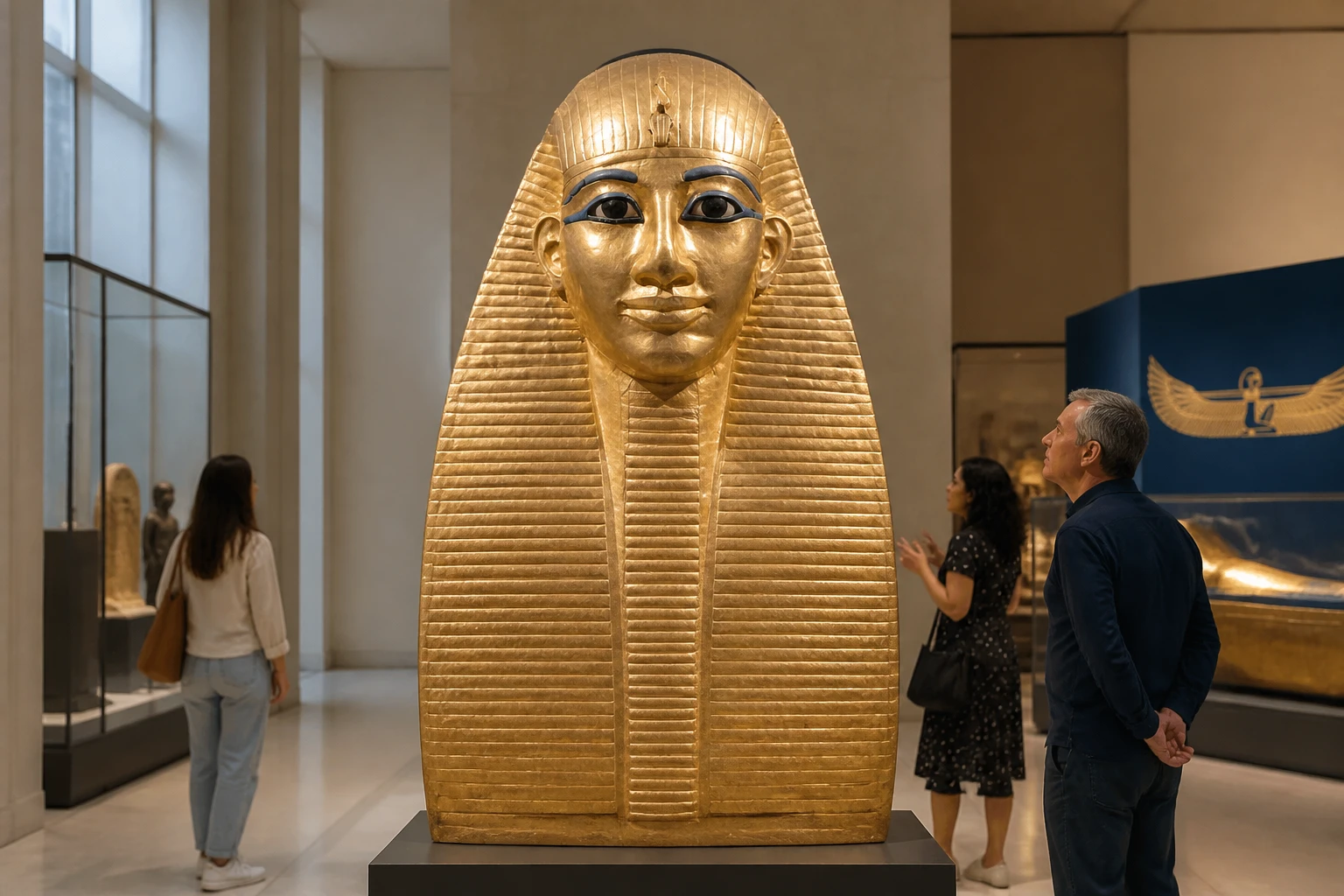
Royal pieces still deliver the spectacle visitors expect. Among them is the gold funerary covering of Psusennes I from his intact 21st Dynasty tomb at Tanis, discovered by Pierre Montet in 1939. The tomb held thousands of objects and is one of the few largely undisturbed royal burials besides Tutankhamun’s.
The gold collar of Psusennes I is repeatedly called the heaviest known piece of ancient jewelry, with published weights ranging from about 9.5 to 11 pounds depending on the source. Other standouts include the outer anthropoid coffin lid of Thuya (parents of Queen Tiye), the gilded armchair of Princess Sitamun, the gold funerary mask of Amenemope, Ahhotep’s necklace of golden flies awarded for bravery, and the massive granodiorite family statue of mayor Sennefer with his wife and daughter.
| Object | Period / Origin | Material highlight | Why it stands out |
|---|---|---|---|
| Outer coffin lid of Thuya | Dynasty 18, KV 46 | Gilded wood, glass, obsidian eyes | Lifelike gaze; parents of Queen Tiye |
| Gold collar of Psusennes I | Dynasty 21, Tanis | Solid gold with inlays | Heaviest ancient jewelry known |
| Menkaure triad | Old Kingdom, Giza | Schist | King as living god with deities |
| Sitamun armchair | Dynasty 18 | Gilded wood and reed | Royal comfort and craft |
| Golden City headrest | Amenhotep III era | Limestone | Everyday insect protection for workers |
Dr. Tarek El Awady, former director of the Egyptian Museum in Cairo and exhibition curator, noted that some masterpieces such as the Ahhotep necklace may never travel again once they return to Luxor Museum lists. Transport required an “army” of specialists because any error with these objects is unacceptable.
Why San Francisco First
Egypt’s Minister of Tourism and Antiquities Sherif Fathi (also referred to as Sherif Fathi Attia) attended the preview and stressed the long relationship with the Fine Arts Museums. He highlighted 50 American archaeological missions active in Egypt, joint restoration work and cooperation recovering stolen artifacts. The exhibition mixes royal splendour with objects of ordinary people who worked behind the kings, he said.
This is the third major ancient Egypt exhibition at the Fine Arts Museums in roughly 20 years. Earlier Tutankhamun shows in 1979 and 2009 still linger in local memory, so the “rare” label draws some pushback on social media even as the Golden City material is genuinely new to North America. California Lt. Governor Eleni Kounalakis previewed the show and met Hawass, underscoring the civic and scholarly attention.
El Awady was frank about the larger goal: Egypt has more than 4,000 archaeological sites that need visitors and funding for preservation. The tour is cultural diplomacy and tourism marketing at the same time.
What a Visit Looks Like Right Now
The de Young presentation features 130 exquisite works spanning 3,000 years drawn from the Egyptian Museum in Cairo and the Luxor Museum. Public tickets are listed around $40, with member discounts and limited complimentary allotments by membership level. Late Night Editions after-hours events and guided tours are already scheduled. Demand is high enough that member ticket rules were tightened.
After San Francisco the show moves to the Kimbell Art Museum in Fort Worth, one of only two North American venues planned, from March 14 to September 19, 2027. A major catalogue by Hawass accompanies the tour.
Dreyfus has emphasized the extraordinary condition of many pieces: inlaid eyes still intact, gold surfaces gleaming, fine carving visible on hard granite. Visitors stand face to face with objects that once lay in sealed tombs or workshops abandoned for three millennia.
Afterlife Logic Still Feels Personal
The final section returns to mortality. Egyptians treated death as transition, not end. Mummification, amulets, spells and canopic jars protected the body so the spirit could live on. Hearts were weighed against the feather of ma’at; a heavy heart meant destruction. Even a pharaoh faced that judgment.
Gold finger and toe stalls, silver coffins and elaborate masks show the lengths taken for royal eternity. Everyday items from the Golden City show the same concern scaled to ordinary lives. The show never separates the spectacular from the practical.
Recent discoveries keep adding texture. A recent 4,000-year-old Egyptian handprint find on a soul house elsewhere reminds viewers that new evidence still surfaces from the same civilization.
The de Young galleries now hold both the expected glitter and the quieter evidence of the people who made the glitter possible. That combination is what will stay with many after the gold is packed for Texas.
Frequently Asked Questions
What is the Golden City featured in Treasures of the Pharaohs?
It is the largest known ancient Egyptian workers’ settlement of its type, excavated on Luxor’s west bank starting in 2020-2021 and dating mainly to Amenhotep III. Abandoned after Akhenaten’s religious shift, it preserves workshops, homes and streets like a frozen industrial town; about 20 of its objects appear for the first time in North America.
How many artifacts are in the de Young exhibition and where do they come from?
Exactly 130 works travel from the Egyptian Museum in Cairo and the Luxor Museum. They cover roughly 3100 BC to the Ptolemaic period and include both royal masterpieces and ordinary tools and furniture.
When does Treasures of the Pharaohs close in San Francisco and where does it go next?
It remains at the de Young through January 31, 2027, then opens at the Kimbell Art Museum in Fort Worth from March 14 through September 19, 2027. Those are the only two North American stops announced.
Who curated the exhibition and wrote the catalogue?
Dr. Tarek El Awady, former director of the Egyptian Museum in Cairo, curated the touring show. Renée Dreyfus curated the San Francisco presentation. Egyptian archaeologist Dr. Zahi Hawass wrote the major scholarly catalogue.
Why do sources give different weights for the Psusennes I gold collar?
Museum materials list it near 9.5 pounds while some press coverage has cited about 11 pounds. Both treat it as the heaviest known piece of jewelry from the ancient world; the slight variance reflects different measurement or reporting conventions for the same object.
