
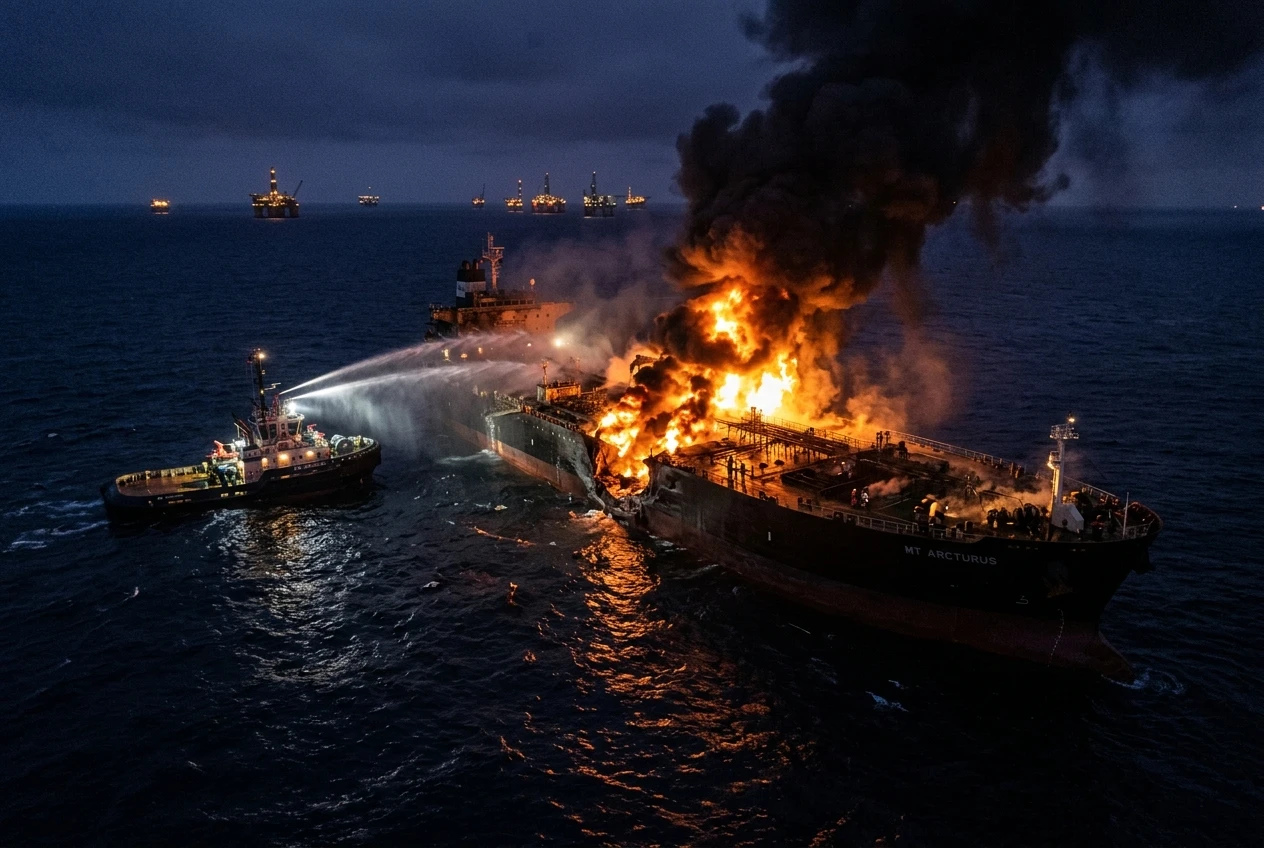
Saudi Arabia and Qatar condemned Iran’s strike on the Saudi crude tanker Wedyan and the Qatari LNG tanker Al Rekayyat as the vessels transited the Strait of Hormuz on Tuesday, July 7, 2026. The Saudi Foreign Ministry called the attacks “a serious threat to the safety and security of international navigation and the stability of global energy markets,” and said Riyadh holds Tehran “fully responsible for these attacks, their damage and all their repercussions,” according to the statement carried by the Saudi Gazette.
Qatar’s Foreign Ministry spokesman Majed Al-Ansari went further, framing the strike on the Qatari-owned LNG carrier as “an unacceptable attack on the security and safety of international maritime navigation” and a “grave and explicit violation of international law.” He added that Doha holds Iran “fully legally responsible” for the attack and any resulting damage or consequences. Both capitals pointed to UN Security Council Resolution 2817 as the legal anchor for their demands.
The condemnations were the loud and visible story. The consequential one played out a few hours later, when the United States announced it had launched more than 80 strikes on Iranian targets in retaliation. The Islamabad Memorandum of Understanding, signed on June 17 by President Donald Trump and Iranian President Masoud Pezeshkian to end the war in the strait, had just taken its most direct hit.
The US Retaliation: 80-Plus Targets and an Oil-License Revocation
US Central Command said on Tuesday night that its forces had begun a series of strikes against Iran in response to attacks on three commercial vessels transiting the Strait of Hormuz, according to a report citing the US military’s post on X. CENTCOM said the strikes were intended to “impose heavy costs” on Iran for “targeting commercial shipping crewed by civilians in an international waterway.”
The US military described the attacks as “a clear violation of the ceasefire,” a reference to the framework Trump and Pezeshkian signed in Islamabad three weeks earlier. The Washington Post, citing US officials, reported that US forces hit more than 80 targets in the new wave of strikes late Tuesday, the largest single US response since the Islamabad deal.
Beyond the military response, Washington moved on the economic lever. The United States is revoking a general license that had authorized the sale of Iranian oil, Reuters reported Tuesday citing a US official. The official called Iran’s actions “wholly unacceptable” and warned they “would be met with consequences,” while adding that negotiators continued to work in good faith toward a final agreement despite the latest escalation.
Iran’s Denial: ‘Perplexing’ and the Route Argument
Tehran rejected the accusations. Foreign Ministry spokesperson Esmaeil Baghaei called Qatar’s allegations “perplexing” and “inconsistent with good neighborly relations,” according to a statement reported by Iran International. He shifted the explanation toward shipping practices rather than Iranian fire: “commercial vessels using routes not coordinated with Iran, or tampering with ship-tracking systems, created risks and disrupted Tehran’s efforts to facilitate safe passage through the Strait of Hormuz.”
Baghaei added that Iran was “diligently fulfilling its commitments under the memorandum of understanding” on managing the strait, and urged regional states and shipping companies to “refrain from any actions that contradict the provisions of the memorandum.” The argument reframes the attack as a navigational-discipline problem rather than a violation of the ceasefire. It also leans directly on the Islamabad framework the US says Iran is now breaching.
The Gulf Closes Ranks: Bahrain and the GCC
Saudi Arabia and Qatar did not stand alone. Bahrain’s Foreign Ministry on Tuesday condemned the strikes on the Wedyan and Al Rekayyat, saying the incident “endangered the crews of both vessels” and violated “international law and the Islamabad memorandum of understanding,” per a statement reported by Iran International. Bahrain became the first Gulf capital to name the Islamabad MoU by title in its response.
Gulf Cooperation Council Secretary-General Jassim Mohammed Al-Budaiwi escalated the regional framing, calling the strike on the Saudi tanker a “criminal Iranian act” and “a dangerous escalation threatening international navigation security and energy supplies.” He said the GCC states “fully stood with Saudi Arabia and supported all measures taken by Riyadh to protect its national interests,” a phrase that pre-justifies any Saudi response short of war.
How each capital and bloc framed the strike:
| Party | Spokesperson | Key phrase | Legal anchor cited |
|---|---|---|---|
| Saudi Arabia | Foreign Ministry (statement) | “grave violation,” “fully responsible” | UN Security Council Resolution 2817 |
| Qatar | Spokesman Majed Al-Ansari | “unacceptable attack,” “fully legally responsible” | International law, freedom of navigation |
| Bahrain | Foreign Ministry | “endangered the crews of both vessels” | Islamabad memorandum of understanding |
| Gulf Cooperation Council | Secretary-General Jassim Mohammed Al-Budaiwi | “criminal Iranian act,” “dangerous escalation” | International navigation security |
| Iran (rebuttal) | Foreign Ministry spokesperson Esmaeil Baghaei | “perplexing,” vessels used “uncoordinated routes” | Claims compliance with the memorandum |
The Legal Frame: UN Resolution 2817 and the Islamabad Memorandum
Two documents carry the diplomatic weight of this dispute. The first is UN Security Council Resolution 2817, adopted earlier in 2026, which demanded that Iran cease its attacks on shipping and respect freedom of navigation through the strait. The International Maritime Organization cited Resolution 2817 at its extraordinary Council session on March 18 to 19, 2026, where it “strongly condemned the threats and attacks against vessels and purported closure of the Strait of Hormuz,” according to the IMO summary of decisions. The Council directed Secretary-General Arsenio Dominguez to begin work on a safe-passage framework to evacuate the merchant ships and seafarers trapped in the Gulf.
The second document is the Islamabad Memorandum of Understanding itself, signed on June 17, 2026, by Trump and Pezeshkian to end the war in the strait and lift the blockades both sides had imposed. Bahrain, the GCC, and Iran’s own spokesperson all cite the memorandum in their July 7 statements, but they cite it to reach opposite conclusions: the Gulf states say Iran violated it, and Iran says it is honoring it.
- IMO Council session: March 18 to 19, 2026, in London, with more than 120 Member States participating.
- Islamabad Memorandum: signed June 17, 2026, by Trump and Pezeshkian.
- CENTCOM strikes on Iran: June 26 (over M/V Ever Lovely) and again the night of July 7.
- Tankers struck July 7: the Saudi-owned Wedyan and the Qatari-owned Al Rekayyat.
For background on how the deal was sold to Gulf capitals, see the earlier Gulf States Welcome US-Iran Deal, Press for Hormuz Implementation. On the energy hedge that has been quietly built against a re-closed strait, see Saudi Arabia, South Korea Sign Oil MoU Tied to a Closed Hormuz.
What the Strait Carries, and Why It Matters
Before the war began on February 28, 2026, the Strait of Hormuz carried about 25 percent of the world’s seaborne oil trade and 20 percent of global LNG, with an estimated 84 percent of crude and condensate shipments destined for Asian markets, according to the Wikipedia summary of the 2026 Strait of Hormuz crisis. Qatar, the operator of the Al Rekayyat, is the world’s largest LNG exporter.
The Wedyan is a Bahri VLCC, the Saudi national carrier’s exclusive provider of crude transportation for Saudi Aramco’s CIF sales. The Al Rekayyat is a Nakilat-owned Q-Flex-class LNG carrier, part of a fleet that represents about 12 percent of the global LNG carrying capacity. Striking these two ships at once hits both the crude lane and the LNG lane that feed Asia and Europe.
That is the calculation behind the rapid escalation. A single strike on a single tanker might have been written off as a navigation dispute. Two strikes on the two largest Gulf exporters’ flagships, on the same day, in the waterway the Islamabad Memorandum was meant to keep open, leave the deal looking less like a framework and more like the incident it was supposed to prevent.
Frequently Asked Questions
Which two tankers were hit in the Strait of Hormuz on July 7, 2026?
The Saudi crude tanker Wedyan, owned by Bahri, and the Qatari LNG tanker Al Rekayyat, owned by Nakilat and chartered by Qatargas. CENTCOM’s July 7 statement also referenced a third commercial vessel that was attacked the same day.
How did the United States respond to the July 7 attacks?
CENTCOM launched a series of strikes against Iran the same night, hitting more than 80 targets according to US officials cited by the Washington Post. The US also revoked a general license that had authorized the sale of Iranian oil.
What is the Islamabad Memorandum of Understanding?
A June 17, 2026 deal signed by President Donald Trump and Iranian President Masoud Pezeshkian to end the 2026 war in the Strait of Hormuz and lift the blockades both sides had imposed. Bahrain’s July 7 statement was the first Gulf capital to cite the memorandum by name.
What is UN Security Council Resolution 2817?
A 2026 resolution demanding that Iran cease attacks on commercial shipping and respect freedom of navigation in the strait. The International Maritime Organization cited it at its March 18 to 19 extraordinary Council session as the legal basis for condemning attacks on merchant vessels.
Why did Iran deny the July 7 attacks?
Foreign Ministry spokesperson Esmaeil Baghaei called Qatar’s accusations “perplexing” and said commercial vessels using routes not coordinated with Iran created risks. He said Iran was fulfilling its commitments under the memorandum on managing the strait.
