
Yemen’s Houthi movement fired ballistic missiles and drones at Saudi Arabia’s Abha International Airport on Monday, ending a truce in place since 2022. Saudi-led coalition air defences intercepted the weapons, with no immediate reports of casualties.
The Houthis said the attack was retaliation for a strike on Sanaa International Airport earlier in the day, an operation Yemen’s internationally recognised government claimed and blamed on Saudi Arabia. The exchange marked the first major escalation between the two sides since the truce came into effect, and threatened to upend a frozen conflict on the kingdom’s southern border at a moment when the wider region is already on edge.
Monday’s Exchange, Hour by Hour
The day’s violence moved in two waves, separated by several hours of accusation and threat. In the morning, the Houthi movement, which controls northern Yemen and most of its population centres, accused Saudi Arabia of launching airstrikes against Sanaa International Airport and said it would retaliate.
Houthi military spokesman Brig Gen Yahya Saree called the attacks “blatant aggression” and said they had ended a period of de-escalation. The Saudi government’s communication office did not immediately respond to a request for comment on the accusations, but the Saudi-led coalition’s spokesperson later confirmed its air defences had dealt with ballistic missiles fired toward the kingdom’s southern region.
By Monday evening, the strike on Abha had been claimed by the Houthis and intercepted by Saudi air defences. The sequence of claims and counter-claims traced the steps that took the two sides from accusation to active fire in a single calendar day:
- Morning: The Houthis accuse Saudi Arabia of striking Sanaa International Airport runway.
- Yemen’s internationally recognised government, heavily backed by Riyadh, claims responsibility for the Sanaa strike.
- Yemen’s defence minister warns in a video statement that “our patience has run out” and vows to confront any hostile aircraft violating Yemeni airspace.
- The aircraft at the centre of the row, an Iranian Mahan Air flight, is diverted to Houthi-controlled Hodeidah Airport, about 150 kilometers (93 miles) southwest of Sanaa.
- The Houthi military spokesman announces, in a video statement on Telegram, that the Yemeni Armed Forces carried out a military operation targeting Abha International Airport using ballistic missiles and unmanned aerial vehicles.
- Saudi-led coalition spokesperson confirms the kingdom’s air defences dealt with the missiles.
- The UN Security Council convenes an emergency meeting on the developments.
Why the Houthis Struck Back
The trigger, both sides agreed, was an Iranian passenger plane. Earlier in the month, a Houthi delegation had travelled to Tehran for the funeral of Iran’s Supreme Leader Ayatollah Ali Khamenei, and Iran had sought permission for a Mahan Air flight from Tehran to Sanaa to bring the delegation home. Yemen’s Presidential Leadership Council, led by Rashad al-Alimi, denied the request and accused the Houthis of insisting on receiving the Iranian flight “outside the legal and sovereign frameworks governing civil aviation.”
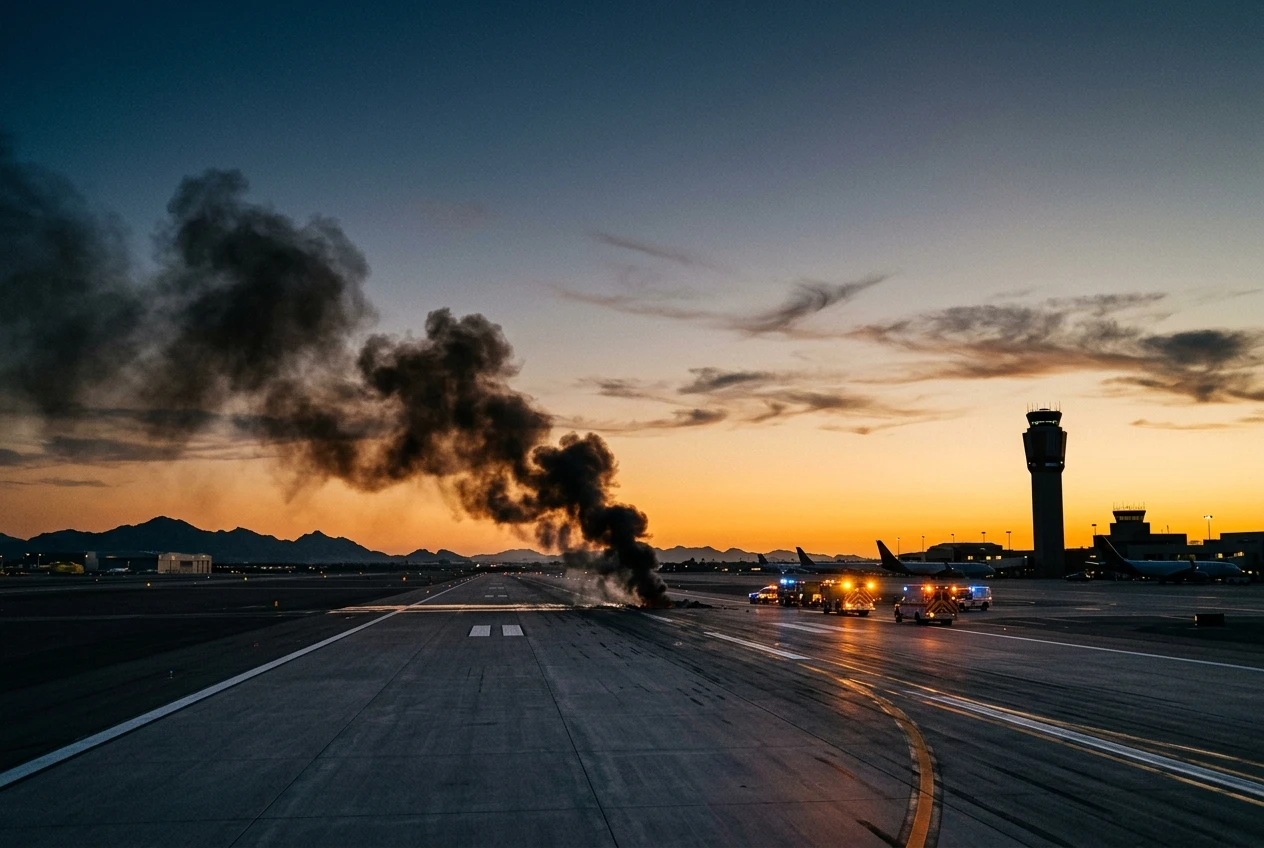
The Houthis said Saudi planes had earlier violated their airspace to try to block an Iranian plane carrying the delegation out of Sanaa, and warned Saudi airports would be hit if Riyadh acted again. On Monday morning, that warning returned with force: Houthi-aligned media published footage that appeared to show a missile striking a runway at Sanaa, followed by a loud explosion.
In a video statement on Telegram, Saree said the Yemeni Armed Forces carried out a military operation targeting Abha in response to “this criminal Saudi aggression.” Yemen had previously accused Riyadh of trying to enforce the airspace restriction itself, and a Houthi-led government had threatened to break the Saudi siege on Sanaa “regardless of the cost.” Earlier funeral flight threats against Saudi airports had already produced a public reckoning, and the Mahan Air flight itself became a flashpoint, as detailed in coverage of how a Mahan Air flight exposed the Saudi-Iran deal struck in 2023.
In response to this criminal Saudi aggression, the Yemeni Armed Forces carried out a military operation targeting Abha International Airport, using a number of ballistic missiles and unmanned aerial vehicles.
Saree also warned airlines against flying through Saudi airspace, saying the warning should be taken “seriously until the blockade on Sanaa International Airport is lifted.”
The Sanaa Strike and the Aircraft Question
Who flew the mission against Sanaa is not fully settled. The internationally recognised government in Yemen, where many of its members reside in Riyadh, claimed the strike. Yemen’s defence ministry said the runway at Sanaa International Airport had been targeted to prevent an Iranian plane from landing in violation of Yemeni sovereignty, and said government forces would respond to any hostile aircraft violating Yemeni airspace “by all available means.”
In a video statement released shortly before the strikes, Yemen’s Defence Minister Gen Taher al-Aqili warned against infiltrating Yemeni airspace with Iranian aircraft. “At this moment, we say that our patience has run out,” he said. “Accordingly, we will respond appropriately to this treacherous and brutal act, and we will confront and deal with the hostile aircraft violating Yemeni airspace and sovereignty by all available means.” The Saudi-led coalition did not publicly confirm Saudi participation. Andreas Krieg, a lecturer in security at King’s College London, told AFP it was “technically possible” the government had carried out the strike with planes provided by the UAE, though he said that was unlikely because the older jets the government flies “are in a bad shape and probably won’t fly far.” “This is why it is more likely that it was the Saudis,” he said.
The Houthis blamed Saudi Arabia for the Sanaa strikes. Riyadh has neither confirmed nor denied responsibility.
Inside Saudi Arabia’s Air Defence Response
Saudi air defences “have dealt with a threat from ballistic missiles launched by the terrorist Houthi militia toward the southern region,” coalition spokesperson Turki al-Malki said on X, without providing further details. The strike on Abha was the first claimed by the Houthis against Saudi Arabia since the truce went into effect. The Saudi government’s communication office did not immediately respond to a request for comment. Iran’s foreign ministry separately condemned the attack on Sanaa airport, with a spokesman describing it “as a clear violation of international law,” a framing the Houthis echoed.
Saudi Arabia has remained relatively isolated from the Iran conflict, less affected militarily and economically by Iranian attacks than most other Gulf states, and has pursued a diplomatic resolution. A key cushion has been its ability to continue exporting oil from its west coast on the Red Sea given the effective closure of the Strait of Hormuz. A wider conflict between the Houthis and Saudi Arabia could challenge that.
The ICRC Plane and a Failing Truce
A second aircraft sat at the centre of Monday’s escalation. Moammar bin Mutahar Al-Eryan, the information minister in Yemen’s internationally recognised government, said the Houthis were detaining a plane belonging to the International Committee of the Red Cross at Sanaa airport and holding its pilot and co-pilot.
“All ICRC staff and the crew of the plane are safe and accounted for,” Hachem Osseiran, ICRC spokesperson for the Middle East, told AFP, declining to comment further. The ICRC plane’s detention sat alongside a separate collapse: in recent days, an ICRC-mediated prisoner exchange between the Houthis and the internationally recognised government fell through, with both sides exchanging blame.
UN special envoy for Yemen Hans Grundberg said his office was monitoring Yemeni airspace developments and urged all parties to engage in dialogue that preserves the “relative calm Yemen has experienced since 2022.” At an emergency UN Security Council meeting, UN Assistant Secretary-General for political affairs Khaled Khiari told the 15-member council: “Yemen and the wider region cannot afford another cycle of escalation. We call on all actors to constructively engage in negotiations under UN auspices.”
Why the 2022 Truce Was Always Fragile
The truce that broke on Monday was brokered by the United Nations and came into effect in 2022 after years of Saudi-led coalition airstrikes on Houthi-controlled territory. It had largely held even as the wider region escalated, with the Houthis firing on Red Sea shipping and launching missiles at Israel during the Gaza war, and Iran and the United States trading attacks affecting the Gulf.
That resilience came with structural cracks. Tensions rose earlier in 2026 between Saudi Arabia and the UAE as their years-long partnership in Yemen broke down, leading to the UAE pulling out of Yemen. The Saudi-led coalition that intervened in 2015 had already been splintering, weakened further when a separatist movement backed by the UAE swept through southern territory late last year.
Each decision left the truce thinner. The Houthi delegation’s earlier flight to Tehran on an Iranian plane had already shown how quickly the de-escalation could be tested by a single airplane. A historical timeline of Houthi strikes on Saudi Arabia from the United States Institute of Peace documents how the group has repeatedly returned to Saudi oil sites, airports and cities when regional pressure builds.
The truce had been tested and pushed back, then tested again. The Mahan Air flight became its breaking point on Monday.
What Could Unravel If the Cycle Continues
Analysts framed the day’s events as a test of the truce’s survival. The Houthis’ first direct strike on Saudi territory since the 2022 truce was evidence the de-escalation was collapsing, they said. Mohammed al-Basha of the US-based risk advisory Basha Report gave AFP his assessment of what comes next.
If this cycle of action and retaliation continues, it could effectively mark the collapse of the April 2022 ceasefire framework and signal a return to a much more intense phase of the conflict.
Saudi Arabia’s ability to keep oil flowing through Red Sea terminals rather than the Strait of Hormuz has been a quiet buffer during the wider Iran conflict. A wider Houthi-Saudi war would put that arrangement under direct pressure. The Houthi attacks on Red Sea shipping during the Gaza war demonstrated the group’s reach beyond Yemen’s borders. The figures below capture the scale of what the truce had been holding in place:
- 2015: Year the Saudi-led coalition intervened in Yemen’s civil war
- 2022: Year the UN-brokered truce came into effect
- About 150 kilometers (93 miles) southwest of Sanaa: Distance to Hodeidah Airport, where the Iranian Mahan Air flight landed
- 2026: Year the UAE pulled out of Yemen as its partnership with Saudi Arabia broke down
Al-Alimi said he had “ordered that the scope of the confrontation not be expanded.” Saree, in a separate statement, said the warning to airlines should be taken “seriously until the blockade on Sanaa International Airport is lifted.”
