
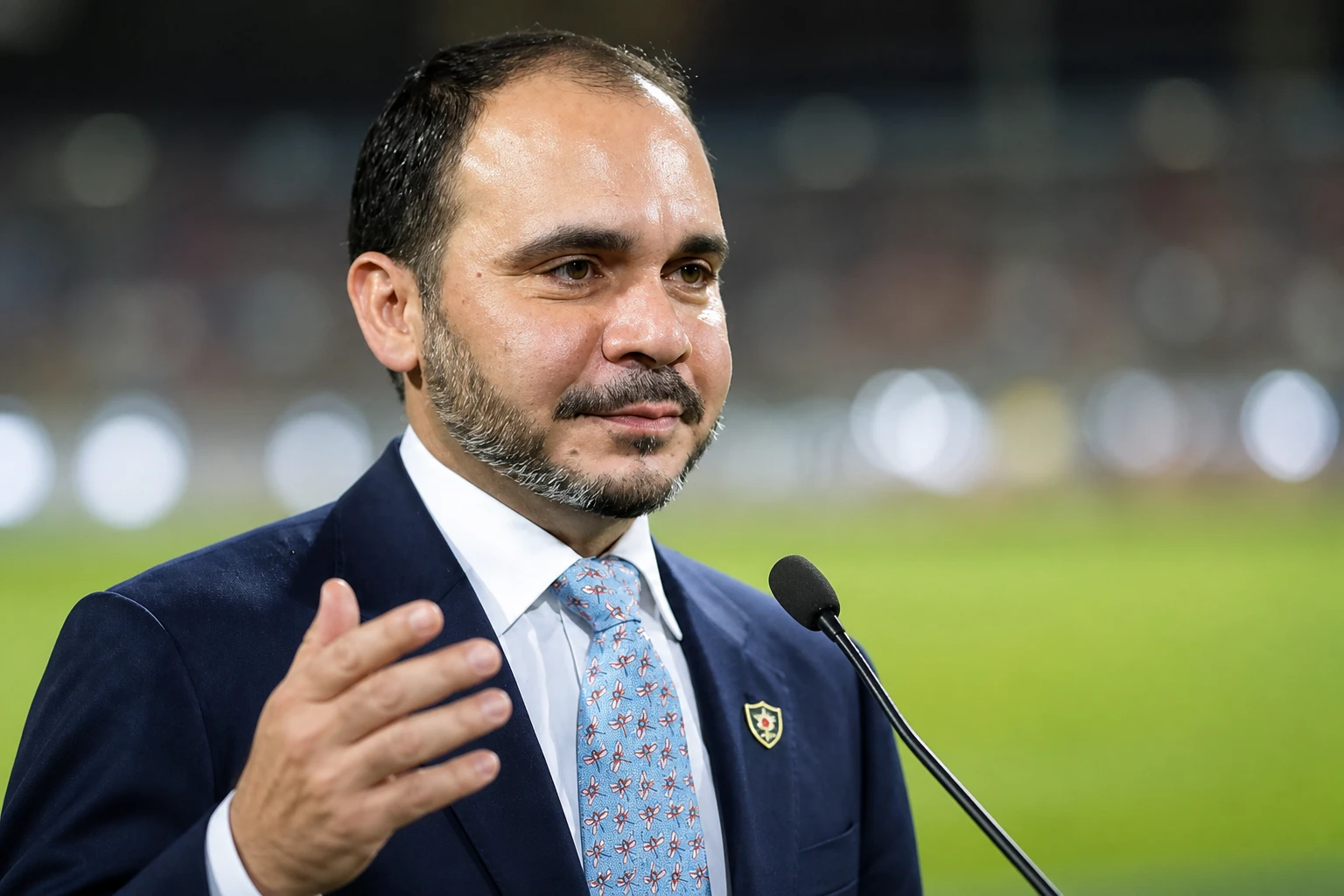
Prince Ali bin Al Hussein, president of the Jordanian Football Association, accused FIFA of blackmail on Tuesday after the governing body allegedly tied help on visas, taxes and unpaid prize money to an endorsement of Gianni Infantino’s reelection. The charge landed four days after Infantino withdrew a secret plan to sell a stake in World Cup commercial rights, with UEFA already declaring it had lost confidence in his leadership.
Jordan made its first World Cup appearance this summer. Ali, a former FIFA vice-president and two-time presidential candidate, said the federation faced three concrete problems that FIFA refused to resolve for months until a verbal message arrived during the tournament.
The Charge From Amman
In a detailed post that drew more than 16,000 likes and 3.4 million views within hours, Ali listed the hurdles a small-budget FA encountered and then described the condition attached to any relief.
For months, FIFA has been refusing to help us on any of these or other matters until it was verbally communicated to me, during the World Cup, that if I endorsed Infantino it would go a long way to helping our FA out. We pride ourselves in Jordan in upholding ethical values. We did not endorse him before and certainly will not now. But the whole situation amounts to blackmail and we refuse to give in to that.
The full statement on his X account also noted that FIFA “brags about how many billions they have in reserve” while Jordan still awaits Arab Cup money. FIFA has not responded to requests for comment from multiple outlets.
The timing amplified the charge. Ali spoke while confederations were still digesting the collapse of the commercial plan and while European associations were already withdrawing support. A regional figure with presidential campaign experience putting the word blackmail on the record gave private complaints a public label they had lacked.
Three Concrete Hurdles Jordan Faced
Ali framed the problems as the practical cost of a first World Cup for a federation with limited resources. Ticketed fans were denied US visas. Players and staff faced American taxes that teams based in Canada or Mexico avoided. Prize money from a FIFA event last December remains unpaid.
| Issue | Ali’s Claim | Context |
|---|---|---|
| Fan visas | Not all ticket holders granted entry despite “exorbitant” prices | Jordan’s debut group-stage run in the expanded 48-team tournament |
| US taxes | Players and staff liable through FIFA; unbudgeted cost | Only US-hosted teams hit; Canada/Mexico camps avoided it |
| Arab Cup prize | Runner-up money still unpaid since December | Reported $4.2 million for finalists; FIFA reserves estimated at $7 billion |
Jordan earned roughly $10.5 million for reaching the World Cup group stage, part of a record prize pool. The tax hit reduced what reached players and staff. The Arab Cup finalist figure of more than $4.2 million was widely reported at the time of the December 2025 tournament in Qatar, where Jordan lost 3-2 to Morocco after an unbeaten run to the final.
For a small-budget FA, each item carried weight. Visa denials wasted fan spending already locked in at high prices. The tax liability arrived as an unplanned deduction from tournament earnings. The unpaid Arab Cup sum left a prior competition unresolved even as a new World Cup cycle began. Ali’s point was that none of the three moved until the endorsement request arrived.
Why Prince Ali’s Voice Carries Weight
Ali is the third son of Jordan’s late King Hussein and half-brother of the current king. He founded and leads the West Asian Football Federation, which counts 12 FIFA members. He served as a FIFA vice-president from 2011 to 2016, when he was replaced by Sheikh Salman bin Ibrahim Al-Khalifa of Bahrain.
- Two-time presidential candidate: against Sepp Blatter in 2015, third in the five-candidate 2016 field that elected Infantino
- Policy record in office: lifted FIFA’s ban on the hijab in women’s football
- Development focus: backed funding for Middle East facilities while vice-president
- Regional base: leads a body that gathers a dozen FIFA members under one banner
That history makes him a known quantity inside Asian football at the precise moment Infantino needs every endorsement he can secure. His public refusal also fits a pattern of smaller associations testing whether the post-FFE climate has reduced the cost of speaking out. Crowd reaction on X quickly connected the post to the wider leadership freefall, treating the blackmail language as confirmation of leverage tactics long discussed in private.
The Collapsed Plan That Changed the Climate
Infantino’s troubles escalated after The Times reported on 28 July that FIFA planned a new subsidiary, FIFA Forward Enterprise, to hold commercial rights to the World Cup and other competitions. Private investors, reportedly led by Joshua Kushner’s Thrive Eternal and advised by JPMorgan, would take a minority stake. FIFA valued the vehicle at around $20 billion and projected $4.2 billion raised, with upfront payments of up to $20 million or more per member association.
UEFA called the move opaque and a line that should never be crossed. CONCACAF and the Asian Football Confederation demanded answers on why the plan was developed in secret, who appointed the banks and funds, and why FIFA needed external capital while sitting on large reserves. Infantino withdrew the proposal on 31 July / 1 August, saying it had created divisions. The details of the withdrawn Forward Enterprise plan show member associations were given a September deadline to accept the optional payment.
Senior FIFA figures including secretary general Mattias Grafstrom and global football development chief Arsene Wenger later said they had been kept in the dark. UEFA declared it had lost confidence in Infantino’s leadership and raised the possibility of legal action or arbitration.
- Wales became the first association to withdraw prior support for Infantino’s reelection.
- Serbia and Sweden followed the same day.
- The English FA prepared to withdraw its earlier letter of support.
- UEFA framed the episode as a broader loss of trust across the football family.
Qatar’s FA was among those that publicly welcomed the withdrawal and continued to back Infantino. The split tracks older fault lines between European skepticism of commercial expansion and the development funding needs of many other confederations. Yet even AFC leadership had called the lack of consultation unacceptable.
The speed mattered. A plan valued in the tens of billions, built without the knowledge of FIFA’s own senior executives, was pulled within days of public exposure. That sequence left confederations less willing to treat governance complaints as private matters.
Election Calendar and the Numbers That Matter
Infantino announced his 2027 reelection bid at the FIFA Congress in Vancouver earlier this year. Candidates must declare by 18 November 2026. The vote is scheduled for 18 March 2027 in Rabat, Morocco. A successful challenge would require a credible alternative and enough of the 211 member associations to break from the incumbent.
- 28 July 2026, Times report reveals FIFA Forward Enterprise proposal.
- 31 July-1 August, Infantino withdraws the plan after confederation opposition and boycott threats.
- 1-3 August, UEFA no-confidence statement; Wales, Serbia, Sweden withdraw support.
- 4 August, Prince Ali posts blackmail accusation.
- 18 November 2026, Deadline for presidential candidates.
- 18 March 2027, FIFA Congress vote in Rabat.
No clear rival has yet emerged, though names such as CONCACAF president Victor Montagliani have circulated in reporting. Infantino still holds residual support in parts of Asia, Africa and the Middle East, where development money carries weight. Ali’s intervention tests how solid that base remains once a high-profile regional figure refuses the transaction publicly.
The calendar leaves roughly fifteen months between the blackmail post and the Rabat vote. That span is long enough for a rival to organize, and short enough that every withdrawn endorsement now carries cumulative weight.
Smaller Federations Now Hold the Microphone
Jordan’s three complaints are specific, but the structure Ali described is familiar to many mid- and small-tier associations: help on logistics, payments or development arrives more readily when political alignment is clear. The FFE collapse removed the immediate commercial sweetener and, with it, some of the fear of open criticism. That is the reckoning now visible.
Ali has also called in recent days for ending the secret ballot in presidential elections so that association presidents face their own fans and officials. The suggestion lands as federations weigh whether continued support for the current leadership is tenable. Parallel stories of internal pressure are already circulating, including the Saudi FA president resignation after group exit, another sign that World Cup results and governance questions are colliding for several associations.
FIFA’s financial position remains strong. Reporting around the tournament noted that FIFA banks billions from the World Cup while host cities absorb infrastructure and security costs. That imbalance fuels the argument, made by Ali and others, that a governing body sitting on multi-billion reserves should not leave finalist prize money unpaid or condition basic assistance on political loyalty.
Conditional Help Grows Harder to Defend
Ali’s account sets out a simple sequence. Three practical problems sat unresolved for months. A verbal message during the World Cup linked relief to an endorsement. Jordan refused. The public charge followed.
That sequence matters because it converts a familiar private complaint into a documented case. Visas, taxes and unpaid prizes are ordinary federation burdens. Tying their resolution to a reelection pledge turns ordinary burdens into leverage. Once described in those terms by a former vice-president, the practice becomes harder for other associations to dismiss as routine diplomacy.
The FFE withdrawal sharpened the same point. Upfront payments of up to $20 million or more per member association had offered a fresh commercial reason to stay aligned. With that vehicle gone, the cost of refusing an endorsement fell. Associations that once calculated in private can now weigh the same choice under public scrutiny, with Ali’s language available as a reference.
European and Asian Responses Pull Apart
The reaction map already on the record shows two tracks running at once.
- Europe: UEFA’s no-confidence declaration, boycott threats, and successive support withdrawals by Wales, Serbia, Sweden and a prepared English FA shift
- Parts of Asia and the Middle East: residual backing for Infantino, Qatar’s public welcome of the withdrawal paired with continued support, and development funding still carrying political weight
- AFC leadership: criticism of the secret process even while stopping short of a call for immediate departure
Those tracks are not new. European skepticism of commercial expansion has long met the funding needs of other confederations. What changed is the shared objection to secrecy. CONCACAF and the AFC demanded answers on who appointed the banks and funds and why external capital was required while reserves remained large. That procedural anger crossed the older commercial divide.
Ali’s post lands inside the Asian track. A West Asian leader with twelve federations in his own body refused the endorsement transaction and named it blackmail. The residual support Infantino holds in the region now faces a visible counter-example from inside the same neighbourhood.
What the Next Months Will Test
Infantino must still answer the concrete questions confederations have put about the secret development of FFE, the selection of advisers and the necessity of external capital. He has not yet done so in detail. European associations continue to coordinate withdrawals of support. Asian and other confederations have stopped short of calling for his immediate departure but have made clear that the process failures were unacceptable.
Prince Ali’s post does not by itself decide the March election. It does remove any remaining ambiguity about how at least one influential West Asian voice will vote, and it supplies a public vocabulary, blackmail, for practices that previously stayed off the record. For a president who spent the World Cup looking unassailable, the speed of the reversal is the story. The unpaid $4.2 million, the visa denials and the surprise tax bills are now part of the record that every federation can cite when the endorsements are counted.
FIFA’s next statements, if any, and the first credible alternative candidacy will show whether this reckoning stays contained or becomes the end of an era.
