
Yemen’s Houthis threatened on Friday to target Saudi Arabia’s airports and vital assets after accusing Riyadh of trying to prevent an Iranian civilian aircraft from landing at Sanaa International Airport. In a video statement, Houthi military spokesman Yahya Saree said the group had thwarted an attempt by Saudi warplanes to enter Yemeni airspace at 5:20 am (0220 GMT) in a bid “to prevent an Iranian civilian aircraft carrying more than 200 stranded, wounded and sick citizens from landing at Sanaa International Airport.”
Houthi media said the Iranian flight had taken off after the standoff, heading back to Tehran carrying the Houthi delegation meant to attend the funeral of Ayatollah Ali Khamenei, Iran’s former supreme leader, who was killed in US-Israeli strikes on February 28. The renewed threats land four months after the two sides agreed to their largest prisoner exchange, and they expose how the airspace around the Houthi-controlled capital has become a corridor for the wider fallout from Khamenei’s death.
The Threat Yahya Saree Delivered
Yahya Saree, the Houthi military spokesman, read his warning on Friday from a video statement carried by regional outlets. He framed the address as a direct warning to the Saudi government. “We warn the criminal Saudi enemy against repeating any attempt to violate our airspace or any aggression targeting our country,” he said. “Such actions will be met with airports and vital interests on land and sea,” he added.
We warn the criminal Saudi enemy against repeating any attempt to violate our airspace or any aggression targeting our country. Such actions will be met with a comprehensive response targeting its airports and vital interests on land and sea.
The phrase “vital interests on land and sea” carried the same weight as in earlier Houthi statements: every Saudi airport, every oil installation, every port. Saree did not name specific targets or offer a timeframe. He said the group’s fighters stood ready for “any options” and had “their fingers on the trigger to implement directives aimed at breaking the Saudi-American siege,” without elaborating.
Flights between the Houthi-controlled Sanaa and Tehran “will continue despite any possible consequences,” Saree added. The direct framing of Saudi airports carried a familiar Houthi threat pattern, though the immediate trigger this time was an alleged airspace incursion rather than a rocket or drone strike. A JPost report on the same Friday statement said Houthi forces had fired air defense missiles at a Saudi warplane near Sanaa. Sanaa’s airport and the kingdom’s airports have been recurring targets in Houthi rhetoric since the war began in 2015.
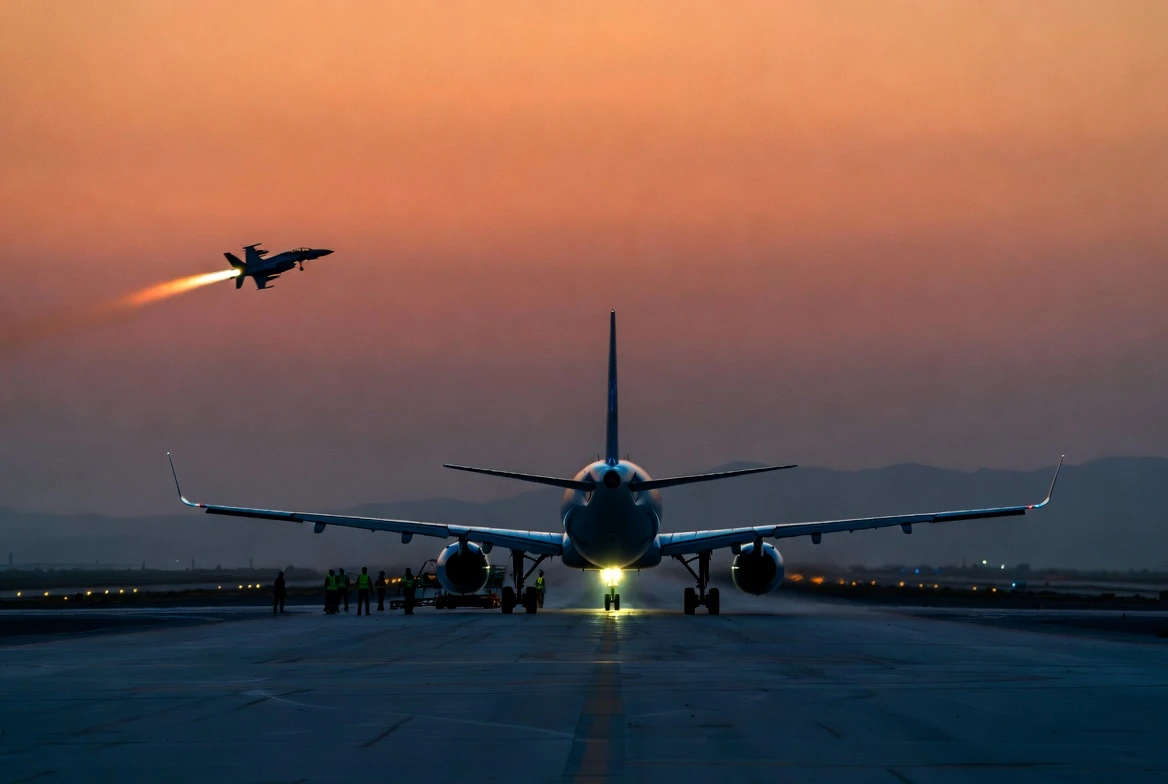
The Flight Saudi Warplanes Are Accused of Blocking
Saree said the rebels had thwarted an attempt by Saudi warplanes to “infiltrate” Houthi-controlled airspace at 5:20 am (0220 GMT). The aim, he said, was “to prevent an Iranian civilian aircraft carrying more than 200 stranded, wounded and sick citizens” from landing in Sanaa. Houthi media earlier reported the aircraft had successfully landed before heading back to Tehran with the Houthi delegation on board.
The same JPost report said Houthi forces had fired air defense missiles at a Saudi warplane that entered Yemeni airspace near Sanaa International Airport. The Saudi aircraft “was attempting to prevent an Iranian civilian plane carrying more than 200 wounded, sick, and stranded Yemenis from landing,” Saree said in the statement reported by the Post. The Houthis claimed the Saudi warplane “was forced to leave the area.” Saudi Arabia has not publicly addressed the Iranian flight, or confirmed the Houthi account of the interception.
Why the Plane Was Flying: The Funeral in Tehran
The passenger plane was ferrying a Houthi delegation to a mourning ritual that began on July 4. Ayatollah Ali Khamenei, Iran’s supreme leader since 1989, died on February 28 in US-Israeli air strikes that triggered what regional outlets have called the Middle East war. Iran’s government declared 40 days of national mourning at the time, and the funeral ceremonies at the Imam Khomeini Mosalla Grand Mosque in Tehran drew foreign delegations from across the region, The Times of Israel reported, posting an Associated Press photograph of crowds at the start of the days-long funeral ceremonies. The Houthi delegation’s seat on the flight tied a small Yemeni airport to the largest state funeral Tehran has held in over three decades. Houthi media tracked the delegation’s movements through the morning the threats landed.
Houthi media earlier reported the delegation was the same body meant to participate in the mourning. The trip sat inside a wider pattern of Houthi delegations travelling to Tehran to meet Iranian officials since the war began. The flight’s importance was not its passenger list but its destination, the funeral of a patron leader whose death reshaped the regional order.
Saree’s statement said air travel between Sanaa and Tehran would carry on “despite any possible consequences.” That phrasing put the choice on Riyadh: open the corridor or accept the implied risk of more confrontations of the kind Friday produced. The wider context also sits inside broader regional shifts, including a fresh Saudi coalition warning to Yemen separatists that has paralleled the prison deal, and the deeper Saudi UAE rivalry reshaping Yemen and Sudan that has split the war’s sponsors.
Riyadh’s Overnight Reply
The Saudi-led coalition issued its response in the early hours of Saturday. It said the Houthi statements against the kingdom were an attempt to “divert attention away” from the group’s “violations” against the Yemeni people, the JPost reported. The coalition, which has fought alongside Yemen’s internationally recognised government since 2015, warned it would respond with “unprecedented force” to any attempt to target the kingdom, per the Saudi coalition’s overnight response and missile test details. That language has been a steady backdrop of the coalition’s statements since the war began.
The Saudi-led coalition’s overnight statement did not directly confirm or deny whether its warplanes were involved. The framing that Houthi threats are an attempt to “divert attention” from “violations” has been the coalition’s standard language against the rebels for years. Friday’s accusations are the first against the kingdom tied to an Iranian civilian flight in the current ceasefire period. The wider Middle East war saw Iran “pummel” oil-rich neighbours while the Houthis stayed quiet, a pattern the new accusations stress but do not yet break.
A Prisoner Deal Designed to Lower the Temperature
The renewed threats come four months after the largest prisoner exchange of the Yemen conflict. On May 14, the internationally recognised Yemeni government and the Houthis signed a UN-backed agreement in Amman, Jordan, to release more than 1,600 detainees. Under the deal the Houthis released 580 prisoners, including seven Saudis and 20 Sudanese, and the government released 1,100 Houthi prisoners, according to Houthi official Abdulqader al-Mortada.
- 1,600+ detainees scheduled for release in the Amman deal
- 580 prisoners the Houthis are releasing
- 1,100 Houthi prisoners the government is releasing
- 1,728 detainees in the separate count given by government negotiator Yahya Kazman
- Nearly 900 detainees in the April 2023 ICRC-coordinated swap
Saudi Arabia welcomed the agreement the next day. The Houthis called it “a historic accomplishment.” The International Committee of the Red Cross’s head of delegation in Yemen, Christine Cipolla, said the agreement “represents a crucial step forward” and that the ICRC was “ready to assume its role as a neutral intermediary in implementing these complex humanitarian operations.” The deal was the second major prisoner swap since April 2023, when the two sides exchanged nearly 900 prisoners in an ICRC-coordinated operation. The two sides agreed to hold further talks on additional releases and allow mutual visits to detention facilities.
The agreement followed more than three months of negotiations in Amman, in line with a December understanding reached after UN-facilitated consultations in Muscat. It also restated an “all for all” principle, with talks on additional releases and mutual detention visits to follow. May’s deal sat alongside two 2026 signals of how thin the freeze has grown: Houthi leader Abdul-Malik al-Houthi’s June statement that his group would resume attacks on Israel if the Gaza war flared back up, and Israeli Defense Minister Israel Katz’s response, “Israel’s account with the Houthis remains open.” More on the structure sits in the May 2026 prisoner exchange agreement terms.
Where the War Stands After a Decade
The Houthi war with Yemen’s internationally recognised government began in 2015 after the rebels seized the capital Sanaa in 2014, drawing a Saudi-led military intervention the following year. The conflict has killed hundreds of thousands of people and triggered one of the world’s worst humanitarian crises. The Houthis control Sanaa and much of the north, including most population centres, while the internationally recognised government holds much of the south.
| Houthis | Internationally recognised government | |
|---|---|---|
| Seized or recognised | Seized Sanaa in September 2014 | Recognised internationally since the Saudi-led intervention began in 2015 |
| Territory | Sanaa and much of the north, including most population centres | Much of the south |
| Patron | Iran | Saudi-led coalition |
| May 14 prisoner release | 580 prisoners, including seven Saudis and 20 Sudanese | 1,100 Houthi prisoners |
Direct fighting has been largely frozen since a UN-negotiated truce in 2022. The prisoner exchanges, the funeral flight, and Friday’s airspace clash sit inside that frozen frame, one that has held longer than any ceasefire the war has seen. The May agreement was framed by the UN as part of a wider series of confidence-building measures meant to keep the freeze from cracking. The Saudi-led coalition said on Saturday it would respond with “unprecedented force” to any further escalation, while the JPost reported on Monday, citing two people familiar with the matter, that the Houthi group had been conducting tests aimed at improving the range and accuracy of its missiles. Israeli Defense Minister Israel Katz’s June response to the group’s leader remains the most direct warning from a regional capital: “Israel’s account with the Houthis remains open.”
