
Italy has emerged as a leading candidate to verify that Lebanese Armed Forces units clearing pilot zones in the south have left those areas free of Hezbollah fighters and weapons, according to three sources familiar with US-facilitated talks now under way in Rome.
The discussions opened Tuesday and run through Thursday. They sit inside the June 26 Trilateral Framework that links phased IDF redeployment to confirmed LAF control and the disarmament of non-state groups.
Rome Talks Focus on Who Checks the Ground
Israel originally wanted its own forces to enter the zones after the LAF moved in, providing the final confirmation of a Hezbollah-free area. Lebanon rejected that outright. Officials from the three governments then turned to third countries for the verification role.
Italy is one option under active discussion. No decision is final and other names remain on the table, one source said.
The impasse was structural rather than personal. Direct Israeli entry would have undercut the Lebanese claim to exclusive authority on its own soil. Leaving confirmation solely to the LAF would have left Israel without an external check it could trust. A third country is the compromise that keeps both red lines intact.
US State Department spokesperson Tommy Pigott confirmed the Rome round on X:
Building directly on the momentum from President Trump’s meeting with President Aoun, Prime Minister Netanyahu, and the successful launch of the first pilot zones in southern Lebanon, the latest U.S.-facilitated talks between Israel and Lebanon began today in Rome and will continue through August 6.
Pigott added that the US remains fully committed to the process in a way that delivers lasting security, eliminates threats to Israel, and restores Lebanese state authority in the south.
That public framing matches the private agenda. The Rome round is not renegotiating the Framework. It is filling the single operational gap the text left open: who walks the ground and signs off before the next redeployment can proceed.
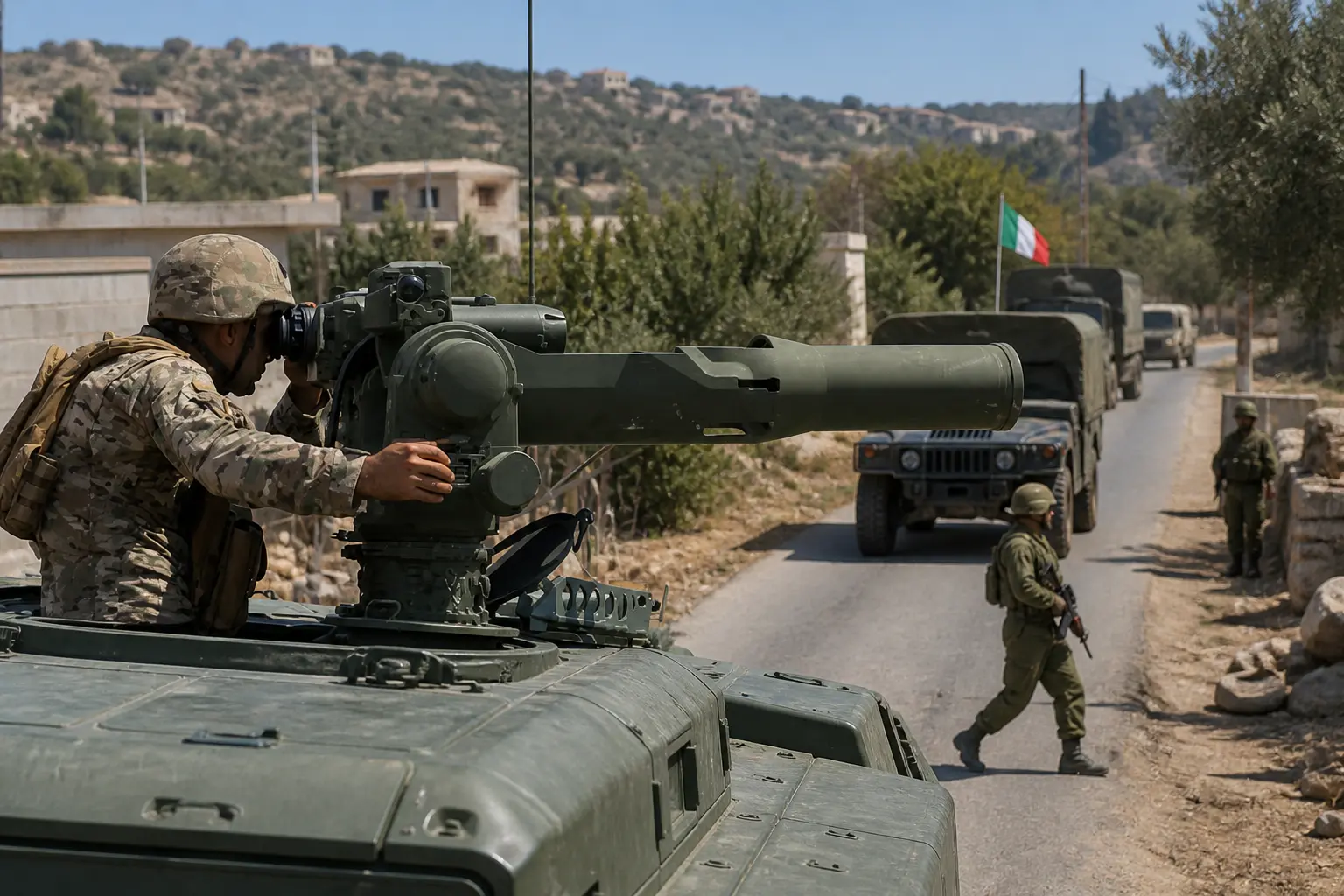
The Framework That Created the Pilot Zones
The Trilateral Framework, signed in Washington on June 26 by Israel, Lebanon and the United States, sets a sequenced path. The LAF gradually takes full security responsibility in agreed pilot zones. Once disarmament of non-state armed groups and dismantlement of their infrastructure are confirmed, the IDF can redeploy, reconstruction can start, and civilians can return under exclusive Lebanese control.
Two initial zones were already agreed by the IDF and LAF. Future zones require mutual consent. The United States pledged to work closely with both sides to verify and support the process. The text itself does not name UNIFIL for any implementation role.
- Core sequence: LAF enters, non-state groups and infrastructure cleared, confirmation delivered, IDF redeploys, civilians return.
- US role: facilitation, capacity support for the LAF, and verification partnership.
- Lebanese commitment: monopoly on force, complete verified disarmament of all non-state armed groups anywhere in the country.
- Israeli position: no territorial ambitions; military action ends when the threat ends.
| Step | Actor | What must be true |
|---|---|---|
| 1. Entry | LAF | Full security responsibility inside the agreed pilot zone |
| 2. Clearance | LAF | Non-state fighters, weapons and infrastructure removed |
| 3. Confirmation | Third-party verifier | Ground check accepted by both Israel and Lebanon |
| 4. Redeployment | IDF | Forces pull back once confirmation is delivered |
| 5. Return | Civilians | Reconstruction and return under exclusive Lebanese control |
That structure is what makes a credible third-party ground check essential. Without step three, steps four and five cannot start. The same pilot zones and verified LAF control language drives every current negotiation.
Performance, not timetable, governs the pace. Each zone advances only when confirmation arrives. That is why the identity and authority of the verifier now dominate the Rome agenda.
Why UNIFIL Is Off the Table
UNIFIL’s mandate ends 31 December 2026 after a final extension. Israel and the United States oppose any further renewal and do not want the force conducting final verification on the ground.
Resolution 1701 in 2006 already tasked UNIFIL with helping ensure southern Lebanon was free of armed groups other than the Lebanese state. Two decades of rocket fire, tunnel networks and parallel command structures showed the limits of that model. The new Framework deliberately bypasses another open-ended UN mandate.
- August 2025: Security Council gives UNIFIL its last extension to 31 December 2026 and asks for post-withdrawal options.
- June 2026: Trilateral Framework signed with no UNIFIL role written in.
- July 2026: First pilot-zone handovers begin after partial Israeli withdrawals.
- August 2026: Rome talks turn to third-country verification as the UN clock runs down.
After the list, the practical problem is simple. Someone still has to walk the ground, inspect the bunkers and certify the result before the next redeployment step can occur.
The Framework’s authors treated the UN route as already tested and found wanting. By omitting any UNIFIL implementation role they forced the parties to build a narrower, time-bound alternative. Rome is where that alternative is being named.
Italy Already Sits Closest to the Job
On the same Tuesday the Rome talks opened, Lebanese Army Commander Gen. Rodolphe Haykal met Lt.-Gen. Giovanni Maria Iannucci, head of Italy’s Joint Operations Command. The Lebanese Army said they reviewed the overall situation, recent developments, ways to support the LAF, and options after UNIFIL ends.
Italy has been inside southern Lebanon for decades. It is a long-standing major European contributor to UNIFIL. As of 1 July 2026 the mission listed Italy contributes 740 peacekeepers. Earlier figures put the Italian contingent near 1,100, second only to Indonesia at points.
In December 2025 Italian Defence Minister Guido Crosetto visited the contingent and stated that even after UNIFIL, Italy would continue supporting an international presence and LAF capacity development. A ministry spokesman confirmed that included keeping troops in the country.
Italy’s position in numbers and history:
- 740 current UNIFIL personnel (July 2026 roster)
- Decades of continuous presence since the original 1978 mission and the 2006 expansion
- Explicit political decision to remain after the UN flag comes down
- Direct command-level channel with the LAF opened the same day verification talks began
That combination makes Italy the stakeholder with the most existing infrastructure, local knowledge and political willingness already in place. Other countries would start colder.
The same-day meeting between Haykal and Iannucci is more than coincidence. It shows the bilateral channel is already open and working on post-UNIFIL support at the exact moment the three governments are shopping for a verifier. Continuity of command contact reduces the ramp-up time any new mandate would otherwise require.
Who Feels the Choice First
The LAF needs a partner that strengthens rather than undermines its claim to exclusive authority. A familiar European force already working with Lebanese units fits that requirement better than a new arrival or a return to pure UNIFIL structures.
Northern Israeli communities measure success by whether rockets and tunnels stay gone. Recent IDF work, including the dismantling of a 200-meter Hezbollah tunnel at Majdal Zoun, shows how much infrastructure still sits near the Blue Line. A third-country verifier that Israel can accept lowers the chance of another freeze when the next zone comes due.
Hezbollah rejected the Framework outright and continues to frame any disarmament effort as a threat that could tip Lebanon toward internal conflict. Verification that actually removes weapons and fighters undercuts that narrative on the ground even if the political rejection remains.
Lebanese civilians waiting to return to southern villages care less about the flag on the inspector’s sleeve than about whether the clearance sticks long enough for reconstruction money to flow. The Framework ties those funds to confirmed LAF control.
Each audience therefore reads the same appointment differently. For the LAF it is capacity support. For northern Israeli towns it is an external guarantee. For Hezbollah it is pressure on the ground. For returning civilians it is the switch that turns clearance into reconstruction.
Third Country Checks Close the Trust Gap
The original Israeli preference for its own final inspection and the Lebanese refusal of that model left a narrow corridor. Only a third country can occupy it without forcing either side to abandon a core position.
Italy’s existing footprint shortens the trust-building phase that any outsider would otherwise face. Decades on the Blue Line, a current contingent of 740, and an already stated intent to remain after December 2026 give both capitals a known quantity rather than an untested arrival.
The mechanism is straightforward. The LAF clears. The third-country team inspects people, caches, tunnels, posts and command nodes. Confirmation, once accepted, unlocks IDF redeployment and the reconstruction window. Rejection or dispute freezes the zone where it stands.
Because future zones still require mutual consent, a verifier both sides already tolerate becomes the practical enabler of the entire map. A rejected name would stall every subsequent handover even if the paper Framework remained intact.
Practical Checks and Remaining Gaps
Verification will have to cover people, weapons caches, tunnels, observation posts and command nodes. The Framework language is performance-based: confirmation of successful disarmament and dismantlement triggers the next steps. How many inspectors, what access rights, what dispute mechanism, and who pays are still open.
What we know
- Rome talks are live through 6 August and cover third-country options.
- Italy is under active discussion and already meeting LAF leadership on post-UNIFIL support.
- Israel and the US rule out both IDF entry for final checks and an extended UNIFIL mandate for the role.
- Two pilot zones are already in the hand-over sequence; more require mutual agreement.
What remains unconfirmed
- Which country or mix of countries will receive the formal mandate.
- Exact rules of access, inspection protocols and dispute resolution.
- Whether any residual Italian or other bilateral presence after 31 December will operate under a new political umbrella.
The earlier framework deal targets Hezbollah not full withdrawal as the central condition. That remains true. The verifier is the missing operational piece that turns the paper sequence into real redeployments. Recent tunnel finds near the border keep the pressure on every party to get the check right the first time.
Open questions on access and dispute rules matter because a single contested bunker can halt an entire zone. The Rome talks must therefore produce not only a name but a working method both capitals will treat as binding.
The Quiet Continuity Option
Italy never sought the spotlight in the June Framework signing. It simply stayed on the ground, kept talking to the LAF, and left the door open after UNIFIL’s planned exit. When the three governments needed a credible pair of eyes that neither side would reject on principle, the country already packing the southern roads became the natural shortlist entry.
Whether Rome produces a formal invitation this week or later, the structural logic is already visible. The force that spent years watching the Blue Line is now the one most ready to certify that the next stretch of it has finally changed hands for good.
