
Israel published a tender Tuesday for Project Nexus, a nationally produced quantum computer, and opened parallel requests for information on a physical AI testing ground and foundation-model policy. The move marks the first implementation steps of the national AI program under Government Decision 4255.
The Prime Minister’s Office National AI Directorate and the Finance Ministry Accountant General’s Department framed the package as the start of applied work on technological sovereignty and long-term competitiveness.
Three Flagship Moves Leave the Strategy Phase
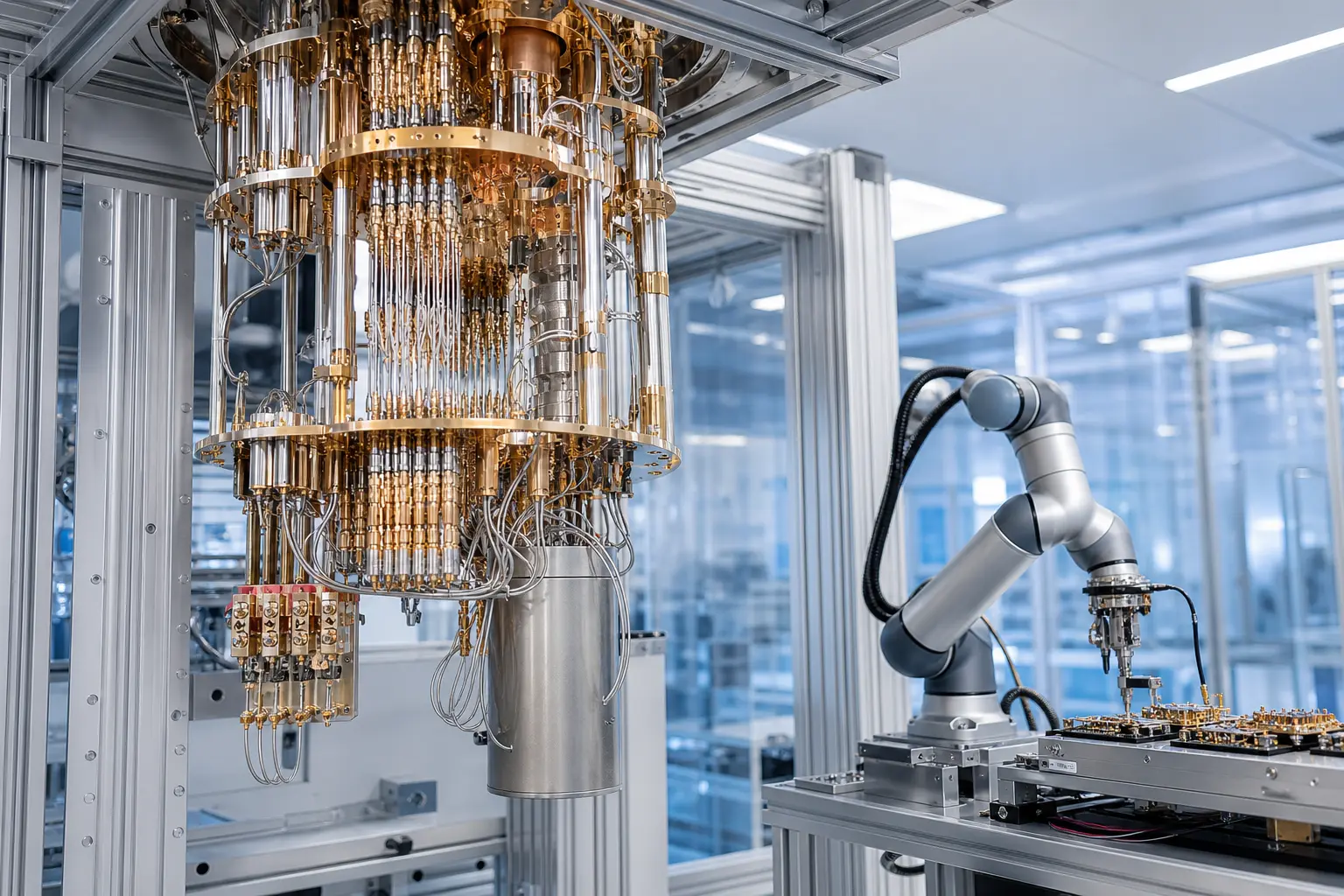
The joint PMO and Finance Ministry statement on the three initiatives lists Project Nexus first. A tender will establish a locally produced quantum computing platform meant to guarantee a domestic machine and support the range of quantum technologies already under development in Israel.
Officials acknowledge the work is long-term. The government expects to procure a full national system only after the technology matures. The tender itself will run in several stages, draw international participants, and take years.
- Project Nexus tender for a national quantum platform built as far as possible with Israeli technology.
- Request for Information on a National Physical AI Testing Ground for real-world simulations in highways, hospitals, factories, agriculture and other settings.
- Request for Information on paths to greater Israeli capability and sovereignty in foundation models, the large systems that power advanced AI.
Brig.-Gen. (res.) Erez Askal (also rendered Eskel), director of the National AI Directorate, said the steps move the country from vision to practical implementation while focusing on comparative advantages. Senior Finance Ministry Deputy Accountant General for Innovation and Technology Evyatar Peretz said the projects give industry and the economy the foundation to lower barriers and secure sovereignty.
The IIA Already Seeded Multi-Platform Access
The Nexus tender sits beside a separate Israel Innovation Authority call issued roughly six weeks earlier. That program offers up to NIS 100 million grant for multi-platform quantum R&D infrastructure so industry and academia can evaluate, integrate and adopt quantum technologies.
The center must host at least three different processing approaches and provide services ranging from benchmarking and algorithm development to error correction, hybrid classical-quantum workflows, proof-of-concept runs and workforce training. Grant rates sit at 55 percent or 66 percent of approved budgets. The submission deadline is 8 October 2026. Officials expect operations to begin by the end of the year with an initial focus on Israeli developers.
| Element | Requirement or Detail |
|---|---|
| Funding ceiling | Up to NIS 100 million total grant |
| Minimum platforms | At least three (superconducting, trapped-ion, neutral-atom, photonic, quantum-dot among options) |
| Core services | Benchmarking, algorithm testing, software toolchains, error-correction research, industry PoCs, training |
| Location and ownership | Carried out in Israel; know-how owned by the applicant |
The earlier infrastructure that served researchers relied on limited foreign processors. The new call aims at industry-grade access and comparison across architectures.
Why the Timing Matches a Crowded Global Field
Countries have poured large sums into national quantum programs. The United States reauthorized its National Quantum Initiative with additional billions on top of earlier outlays and Department of Energy centers. China’s figures are widely estimated in the multi-billion-dollar range though disbursement remains opaque. The United Kingdom has committed several billion pounds across strategy expansions. Japan, Germany, France, South Korea and others maintain multi-hundred-million to multi-billion programs.
Israel’s public record leans more on venture capital and targeted grants than pure government scale. Recent tallies put private funding into Israeli quantum startups above $650 million. That pattern leaves the new tender as a deliberate state bet rather than a matching-funds race.
| Country / Bloc | Selected Public Commitments (approximate) |
|---|---|
| United States | $1.2B (2019-24) + $1.8B (2025-29) + DOE centers |
| China | $5B-$15B range (disputed) |
| United Kingdom | £2.5B + £2B expansion |
| Germany / France | €2B / €1.8B national plans |
| Israel | VC-driven $650M+ plus new targeted grants and tender |
Nadav Cohen, AI and computer science professor at Tel Aviv University and co-founder of Imubit, told The Times of Israel that acting early on an emerging technology is the right direction because Israel arrived late to general AI. He also cautioned that quantum remains a very long-term scientific effort whose tangible fruit is unclear even several years out, with some observers arguing it may never deliver at scale. The circulating take on X and in Israeli tech circles echoes that split: early initiative is welcome, yet quantum should not automatically sit at the top of the priority list.
Startups, Defense Labs and Universities Hold the Skin
Israeli quantum companies already span hardware, control systems, software and error correction. Quantum Machines, Classiq, Qedma, Quantum Art and QuamCore raised hundreds of millions in recent cycles. The sector’s breakout funding year left the country with a diversified stack rather than a single champion.
Defense and dual-use work supplies a natural demand signal. Autonomous systems, sensing, optimization under contested conditions and cryptography all map onto physical AI and eventual quantum advantage. Academia at Tel Aviv University, Weizmann and others supplies talent and early hardware. The new tender and infrastructure are designed to give those groups a shared national platform instead of fragmented foreign cloud access.
Cohen argued that combining defense, academia and startups could make Israel a leader in physical AI within three to five years even if general foundation-model leadership stays out of reach against the United States and China. That assessment travels with the RFI language itself, which emphasizes real-world edge cases in domains where Israeli firms already operate.
From National Initiative to Open Multi-Tech Center
Israel launched the Israel National Quantum Initiative in 2018 with an initial budget near $390 million focused on research, workforce and industrial innovation. A major milestone arrived in June 2024 when the Israeli Quantum Computing Center opened in 2024 at Tel Aviv University under Quantum Machines with Innovation Authority support.
- 2018, Israel National Quantum Initiative launched with multi-year public backing.
- 2024, IQCC opens, integrating multiple qubit modalities with NVIDIA DGX Quantum classical resources and open access for researchers and developers.
- July 2026, Innovation Authority issues NIS 100 million call for next-generation multi-platform R&D infrastructure aimed at industry adoption.
- August 2026, National AI Directorate and Finance Ministry publish Project Nexus tender plus Physical AI and foundation-model RFIs.
The IQCC already housed superconducting and photonic systems with plans for more, plus hybrid workflows. Project Nexus aims higher: a sovereign national platform rather than a research testbed alone.
Physical AI Ground and Foundation Models Complete the Wager
The Physical AI RFI seeks a national testing ground that functions as a global center for real-world simulations. Companies and researchers would run systems in complex environments that classical labs cannot fully replicate. Breakthroughs are expected in robotics, edge computing, sensing and data processing by marrying commercial activity with distinctive Israeli capabilities.
The third RFI maps domestic strengths in foundation models and explores policy levers that could strengthen competitive position. Large models have become strategic infrastructure. Israel has watched the United States and China pull ahead in training scale and chip access; the document treats sovereignty here as a parallel priority to hardware.
Together the three tracks form a single bet: accept that general AI leadership is unlikely, double down on niches where defense experience and dense startup talent already exist, and keep a long-horizon claim on quantum so the country is not locked out later. Earlier policy experiments such as earlier Israeli AI labeling rules for elections showed the state already trying to shape AI use cases; the new package scales that impulse to infrastructure.
Funding Reality Still Sits Ahead of the Tender Paper
Askal estimated in a July Knesset appearance that implementing the full national AI plan would require roughly NIS 5 billion ($1.66 billion) a year. The Finance Ministry has not confirmed that figure for the current steps. Decision 4255 itself is a strategy and governance document, not a multi-year appropriation. The 2027 state budget will decide whether the larger ambitions, including a national target of computing power equivalent to 100,000 AI accelerators, become line items.
The Directorate currently operates with a far smaller staff and budget. Critics and participants note that announcements without sustained funding risk becoming memory rather than infrastructure. Israeli software companies have already felt the pressure of rapid AI change; Israeli software firms already reshaping around AI agents illustrate how quickly commercial models shift even without new national hardware.
- NIS 100 million, IIA quantum infrastructure ceiling already in the market.
- NIS 5 billion annual estimate, Askal’s July figure for the broader national plan (unconfirmed by Finance).
- 2027 budget cycle, practical moment when multi-year money must appear or the bet stays paper.
- Years-long tender, Nexus procurement itself will stretch across technology maturation stages.
Dr. Smadar Itzkovich, founder and CEO of AI & Quantum Sovereignty Lab, called the tender a smart and bold move that places Israel alongside Japan and the UK, which made similar early moves this year. She asked what Israel’s larger vision for the quantum field will be once the platform exists. That question remains open.
The tender and RFIs are now live. Domestic companies, universities and international partners will decide how many respond, how the multi-stage process unfolds, and whether the 2027 budget turns the sovereignty language into sustained capital. The bet is placed; the payout schedule is still being written.
