
Jordanian Foreign Minister Ayman Safadi is hosting Arab League counterparts plus ministers from Turkey, Indonesia, Malaysia and Pakistan on Wednesday after warning that Israeli actions at Jerusalem’s holiest shared site amount to an “imminent” threat of takeover. He told The Guardian the changes risk a religious conflict that would spread far beyond Palestine and Jordan.
Amman’s move follows a July 23 mass visit that Jordanian officials called the worst modern breach of the status quo. The deeper driver sits inside Jordan itself: water cuts, a population already more than half of Palestinian descent, rising Islamist strength and an Israeli election season that rewards hardline steps.
The July Ascent That Alarmed Amman
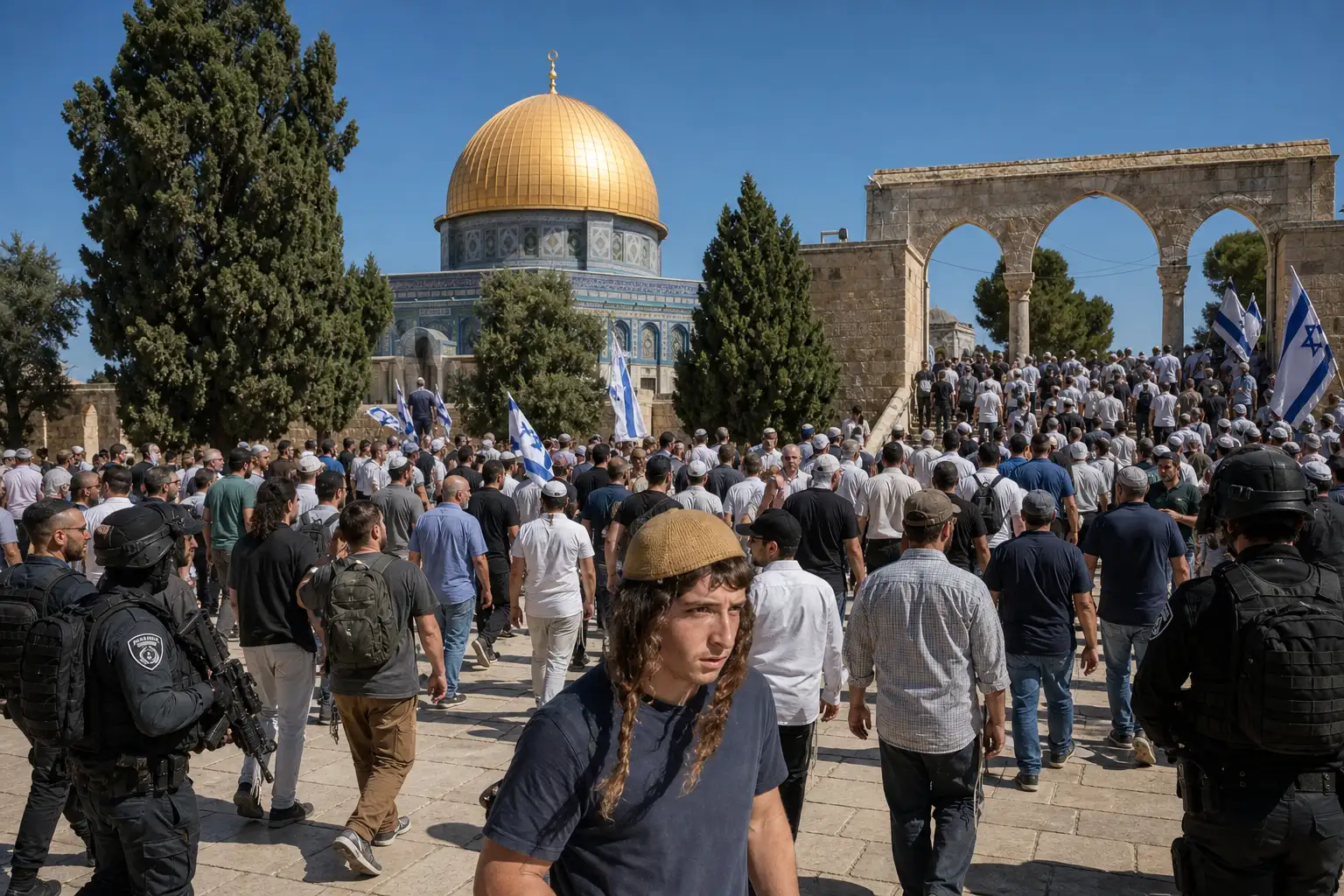
On 23 July, National Security Minister Itamar Ben-Gvir joined thousands of religious-right activists and settlers at the compound known to Muslims as the Al-Aqsa Mosque / Haram al-Sharif and to Jews as the Temple Mount. They prayed, performed rituals, waved Israeli flags and sang the national anthem under heavy police escort.
The Islamic Waqf, which administers the site, recorded 3,228 Israelis entering in the morning hours alone according to reports carried by Al Jazeera. The Guardian put the figure above 2,000. Palestinian officials and other outlets cited totals over 4,000 across the day. It was Tisha B’Av, the fast marking the destruction of the ancient Temples.
| Source | Reported Jewish visitors 23 July | Notes |
|---|---|---|
| The Guardian | More than 2,000 | Religious right, mostly settlers, led by Ben-Gvir |
| Islamic Waqf (via Al Jazeera) | 3,228 morning | Thousands more expected afternoon |
| Palestinian / other tallies | Over 4,000 total day | One of largest single-day figures this year |
Ben-Gvir posted that Jews praying there “feel like the owners” and saw “enormous progress.” He has previously floated raising the Israeli flag and building a synagogue. Prime Minister Benjamin Netanyahu had earlier backed expanded Jewish prayer, saying changes were coordinated with him while still claiming the status quo held.
- Muslims may pray; non-Muslims may visit in limited hours but not conduct religious worship.
- The Jerusalem Islamic Waqf manages day-to-day affairs under Jordanian oversight.
- Israeli police control security and access points.
- Printed prayer materials and open Jewish prayer were long restricted; enforcement has loosened.
Jordan’s foreign ministry condemned the visit as a desecration and escalation. The Palestinian religious endowments ministry called it an attempt to ignite regional religious war.
What the Status Quo Still Formally Bars
The arrangement dates to Israeli decisions after the 1967 war. Defense Minister Moshe Dayan left the Waqf in place and barred Jewish prayer to limit wider conflict. Only Muslims pray; others visit.
Jordan’s Hashemite monarchy holds custodianship of Muslim and Christian holy sites in Jerusalem, a role with roots more than a century old and reaffirmed after 1967. The 1994 treaty language on Jordan’s special role commits Israel to respect that historic position and give it high priority in permanent-status talks.
The Jerusalem Islamic Waqf under Hashemite custodianship remains the formal administrator. International bodies including the UN, UNESCO and the Arab League have repeatedly recognized the framework. In practice, Jewish prayer has become more frequent and open under successive right-wing governments, especially since Ben-Gvir took the national security portfolio and installed allies in Jerusalem police leadership.
Amman also flagged recruitment of religious Jewish officers for a dedicated Temple Mount police unit. That step, if completed, would further shift day-to-day control.
- 1967: Israel captures East Jerusalem; Dayan keeps Waqf administration and bars non-Muslim prayer.
- 1994: Israel-Jordan peace treaty reaffirms Jordan’s special role in Muslim holy shrines.
- 2000: Ariel Sharon visit helps spark the second intifada.
- 2023 onward: Ben-Gvir and allies expand visits, prayer allowances and political claims; Hamas named its October attack “Al-Aqsa Flood.”
- 23 July 2026: Largest single recent mass prayer event with a serving minister present.
Jordan Treats the Compound as Regime Risk
Custodianship is prestige and religious duty for the Hashemites. It is also leverage and vulnerability. Safadi called Jerusalem “a tinderbox” and said Amman is using every available tool, legal protests and public awareness campaigns included.
The kingdom’s own map is more fragile than the diplomatic language suggests.
Water Already Turned Down
Israel still delivers the 50 million cubic metres a year required by the 1994 treaty. A 2021 deal that roughly doubled the volume expired in late 2025 after repeated short extensions. Israeli officials have linked extra water to warmer Jordanian rhetoric and fuller diplomatic ties. Jordan is among the world’s most water-scarce countries; the cut lands as punishment for Gaza criticism and custodianship complaints.
50 million m³, current treaty baseline still flowing.
~100 million m³, the 2021 temporary ceiling now gone.
11.5 million, Jordan’s population, more than half of Palestinian origin from earlier refugee waves.
King Abdullah has declined meetings with Netanyahu partly over the water file. Israeli officials have said goodwill would put water, energy projects and ties back on the table.
Demographics and the Red Line
Safadi repeated that any forced displacement of West Bank Palestinians into Jordan is a red line. “We will do whatever it takes to prevent” it, he said. An influx would hit the economy, raise political anger and further dilute the East Banker core that underpins the monarchy. East Bankers already watch identity and power balance carefully.
West Bank operations and settler expansion have heightened the fear that an election-season Israeli government could try irreversible geographic changes before voters go to the polls.
Islamist Strength at Home
The Umma party (formerly Islamic Action Front, political arm of the Muslim Brotherhood) is now Jordan’s largest parliamentary bloc. Gaza and Jerusalem events helped it win more than 22 percent of seats. Dima Tahboub, an Umma MP and spokesperson, told The Guardian that anti-normalisation sentiment has grown over annexation talk, water denial and daily settler access to Al-Aqsa while Palestinian Jerusalemites face barriers.
The monarchy outlawed the Brotherhood and slowed political reform after the Islamist surge. It still needs the party’s cooperation against external pressure. Tahboub said the government could push harder internationally but understands geographic and economic limits, including reliance on the United States.
September Holidays Meet an Israeli Election
Jewish high holidays in September usually bring larger visitor numbers to the compound. This year they fall inside an intense Israeli election campaign. Netanyahu’s far-right coalition is fighting for survival. Parties will compete for religious and nationalist voters, and the Temple Mount has become a visible arena for that contest. The religious Israeli voters and party weight already shape coalition math; public prayer displays amplify the signal.
The Temple Mount movement’s path into state power has accelerated under Ben-Gvir and allied ministers. What once sat at the fringe now operates with police facilitation and cabinet cover. Jordan reads every additional open prayer and every new unit as another step toward permanent change that no later government would easily reverse.
Safadi’s summit is timed to put Arab and Muslim capitals on record before those holidays begin. Pakistan’s Foreign Minister Ishaq Dar travelled to Amman specifically to help shape a joint position and reaffirm support for Palestinians.
Quiet Capitals and the Peace Treaty’s Strain
Jerusalem expert Daniel Seidemann wrote that Jordanian concerns are well-founded. The abuse of the status quo “entails grave risks of convulsive violence” that would send shockwaves through the region and beyond, including European cities. He called the international community’s silence baffling and reckless, noting Ben-Gvir is openly celebrating the humiliation of the old rules.
Jerusalem specialist Daniel Seidemann’s warning tracks with Amman’s private assessments: left unattended, the site produces blood.
The dangerous collapse of the Status Quo is there for all to see. Lest anyone has doubts, Ben Gvir is triumphally shouting it from the rooftops.
Seidemann posted the assessment as the Guardian story circulated. Crowd reaction on X mixed alarm at religious war risks with reminders of Jordan’s own history with Palestinians and skepticism that the status quo can hold forever. The sharper take is that Israel’s far right treats the compound as a sovereignty test while Arab capitals issue statements and little else, leaving Jordan exposed.
The 1994 peace treaty remains intact on paper. Ambassadors have been absent since the Gaza war began. Water is already a pressure point. US forces on Jordanian bases, hit repeatedly by Iranian strikes, add another layer of domestic anger; hundreds of prominent Jordanians signed an open letter last month calling for American withdrawal. Jordan’s air force has intercepted drones and missiles aimed at Israel, a role that buys security cooperation but fuels the charge that Amman serves as Israel’s first line of defence.
Every new Temple Mount incident raises the political cost of normal relations. Safadi’s emergency meeting is one tool. Legal protests and public warnings are others. The monarchy’s calculation is that losing the status quo at Al-Aqsa would not stay a Jerusalem story. It would feed the same currents already eroding its domestic room to manoeuvre.
Ministers gather in Amman on Wednesday with that full ledger on the table.
