
Jordan’s foreign minister Ayman Safadi hosts Arab League counterparts plus ministers from Turkey, Indonesia, Malaysia and Pakistan today after warning of an “imminent” Israeli takeover of Jerusalem’s al-Aqsa compound that could “trigger a religious conflict.” The alert follows the July 23 entry of more than 2,000 religious-right Israelis, led by National Security Minister Itamar Ben Gvir, who prayed and performed rituals across the site.
The compound is the third-holiest site in Islam and the holiest in Judaism. Jordan’s Hashemite monarchy holds long-standing custodianship. What Amman fears most, however, sits one step beyond the plaza stones: irreversible West Bank shifts timed to Israel’s October election that could dump demographic, economic and political shocks onto the kingdom itself.
The July 23 Breach Jordan Calls Historic
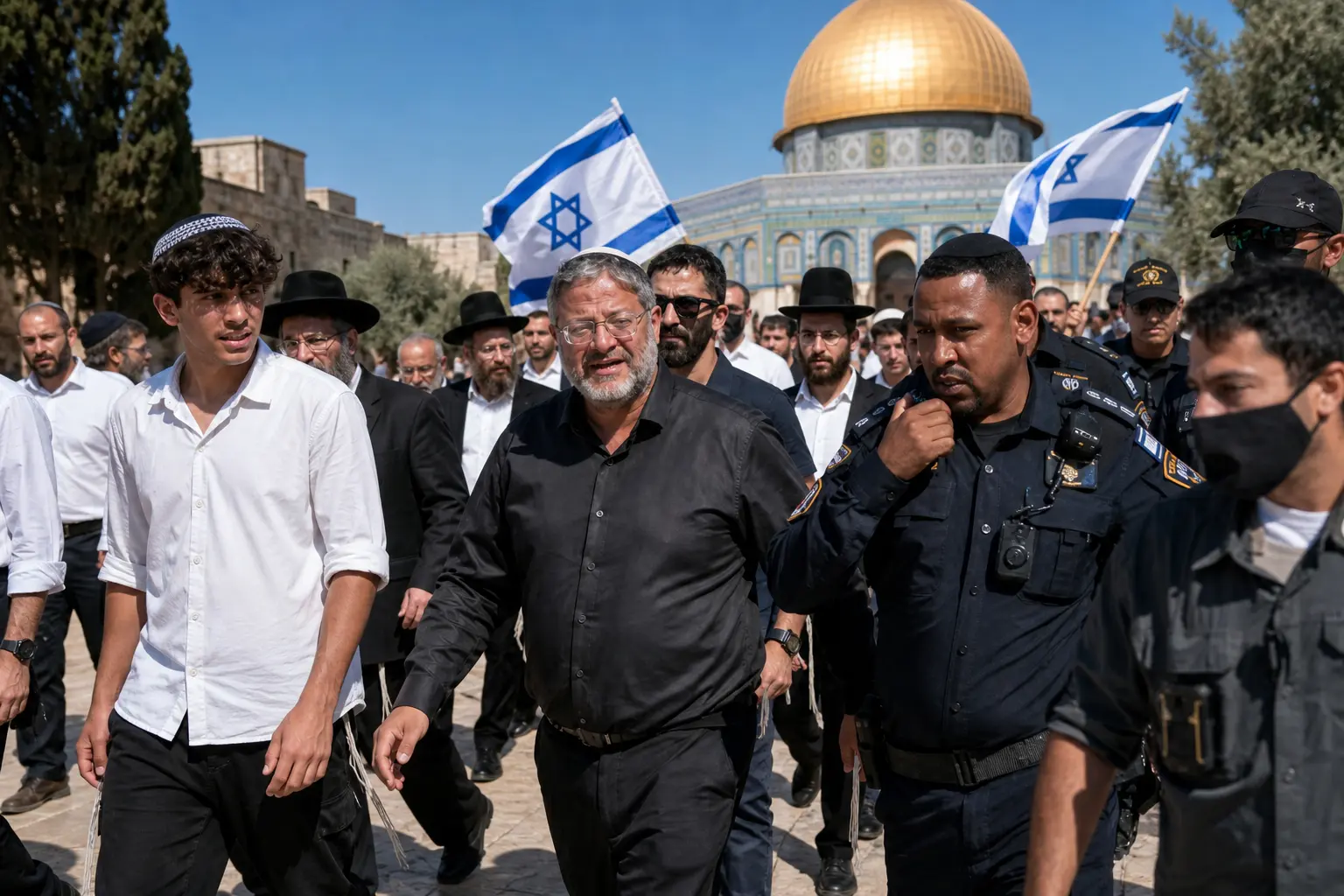
On Tisha B’Av, the Jewish day of mourning for the ancient Temples, Ben Gvir joined settlers and far-right activists under heavy police protection. The Islamic Waqf, which administers the site, counted 3,228 Israelis entering in the morning hours alone; Palestinian and other tallies ran higher. Participants prayed near al-Aqsa mosque and the Dome of the Rock, waved Israeli flags and sang the national anthem.
Jordanian officials labeled it the worst modern violation of the rules that bar non-Muslim prayer. Ben Gvir posted that Jews there “feel like the owners” and that “we see enormous progress here.” He has previously called for a synagogue and an Israeli flag on the compound. Overnight, some marchers attacked Palestinians and vandalized a Muslim cemetery; police arrested 16 Jewish suspects.
This is a constant threat, a dangerous threat that we’re trying to counter in every tool that we have possible. We warn that tampering with the status quo could trigger a religious conflict that will reverberate beyond Palestine and Jordan into the whole Muslim world.
Ayman Safadi told The Guardian. He called Jerusalem “a tinderbox” and said the international community must grasp the danger.
How the Old Arrangement Was Supposed to Work
Only Muslims may pray at the site under the long-standing status quo. Non-Muslims may visit during set hours. The Jerusalem Islamic Waqf, under Jordanian custodianship, runs internal affairs; Israel controls external security and access.
The arrangement traces to Ottoman practice, solidified after 1967 when Israel captured East Jerusalem and returned day-to-day control of the compound to the Waqf. Jordan’s special role was reaffirmed in the 1994 peace treaty Article 9 language, which states Israel “respects the present special role of the Hashemite Kingdom of Jordan in Muslim Holy shrines in Jerusalem” and will give that role high priority in any permanent-status talks.
- 1878 onward: Treaty of Berlin and Ottoman-era customs set early parameters for holy sites.
- 1924: Hashemite custodianship of Muslim and Christian sites consolidated under British Mandate conditions.
- 1967: After the Six-Day War Israel retains security while restoring Waqf administration.
- 1994: Israel-Jordan peace treaty formally recognizes Jordan’s special role.
- 2000: Ariel Sharon’s visit helps ignite the second intifada.
- 2023-2026: Repeated large Jewish visits, prayer materials allowed, and political sponsorship accelerate erosion.
Analysts at research centers have documented how the decades-long Status Quo arrangement details once limited discord; those limits are now routinely tested. Parallel tensions appear in disputed digs near the Temple Mount that keep the archaeology itself contested.
Amman’s Real Red Lines Sit Downstream
Jordan is water-scarce and demographically delicate. More than half of its 11.5 million people descend from earlier Palestinian refugee waves. East Bankers already worry about further dilution of national identity. Safadi called any mass displacement of West Bank Palestinians into Jordan a red line Amman “will not allow to be crossed” and vowed to “do whatever it takes” to stop it.
| Pressure Point | Baseline | Current Strain |
|---|---|---|
| Water supply from Israel | 50 million cubic metres/year (1994 treaty) | 2021 deal doubled volume to ~100m; expired late 2025 after extensions; Israel refused renewal and held at 50m |
| Jordan population | 11.5 million | Over half of Palestinian origin; new influx would hit economy, services and identity balance |
| Political Islam | Monarchy-led gradual reform | Umma party (ex-IAF) took >22% of seats after Gaza war surge; Muslim Brotherhood banned |
| US security presence | Forces on Jordanian bases | Open letter from hundreds of notables demanding withdrawal after Iranian strikes killed Americans |
Israeli officials have linked the water freeze to Jordanian criticism of civilian deaths in Gaza and hinted supplies could rise again if rhetoric softens. That leverage raises the domestic cost of the peace treaty for King Abdullah’s government.
- Prevent any forced Palestinian transfer into Jordan
- Stop further erosion of exclusive Muslim prayer rights at al-Aqsa
- Restore fuller water volumes needed by a larger population
- Contain anti-normalisation sentiment that already exceeds pre-Gaza levels
Dima Tahboub, parliamentarian and Umma party spokeswoman, said anti-normalisation has grown because of annexation talk, the water denial and “daily challenges to the custodianship.” Every day settlers enter while Palestinian Jerusalemites face barriers, she added.
September Holidays Meet an Election Campaign
Major Jewish holidays fall in September this year. Rosh Hashanah begins September 11, followed by Yom Kippur and Sukkot. Far larger Jewish visitor numbers are expected. Those dates sit inside Israel’s election campaign; the Knesset set voting for 27 October, the latest legal date.
Netanyahu’s far-right coalition is fighting for survival. Ben Gvir’s Otzma Yehudit and Bezalel Smotrich’s Religious Zionism hold outsized influence. Polls have often shown the bloc short of 61 seats, raising the incentive for bold nationalist moves that lock in facts on the ground before voters decide. Amman is also watching a recruitment drive that seeks religious and far-right Jews for a special Temple Mount police unit, including outreach in activist WhatsApp groups.
Key campaign pressures
- October 27 election: first full-term completion for a Netanyahu far-right government in decades
- Religious voter base: parties compete for nationalist and settler support that rewards Temple Mount assertiveness
- Pre-vote window: three months in which geography can still be altered in ways hard to reverse
Surveys of religious voters’ weight in Israeli coalitions show that bloc remains steady even when parties under- or over-perform. At the same time many Israelis ranking internal rifts above external threats see the same polarisation that fuels al-Aqsa visits.
Who Pays If the Compound Becomes a Permanent Flashpoint
Jordan’s monarchy has slowed political reform after the Islamist surge. It depends on US security support yet faces domestic backlash when Jordanian air defences intercept Iranian drones aimed at Israel and when American personnel on its bases become targets. Hundreds of prominent Jordanians signed a July letter calling for US force withdrawal, arguing the presence raises risks without serving national interest.
Israel gains short-term political capital with its right flank and asserts sovereignty claims. It risks wider regional isolation and the loss of a quiet border. Palestinians in Jerusalem and the West Bank face tighter access and the threat of larger expulsions. Arab and Muslim states attending today’s meeting gain a platform but few practical levers short of coordinated diplomatic pressure or economic steps.
History offers precedents. Mandate-era riots, the 2000 Sharon visit that fed the second intifada, and the 2023 Hamas attack named “al-Aqsa Flood” all show how the compound can ignite broader violence. Peace Now called the July prayers a “dangerous provocation” that “directly violates the fragile status quo.”
The Cost of Normal Relations Keeps Rising
Safadi’s meeting aims to build legal protests, awareness and a common Arab-Islamic position. Jordan has few military options and heavy economic dependence. Its loudest tools remain diplomacy, the peace treaty’s own text, and the threat that further Israeli moves will make the 1994 relationship politically unsustainable at home.
For now the compound remains under dual control. Jewish prayer continues in practice even as both sides claim the status quo still holds. The next test arrives with the September holidays. If those visits grow larger and more ritualised under election-year cover, Amman’s second-order fears move from warning to immediate crisis.
Jerusalem stays a tinderbox. The fuel, Jordan insists, is no longer only the stones of the Mount.
