
BUSINESS
Egypt Bets Its Fleet Rebuild on One Chinese Yard
Egypt took two Hantong Kamsarmax bulkers and asked the same Jiangsu yard to seed a home repair plant, while the 40-ship 2030 target still needs ten hulls.

Egypt took delivery of two 82,000-ton Kamsarmax bulkers from China’s New Hantong Shipyard on 14 August 2026. Transport Minister Kamel El-Wazir used the same visit to ask the yard to pull two more hulls forward and to help plant a commercial repair yard in Egypt.
National Navigation Company now runs 16 vessels. The 2030 plan still calls for 40 ships owned by four ministry companies, and most of those extra hulls are not in the Hantong queue.
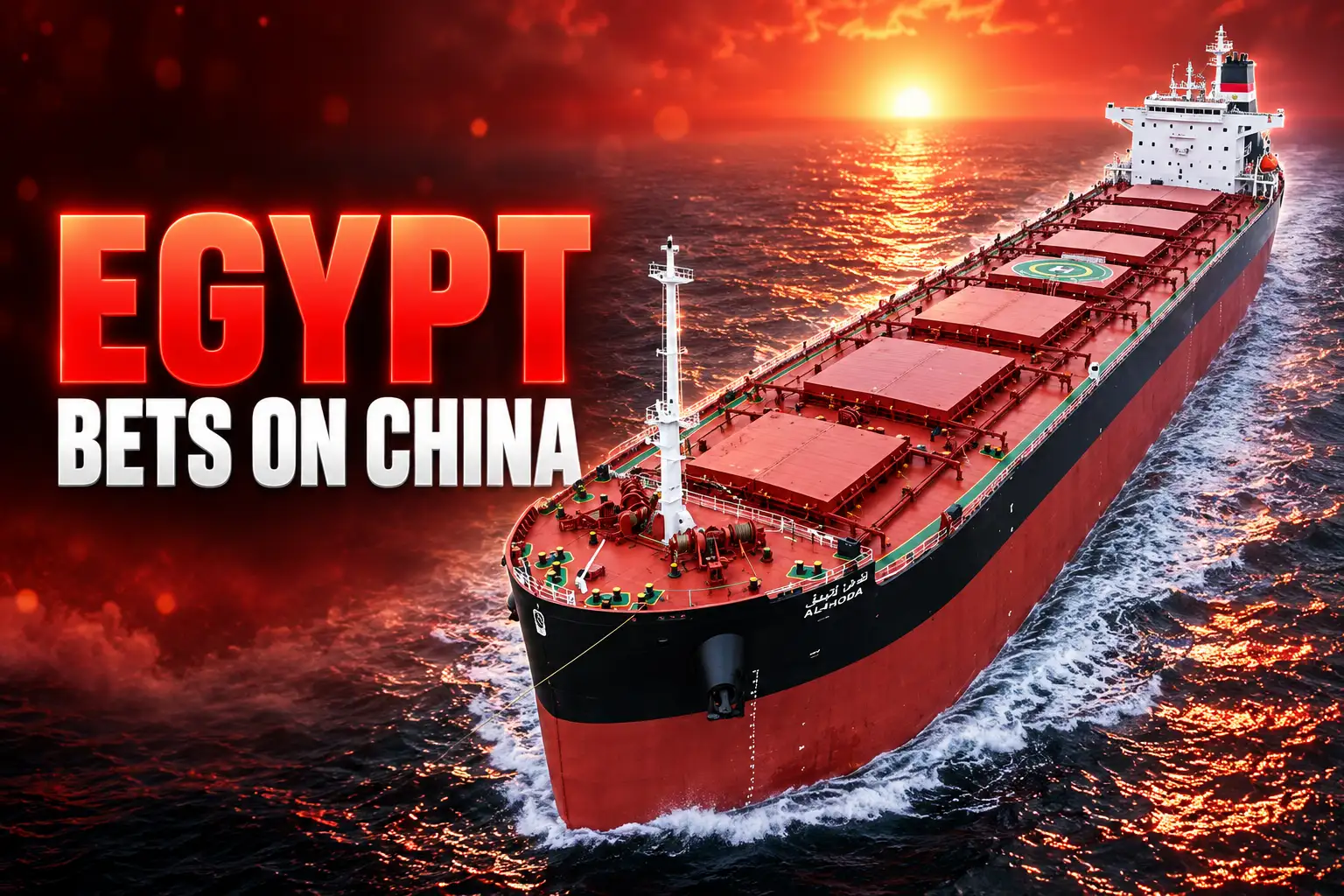
Two Kamsarmax Sisters Leave a Jiangsu Yard
Wadi Al-Nil and Wadi Al-Qamar are identical dry bulk carriers built for NNC at Jiangsu New Hantong Ship Heavy Industry in Yangzhong. El-Wazir attended the handover with NNC managing director Mohamed Soliman Metwally and Hantong chairman Meng Chengjun. On 15 August 2026 the ministry said Wadi Al-Nil had already sailed for Egypt, while Wadi Al-Qamar was preparing to follow.
🚢 Transport Minister Kamel El-Wazir witnessed the National Navigation Company’s (NNC) handover of two new vessels, “Wadi Al-Nil” and “Wadi Al-Qamar,” from China’s New Hantong Shipyard.
📌 For more details 👇https://t.co/0wqWAR4L5T pic.twitter.com/qRxnWMLsew
— State Info. Service (@SISEGY) August 14, 2026
The State Information Service posted the yard photos the same day. Cabinet Media Centre figures issued later in August set out the pair as sister Kamsarmax ships, each designed for long dry-bulk hauls rather than for the Suez liner trades that dominate Egypt’s port story.
THE TWO SHIPS
| Item | Wadi Al-Nil and Wadi Al-Qamar |
|---|---|
| Class | Kamsarmax dry bulk |
| Deadweight | 82,000 tons each |
| Length | 229 metres |
| Beam | 32.26 metres |
| Draft | 14.5 metres |
| Main engine | MAN B&W, 7,490 kW, with SCR |
| Fuel | 2,054 cubic metres, up to 90 days |
| Fresh water | 20 tons a day from onboard plant |
Each hull also carries a ballast-water system and engine-monitoring gear that the Cabinet sheet lists as meeting current environmental rules. Together the pair adds 164,000 tons of deadweight to an Egyptian-flag dry-bulk book that has been thin for years.
The delivery reflects the growing Egyptian-Chinese strategic partnership, particularly in the transport sector.
Kamel El-Wazir, Minister of Transport, at the New Hantong handover
He tied the ships to a wider China file that already covers ports, logistics, railways, green mass transit, digital work, and smart ports. Shipbuilding sat on that list as a customer relationship, not yet as a plant on Egyptian ground.
Five Hulls, One Private Chinese Builder
NNC did not arrive in Yangzhong as a first-time buyer. The ministry dates the present programme to Wadi Al-Arish, another Kamsarmax handed over in January 2024. Contracts for Wadi Al-Nil and Wadi Al-Qamar followed in April 2024. On 24 June 2025 the same parties signed for Wadi Al-Natrun and Wadi Al-Alaki, two more 82,000-ton sisters first timed for September 2028 and November 2028.
THE HANTONG PROGRAMME
- January 2024: NNC takes delivery of Wadi Al-Arish, the first Kamsarmax named in this yard relationship.
- April 2024: Contracts are signed for Wadi Al-Nil and Wadi Al-Qamar.
- 24 June 2025: Contracts are signed for Wadi Al-Natrun and Wadi Al-Alaki, for 2028 delivery.
- 14 August 2026: El-Wazir witnesses handover of Wadi Al-Nil and Wadi Al-Qamar.
- End-2027 (requested): The minister asks the yard to bring the last pair forward from 2028.
That is five ships in one private Chinese yard, three already delivered and two still on the berth plan. Metwally said the 2028 pair would lift the renewal share of NNC’s owned fleet to about 54 percent. That share is a future figure, not a description of the 16 ships NNC holds now.
El-Wazir’s 2027 ask would shave a year off the last two hulls if Hantong can move the slots. Nothing published since the ceremony shows the yard accepting that date.
Egypt Wants 40 Ships and 30 Million Tonnes
The minister repeated a standing Transport Ministry goal: 40 commercial ships by 2030, fully owned by companies under the ministry, able to move about 30 million tonnes a year. The point, as he put it, is to put more Egyptian-flag tonnage under Egypt’s own foreign trade and onto international routes, and to cut freight bills paid in hard currency.
Ministry figures circulated in December 2025 put the then-existing commercial fleet near 20 ships and 9 million tonnes a year. Thirty million tonnes would be more than triple that older baseline. The two new bulkers do not close that gap on their own.
EGYPT’S FLAGGED FLEET IN 2024
- National flag: UNCTAD’s maritime profile records 1.84 million DWT under the Egyptian flag, across 444 ships of 100 gross tons and above.
- Ships Egyptians own: The same 2024 sheet puts beneficial ownership at 4,031 thousand DWT, which means a large share of Egyptian-controlled tonnage sails under other flags.
- Home building: Egypt’s recorded shipbuilding output that year was 19,297 gross tons, a rounding error beside a Kamsarmax series.
- What 40 means: The ministry’s 40-ship target is a tight set of large units in four state companies, not the 444-vessel UNCTAD count that includes much smaller craft.
Those UNCTAD totals explain why Cairo is buying in China. They also show why two 82,000-ton sisters are a start, not the 2030 plan.
Hantong’s Yard Is Built for a Different Scale
Jiangsu New Hantong is not a state giant in the COSCO mould. It sits in Yangzhong, near the Taizhou Yangtze bridge, on 1,590,000 square metres with 1,300 metres of river frontage. The company’s own profile lists a 300,000 DWT dry dock of 485 metres by 96 metres, two 80,000-ton slipways of 290 metres by 40 metres, 250,000 tons of steel a year, and an annual shipbuilding capacity of 2 million dwt.
Lloyd’s Register’s yard file says the plant has built ships since 2008 and lists bulkers, including the 82,000 DWT type NNC keeps ordering, among its standard products. Egypt’s five-ship series is a repeat Kamsarmax slot for a yard that measures itself in millions of tons a year. That is useful for Cairo, because the design is already in the shop. It is also a reminder that NNC is not the account that fills those slipways.
Meng Chengjun therefore had every reason to smile through a state handover and no obvious need to sign away repair know-how unless the Egyptian file grows. Repeat orders help a private Jiangsu builder. A satellite repair yard in Egypt is a different kind of deal, with land, labour, and a local partner that Hantong has not named.
Alexandria Already Docks Ships This Size
The repair-yard ask lands in a country that already cuts steel on the Mediterranean. Alexandria Shipyard, founded in 1962 and now under the maritime investment holding MIASO, publishes three docks at Kabbary. Its own repair page rates the large graving dock for ships up to a large dock rated at 85,000 DWT, 267 metres long and 39.6 metres wide, with a 9.5-metre dock draft.
ALEXANDRIA’S THREE DOCKS
- Large graving dock: 85,000 DWT, 267 metres by 39.6 metres, 9.5-metre draft, which covers a 229-metre, 32.26-metre Kamsarmax on length and beam.
- Small graving dock: 10,000 DWT, 158.5 metres by 18.9 metres, 6.4-metre draft, too tight for these sisters.
- Floating dock: 6,000 DWT and 150 metres, built for much smaller craft.
A light Kamsarmax can physically enter that large dock. What Alexandria has not done is build one. The yard’s facilities record still names Qena and Damietta, 38,500 tons deadweight bulkers, as the largest ships ever completed in Egypt. An 82,000-ton Kamsarmax is more than double that. Newbuild work of this class stays in Yangzhong. The minister did not ask Hantong for a launch berth that could float an 82,000-ton hull. He asked for a specialist commercial repair yard modelled on the Chinese plant.
That distinction matters for the people already on the tools in Alexandria and in the Suez Canal Authority yards. A Hantong-styled commercial repair shop would sit beside docks that can already take these ships, and it would need a reason to exist beyond empty waterfront.
Four State Companies Have to Carry the Target
NNC is only one of four ministry names in the 40-ship sheet. Planning figures issued in late August 2026 set NNC at 20 ships by 2030, the Egyptian Company for Oil Tankers at 6, Cairo Ferries at 4, and Arab Bridge Maritime at 10. After the Hantong handover those four fleets add up to 30 hulls, which leaves a gap of 10.
THE 40-SHIP SPLIT
| Company | Now | 2030 target | How the gap fills |
|---|---|---|---|
| National Navigation Company | 16 | 20 | 2 Kamsarmaxes on order, 2 feeders of 2,400 TEU planned for 2027 |
| Egyptian Company for Oil Tankers | 2 | 6 | 4 liquid-bulk ships still to contract |
| Cairo Ferries | 2 | 4 | 2 ships still to contract |
| Arab Bridge Maritime | 10 | 10 | Already at the listed size |
| Total | 30 | 40 | 10 more hulls, of which 2 are ordered |
Two of NNC’s remaining four ships are the Hantong sisters already under contract. The other two are feeder container ships the ministry listed for contract in 2027, not as part of the five-ship dry-bulk programme. The tanker and ferry gaps sit even further from Yangzhong. If those eight uncontracted hulls go to other yards, or slip past 2030, Hantong will still have been a successful dry-bulk supplier and the 40-ship chart will still be short.
NNC’s own 16-to-20 step is the part of the plan this Chinese relationship can actually finish. The national chart is a different job, split across oil products, passengers, and the existing Arab Bridge fleet that already sits at 10.
The Repair Yard Is Still Only a Request
El-Wazir put two asks on the table in Yangzhong besides the polite language of partnership. He wanted Wadi Al-Natrun and Wadi Al-Alaki at the end of 2027 rather than 2028. And he wanted Hantong’s help to start a specialist commercial repair yard in Egypt, modelled on the Jiangsu works. Both remain requests.
WHAT WE KNOW
- The ships: Wadi Al-Nil and Wadi Al-Qamar were handed over on 14 August 2026 and lift NNC to 16 vessels.
- The pipeline: Five Kamsarmaxes sit in the Hantong programme, with two still due in 2028 unless the yard accepts 2027.
- The ask: The minister proposed a specialist commercial repair yard in Egypt modelled on New Hantong.
WHAT IS UNCONFIRMED
- Yard reply: No published Hantong commitment on an Egyptian repair plant has followed the ceremony.
- New dates: No contract amendment has been issued for an end-2027 delivery of Wadi Al-Natrun and Wadi Al-Alaki.
- Site and cost: No location, budget, or Egyptian partner has been named for the repair plant.
A public conversation around the handover stayed thin. The live issue in Cairo is owned tonnage and freight paid abroad, not the brand on the builder’s gate. Until the yard signs a date change or a repair-plant paper, Egypt’s Chinese shipping file is still a five-ship bulk account at a fast private Jiangsu builder, plus an Alexandria dock that can already take these hulls when they need steel.
Ten more ships across four companies still sit between the ministry and the 2030 chart. Two of them already have a berth in Yangzhong. The rest do not.

Ninja Theory Staff Face Redundancy After Two Xbox Sales Collapse

Amazon Sells the MacBook Air at Its Pre-Hike Price

U.S. Slows Jet Parts to Squeeze China’s Flying Fleets

PEGI Pulled the GTA 6 Age Rating After Cocaine Details

Northwestern’s Smaller Ryan Field Gave Penn State Nowhere to Hide

Aramco Crash Kills 14 Two Days After Oil Restart

Salah Captained Egypt to Their First World Cup Win

Apple Labor Day Deals Hide June’s Memory Price Hike

Palworld 1.0.4 Adds Palpedia Search After the 1.0 Launch

Zelda’s 40th Switch 2 Ships Without a Zelda Game
-
 BUSINESS3 months ago
Aramco Crash Kills 14 Two Days After Oil Restart
-
 NEWS4 months ago
Salah Captained Egypt to Their First World Cup Win
-
 NEWS1 month ago
Apple Labor Day Deals Hide June’s Memory Price Hike
-
 GAMING4 weeks ago
Palworld 1.0.4 Adds Palpedia Search After the 1.0 Launch
-
 GAMING4 weeks ago
Zelda’s 40th Switch 2 Ships Without a Zelda Game
-

 NEWS3 months ago
El Niño Puts Israel’s Needed Winter Rain on a Flood Clock
-

 ENTERTAINMENT4 weeks ago
King Charles Letter Keeps Harry and Meghan as Private Citizens
-

 NEWS3 months ago
Saudi Visa Routes Split Nigerian Travelers Into Two Speeds