
BUSINESS
Egypt Becomes the Factory Floor of MENA Beauty
Egypt’s cosmetics market reached $900 million in 2024, but L’Oréal’s 10th of Ramadan plant already ships 85% of output across MENA as Unilever expands too.

GMI Research put Egypt’s cosmetics market at $900 million in 2024, with a path to $1.57 billion by 2032 at a 7.2% annual rate. L’Oréal’s only factory in the Middle East and North Africa, in 10th of Ramadan City, already ships 85% of its output to 20 countries.
On September 21, 2026, the French group added EGP 240 million (€4 million) to that plant. A week later, Unilever opened a new Sunsilk line in 6th of October City whose whole extra output is meant to leave Egypt.
What the $900 Million Figure Measures
The $900 million total is a domestic sales number, the value of cosmetics bought inside Egypt, not the value of goods leaving its factories. GMI Research, in a December 2025 note, recorded USD 900 million in 2024 and a climb to $1,570 million in 2032. That 7.2% rate runs from 2025 to 2032. Coverage in June 2026 folded the same round number into 2025, which is how it entered the news cycle.
Skincare held the largest slice in 2024, which fits a hot, high-UV climate where sun cream and daily moisturiser are closer to household goods than luxury. Hair care sits close behind. Offline shops still take most sales because buyers want to test texture and scent, GMI found, while online is the fastest-growing channel, helped by state support for e-commerce and tools such as virtual try-on.
THE GMI RESEARCH BASELINE
- 2024 sales: $900 million in cosmetics revenue inside Egypt.
- 2032 forecast: $1.57 billion, a 7.2% compound annual rate from 2025 to 2032.
- Household spending: $341 billion in 2024, up from $313 billion in 2023.
- Social reach: more than 45 million social media users in January 2024, about 40% of the population.
Household consumption rose by $28 billion in a single year on those figures, an increase of about 9%. GMI ties the cosmetics lift to that spending, to a youth share it puts at around 60% of the population citing UNFPA, and to cities that are adding nearly one million people a year at about 2% urban growth. The retail total can grow even when most of what the big plants make is ticketed for someone else’s bathroom shelf.
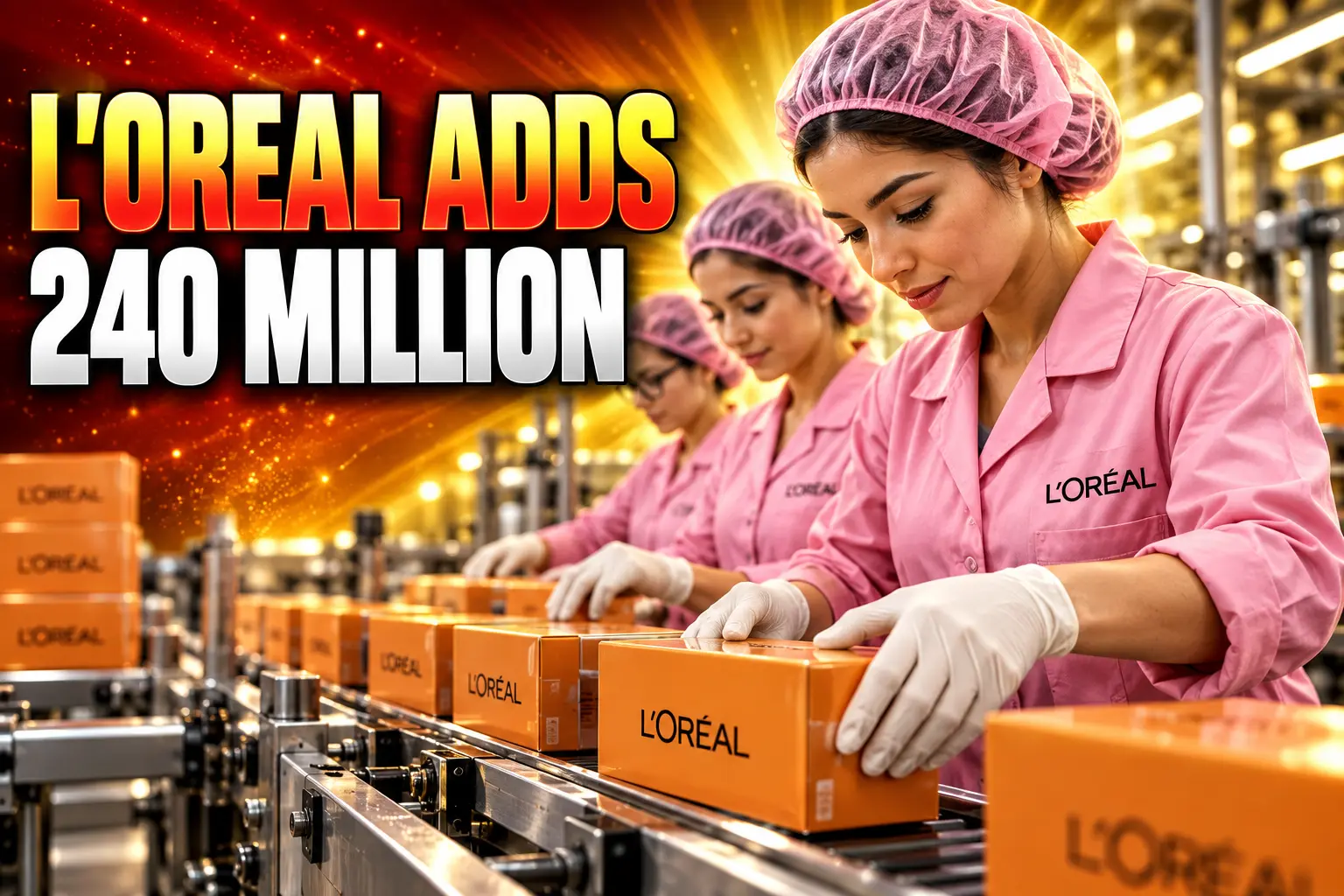
The Only MENA Plant Sends 85% of Output Abroad
L’Oréal Egypt dates to 2009. The factory came in 2013 on a 100,000-square-metre plot in 10th of Ramadan City, with about 17,000 square metres under roof, as the group’s Consumer Products hub for the region. It is still the group’s sole manufacturing site in MENA. Brands on the floor include L’Oréal Paris and Garnier, and the Egyptian unit lists 14 global brands in all.
Over 85% of the plant’s production is exported to over 20 countries across the Middle East and North Africa, L’Oréal says, which leaves about 15% for shops at home. In five years the site turned out 442 million units. Annual capacity, as described in talks with the industry ministry in April 2026, is 100 million units. Cumulative spending on the factory is about €100 million.
HOW THE RAMADAN CITY PLANT GREW
- 2009: L’Oréal Egypt begins operating in the country.
- 2013: The greenfield plant in 10th of Ramadan City is established as the MENA hub for consumer products.
- February 2015: The group inaugurates the site and presents it as the first LEED certified factory in Egypt.
- 2019: Locally made haircare packs shift to 100% recycled plastic.
- January 2025: Recycled or reused water covers 100% of industrial needs at the plant.
- June 28, 2026: Asterès presents a socio-economic study in Cairo under the Prime Minister’s Office.
- September 21, 2026: L’Oréal announces EGP 240 million to expand the same site.
The General Authority for Investment and Free Zones still files the plant as an €100 million factory in Egypt that ships most of what it makes. Local content is uneven. Packaging is about 70% Egyptian; raw materials are about 30%. Industry Minister Khaled Hashem has asked the company for a list of inputs it still imports, so the ministry can try to find local substitutes. That gap is the next fight, because a plant that exports 85% of its bottles still leans on foreign cream and oil.
10th of Ramadan Gets Another EGP 240 Million
The new money is for haircare, hair colour, and skincare lines, and for more local packs. Hashem toured the floor with Investment and Foreign Trade Minister Mohamed Farid and France’s ambassador to Egypt, Éric Chevalier. Hashem called pharmaceuticals and cosmetics among Egypt’s most promising export industries and said the plant’s solar power and water reuse match ministry policy on resource-efficient factories. Farid framed the cheque as the kind of productive, export-led spending the state wants from firms already on the ground.
Mohamed El Araby, country managing director of L’Oréal Egypt, tied the expansion to volume, to regional shipping, and to the water-and-power model the ministers had just walked through.
This EGP 240 million investment underscores our deep-rooted confidence in Egypt’s dynamic economy and industrial potential. This expansion allows us to significantly scale our production capacity, strengthen our export footprint across regional markets, and accelerate our commitment to sustainable manufacturing. We are proud to partner with Egypt in driving high-value industrial growth, fostering local talent, and setting new benchmarks for responsible business.
Mohamed El Araby, Country Managing Director, L’Oréal Egypt, plant visit, September 21, 2026
Chevalier called the group a working example of what French firms put into Egyptian industry, from jobs and training to local production, and read the EGP 240 million as a vote of confidence in the French-Egyptian commercial tie. The factory holds ISO 9001 and ISO 22716 certificates for quality systems and cosmetic good practice. That does not change the mix on the loading dock. Extra lines in Ramadan City will feed the same 20-country map unless the 15% that stays home starts to rise.
The Same Export Play at Unilever Mashreq
Hashem was back in a personal-care plant five days later. On September 26, 2026, he opened the 13th production line at Unilever Mashreq’s personal care factory in 6th of October City, a Sunsilk line that lifts the site’s yearly output by 20% and is reserved for export. The Mashreq plant is 20 years old. It already sends about 65% of its capacity to more than 30 countries. About 80% of the materials used in making those goods are sourced inside Egypt.
Unilever runs three factories in the country, two in 6th of October City and one in Borg El Arab, Alexandria, and uses Egypt as a regional base for North Africa, the Levant, and Iraq. The Mashreq site covers about 22,000 square metres, with 13,000 square metres built, and turns out personal care, beauty, and home care brands including Sunsilk, Dove, LUX, Lifebuoy, Clear, and TRESemmé. Hashem described the new line as a multinational using Egypt as a production base and a door to other markets, citing location, trade deals, labour, and infrastructure.
TWO PLANTS, ONE SHIPPING PATTERN
| Company | Site | Share leaving Egypt | Reach |
|---|---|---|---|
| L’Oréal | 10th of Ramadan City | 85% of output | 20 countries |
| Unilever Mashreq | 6th of October City | 65% of site capacity | More than 30 countries |
Put those rows next to the $900 million domestic market and the picture sharpens. Egypt is selling more cream and shampoo at home, and it is also renting out its industrial cities as a cheap, well-placed make-and-ship deck for MENA and beyond. A weak pound makes local factory work more necessary for mass brands and makes Egyptian-made stock cheaper on the way out. Packaging converters feel that first, because bottles, caps, labels, and cartons are the inputs both groups say they want to buy closer to the line.
Skincare, Beards, and 45 Million Social Accounts
The home market that GMI sized at $900 million is not a footnote to the export story. It is the reason a plant can run some of its mix for Cairo and Alexandria even while most pallets go to the Gulf and North Africa. Younger buyers, GMI says, treat skincare and colour as identity, not only as hygiene. Male demand has moved past soap, into beard oil and shaving cream, as trimming and shortening beards became a paid routine.
Sun care is the climate product. High unprotected UV exposure has pushed sunscreen from a holiday SKU toward a daily one, and hair care has picked up keratin claims aimed at heat and dryness. Social media is the shop window. Egypt had more than 45 million users in January 2024. GMI flags TikTok, Instagram, and YouTube as the places brands now spend, with influencer reviews doing work that TV spots used to do.
WHAT IS LIFTING DEMAND AT HOME
- Young buyers: GMI, citing UNFPA, puts youth at around 60% of the population and treats millennials and Gen Z as core users of skincare and colour.
- Male grooming: beard oil and shaving cream have followed a shift toward trimmed beards, pulling men into aisles they used to skip.
- Climate: desert heat, humidity, and UV make suncare and daily moisturiser closer to staples than treats.
- Social proof: more than 45 million accounts in January 2024, with Marico among the firms mixing TikTok contests, campus activations, and male salon visits.
Marico’s mix of a TikTok contest, a creator, university stops, and barber-shop visits is the pattern in miniature: a feed that ends in a real aisle. Offline still wins on trust. Online wins on speed. Any forecast to $1.57 billion by 2032 assumes those two channels keep feeding each other rather than one wiping out the other.
Egyptian Brands That Still Share the Shelf
GMI’s roster of 12 names is not a foreign-only list. Unilever, L’Oréal, P&G, Estée Lauder, Beiersdorf, Shiseido, Avon, and Marico sit beside Egyptian Company for Cosmetics, Eva Cosmetics, Weiser Cosmetics, and Nile Cosmetics. Firms with plants inside the country, GMI notes, have used that footprint to cut prices and widen availability. The cost edge is the same one L’Oréal and Unilever are compounding with new lines.
Eva Cosmetics, part of the Armanious Group, is the clearest local counterweight on volume. The company describes itself as a leading Egyptian personal care maker, with more than 100 years behind the group, more than 20 brands, a plant rated at over 385 million units a year, and exports to over 13 countries. Unit capacity is not the same as retail value, and Eva’s mix is not L’Oréal’s, but 385 million units is nearly four times the 100 million unit rating on the Ramadan City site. Local makers still compete on price and on knowing the shopper; the global plants compete on scale and on a supply chain that already points at Jeddah and the wider GCC.
That split is why a $900 million home market can expand without every extra bottle being made for Egyptians. The same factory map that fills Carrefour in Cairo fills pharmacies in Riyadh. Egyptian names hold space on the shelf. They do not set the shipping schedule.
A Dry Country Runs a Closed Water Loop
The Ramadan City plant now runs on 100% renewable energy and, since January 2025, covers 100% of its industrial water with recycled or reused supply. Haircare packs made locally have used 100% recycled plastic since 2019. The site keeps a zero-landfill protocol. For a water-stressed country, a cosmetics line that does not draw a fresh industrial stream is a selling point the ministry can put on a tour, and Hashem did.
Jobs are the other number the June 28, 2026 briefing was built to land. Asterès, a Paris consultancy using OECD-style modelling, found that L’Oréal supports more than 22,000 jobs across the value chain in Egypt, with each direct role generating 43 more in packaging, logistics, distribution, raw materials, and retail. Over 98% of the Egypt team are local, the company says. Community programmes had reached 117,000 people by the end of 2025. Those figures are larger, and more honest about where the work sits, than a headcount limited to the factory gate.
The $900 million market will keep getting cited because it is simple. The load-bearing facts sit in Ramadan City and 6th of October: 85% of L’Oréal’s output already leaves, Unilever just opened a line that will not sell a bottle at home, and both groups are asking Egyptian pack makers to fill the gap the pound made expensive to import. EGP 240 million does not turn a regional export plant into a domestic one. It makes the plant bigger.

Ninja Theory Staff Face Redundancy After Two Xbox Sales Collapse

Amazon Sells the MacBook Air at Its Pre-Hike Price

U.S. Slows Jet Parts to Squeeze China’s Flying Fleets

PEGI Pulled the GTA 6 Age Rating After Cocaine Details

Northwestern’s Smaller Ryan Field Gave Penn State Nowhere to Hide

Aramco Crash Kills 14 Two Days After Oil Restart

Salah Captained Egypt to Their First World Cup Win

Apple Labor Day Deals Hide June’s Memory Price Hike

Palworld 1.0.4 Adds Palpedia Search After the 1.0 Launch

Zelda’s 40th Switch 2 Ships Without a Zelda Game
-
 BUSINESS3 months ago
Aramco Crash Kills 14 Two Days After Oil Restart
-
 NEWS4 months ago
Salah Captained Egypt to Their First World Cup Win
-
 NEWS1 month ago
Apple Labor Day Deals Hide June’s Memory Price Hike
-
 GAMING4 weeks ago
Palworld 1.0.4 Adds Palpedia Search After the 1.0 Launch
-
 GAMING4 weeks ago
Zelda’s 40th Switch 2 Ships Without a Zelda Game
-

 NEWS3 months ago
El Niño Puts Israel’s Needed Winter Rain on a Flood Clock
-

 ENTERTAINMENT4 weeks ago
King Charles Letter Keeps Harry and Meghan as Private Citizens
-

 NEWS3 months ago
Saudi Visa Routes Split Nigerian Travelers Into Two Speeds