
BUSINESS
Doosan Steam Contracts Equip 5,800 MW of Saudi Gas Plants
Doosan Enerbility booked $248 million of steam turbines for two 2,900 MW Saudi gas plants due in 2028, as the kingdom also adds solar at speed.

Doosan Enerbility signed about 340 billion won ($248 million) of steam-turbine and generator work for two 2,900 MW Saudi gas plants due by 2028. The buyer is not the utility. It is a Spanish-Egyptian construction joint venture putting up the Ghazlan 2 Expansion and the Hajar Expansion, each 400 km northeast of Riyadh.
Those two blocks add 5,800 MW of combined-cycle gas. Doosan’s job is the steam half of that build, a narrow slice that still decides how the plants turn exhaust heat into extra megawatts.
Two Plants Add 5,800 MW of Combined-Cycle Gas
Doosan said on May 27, 2025 that it had just signed the Ghazlan 2 package and that the Hajar package had been signed in April with the same engineering, procurement, and construction joint venture. Técnicas Reunidas of Spain and Orascom Construction of Egypt form that venture. Each plant is rated at 2,900 MW and is to be built in phases through 2028.
THE TWO SAUDI BLOCKS
| Project | Plant rating | Steam packages | Build target |
|---|---|---|---|
| Ghazlan 2 Expansion | 2,900 MW | 650 MW and 540 MW | Phased through 2028 |
| Hajar Expansion | 2,900 MW | 650 MW and 540 MW | Phased through 2028 |
The company’s English release puts the two jobs together as 340 billion won supplier contracts for steam turbines and generators. That is equipment money, not the cost of the power stations. The gas turbines, heat-recovery boilers, and civil works sit on the EPC books.
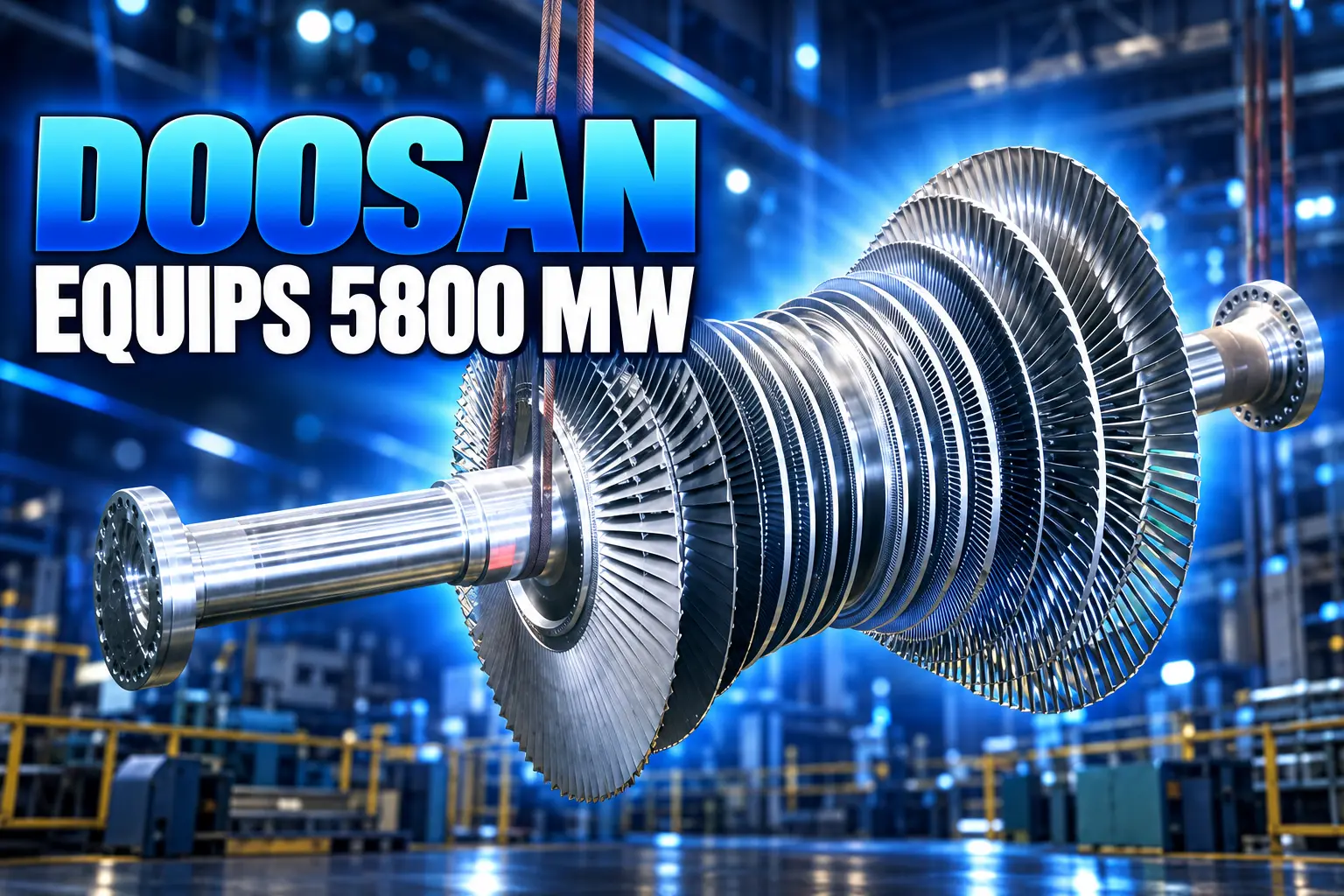
What Doosan Is Shipping to Each Site
Each plant gets two steam-turbine and generator sets, one in the 650 MW class and one in the 540 MW class. Across both sites that is four steam turbines and four generators. Add the two steam ratings and the Korean firm is covering 1,190 MW of steam output at each station, 2,380 MW in total.
A combined-cycle block burns gas in a turbine, then dumps the hot exhaust into a boiler that makes steam for a second turbine. Doosan is on that second machine. The 2,900 MW nameplate is the whole island, gas side included, so most of each plant’s watts will come from machines Doosan is not supplying.
Seungwoo Sohn, chief executive of Doosan Enerbility’s Power Services Business Group, tied the win to a long Gulf sales record rather than to a single tender.
Backed by the foundation of trust and technological expertise that we have built up over the past 40 years in the Middle East region, we are continuously securing contracts in the region. We aim to deliver quality products in a timely manner for this project as well, thereby earning strong customer trust, and will do our best to also secure the follow-up projects that are currently lined up.
Seungwoo Sohn, CEO of Doosan Enerbility’s Power Services Business Group
He was speaking on the May 27 announcement. The follow-up line was not filler. Another Gulf steam order landed before the year was out.
Ghazlan Already Runs an Older 4,256 MW Station
Ghazlan 2 is an expansion, not a greenfield site in empty desert. Global Energy Monitor lists Ghazlan’s existing 4,256 MW station at Al Juaima’h in the Eastern Province, on the Gulf side of the country, owned entirely by Saudi Electricity Company, now branded Saudi Energy.
GHAZLAN UNITS ON THE GROUND
| Block | Status | Capacity | Technology |
|---|---|---|---|
| Units 1 to 4 | Operating, 1980 to 1982 | 400 MW each | Gas-fired steam, Siemens |
| Units 5 to 8 | Operating, 2001 to 2003 | 664 MW each | Gas-fired steam |
| Expansion-1 | Construction | 1,600 MW | Combined cycle |
| Expansion-2 | Construction, planned 2028 | 2,900 MW | Combined cycle, Doosan steam |
The older eight units are straight steam machines on natural gas, a 1980s-to-early-2000s design. Expansion-2 is the 2,900 MW combined-cycle block in Doosan’s contract. Expansion-1 is a separate 1,600 MW combined-cycle addition also listed as under construction, so Ghazlan is being rebuilt in layers while the original station keeps running.
Hajar sits in the same 400 km band northeast of Riyadh in Doosan’s description. The company did not publish a unit-by-unit history for that site, and it should not be mixed up with Hajar Two Electricity Company, the project firm on a different Eastern Province plant.
A Spanish-Egyptian Joint Venture Holds the Build
Doosan’s customer is the EPC pair, not a direct utility purchase order. Técnicas Reunidas and Orascom are the contractors wrapping the Korean steam packages into two 2,900 MW stations. That pairing is already carrying a larger Saudi gas job on a nearby coast.
In March 2025 the same 50-50 joint venture signed an EPC contract in excess of $2.6 billion to build the 3,010 MW Qurayyah independent power project expansion for Hajar Two Electricity Company. Técnicas Reunidas put its share at 50 percent and the schedule at 44 months to commercial operation. ACWA Power and Saudi Electricity Company each hold 40 percent of that project company, with Haji Abdullah Alireza & Co. on 20 percent, under a 25-year power purchase agreement with Saudi Power Procurement Company and a target of the second quarter of 2028.
Qurayyah is not Ghazlan 2 or Hajar. It is the same builders stacking Eastern Province combined-cycle work, with Doosan on the steam island at the two 2,900 MW expansions and a much larger civil-and-procurement ticket sitting with the Spanish-Egyptian venture at Qurayyah. Osama Bishai, Orascom Construction’s chief executive, said the Qurayyah award extends the firm’s partnership with Técnicas Reunidas in Saudi Arabia and the region after a run of Egyptian gas plants.
Doosan Holds 33.1% of a 22.1 GW Niche
The May release measured the company’s place in a tight product class, not in all turbines. Over five years, Doosan said it took 33.1% of worldwide orders for ultra-large combined-cycle steam turbines, 7.3 GW out of 22.1 GW, across 12 units, using the McCoy Report’s size bands. Nine of those steam turbines were contracted in Saudi Arabia since 2024, and the Ghazlan 2 and Hajar packages are four of the nine.
MCCOY STEAM-TURBINE SIZE BANDS
- Small: 5 MW to 30.0 MW.
- Medium-range: 30.1 MW to 100.0 MW.
- Large: 100.1 MW to 300.0 MW.
- Ultra-large: 300.1 MW and above, the band Doosan cites for the 33.1% share.
A 650 MW machine and a 540 MW machine both sit in that top band. The share figure is a five-year order tally in gigawatts, not a count of every steam turbine on earth, and it is Doosan’s reading of McCoy, not a regulator’s league table. Inside that slice, though, the Korean firm is the name that keeps showing up on Gulf steam islands while gas-turbine brands fight over the other half of the block.
Vision 2030 Still Buys Dispatchable Gas
Saudi Arabia is not choosing steam instead of solar. It is buying both, because a grid that adds photovoltaic parks still needs machines that run after sunset and through the summer peak. The King Abdullah Petroleum Studies and Research Center tracks the solar-and-wind side of that split and states the official target as 100 to 130 gigawatts of renewable capacity before 2030, with half of electricity from renewable sources by then.
THE PARALLEL BUILD
- Operating solar and wind: KAPSARC put cumulative operating renewable capacity at 19.3 GW as of September 2026, up from 0.3 GW in 2020, more than 63 times the earlier base, and at 12.3 GW at the end of 2025.
- Utility pipeline: Saudi Energy said in its 2025 financial statement that it had nearly 24 GW of generation projects under execution, covering plant expansions, thermal and renewable partnerships, and conversions from liquid fuel to gas.
- These two gas blocks: 5,800 MW of combined-cycle plant, with 2,380 MW of that on Doosan steam, due in phases through 2028.
A 2,900 MW gas block is a multi-decade fuel decision even when the same ministry is filling a renewable dashboard. Combined-cycle plants in this class are being sold as a way to burn gas instead of crude in the power sector, which cuts the oil that used to go into boilers. They still need steam turbines, and they still need night-time megawatts that a solar tracker does not provide. That is the load Doosan is selling into.
A Qatar Steam Order Followed in December
Sohn’s line about lined-up follow-on work had a dated answer later in 2025. On December 15, Doosan said it would supply two 430-megawatt steam turbines for Qatar Facility E, a 2,400 MW gas combined-cycle plant about 10 km southeast of Doha, under a contract with Samsung C&T worth about 130 billion won, with delivery by 2029. It was the firm’s second Qatar order that year after a peaking-unit job of about 290 billion won in March.
THE ORDER CALENDAR
- April 2025: Doosan signs the Hajar Expansion steam-turbine and generator package with the Técnicas Reunidas-Orascom venture.
- May 27, 2025: The company announces the Ghazlan 2 package and the combined 340 billion won value for both Saudi jobs.
- December 15, 2025: Doosan books the Facility E steam packages in Qatar, two 430 MW units, for commissioning work running to 2029.
- 2028: Ghazlan 2 and Hajar are scheduled to finish in phases, the date that turns these contracts into electrons on the Saudi grid.
The 340 billion won ticket is already booked. The 5,800 MW those steam packages serve is still being built. Until those units spin, the order is a claim on future Gulf peak power, sitting beside a renewable tracker that is rising on a different clock.
Frequently Asked Questions
What Equipment Is Doosan Supplying to the Saudi Plants?
Doosan is supplying steam turbines and generators only, two sets per plant in the 650 MW and 540 MW classes, which add up to 1,190 MW of steam rating at each 2,900 MW station. Gas turbines, heat-recovery steam generators, and the rest of the combined-cycle island are outside this contract and sit with the Técnicas Reunidas-Orascom EPC venture.
Where Is the Ghazlan Power Plant?
The existing Ghazlan station is at Al Juaima’h in Saudi Arabia’s Eastern Province, at 26.854149, 49.897649, on the Gulf about 400 km from Riyadh. Eight gas-fired steam units dating from 1980 to 2003 already total 4,256 MW there, all under Saudi Electricity Company ownership, before the 2,900 MW Expansion-2 block that carries the Doosan steam kits.
How Are Ultra-Large Steam Turbines Defined?
Doosan cites the McCoy Report, which splits steam turbines into small (5 to 30.0 MW), medium-range (30.1 to 100.0 MW), large (100.1 to 300.0 MW), and ultra-large (300.1 MW and above). The 540 MW and 650 MW Saudi machines are both ultra-large under that ladder, which is why they count toward the 7.3 GW, 12-unit, five-year tally.
What Electricity Mix Is Saudi Arabia Targeting by 2030?
KAPSARC’s renewables tracker, which draws on Ministry of Energy project lists and is updated monthly, states the aim as 100 to 130 GW of renewable capacity before 2030 and 50 percent of electricity from renewable sources by that year. Operating solar and wind had already reached 19.3 GW by September 2026 on that tracker, which still leaves a large thermal share for gas plants of the Ghazlan 2 and Hajar class.

Ninja Theory Staff Face Redundancy After Two Xbox Sales Collapse

Amazon Sells the MacBook Air at Its Pre-Hike Price

U.S. Slows Jet Parts to Squeeze China’s Flying Fleets

PEGI Pulled the GTA 6 Age Rating After Cocaine Details

Northwestern’s Smaller Ryan Field Gave Penn State Nowhere to Hide

Aramco Crash Kills 14 Two Days After Oil Restart

Salah Captained Egypt to Their First World Cup Win

Apple Labor Day Deals Hide June’s Memory Price Hike

Palworld 1.0.4 Adds Palpedia Search After the 1.0 Launch

Zelda’s 40th Switch 2 Ships Without a Zelda Game
-
 BUSINESS3 months ago
Aramco Crash Kills 14 Two Days After Oil Restart
-
 NEWS4 months ago
Salah Captained Egypt to Their First World Cup Win
-
 NEWS1 month ago
Apple Labor Day Deals Hide June’s Memory Price Hike
-
 GAMING4 weeks ago
Palworld 1.0.4 Adds Palpedia Search After the 1.0 Launch
-
 GAMING4 weeks ago
Zelda’s 40th Switch 2 Ships Without a Zelda Game
-

 NEWS3 months ago
El Niño Puts Israel’s Needed Winter Rain on a Flood Clock
-

 BUSINESS8 months ago
Egypt Bets EGP 638 Billion Can Open Sinai to Investors
-

 ENTERTAINMENT4 weeks ago
King Charles Letter Keeps Harry and Meghan as Private Citizens