
BUSINESS
Riyadh Air Trains Saudi Cabin Crew for a 2027 Start
Riyadh Air will put Nawat-trained Saudi cabin crew on board in 2027, after already launching with crew from over 60 countries.

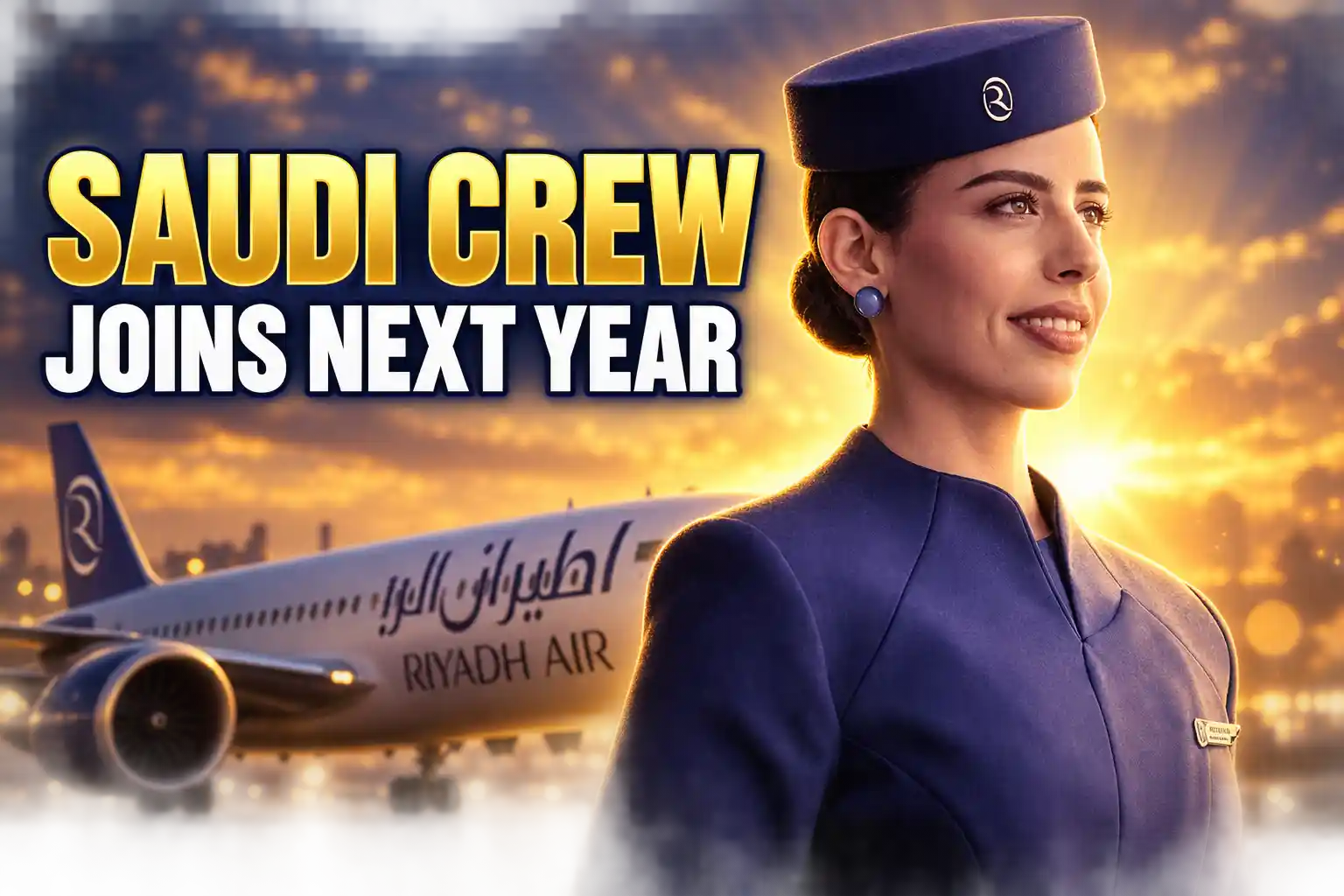
Riyadh Air’s Nawat Cabin Crew Program will put Saudi men and women into the cabin in 2027, after the airline has already begun public flying. The Public Investment Fund carrier opened the eight-month train-to-hire track on 11 May 2026 for Saudi nationals aged 21 and above.
Chief executive Tony Douglas said in June 2026 that cabin crew already came from over 60 nationalities. Nawat is the slower door, a Saudi-only course whose graduates arrive once paying guests are already on board.
The Airline Is Already Flying Without Them
Riyadh Air started public service to London Heathrow on 10 June 2026, after an invite-only run on a leased Boeing 787-9 that began on 26 October 2025. The Nawat press release, issued a month before that public start, said successful candidates would join as cabin crew in 2027.
On 20 July 2026, with six 787-9s in service to six cities, Douglas tied more Dreamliner orders to a plan of over 100 destinations by 2030. By 1 October 2026 he said the airline was flying eight aircraft to 14 destinations and aimed to be on sale to almost 30 by the end of 2026, with London rising to nine weekly flights from 2 November 2026.
The people working those cabins were hired on a different clock. On 3 September 2024 the airline said its first 32 cabin crew had finished initial training, long before Nawat existed as a Saudi train-to-hire path.
We're thrilled to announce that our first batch of 32 cabin crew members has successfully completed their initial training course! This milestone gets us one step closer to our operations starting in 2025. Congratulations to our first graduates—onward to new heights! #RiyadhAir
— Riyadh Air | طيران الرياض (@RiyadhAir) September 3, 2024
HOW THE CREW CLOCK DIVERGED
- March 2023: The Public Investment Fund launches Riyadh Air as a wholly owned carrier.
- 3 September 2024: The first 32 cabin crew finish initial training.
- 26 October 2025: Invite-only Riyadh-London flights begin on a leased 787-9.
- 11 May 2026: The Nawat Cabin Crew Program opens to Saudi nationals.
- 10 June 2026: Public commercial service to London Heathrow begins.
- August 2026: The first Nawat intake is scheduled to begin training.
- 2027: Successful Nawat candidates join as cabin crew.
That gap is the whole hiring design. The network had to staff 787s as they arrived; the Saudi course was built as an eight-month pipeline, not as a launch crew.
What Nawat Asks of Saudi Applicants
Nawat is a train-to-hire course, not a short assessment day for people who already hold a cabin-crew licence. Riyadh Air welcomes Saudi men and women aged 21 and above who want hospitality work, and it does not list prior airline experience as a condition.
The airline’s careers site still describes an eight-month NAWAT Cabin Crew Program built with Bunyan for Training Company in Riyadh, aligned with international aviation standards, for the Inflight Experience Team. The May press release said the course covers technical skill, safety procedures, language, and professional service, and that a national roadshow would start in Riyadh alongside online applications.
WHAT THE COURSE PROMISES
- A job at the end: Training is guaranteed to lead to employment on successful completion.
- A recognised ticket: Hands-on training comes with an internationally recognised cabin crew qualification.
- A mapped path: The airline offers a structured career path with room to move up.
- A four-part syllabus: Safety, technical knowledge, language, and service sit at the centre of the eight months.
Nahar Aljahani, senior vice president of talent acquisition and business partners, said cabin crew are an essential part of operations and that Nawat supports a goal of more than 200,000 direct and indirect job opportunities under Vision 2030. The airline’s own language is “thousands” of Saudi cabin crew over the coming years, not a single-class headcount, and it has not later published how many people the August intake took.
Hafawa Has to Live in the Aisle
The delayed Saudi class is being asked to carry a brand the airline is already selling. On the careers pages, every flight is framed as Saudi hospitality delivered through Hafawa. Riyadh Air has used the same word for its lounge at King Khalid International Airport, calling Hafawa an Arabic word embodying warmth and hospitality.
Douglas put that word on the aircraft as well. When public London bookings opened, he said guests would get comfort, technology, and distinctive Saudi Hafawa hospitality from the moment they step on board.
Aljahani gave the cabin a second image. Crew would be trained under a philosophy known as The Lavender Thread, drawn from traditional Saudi hospitality, and would work as ambassadors rather than as a generic Gulf cabin team.
Our cabin crew will represent a new generation of Saudi hospitality ambassadors, combining global standards with warmth, generosity, and authenticity.
Nahar Aljahani, Senior Vice President of Talent Acquisition and Business Partners, Riyadh Air
That is a product claim with a lag. The 2027 class is being taught to embody a Saudi welcome on aircraft whose first paying year will have been worked by a mixed international crew, in Ashi-designed uniforms, on routes that already include London, Jeddah, Dubai, Cairo and a growing Asian list.
Two Doors Open Into the Same Cabin
Nawat is not the only way onto a Riyadh Air jumpseat. The airline has run cabin-crew roadshows well beyond the Kingdom, and in June 2026 Douglas put numbers on the global funnel that Nawat does not replace.
We’ve had over 2 million people apply to be considered for being members of the Riyadh Air family over the last 2 and 1/2 years. 2 million people. This is incredible. 146 different nationalities. And right now, we’ve got over 60 different nationalities in our cabin crew.
Tony Douglas, Chief Executive, Riyadh Air, June 2026 interview
The open international route runs through city assessment days, then a job offer and a move to Riyadh. Nawat selects Saudi candidates first and then schools them for eight months. Both doors feed the same Inflight Experience Team; they do not start at the same time.
THE TWO CREW PIPELINES
| Track | Who can apply | How they are trained | When they are in the cabin |
|---|---|---|---|
| Nawat Cabin Crew Program | Saudi men and women aged 21 and above | Eight-month train-to-hire with Bunyan | 2027, after successful completion |
| Open cabin crew hiring | Applicants through global roadshows and city listings | Assessment days, then a job offer and relocation to Riyadh | Already flying; over 60 nationalities as of June 2026 |
Gulf carriers have long staffed long-haul cabins this way, drawing English-speaking crew from many countries and training them to a house style. Riyadh Air copied that machine to get airborne, then added a national course that takes the better part of a year. The Saudi track is localisation with a delay, not a closed shop at launch.
Cadets, Engineers and the Rest of Nawat
The cabin course sits inside a wider Nawat label that the airline had already used for other Saudi pipelines. The May release said the cabin program complements an Aircraft Engineering Program and a Cadet Pilot Program, and that Nawat is meant to localise roles across the business, not only in the aisle.
OTHER NAWAT PATHS NAMED IN THE RELEASE
- Female engineers: Riyadh Air cites a program to employ female Saudi engineers in aircraft maintenance.
- Maintenance degrees: Specialised bachelor’s scholarships cover mechanical and avionics engineering for aircraft maintenance.
- Corporate graduates: The Nawat Graduate Program rotates university graduates through corporate departments.
- Cadet pilots: A first Cadet Pilot Program is meant to open the flight deck to aspiring Saudi pilots.
Those paths matter because a 787 network does not run on cabin crew alone. As aircraft arrive, the airline also needs licensed engineers, pilots, and office staff who can grow with a hub that is supposed to reach over 100 cities by 2030. The cabin program is the most visible hire because guests meet it. The rest of Nawat is how the airline says it will staff the work guests never see.
The 200,000 Jobs Tied to Every New Route
Aljahani tied Nawat to more than 200,000 direct and indirect job opportunities under Vision 2030. That figure is the airline’s own long-range claim, restated when it firmed more Boeing 787s. In the 20 July 2026 order announcement, Riyadh Air said expanding its global reach should generate over 200,000 direct and indirect jobs and contribute over $20 billion (SAR 75 billion) to non-oil GDP growth by 2030.
The General Authority of Civil Aviation uses a different yardstick for the whole sector. Abdulaziz Al-Duailej, GACA’s president, has said Saudi aviation will need 274,000 direct jobs by 2030, up from 104,000. Nawat cannot close that gap by itself. It is one airline’s cabin and training slice of a much larger hire, spread across airports, maintenance, cargo, and other carriers including Saudia.
THE SCALE BEHIND ONE CABIN COURSE
- Over 2 million: Job applications in 2.5 years, Douglas said in June 2026.
- 146 nationalities: The spread of those applicants, per the same remarks.
- Over 60: Nationalities already in the cabin crew in June 2026.
- Over 200,000: Direct and indirect jobs Riyadh Air says it will generate by 2030.
The 787-10 order sitting behind those jobs adds 50 seats per flight against the 787-9 and, Boeing said, cuts fuel use 25% compared with the aircraft it replaces. More seats per round trip is more crew needed per departure, which is why a 2027 Saudi class still has work waiting even if the first year was staffed from abroad.
The Careers Site Still Wants Applicants
Riyadh Air has not issued a later public tally of who entered training in August 2026. Its cabin-crew careers page still invites Saudi men and women onto the Nawat course, still names Bunyan, and still sells Hafawa as the point of the job. That present-tense listing is the hardest evidence that the Saudi door remains open, whether the first class is already in a classroom or still being filled.
For a new long-haul airline, that is a practical split. Aircraft deliveries do not wait for an eight-month syllabus, and a 14-destination network in early October 2026 already needs working crew. Nawat is how the carrier says those cabins will look more Saudi as the map grows toward 100 cities.
The first Nawat class will board 787s whose service style has already been set by colleagues from over 60 countries. They inherit Hafawa in a cabin that has been selling it without them.

Christa Pike Survived the Execution Tennessee Would Not Pause

Musk’s Oligarch Charge Hits a Queue of Three

Circle Puts USDC and EURC Into SAP Pay Workflows

Ring’s First Smart Lock Skips Home Wi-Fi for Sidewalk

GTA 6 Puts Cash Back on the Story Path

Salah Captained Egypt to Their First World Cup Win

Aramco Crash Kills 14 Two Days After Oil Restart

Apple Labor Day Deals Hide June’s Memory Price Hike

Zelda’s 40th Switch 2 Ships Without a Zelda Game

Palworld 1.0.4 Adds Palpedia Search After the 1.0 Launch
-
 NEWS5 months ago
Salah Captained Egypt to Their First World Cup Win
-
 BUSINESS4 months ago
Aramco Crash Kills 14 Two Days After Oil Restart
-
 NEWS2 months ago
Apple Labor Day Deals Hide June’s Memory Price Hike
-
 GAMING1 month ago
Zelda’s 40th Switch 2 Ships Without a Zelda Game
-
 GAMING1 month ago
Palworld 1.0.4 Adds Palpedia Search After the 1.0 Launch
-

 NEWS3 months ago
El Niño Puts Israel’s Needed Winter Rain on a Flood Clock
-

 ENTERTAINMENT1 month ago
King Charles Letter Keeps Harry and Meghan as Private Citizens
-

 ENTERTAINMENT4 months ago
A Thousand and One Drops Off Riyadh’s October Calendar