
NEWS
The Alamein Memorial Names the Men With No Grave
The Alamein Memorial in Egypt names 11,869 Commonwealth dead with no grave, while Egyptian gardeners and an Indian cremation memorial hold the site together.

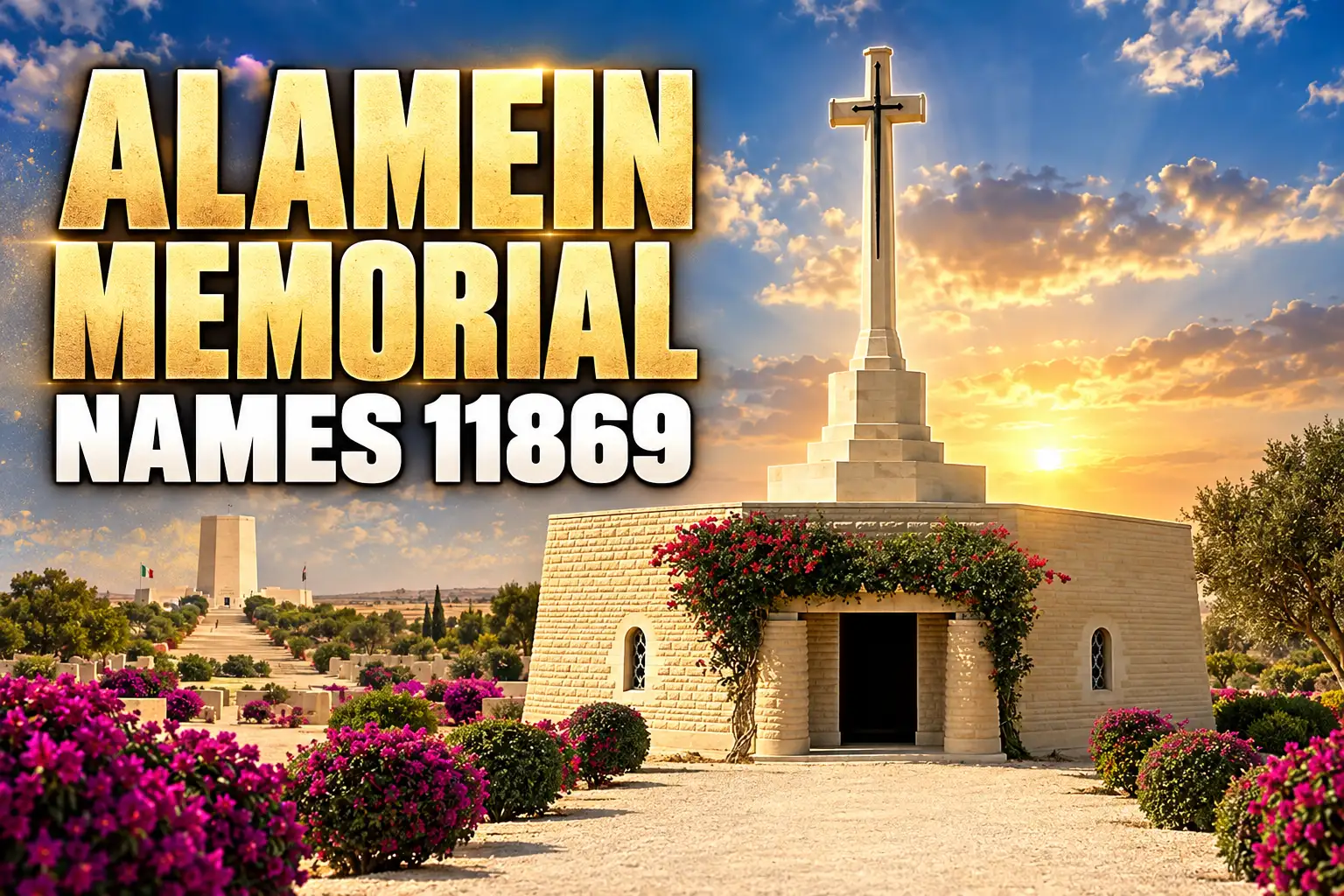
The Alamein Memorial lists 11,869 Commonwealth servicemen with no known grave at the gate of El Alamein War Cemetery in Egypt. That figure, from the Commonwealth War Graves Commission register, is larger than the cemetery behind it. Field Marshal Montgomery unveiled the cloister on 24 October 1954, twelve years after the Second Battle of El Alamein began.
English-language copy still treats the place as an Australian shrine, because three Victoria Cross graves and a 9th Division monument sit in easy reach of a camera. The stone says something else. Most of the names belong to men who were never found, and a second memorial at the back of the plot honours hundreds whose faith required cremation rather than a headstone.
The Cloister Holds More Names Than Graves
The memorial is the cemetery entrance, not a side chapel. Commission notes put more than 8,500 soldiers with no known grave on the land-force panels, men who died in Egypt and Libya, in Eighth Army operations in Tunisia up to 19 February 1943, and in Syria, Lebanon, Iraq and Persia. The air-force panels name more than 3,000 airmen lost over those same campaigns and over Greece, Crete, the Aegean, Ethiopia, Eritrea, the Somalilands, Sudan, East Africa, Aden and Madagascar, plus men of the Rhodesian and South African Air Training Scheme.
El Alamein War Cemetery, Egypt’s largest Commission cemetery, holds 7,240 Commonwealth burials of the Second World War, of which 815 are unidentified, and 102 graves of other nationalities. Subtract the unnamed and 6,425 Commonwealth dead have a marked grave. The missing on the gate still outnumber them.
THREE MEMORIALS ON ONE PLOT
- Alamein Memorial: 11,869 identified names of men with no known grave, carved on Portland stone inside the entrance cloister.
- War cemetery: 7,240 Commonwealth burials, 815 of them unidentified, plus 102 graves of other nationalities.
- Cremation memorial: 603 identified names in the south-eastern part of the cemetery, for men whose remains were cremated in Egypt and Libya according to their faith.
The Second Battle ran from 23 October to 4 November 1942. Graves in the plot come from the whole Western Desert campaign, concentrated from that fighting and the weeks before it. The 84th anniversary of the opening barrage falls on 23 October 2026.
Who Is Named on the Alamein Memorial
A Commission feature written for the battle’s 75th anniversary broke the cemetery and the walls down by force. British and colonial names dominate the memorial. Indian Army names dominate the cremation panels. Australian and New Zealand graves are thick in the rows, which is why visitors from those countries feel the place belongs to them, but they are not the majority on the stone.
THE CEMETERY AND THE WALLS
| Force | Buried in the cemetery | Named on the Alamein Memorial | Cremation memorial |
|---|---|---|---|
| British and colonial | Some 3,480 | 7,100 | None |
| Australian | 1,234 | In the combined ANZAC total | None |
| New Zealand | 1,107 | In the combined ANZAC total | None |
| Indian Army | 198 | 1,802 | 589 |
| South African | 495 | Some 1,230 | None |
| Canadian | More than 30 | 212 | None |
A Commission briefing on ANZAC sites puts about 1,500 Australian and New Zealand names on the memorial without splitting the two. Add the graves and 2,341 ANZAC dead are in the ground. Indian Army totals at the site run higher than that once the cremation panels are counted: 198 buried, 1,802 Indian names on the memorial, and 589 on the cremation memorial, 2,589 in all.
Canada sent no army to the desert. Royal Canadian Air Force aircrew flew with RAF and RAAF squadrons, and 212 of them are on the walls. One is air gunner Roderick Charles Mutch, reported missing after a raid on German transport as Rommel began to pull back. His wing commander wrote to the family that the aircraft was seen to crash after heavy ground fire and told them not to place too much faith in a report that someone had got out by parachute.
Captains Hector and Tom Chadwick of the 3rd King’s Own Hussars, brothers born in Jamaica and raised in Gloucester, show how British names stack up. Hector was killed by shelling on 25 October 1942 as his tank moved through a minefield gap. Two days later Tom went out in a scout car with Captain Peter Elford and Captain Daniel McCarthy to mark the grave. An 88 mm shell killed all three. Hector, Tom and Daniel lie side by side. Elford is on the memorial with the other 7,100 British missing.
Faith Forbade a Headstone for 603 Men
The Alamein Cremation Memorial stands in the south-eastern part of the cemetery and names 603 men whose remains were cremated in Egypt and Libya. They are not the same as the missing. Their bodies were recovered. Their faith required fire rather than a Christian plot, so they have panels instead of a row of stones.
The Commission’s 2017 count puts 589 of those names on Indian Army units. After the Second World War the Commission built cremation memorials because Indian dead had too often been treated as if they had no grave at all, when the grave had simply been a pyre. El Alamein is one of those corrections.
Lance Naik Muhammad Umar of King George V’s Own Bengal Sappers and Miners is among four men of that unit buried in the cemetery rather than cremated. He was 23, from Kandar near Peshawar, in what is now Pakistan. At the start of the second battle the Bengal Sappers had to clear mines in front of 4th Indian Division. Indian units had already fought in Syria and against the Italians in East Africa before they came to this strip of coast.
South Africa’s 495 burials include Captain Walter “Jack” Webb, shot down on a recce sortie on 4 November 1942, age 23, after three earlier crashes he had walked away from. New Zealand’s 1,107 include Gunner Alfred Palmerston Cobden of Christchurch, a clerk and first-class cricketer for Canterbury, killed on 24 October 1942 when the ammunition truck he was driving hit a mine.
White Limestone From Nearby Quarries
Sir Hubert Worthington, the Commission’s principal architect for North Africa, designed both the cemetery and the memorial. He kept the cloister, the Cross of Sacrifice and the equal treatment of rank that the Commission had used after the First World War, then changed the fabric for heat, wind and sand. The people of Egypt offered the land. The Imperial War Graves Commission, as it then was, built north of an earlier burial ground that already held about 8,000 men.
HOW WORTHINGTON CHANGED THE PLAN
- Sand walls: Tall protective walls were built to keep drifting sand off the name panels and the graves.
- Sun shelters: The cloister and its three entrance arches throw shade that a European colonnade never had to provide.
- Desert plants: Succulents, including cacti, replaced the roses and herbaceous borders common in France and Flanders.
- Local stone: The shrine uses white limestone taken from nearby quarries, with only pavings and copings in travertine marble brought from Italy, and Portland stone for the name panels.
- Roof terrace: Stairs from the forecourt climb to a flat roof with a view across the cemetery, the desert and, to the north, the sea. The cloister itself runs some 80 metres east to west.
Montgomery unveiled the work on 24 October 1954. BBC World Service carried the ceremony live, a long-range broadcast that was treated at the time as a technical feat. The Commission’s archive of that day shows him taking the salute, walking the Highland guard, and pausing on the roof before the unveiling. Two Lincoln bombers later dropped 250,000 poppies over the graves.
Most of the Gardeners Are Egyptian
The planting is still the hardest Commission horticulture job in the region. Sir Tim Laurence, then vice chairman, said so at the 75th anniversary ceremony on 21 October 2017, with President Abdel Fattah el-Sisi of Egypt among the guests. Laurence said the duty to honour the dead with beautiful planting faced perhaps its greatest test here, and he praised the gardeners, the majority of them Egyptian, for keeping indigenous plants in flower among thousands of headstones in desert sand.
It is wonderful to see today the schools’ interest in the history of the war to visit El Alamein war memorial Cemetery
Baghdady, CWGC Technical Supervisor (Horticulture), North Africa
That line came from the Commission’s North Africa horticulture supervisor in June 2025, when school groups were on the paths. Local staff still meet next-of-kin. In late October 2025 a British family was walked to an uncle’s grave, and members of the Rand Light Infantry Regiment Association came with relatives to name South African dead. The French embassy held its own commemoration at the cemetery the same month.
The Commission now warns visitors about antisocial behaviour near the site and asks them to watch their belongings. Gardeners go off the plot at 14:30, and they take the visitors’ book and the register with them. A police guard remains at the gate until closing.
Three Crosses From One Australian Battalion
Cameras still stop at four Victoria Cross graves. Three of them belong to the 2/48th Battalion of the Second Australian Imperial Force, which is why the Australian story is the one that travels. The fourth is British, and it is older than the October battle.
THE FOUR VICTORIA CROSS GRAVES
- Private Adam Wakenshaw: 9th Battalion, Durham Light Infantry, died 27 June 1942, age 28, Plot XXXII, Row D, Grave 9, the earliest of the four.
- Private Arthur Stanley Gurney: 2/48th Battalion, died 22 July 1942, age 33, Plot XVI, Row H, Grave 21, killed in the first battle at Tell El Eisa.
- Private Percival Eric Gratwick: 2/48th Battalion, died in the night of 25 to 26 October 1942, age 40, Plot XXII, Row A, Grave 6, after an attack on Miteiriya Ridge had cut his platoon to seven men.
- Sergeant William Henry Kibby: 2/48th Battalion, died 31 October 1942, age 39, Plot XVI, Row A, Grave 18. On 23 October he took a machine-gun post, killing three and capturing 12. A week later he went forward alone with grenades and was killed. The award was gazetted on 28 January 1943.
Kibby is one of the 1,234 Australian graves at El Alamein, a total that includes 54 RAAF airmen. The 9th Australian Division, fighting as the northern hinge of Montgomery’s line, took about a fifth of the Eighth Army’s casualties in the two Alamein battles. A separate 9th Division monument stands on a rise beside the cemetery, and monuments on the grounds also honour Greek, New Zealand, South African, Indian and Canadian forces.
The Australian dead are real, and so is the 9th Division’s share of the fighting. They are still a minority of the names on the gate and a minority of the men who have no headstone at all.
Apartments Now Stand Over the Battlefield
Worthington built for empty desert. The coast is no longer empty. The drive from Alexandria is about two hours on the motorway, and the old battlefield is now a strip of North Coast resorts and apartment blocks. Egypt’s official tourism account has even sold the German war cemetery as a detour from the beach. In 1992 the Commonwealth cemetery still sat in open sand, with one restaurant across the road. That isolation is gone.
📍El Alamein War Memorial Cemetery, Egypt. pic.twitter.com/Gr2XL0Uy1n
— Commonwealth War Graves (@CWGC) August 2, 2022
The three cemeteries, Commonwealth, Italian and German, now form one afternoon circuit. Photographs taken on 1 October 2026 move from Wakenshaw’s headstone to the Italian memorial to the German compound without a change of light. On 18 October 2025 the British and German embassies held a joint ceremony at the German cemetery for the 83rd anniversary, with a wreath-laying at the Commission cemetery and officers from more than 30 nations. The 80th anniversary service in October 2022 had brought the Commission’s director general, Claire Horton, and the crew of HMS Albion onto the same gravel.
The walls still do the work they were cut for. They name the men the desert did not give back, including Indian soldiers whose grave was a fire, and they stand on land Egypt gave, kept by Egyptian gardeners while the coast road fills in around them.
Frequently Asked Questions
How Do You Visit El Alamein War Cemetery?
The cemetery sits about 130 km west of Alexandria, off the old coast road just beyond the Alamein police checkpoint, and it is open every day from 07:00 to 17:00. Wheelchair access is signposted. Gardeners leave at 14:30 and take the visitors’ book and casualty register with them, so later arrivals can enter under a police guard but cannot look up a plot on site. The Commission has also warned of antisocial behaviour in the vicinity and asks visitors to watch themselves and their belongings.
Why Does El Alamein Have a Cremation Memorial?
British Imperial forces in the desert included large numbers of Hindu and Sikh soldiers whose faith required cremation, so recovered remains were burned in Egypt and Libya rather than buried under a Commission headstone. Those men were not missing in the sand; they had been found and then cremated. The Commission introduced cremation memorials after the Second World War so those 603 names at El Alamein, 589 of them Indian Army in the 2017 count, would not be treated as if no grave had ever existed.
Are There German and Italian Cemeteries at El Alamein?
Yes. Separate German and Italian war cemeteries stand near the Commonwealth site and are now part of the same visitor circuit along the North Coast. The British and German embassies used the German cemetery on 18 October 2025 for a joint 83rd-anniversary ceremony, then laid a wreath at the Commission cemetery. Egypt’s tourism office has also promoted the German memorial as a stop off the beach road.
When Was the Alamein Memorial Unveiled?
Field Marshal Viscount Montgomery of Alamein unveiled it on 24 October 1954, which the Commission treated as the 12th anniversary of the battle that began on 23 October 1942. BBC World Service carried the ceremony live. Archive film shows Montgomery inspecting a Highland guard and Australian troops, then laying a wreath, while two Lincoln bombers dropped 250,000 poppies over the cemetery.

Ninja Theory Staff Face Redundancy After Two Xbox Sales Collapse

Amazon Sells the MacBook Air at Its Pre-Hike Price

U.S. Slows Jet Parts to Squeeze China’s Flying Fleets

PEGI Pulled the GTA 6 Age Rating After Cocaine Details

Northwestern’s Smaller Ryan Field Gave Penn State Nowhere to Hide

Aramco Crash Kills 14 Two Days After Oil Restart

Salah Captained Egypt to Their First World Cup Win

Apple Labor Day Deals Hide June’s Memory Price Hike

Palworld 1.0.4 Adds Palpedia Search After the 1.0 Launch

Zelda’s 40th Switch 2 Ships Without a Zelda Game
-
 BUSINESS3 months ago
Aramco Crash Kills 14 Two Days After Oil Restart
-
 NEWS4 months ago
Salah Captained Egypt to Their First World Cup Win
-
 NEWS1 month ago
Apple Labor Day Deals Hide June’s Memory Price Hike
-
 GAMING4 weeks ago
Palworld 1.0.4 Adds Palpedia Search After the 1.0 Launch
-
 GAMING4 weeks ago
Zelda’s 40th Switch 2 Ships Without a Zelda Game
-

 NEWS3 months ago
El Niño Puts Israel’s Needed Winter Rain on a Flood Clock
-

 BUSINESS8 months ago
Egypt Bets EGP 638 Billion Can Open Sinai to Investors
-

 ENTERTAINMENT4 weeks ago
King Charles Letter Keeps Harry and Meghan as Private Citizens