
Pakistan’s Deputy Prime Minister and Foreign Minister Ishaq Dar is in Amman today for a ministerial meeting on occupied Jerusalem that Jordan has cast as an emergency response to an imminent threat against the city’s holiest Muslim site.
The gathering, hosted by Jordanian Deputy Prime Minister and Foreign Minister Ayman Al Safadi, pulls in counterparts from the Arab League and key Islamic states. Their stated goal is a unified stance on what Amman describes as fast-deteriorating conditions and Israeli measures that risk sparking religious conflict far beyond Palestine.
The Ministers Gather in Amman
Dar left Islamabad on Tuesday for the one-day visit at Safadi’s invitation. The FO departure statement on the visit said he would reaffirm Pakistan’s support for the Palestinian people and their just cause while holding bilateral talks on regional developments.
Participants include foreign ministers or senior officials from Jordan, Palestine, Egypt, Saudi Arabia, Qatar, Türkiye, Indonesia, Pakistan, Malaysia, Bahrain, Iraq, Morocco, Tunisia, Algeria and Somalia, plus the Arab League secretary-general. They will also call on King Abdullah II.
Jordan framed the session around the work of the Arab Ministerial Committee on illegal Israeli policies in occupied Jerusalem. Extra seats went to non-Arab Muslim states with long records on the issue.
- Core Arab committee members: Tunisia, Algeria, Saudi Arabia, Somalia, Iraq, Palestine, Qatar, Egypt, Morocco
- Additional Islamic participants: Indonesia, Pakistan, Türkiye, Malaysia
- Institutional: Arab League secretary-general
- Host focus: developments at Islamic and Christian holy sites and a joint response
Side meetings will cover the humanitarian picture in Palestine and other mutual interests.
Why Jordan Called Them Now
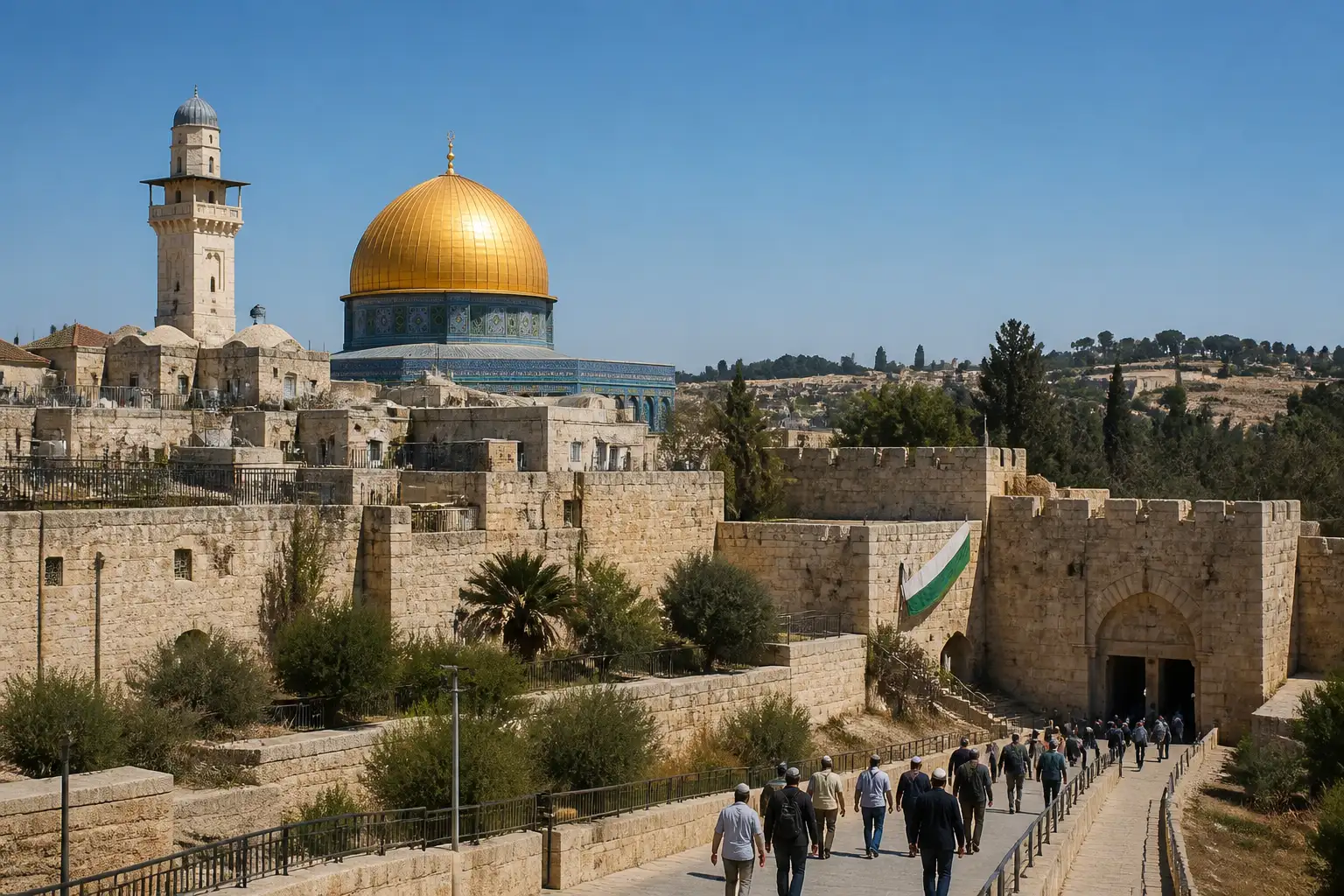
Amman’s urgency stems from a sharp escalation in the status quo at the Al-Aqsa Mosque compound, known to Jews as the Temple Mount. Only Muslims may pray there under long-standing arrangements overseen by Jordan’s Hashemite monarchy.
On 23 July more than 2,000 Israelis from the religious right, mostly settlers and led by National Security Minister Itamar Ben Gvir, entered the compound. They prayed and performed rituals in what Jordanian officials called the worst violation in modern history. Palestinian worshippers faced tight restrictions.
- 23 July 2026: Large settler-led incursion with Ben Gvir present; rituals performed across the site.
- Late July-early August: Reports of recruitment for a special Temple Mount police unit drawing religious Jews.
- September horizon: Major Jewish holidays coincide with an intense Israeli election campaign, raising fears of further challenges to Jordanian custodianship.
Safadi told interviewers the threat is constant and dangerous. “Jerusalem is a tinderbox,” he said. Earlier this year, during the Israel-US conflict with Iran, authorities closed Al-Aqsa and restricted the Church of the Holy Sepulchre for weeks, citing security. Those limits eased after a fragile ceasefire in April, but the underlying pattern of pressure resumed.
Custodianship Under Direct Pressure
The Hashemite role over Muslim and Christian holy sites in Jerusalem dates back a century and was reaffirmed after 1967 and in the 1994 Israel-Jordan peace treaty. Jordan sees current moves as an attempt to hollow it out.
This is a constant threat, a dangerous threat that we’re trying to counter in every tool that we have possible. We warn that tampering with the status quo could trigger a religious conflict that will reverberate beyond Palestine and Jordan into the whole Muslim world.
Ayman Al Safadi, Jordan’s foreign minister, made the case in recent comments. He pointed to government-backed incursions and the risk that far-right elements will use the pre-election window to create irreversible facts. Allegations earlier in 2026 of US-Israeli discussions on replacing Jordanian administration with a multi-faith framework under Israeli control drew sharp joint pushback from Amman and partners including Pakistan.
Jordan also faces parallel pressure. Israel declined to renew a 2021 water-sharing deal that had supplied 100 million cubic metres a year, reverting to the lower 1994 volume. Officials linked the cut to Amman’s criticism of the Gaza campaign. West Bank displacement remains a declared red line: any mass push of Palestinians into Jordan would hit demographics (Palestinian-origin residents already form a majority of the 11.5 million population), the economy and the monarchy’s political balance.
Pakistan’s Consistent Line on Al-Quds
Dar’s presence fits a long Pakistani position. Islamabad was among the first to recognise the State of Palestine in 1988 and has backed an independent, sovereign, contiguous state on pre-1967 borders with Al-Quds Al-Sharif as capital.
In June, Pakistan joined eight other Muslim countries in categorical rejection of any attempt to alter the historical and legal status quo at Jerusalem’s Islamic and Christian holy sites. Pakistani statements have repeatedly condemned settler incursions into Al-Aqsa, Islam’s third-holiest site after Mecca and Medina.
The DPM’s Office release described today’s participation as a manifestation of that principled support. Bilateral talks on the margins will let Dar compare notes with counterparts facing the same pressures on Gaza ceasefire implementation and West Bank settlement expansion.
What the Agenda Covers
Turkish sources outlined the expected discussion points ahead of Hakan Fidan’s attendance. The table below captures the main clusters and the outcomes Amman and partners seek.
| Agenda cluster | Specific concerns | Sought position |
|---|---|---|
| Holy sites status | Al-Aqsa change attempts, settler rituals, Christian site restrictions | Preserve historical and legal status quo; affirm Hashemite custodianship |
| East Jerusalem and West Bank | Demographic shifts, home demolitions, de facto annexation, settler violence | Reject illegal practices; demand accountability |
| Gaza process | Continued attacks despite roadmap talk; ceasefire durability | Concrete international pressure for full implementation |
| Two-state track | Embassy moves to Jerusalem, settlement plans (including E1) | Reaffirm pre-1967 lines with East Jerusalem as capital; UN resolutions |
Fidan is expected to stress Jerusalem’s religious and cultural weight for Muslims, condemn provocations, and link the file to regional stability. Similar language is likely from the Arab side. The group will look for common diplomatic tools short of military options.
Stakes for the Kingdom and Beyond
For Jordan the meeting is existential as much as solidarity. Loss of effective custodianship would strip a core pillar of Hashemite legitimacy. An influx from the West Bank would strain water, jobs and the East Banker-Palestinian balance that underpins the political system. Anti-normalisation sentiment has already risen; the main Islamist bloc (now operating as Umma) gained ground after Gaza and keeps pressing for tougher lines.
The kingdom hosts a significant US military presence that grew during the Iran conflict. Iranian missiles have struck Jordanian bases holding US forces, including recent Iranian missile threats to Jordan bases. That presence is both a security backstop and a domestic political liability. An open letter from hundreds of Jordanian figures recently called for US withdrawal.
Broader risks travel quickly. Past breaches of the status quo helped ignite the second intifada. A collapse now, especially around the High Holidays, could send shockwaves into Muslim communities worldwide and complicate every remaining ceasefire track. Parallel flashpoints such as disputed digs in Jerusalem’s City of David and Jerusalem land disputes highlighted in local arts keep the city on edge.
What we know
- Meeting confirmed for 5 August in Amman with broad Arab-Islamic attendance
- Jordan publicly warned of imminent takeover risk at Al-Aqsa
- July 23 incursion treated as historic violation of status quo
What’s unconfirmed
- Exact language of any final communiqué
- Whether new enforcement mechanisms beyond statements will emerge
- Immediate Israeli response to the gathering
Dar and the other ministers leave Amman tonight. The test is whether the unified position they draft slows the pace of change on the ground or simply records another protest while the tinderbox stays dry only by luck.
