
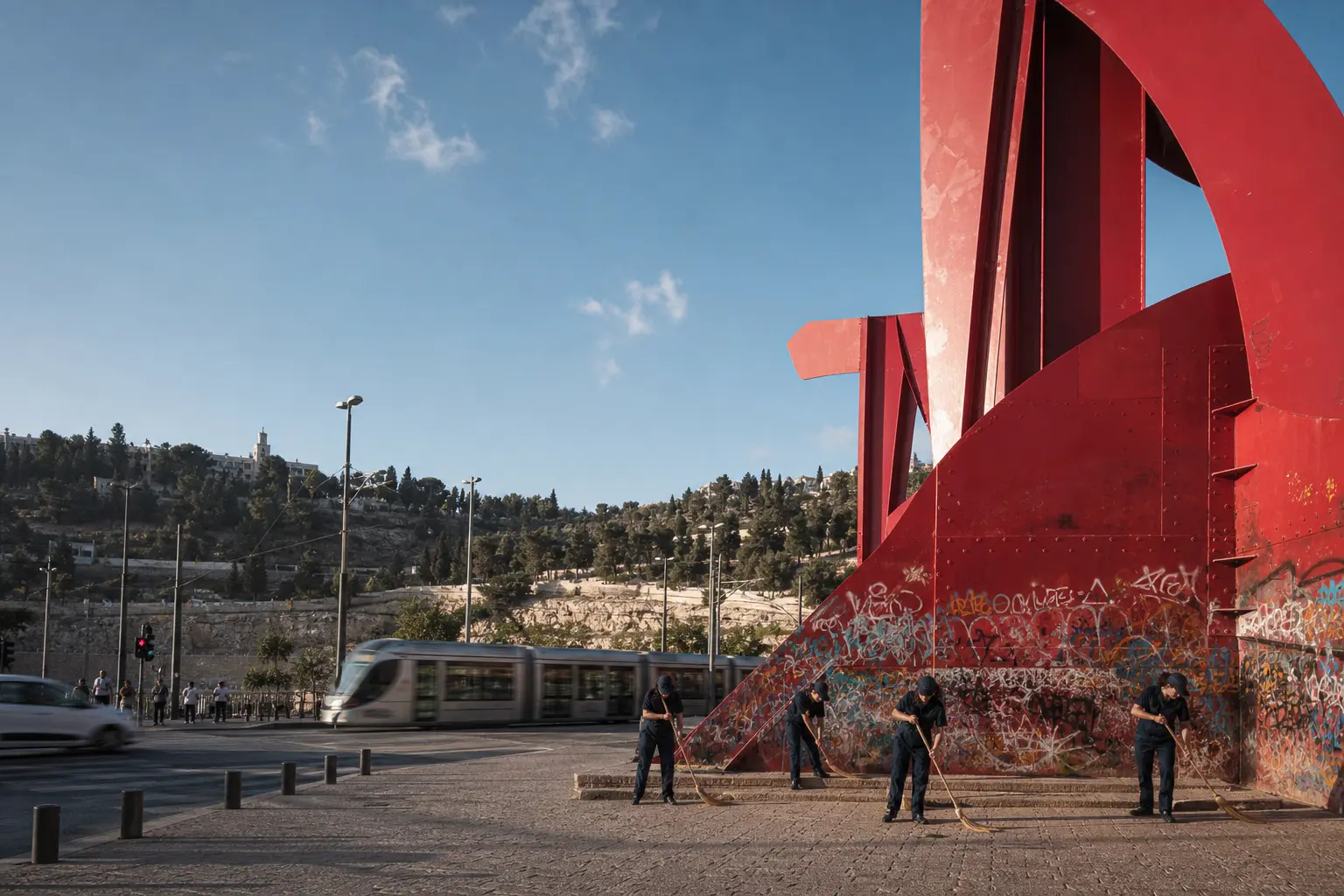
Four performers in matching overalls swept a graffiti-covered, 65-ton steel sculpture clean on Mount Herzl Tuesday night. The choreographed cleanup, staged by the performance group Vacuum Service, opened the 18th edition of Manofim, Jerusalem’s contemporary art festival. The festival runs July 14 through 18 across dozens of studios, galleries and rooftops citywide.
This year’s sharpest new work turns a camera on a real fight over land in the Old City, one that has already drawn lawsuits, bulldozers and, briefly, violence. Jerusalem’s art scene has never stood apart from the city’s harder arguments over space and memory, and this festival keeps proving it.
Eighteen Years of Turning Cranes Into a Verb
Manofim is Hebrew for construction cranes. Artists Lee Hai Shulov and Rinat Edelstein picked the name in 2008, when Talpiot’s industrial blocks were full of literal cranes and their ambitions for the neighborhood’s art scene were just as large.
- Manofim – Hebrew for cranes, chosen as a pun on “Ma Hanofim?”, or “what are the views?”, the founders’ shorthand for wanting to lift Jerusalem’s art scene high enough to see the whole city.
Past editions have drawn support from the Jerusalem Foundation’s Innovation Fund, the Culture and Sport Ministry and the Jerusalem Municipality. Eighteen years on, the festival still calls itself the largest and oldest contemporary art event in Jerusalem, drawing thousands of visitors most years.
In recent years, the event has run with a full production team behind Shulov and Edelstein, including an Arab art curator, Yara Kassem Mahajena, alongside artistic directors and producers, according to the festival’s own listing. This year’s edition runs under the theme Hakara, a Hebrew word covering recognition, acceptance and awareness.
We no longer need to ask if there is art in Jerusalem.
Edelstein, the festival’s co-founder and chief curator, said that of how far the event has traveled since its first year. The theme itself, she has said, means holding several contradictory views of the city at the same time.
A City Becomes One Rotating Gallery
Two years ago, for the festival’s 16th edition, organizers counted more than 30 contemporary art galleries and hundreds of independent artists taking part over five days. This year’s trail runs through Talpiot, Musrara, Nachlaot, Mishkenot Sha’ananim, Jaffa Street and east Jerusalem, anchored by the Art Cube Artists’ Studios in Talpiot, the industrial complex where Manofim began.
- “Four Cubits” by artist Yael Serlin, an installation combining household items, Judaica, animation and video that reflects on the death of her son during his army service
- “Gel Culture Research” at the Shaham Culture Lab in Independence Park, which treats nail art as a study of identity, gender and power in contemporary Israeli life
- “Zik Galaxy,” a 40th anniversary celebration for the interdisciplinary performance collective Zik, staged inside the former Rav Chen mall, a shopping center many Jerusalemites still remember as a movie theater and that now sits mostly empty
Serlin’s piece turns a private loss into a public installation, one of several works this year built around grief and memory. The rooftop at Art Cube will also show World Cup matches during the festival, one half of the screen carrying Hebrew commentary and the other Arabic, the Jerusalem Post reported, a detail organizers say reflects this year’s theme of accommodating more than one point of view.
What Is Rear Cow, and Why Is It at Manofim?
“Rear Cow” is a staged video documentary by artist Guy Dolev that follows the Armenian community’s fight to keep control of the Cows’ Garden, a parking lot and community space inside the Old City’s Armenian Quarter that the Armenian Patriarchate leased to a private developer for a luxury hotel. It is one of several repeat screenings on this year’s schedule, aimed at festivalgoers who may never have followed the underlying property dispute.
The dispute Dolev is filming has run since 2021, when Patriarch Nourhan Manougian signed what residents later learned was a far larger lease than first announced. Israeli land surveyors uncovered the lease’s true scope in 2023, touching off protests and, eventually, bulldozers on the site.
The priest who signed on the patriarch’s behalf, Baret Yeretsian, was defrocked and has since resettled near Los Angeles.
One Parking Lot, Two Communities, $300,000 a Year
The Armenian Quarter is home to roughly 2,000 people, the remnant of a community that traces its presence in Jerusalem back 1,600 years, the oldest Armenian diaspora in the world. The Cows’ Garden lease hands a private company more than 25% of the quarter’s land for a hotel project managed by the Dubai-based chain One&Only.
| Detail | Figure |
|---|---|
| Land under lease | Over 11,500 square meters, about a quarter of the Armenian Quarter |
| Lease term | 98 years, split into two 49-year phases |
| Annual rent to the Patriarchate | $300,000 |
| Planned hotel | Managed by One&Only, 69 to 75 suites |
| Legal status | Two lawsuits pending after the Patriarchate moved to cancel the deal |
“We are at a very dangerous crossroads,” Serop Sahagian, a member of the Armenian Quarter community, told The Media Line after the deal became public. Community members have since filed two lawsuits against the developer, Xana Gardens, arguing the lease broke the Patriarchate’s own rules on how long church land can be leased.
The architecture firm originally hired for the hotel, Safdie Architects, later said it had suspended its work in response to the community’s opposition. Some activists have also linked the developer to Ateret Cohanim, a Jewish land-reclamation group active elsewhere in the Old City, though the group has denied any connection to this deal.
The stakes are demographic as much as legal. The Armenian Quarter has lost 90% of its pre-1948 population, according to a lawyer who worked on a fact-finding report into the deal. The Old City’s walls, which include the Armenian Quarter, have sat on Unesco’s list of World Heritage sites in danger since 1982.
Graffiti and Rail Lines Now Frame a Calder Sculpture
Back on Mount Herzl, the Vacuum Service performance made a similar point without a word of dialogue. The Alexander Calder sculpture the group swept clean has stood since 1977, installed to contrast with the forested hills across the valley. Mount Herzl is also home to Israel’s national cemetery and the Yad Vashem Holocaust memorial, making the hill one of the country’s most solemn addresses.
The sculpture now sits inside a busy intersection, hemmed in by traffic and running parallel to the light rail’s Red Line. The Red Line carries around 180,000 daily rides, more than the entirety of Israel Railways, the national rail operator, according to Jerusalem Deputy Mayor Adir Schwarz. Two more lines, the Green and the Blue, are under construction or in planning across the city.
Manofim staged the cleaning performance at that exact intersection on opening night.
Rooftop Concerts Close a Five-Day Run
Music takes over the Art Cube rooftop for the festival’s final stretch. Indie musician Gedy Ronen performs with the band Devek on Thursday, July 16. The Jimmy Prasad Orchestra, featuring musicians Jimmy Prasad, Avishai Cohen (the trumpeter, not the better-known jazz bassist of the same name) and Rejoycer, closes out the weekend with what organizers describe as a deep dive into sound.
Friday and Saturday round out the schedule with studio tours and artist talks, listed on the festival’s own site. By the time the rooftop crowd thins out this weekend, the view will still run from the YMCA’s bell tower on King David Street to the forested hills beyond Mount Herzl, the same tree line the Calder sculpture has faced since 1977, graffiti and all.
