
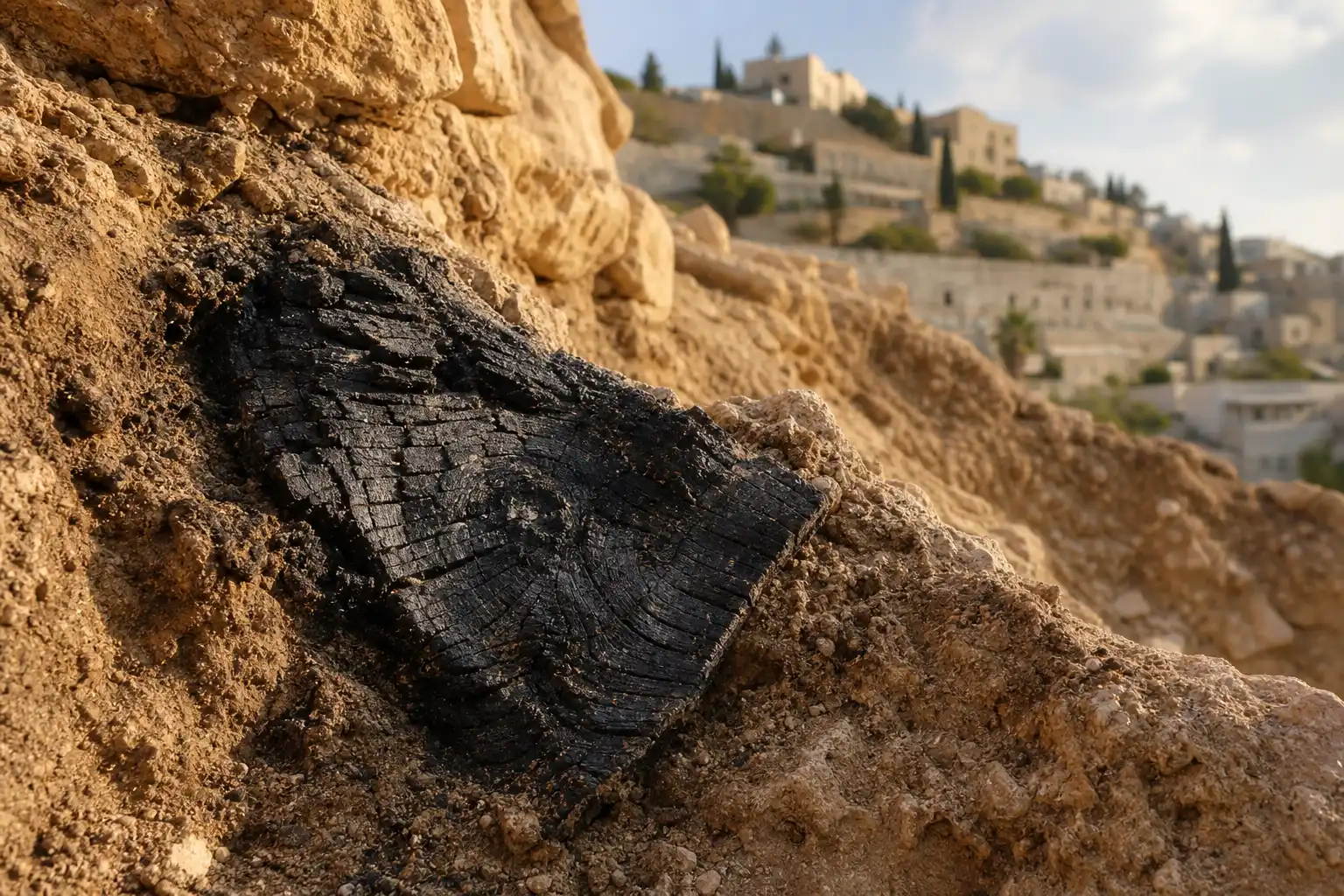
Archaeologists in Jerusalem have pulled a second batch of fire blackened beams from the same collapsed room where Babylonian soldiers burned the First Temple in 586 BC. The Israel Antiquities Authority said Monday the timber counts among the best preserved wood ever recovered from that destruction layer, with growth rings intact enough that scientists could soon date the fire to within 10 years, a resolution Israeli archaeology has never had before.
The dig that produced it is located in Silwan, a Palestinian neighborhood of East Jerusalem, on an excavation bankrolled by a Jewish settlement organization with its own stake in who controls that ground.
Round Two in the Same Burned Room
This is the second set of beams recovered from that exact room. They turned up at the Givati Parking Lot excavation, inside the Jerusalem Walls National Park in the City of David, in a joint dig run by the Israel Antiquities Authority (IAA) and Tel Aviv University.
Crews recovered an earlier batch of charred sycamore beams from the building’s southern half in the early 2020s. This time, digging the building’s other side, they found more timber, some sycamore and some conifer, according to excavation director Efrat Bocher.
“The beams appear to have served as the roof of an inner courtyard in a building from the First Temple period,” Bocher told The Jerusalem Post. “During the destruction, they collapsed onto the floor. We believe that the plaster cladding of the building’s walls, melted by the fire, covered the charred wooden beams, and ultimately enabled their exceptional preservation.”
Other debris recovered from the same room over the years points to a wealthy or official household, not an ordinary house:
- Carved ivory inlays, the kind of luxury item only a rich family or a government office could afford
- A clay seal impression naming Nathan-Melech, whom researchers have tentatively linked to a royal servant mentioned in 2 Kings 23:11
- A second seal reading Acher ben Matanyahu, another official tied to the same court
- A plaster floor built for formal use rather than daily living
“We think it was an administrative building where people also lived,” Bocher has said of the structure. The wider excavation has also turned up a defensive moat at least nine meters deep cutting across the ridge nearby.
Yiftah Shalev, who co-directs the dig for the IAA alongside Tel Aviv University’s Yuval Gadot, believes the wreckage was left exposed on purpose once Jerusalem was rebuilt. “Preserving memory is a human need, seeking to preserve what once existed,” he said.
How Tree Rings Narrowed the Clock to a Decade
Wood is what makes the new precision possible. A tree adds one ring every year, and a beam with enough rings lets scientists match its radiocarbon signature against known swings in the atmosphere’s carbon levels, a technique called wiggle matching.
Johanna Regev, the IAA archaeologist studying the beams, said finds with this many growth rings almost never survive Israel’s climate. “It is very rare in Israel to find wood with such a large number of growth rings,” she said. “Here in the City of David, we found thick beams with many rings, offering significant research potential, with more growth rings enabling higher dating resolution.”
“Until now, we could date finds within a range of hundreds of years,” Regev said. “Now, we can attain much greater precision, narrowing the dating range down to as little as 10 years.”
Her method already has a track record on this exact building. A 2024 paper in the Proceedings of the National Academy of Sciences used wiggle matching on the first sycamore beam recovered from the room. It placed the wood’s felling date at roughly 680 to 670 BC, during the reign of King Manasseh, less than a century before Nebuchadnezzar II’s army burned the building down.
Regev has said her team intends to run the same analysis on the newly recovered wood, to see whether it tells the same story.
The technique traces back to Weizmann Institute of Science labs run by Prof. Elisabetta Boaretto, which in 2024 reported building an absolute chronology for Iron Age Jerusalem by anchoring tree ring sequences to two fixed points in time: the 586 BC destruction and an eighth century BC earthquake.
It is part of a broader wave of precision dating remaking the region’s ancient timeline. Carbon testing has separately redated desert fortresses in the Arava to the Kingdom of Israel, upending older assumptions about who built them.
Why Is Solomon’s Jerusalem Still a Scholarly Battlefield?
Because shaving decades off a single stratum can shift a monumental building out of Solomon’s reign entirely and into a later king’s, and archaeologists have argued over exactly that question for thirty years. Sharper radiocarbon dates raise the stakes on every new stratum instead of settling the fight.
Tel Aviv University’s Israel Finkelstein has argued since the 1990s for what he calls a low chronology. It moves monumental structures long credited to Solomon’s tenth century BC kingdom into the ninth century reign of the Omride dynasty instead. The dispute reshaped how digs across Israel get dated, and it never fully went away.
The 2024 paper behind this month’s dating method waded into that same argument. It stopped short of naming David or Solomon directly, but its authors argued ancient Jerusalem was a more developed city, earlier, than some scholars had assumed. Finkelstein responded within weeks, arguing that some of the links the paper drew between specific walls and specific dates remained tenuous.
Where the two camps land, roughly:
- Regev and Boaretto’s radiocarbon team: combining tree rings with carbon dating now delivers an absolute, high resolution chronology for Iron Age Jerusalem that older pottery typology could never match
- Israel Finkelstein: some of the architecture to date links in the 2024 paper remain tenuous, and Jerusalem’s growth into a major city may still belong to a later century than tradition assumes
- Scholars in the traditional high chronology camp: monumental building tied to Solomon’s tenth century BC reign was founded then, whatever repairs and renovations came later
The Dig Occupies Some of Jerusalem’s Most Disputed Ground
The Givati Parking Lot excavation is located inside Silwan’s Wadi Hilweh neighborhood, a Palestinian area of East Jerusalem just south of the Old City walls. Academic papers describing the same radiocarbon program disclose who pays for it.
A 2021 study on Jerusalem’s Bronze Age chronology that Regev co-authored states the project operated inside the City of David National Park and was funded by the Elad Foundation, known elsewhere as El’ad, a Jewish settlement organization.
El’ad manages the site under an arrangement with the IAA. It has also spent decades buying property nearby to expand a Jewish presence in the neighborhood, according to researchers who track the group.
Emek Shaveh is an Israeli watchdog group of archaeologists that studies how heritage sites get used in political disputes. It argues the arrangement leaves the IAA acting as a subcontractor for the site’s private developer, not an independent regulator. Archaeologist Mahmoud Hawari has gone further, arguing the excavations breach international law because East Jerusalem remains occupied territory.
Archaeology collides with Palestinian heritage politics elsewhere in the region too. Russia recently tied its own archaeological cooperation to a memorandum tied to Palestinian heritage claims.
Heritage Minister Amichai Eliyahu framed Monday’s discovery in the language of belonging. “Jerusalem’s soil continues to provide tangible evidence of the city’s ancient past,” he said. “The wooden beams burned in the destruction of the First Temple stand as a powerful reminder of the Jewish people’s presence in Jerusalem some 2,600 years ago. On the eve of Tisha B’Av, this discovery underscores that our connection to Jerusalem is rooted not only in faith, but also in history, archaeology and collective memory.”
A Tarp-Covered Rival on the Temple Mount
A different set of ancient beams, found decades earlier, shows how unevenly this kind of discovery can be treated. Another set of ancient timbers that may trace back to Solomon’s Temple itself remains exposed under a tarpaulin beside the Golden Gate on the Temple Mount today.
After a 1927 earthquake collapsed the roof of Al-Aqsa Mosque, workers removed beams during repairs. Robert W. Hamilton, the British Mandate’s director of antiquities, examined them at the request of the Waqf, the Islamic trust that administers the Temple Mount. He dated most of the wood to the eighth century Umayyad period, with the finest pieces sent to Jerusalem’s Rockefeller Museum, where they remain on display. The late Gabriel Barkay, who directed the Temple Mount Sifting Project, spent years documenting what happened to the rest.
| Detail | City of David Beams (2026 find) | Temple Mount Beams (1927 find) |
|---|---|---|
| Where found | Givati Parking Lot, City of David | Al-Aqsa Mosque roof, Temple Mount |
| How preserved | Sealed under melted wall plaster after the 586 BC fire | Pulled out during earthquake repair work |
| Who examined them | Johanna Regev’s IAA team with the Weizmann Institute radiocarbon lab | Robert W. Hamilton, British Mandate director of antiquities |
| Dating result | First Temple period, with 10 year precision now in reach | Mostly eighth century Umayyad, centuries after Solomon |
| Current status | Under continued IAA and Tel Aviv University study | Best pieces at the Rockefeller Museum; others reportedly left under a tarpaulin |
The contrast comes down to which authority controls a given patch of ground, and what that authority decides is worth protecting.
Tisha B’Av Sharpens the Timing
The IAA timed Monday’s announcement to land just before Tisha B’Av, the fast that falls this year from sundown on July 22 through nightfall on July 23. Jewish tradition sets the day aside to mourn both the Babylonian destruction of the First Temple in 586 BC and the Roman destruction of the Second Temple in AD 70.
We are just before Tisha B’Av. This discovery makes you feel that you are witnessing the very moment of destruction, the moment when it all happened. It’s deeply moving.
Efrat Bocher, the IAA excavation director, told The Jerusalem Post that the timing added weight to an already rare find.
The Second Temple’s end came more than six centuries later, when Roman legions under the general Titus set it ablaze in AD 70. The historian Josephus wrote that Titus ordered his engineers to tear down what remained once the fire had done its work, a demolition Christian tradition also ties to a warning in the Gospel of Matthew that not one stone would be left standing on another.
This year the fast begins at sundown on July 22, roughly 2,600 years after the fire that scorched the beams now sitting in an IAA laboratory instead of the ground.
Frequently Asked Questions
Do These Beams Date to King Solomon’s Original Temple?
Not to its original construction, based on current dating. The one beam from this same room that has already been fully dated was felled around 680 to 670 BC, during the reign of King Manasseh, roughly three centuries after Solomon’s traditional tenth century BC reign. It documents a later renovation and the building’s eventual destruction in 586 BC, not the temple Solomon originally built.
What Is Wiggle Matching in Radiocarbon Dating?
Wiggle matching lines up a sequence of radiocarbon measurements taken at set intervals along a beam’s growth rings against known swings in the atmosphere’s carbon-14 levels over time. Researchers dating the first beam from this building took five such readings spaced along its growth radius to narrow down when the tree was felled.
Why Do Critics Call the Givati Parking Lot Dig Politically Sensitive?
Israel’s High Court of Justice has upheld the IAA’s authority to excavate in the heart of Jerusalem in cooperation with private organizations, a legal basis critics say blurs the line between scientific research and political goals in a contested part of the city.
What Is the Kedem Center, and Why Does It Worry Preservationists?
El’ad’s longer term plan calls for a large visitor center to rise directly over part of the excavated remains near the Givati Parking Lot. Emek Shaveh says no conservation policy has been published for the ancient material the project would eventually cover.
How Big Is the Givati Parking Lot Excavation?
The site covers roughly half a hectare, among the largest single excavations ever opened inside the City of David. Digging resumed there in 2007 after an earlier phase, begun years before, had stalled.
