
The State Department cleared a possible $1.96 billion sale of up to 20,000 precision rocket guidance kits to Saudi Arabia this week, arming the kingdom to shoot down Iranian drones for a fraction of what interceptors used to cost. The package splits evenly between 10,000 air-to-air and 10,000 air-to-ground sections for BAE Systems’ Advanced Precision Kill Weapon System II, known as APKWS II. Congressional notification is required because American-made components sit inside the kit.
Usually a Saudi arms request this size ignites a fight in Washington over Israel’s military edge. Not this one. A rocket built to kill a drone that costs about as much as itself does not move that needle the way a fighter jet does, and the numbers behind this deal explain why Riyadh wants 20,000 of them right now.
A $1.96 Billion Order for 20,000 Guidance Kits
The State Department’s Bureau of Political-Military Affairs published the notification Wednesday, describing a Foreign Military Sale with an estimated total cost of $1.96 billion. Saudi Arabia is requesting up to 10,000 APKWS II air-to-air guidance sections and 10,000 air-to-ground sections, alongside a full support package.
Unlike a missile, APKWS II is not built from scratch. It is a guidance kit that slots into an ordinary 70 millimeter Hydra rocket, a cheap, decades-old munition the U.S. military has stockpiled by the millions, and turns it into a laser-guided weapon that can chase down something as small and slow as a Shahed-style drone.
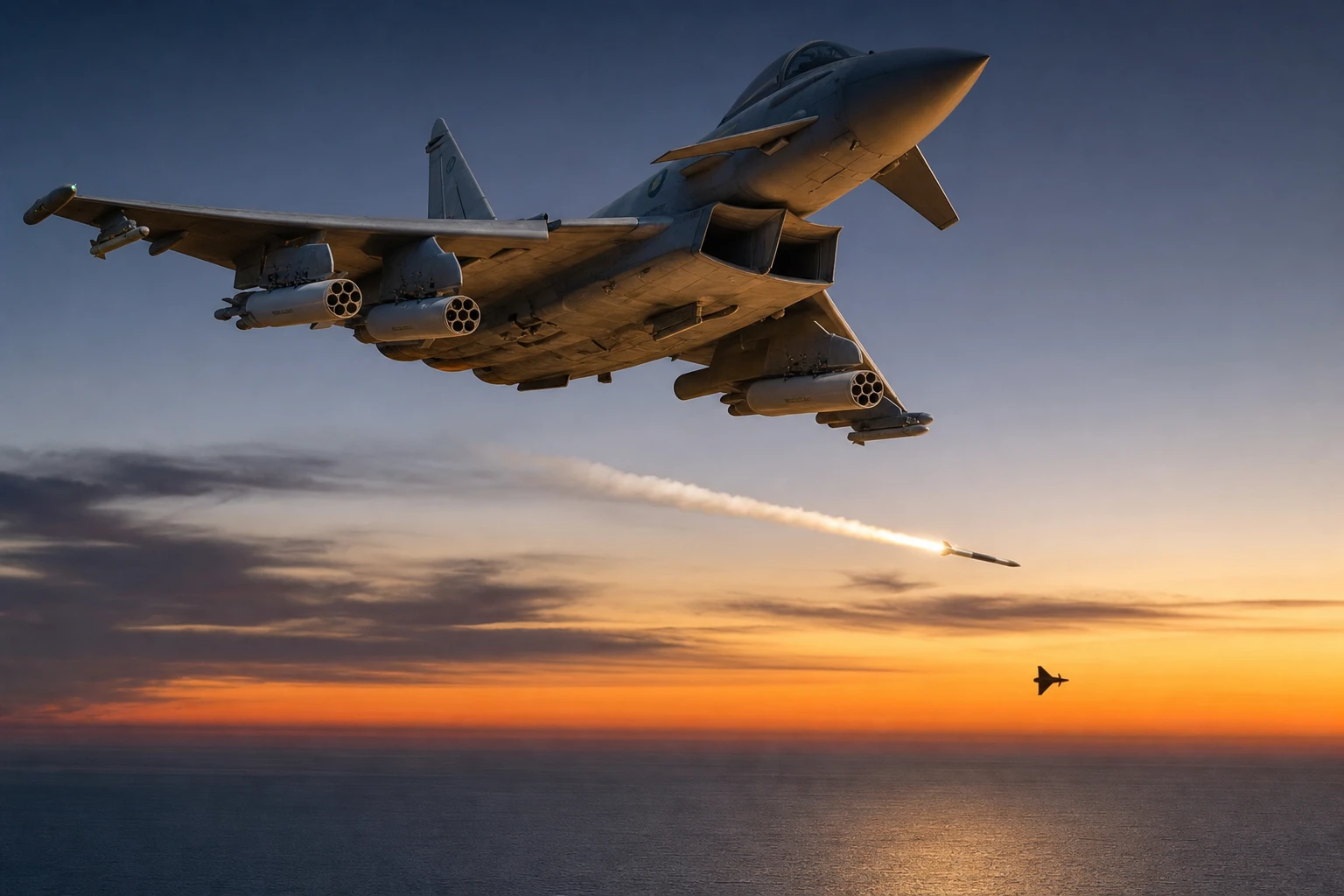
- LAU-131 A/A launchers, the seven-shot rocket pods that mount under a jet’s wings
- Mk-152 high explosive warheads, the payload that detonates on impact
- Mk66 rocket motors, the Hydra propulsion stage that gives each kit its thrust
- Proximity fuzes, practice warheads, spare parts and training support for Saudi crews
The department also said implementation would send 15 additional U.S. government officials and 15 contractor representatives to Saudi Arabia for an extended period to handle technical reviews, training and maintenance. BAE Systems, the British defense contractor, will build the kits through its operation in Nashua, New Hampshire.
Neither of Riyadh’s frontline jets needs modification to carry it. The Royal Saudi Air Force already flies the Eurofighter Typhoon and the F-15SA, the same platforms the Royal Air Force and the U.S. Air Force and Navy have used to intercept Iranian drones during the current conflict, so Saudi crews can draw directly on lessons those allied air forces have already learned in combat.
Riyadh Struck Sanaa Days Before Washington Signed Off
The approval follows a rapid unraveling of a truce that had held since 2022. Saudi Arabia struck Sanaa’s airport to block an Iranian plane carrying a Houthi delegation from landing after Iranian Supreme Leader Ali Khamenei’s funeral. The flight diverted to a Houthi-held airport on Yemen’s Red Sea coast instead.
Houthi forces responded with missiles and drones aimed at Abha International Airport in southern Saudi Arabia. Saudi officials said air defenses intercepted the threat, though the exchange rattled commercial aviation fast enough that Air Cairo pulled its Abha route within days. Houthi leader Abdul-Malik al-Houthi warned that Saudi oil facilities would become targets if Riyadh pressed further into what he called “comprehensive aggression.”
None of this is happening in isolation. The United States and Iran have traded strikes for months since fighting broke out in late February, an exchange that widened again this week along the Strait of Hormuz, where both sides hit targets for a third straight night. Iranian forces have also struck U.S. facilities in Bahrain and Kuwait in the same window, part of what Tehran has called retaliation for renewed American strikes on Iranian territory.
The Math Behind Every Drone Intercept
Set the weapons side by side and the appeal of APKWS II gets obvious fast. A guidance kit costs a small slice of what the missiles fighter pilots fired at drones before it existed.
| System | Approx. Unit Cost | Primary Role |
|---|---|---|
| APKWS II guidance kit | $15,000 to $40,000 | Converts a 70mm rocket into a laser-guided drone interceptor |
| AIM-9X Sidewinder | About $450,000 | Short-range air-to-air missile |
| AIM-120 AMRAAM | About $1 million | Medium-range air-to-air missile |
| Patriot interceptor | About $4 million | High-end ground-based air defense missile |
| Shahed-136 drone | $20,000 to $50,000 | Iranian one-way attack drone used against Gulf targets |
A 2025 report for the Center for a New American Security put APKWS II’s price between $25,000 and $40,000, still a rounding error against a Patriot round. John Waters, a former Air Force F-16 pilot, told Defense One that sending America’s best jets after Shahed-style drones is like using a hammer on a nail already flush with the wall, arguing that “F-35s and F-22s are overkill when it comes to shooting down a drone.”
U.S. Central Command’s Adm. Brad Cooper has said publicly that the military has leaned harder into cheaper interceptors as the drone fight has stretched on. Saudi Arabia, after years of absorbing Houthi drone and missile fire across its southern border, is making the identical calculation with its own fighter fleet.
Why This Deal Skips Israel’s Usual Fight
Big Saudi arms requests typically set off alarms over Israel’s qualitative military edge (QME), a legal standard, codified in 2008, that requires Washington to certify that no Middle East sale erodes Israel’s military superiority. Saudi Arabia’s pending request for 48 F-35 jets has drawn exactly that kind of pushback. Rocket guidance kits have not.
Analysts in both countries read this deal differently than they read a jet sale. Saudi Arabia has not fought a war with Israel in nearly 80 years. It has, however, absorbed repeated Houthi drone and missile attacks out of Yemen, including strikes within the past week. A kit that shoots down Shaheds does not touch the fighter-on-fighter calculus that actually worries Jerusalem.
Protects expensive Patriot missile stockpiles from being depleted by cheap drone swarms.
Zafer Al Ajami, a retired Kuwaiti Air Force colonel and defense analyst, told Breaking Defense that the guidance kits turn ordinary rockets into precision weapons that spare costlier interceptors for bigger threats, and he described the sale as a pragmatic reset in the U.S.-Saudi relationship driven largely by the Houthi threat.
Although Israel and Saudi Arabia maintain no formal diplomatic relations, the two countries have quietly cooperated on shared security concerns for years, often with U.S. support. The Israeli Air Force has built up its own extensive experience intercepting drones with crewed aircraft, and that expertise is likely to reach Saudi Arabia indirectly, through regional partners such as Jordan and the United Arab Emirates.
A Familiar Playbook for Riyadh
Cheap rockets are a new chapter in an old pattern. Washington has weighed Saudi arms requests against Israel’s edge since the Reagan era, and Riyadh has kept coming back for more.
- 1981: The Reagan administration proposed selling AWACS radar planes to Saudi Arabia, the first real test of the qualitative military edge standard and a sale that drew strong objections from Jerusalem.
- 2011: Saudi Arabia ordered roughly $60 billion in American aircraft, including 84 new F-15s and helicopter upgrades, with Israeli firms reportedly supplying about $4 billion in components for the jets.
- 2017: The Trump administration announced a $110 billion arms package during a Riyadh visit; by late 2018, Saudi Arabia had followed through on only about $14.5 billion of it, according to reporting cited by Responsible Statecraft.
- March 2025: Saudi Arabia placed its first APKWS II order, a $100 million deal for 2,000 guidance kits.
- July 2026: The State Department cleared the current $1.96 billion request for 20,000 more kits, a tenfold jump in quantity in under a year and a half.
The Washington Institute has tracked how arms sales became leverage over Saudi behavior, including a 2021 U.S. ban on offensive weapons transfers that Riyadh worked to lift by curbing civilian harm in Yemen. Fighter jets test that leverage every time. Rocket guidance kits barely register on the same scale.
The Volume Problem Cheap Rockets Can’t Solve
None of this guarantees Saudi Arabia wins the drone math. Iran’s own production was running at roughly 2,000 Shahed-class drones a month as of April, according to tracking of the Shahed-136’s cost and production rate, a volume that outpaces what any single country can intercept, however cheap the rockets get.
The same tracking estimates that Gulf state air defenses stopped 93 to 94 percent of a late-February Iranian saturation attack spread across several countries. That sounds like a win until the arithmetic runs the other way: even a defense that stops nearly all incoming drones in a mass raid still lets some through, and the ones that get through still do damage.
The broader war feeding that drone traffic hasn’t slowed down. Fighting between the U.S., Israel and Iran has run since late February, and this week’s strikes along the Strait of Hormuz suggest neither side is backing off soon. Congressional notification is also only a first procedural step, not a signed contract, and Saudi Arabia could still adjust the quantities or timeline before a single rocket changes hands.
Frequently Asked Questions
What is APKWS II?
APKWS II, short for Advanced Precision Kill Weapon System II, is a laser guidance kit built by BAE Systems that slots into an ordinary 70 millimeter Hydra rocket, turning a decades-old unguided munition into a precision-guided interceptor capable of hitting drones and other slow-moving targets.
How much does the Saudi Arabia arms deal cost?
The State Department valued the package at $1.96 billion for up to 20,000 guidance kits, launchers, warheads and support equipment. That works out to roughly $98,000 per kit on average, well above the standalone unit cost, because the total bundles training, spare parts and years of contractor support alongside the rockets themselves.
Does the sale threaten Israel’s military edge?
U.S. law requires Washington to certify that Middle East arms sales do not erode Israel’s qualitative military edge, a standard codified in 2008. Analysts say cheap defensive rockets do not test that standard the way Saudi Arabia’s pending request for 48 F-35 jets does, a request that drew a formal objection from the Israeli Air Force.
When will Saudi Arabia receive the rockets?
There is no firm timeline yet. Congressional notification is only a first procedural step, not a signed contract, and quantities or delivery schedules can still change. Saudi Arabia’s experience with other U.S. systems offers a caution: it bought THAAD missile defense batteries in 2018 and, by some estimates, is still waiting on delivery around 2026.
Has Saudi Arabia bought APKWS II before?
Yes. Riyadh signed a $100 million deal for 2,000 APKWS II kits in March 2025, its first purchase of the system. The new request covers 20,000 more, a tenfold jump in volume in under a year and a half.
