
The Timeless, an Egyptian luxury leather label founded in Cairo, builds handmade goods around a single proposition: that leather’s origin in North Africa, some 120,000 years ago, gives a Cairo brand the oldest heritage argument in fashion. Co-founders Nada Mohamed and Fathia Salama spent years in deliberate conversation before producing a single piece, working from the premise that a continent that gave the world its first wearable material still has something to teach it about how that material is made.
The global fashion industry they are entering generates, per the United Nations Environment Programme, 92 million tonnes of textile waste each year, a volume that has roughly doubled since 2000. Mohamed and Salama, who spent years in conversation before launching anything at all, are selling the opposite of a trend cycle.
A Name That Took Years to Earn
“For years, the idea of creating a brand remained only a conversation between us,” co-founder Nada Mohamed told SceneStyled, the Cairo-based fashion publication. “We never wanted to build something simply to follow trends.”
The frustration the founders identified had a specific shape. Modern fashion, in their reading, had become repetitive: the same silhouettes recycled under different labels, the same seasonal urgency to buy and then replace. “Everything started looking the same,” Mohamed said. What they were looking for was individuality, craft, and what she called “emotional connection,” qualities that the fast-fashion cycle had largely displaced.
Their answer was a label named for what they intended to produce rather than who they were or where they worked. The name carries its own brief: objects with no fixed season, built to outlive whatever trend is currently dominant. By the time the founders began producing, the years of deliberation had already shaped the philosophy as thoroughly as any design brief.
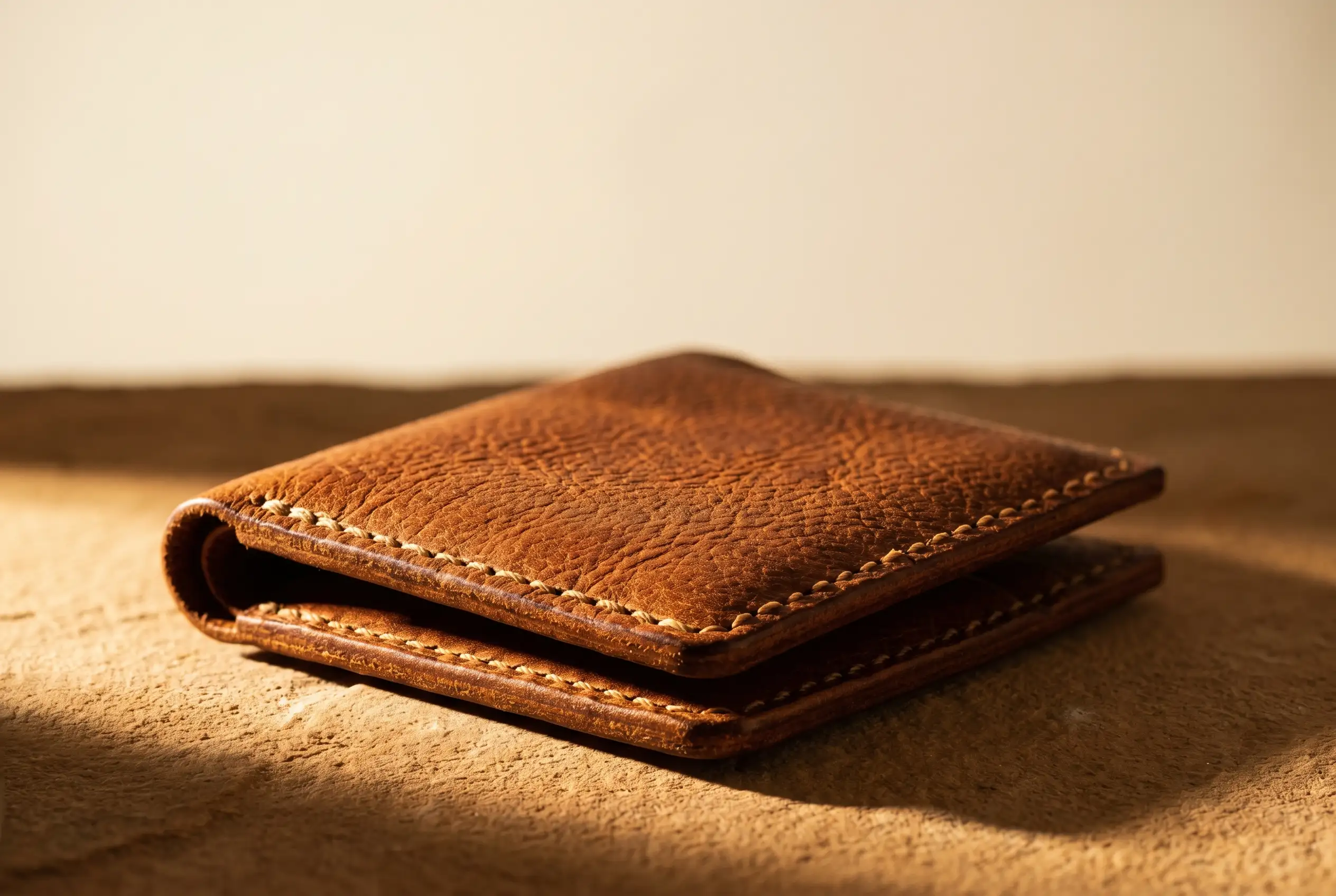
Every item is handmade. The visible irregularity of a hand-cut edge or an imperfect stitch is deliberate rather than incidental: it marks each piece as the work of a specific person in a specific moment, impossible to replicate exactly. Machine-stamped goods age anonymously; a handmade piece creases according to who carries it, accumulating the particular history of its owner over years of use.
“Leather, to us, is far more than material,” Mohamed told the publication. “It carries memory, emotion, protection, history, and human connection. There is something deeply human about leather the way it ages, softens, changes, and becomes more beautiful over time.”
Where Fashion’s First Material Was Born
The brand’s founding claim has archaeology behind it. A 2021 study led by paleoanthropologist Curtis Marean of Arizona State University (ASU) and published in the journal iScience described the analysis of bone tools recovered from Contrebandiers Cave on Morocco’s Atlantic coast, with deposits dated to between 120,000 and 90,000 years old. The implements, including lissoirs, scrapers, and pointed bone awls, carry the precise wear patterns of hide-working: smoothing animal skins, removing fur, preparing leather for use.
Emily Hallett, the study’s lead author and a researcher at the Max Planck Institute for the Science of Human History in Germany, noted that the tools are functionally indistinguishable from instruments leatherworkers still use. Marean described the Contrebandiers assemblage as the oldest bone tool industry in the archaeological record, and the most direct evidence yet for intentional clothing manufacture at that depth of time in North Africa. Earlier genetic studies, which Hallett cited in the research, estimate that clothing lice diverged from head lice roughly 170,000 years ago, suggesting the practice of wearing sewn garments predates even those tools.
The relevance to a Cairo-based label is geographic and logical. Morocco sits on the same North African coast as Egypt. When European fashion houses build their heritage narratives around centuries of tannery craft, they are working with a tradition whose deepest roots, by current archaeological evidence, trace to this continent. To Nada Mohamed and Fathia Salama, that provenance is the founding logic. The argument is that leather has an African origin story, and a label built in Cairo is closer to it than any Parisian atelier has ever been.
Egypt’s Blueprint for Permanence
The philosophy of the label does not come solely from leather’s archaeological record. It comes from the country its founders grew up in.
Coming from Egypt deeply influences the way we think about permanence. Historically, Egyptians did not create only for the present moment; they created with eternity in mind. We believe this philosophy still exists culturally, even subconsciously.
Mohamed shared this with SceneStyled, and it is perhaps the brand’s most compressed mission statement. Egyptian civilization produced objects across three millennia built to outlast their makers, an intention visible in burial objects, furniture, clothing, and jewelry crafted to be useful in another life. The burial object is the more revealing example than the pyramid: the object placed beside its owner was functional by design, made for a purpose that extended beyond any single lifetime.
That instinct, creating for eternity rather than for the moment, is what the founders carry into leather design. The silhouettes are contemporary in shape, but the calculation behind each piece asks: has this accumulated the owner’s memory rather than discarded it at the end of a trend cycle?
“We are not interested in designing for a single season,” Mohamed said. “We want to create pieces that naturally become part of a person’s life and wardrobe over time, designs that age beautifully, carry memories, and still feel elegant years later.”
“To us, real luxury is not about constantly replacing things,” she added. “It is about owning pieces you continue choosing, loving, and returning to for years.”
The Workshop Behind Each Piece
The leather comes from multiple countries, each chosen for its distinct craft tradition. The founders did not anchor the brand in a single national leather story; they drew from several, deliberately. The sourcing geography shifts with each new material, and every country of origin brings its own history of tanning, curing, and finishing to what eventually becomes a finished piece in Cairo.
“In many ways, each piece becomes a meeting point between cultures,” co-founder Fathia Salama told SceneStyled. The artisans who produce the pieces reflect that range: they come from varied national backgrounds and bring different working methods and techniques to shared production. No single tradition dominates the workshop.
“It was never built by a single perspective,” Salama said. “It was shaped by many hands, many stories, and many cultural influences united through one shared language: timeless quality and design.”
The founding principles of the label, stated plainly:
- International sourcing: leather drawn from multiple countries, each selected for its distinct craft heritage and material character
- Multi-national artisan network: makers from varied national backgrounds bringing different techniques to a shared production philosophy
- Every piece handmade, with natural variation ensuring no two objects are identical
- No seasonal collections; pieces designed to be chosen once and kept for decades
The last point matters in the context of how leather ages. An object tied to a trend depreciates aesthetically when the trend passes. A piece with no trend attachment accumulates texture and patina according to its specific use, becoming more distinctive over years rather than less relevant.
Can Permanence Win in a Disposable Market?
The global luxury leather goods segment that The Timeless is entering was valued at $64 billion in 2025, per SkyeQuest market data, and is projected to grow to more than $105 billion by 2033 at a compound annual growth rate of 6.4%. The dominant players, Louis Vuitton, Gucci, Hermès, Prada, have spent decades building heritage narratives anchored in European craft lineages. Hermès’ flagship bags carry waiting lists measured in years and prices that have historically appreciated faster than many conventional asset classes.
Against that concentrated field, the Cairo label enters with one coherent argument: that the continent where leather was worked 120,000 years ago has an older claim to the material’s story than any atelier in Milan or Paris. Whether that argument translates into a loyal customer base is the market test the founders will face. What the data suggests is that the appetite for heritage craftsmanship in luxury leather is real and growing, particularly among buyers who are also watching the broader waste record of the industry they shop from.
The UNEP’s assessment of fashion’s waste record found that textile production doubled between 2000 and 2015, while the average duration of garment use fell by 36% over the same period. Researchers tracking sustainable fashion production at the Geneva Environment Network note that buyers purchased 60% more garments per person in 2014 than in 2000, keeping each for roughly half as long, citing McKinsey data. That trajectory has not reversed.
| Attribute | Fast Fashion Model | The Timeless Approach |
|---|---|---|
| Production method | Industrial, automated; leading fast-fashion brands deliver new designs in as few as 10 days | Fully handmade; each piece the work of skilled artisans, no two identical |
| Primary material | 69% of global textile fibers synthetic, predominantly polyester | Natural leather sourced internationally, each origin chosen for craft tradition |
| Garment discard rate | 85% of garments discarded within a year of purchase | Designed for decades; leather patinas and improves with use |
| Design cycle | Multiple seasonal drops per year; trend-dependent design | No seasonal collections; silhouettes designed for longevity across decades |
| Environmental waste | 92 million tonnes of textile waste generated globally per year (UNEP) | Single object, used and maintained over a lifetime |
The global leather goods market across all segments was valued at over half a trillion dollars in 2025, and the houses that dominate it have been building heritage arguments for a century. The founders of The Timeless are building one from Cairo, from a continent where the evidence for leather-working runs deeper than any European atelier can claim.
Frequently Asked Questions
What Is The Timeless?
The Timeless is an Egyptian luxury leather brand based in Cairo, founded by Nada Mohamed and Fathia Salama. The label produces handmade leather goods, with each piece made by artisans of diverse national backgrounds and designed to be owned for decades rather than replaced seasonally. No two pieces are identical, and the brand follows no trend cycle or seasonal collection calendar.
Who Founded The Timeless?
The brand was co-founded by Nada Mohamed and Fathia Salama, two Egyptian designers who spent several years in deliberate conversation developing the brand’s philosophy before releasing any product. Both founders describe patience as intrinsic to the label’s character: the time spent before launching was, in their view, part of building something worth building.
Where Does The Timeless Source Its Leather?
Leather comes from multiple countries, each selected for its distinct craft tradition and material character. The artisans who produce the pieces also come from varied national backgrounds, which the founders describe as giving the brand a cross-cultural identity rooted in shared quality standards rather than a single national heritage.
How Does The Timeless Differ From Fast Fashion Brands?
The label produces no seasonal collections and follows no trend cycle. Every piece is fully handmade, ensuring each object is unique, and the founding philosophy holds that a well-made leather piece should improve in character with use over years, accumulating its owner’s specific history with wear.
What Does Egyptian Heritage Bring to the Brand’s Design Philosophy?
The founders point to a cultural inheritance from ancient Egyptian civilization, which built objects across millennia with the explicit intention that they would outlast their makers. Co-founder Nada Mohamed describes this orientation toward permanence as something that still exists in Egyptian culture, even subconsciously, and that carries directly into how the brand approaches design and production.
