
Egypt’s economic growth faces a potential cut of between 1.5 and 2.5 percentage points if geopolitical tensions in the Middle East persist, the African Development Bank (AfDB) warned in its African Economic Outlook 2026 (AEO 2026), released May 26 in Brazzaville. The bank named Egypt among Africa’s most exposed economies, pointing to simultaneous pressure on four of the country’s main hard-currency earners: Suez Canal transit fees, tourism receipts, foreign direct investment, and remittances from Egyptians working in Gulf states.
The warning arrives as Cairo is seven months into the final stretch of an eight-review IMF program, with two significant disbursements scheduled through December 2026; the next assessment is set for June 15.
Egypt’s Four-Channel Vulnerability, per AfDB
Africa’s flagship development bank published the AEO 2026 during its annual meetings in Brazzaville under the theme “Mobilising Africa’s Development Financing at Scale in a Fragmented World.” For the continent as a whole, Africa is projected to grow at 4.2 percent in 2026, easing from 4.4 percent in 2025, with continental inflation expected to stay above 10 percent. Twenty-two African economies posted growth rates above 5 percent in 2025, and 13 of the 20 fastest-growing economies globally were on the continent.
Egypt’s position within that outlook carries a specific structural weight. The country sits at the junction of the Suez Canal and the Bab al-Mandab Strait, two maritime chokepoints that have been inside active conflict zones since Yemen’s Houthi movement began striking commercial vessels in late 2023. The AfDB identified that geography as the core of Egypt’s vulnerability: a location at the crossroads of global trade and regional politics that historically supported growth now concentrates geopolitical risk in a way few other African economies face.
The bank’s downside scenario ties the 1.5-to-2.5-percentage-point growth cut to prolonged regional instability that suppresses each of the four foreign-currency channels simultaneously. It also flagged a compounding exposure: as a net energy importer, Egypt faces rising oil and gas costs at precisely the moment that conflict pushes revenue streams lower. The AfDB emphasized that sustained domestic reforms can help the country absorb such shocks, but those reforms take time, and the shocks are already in motion.
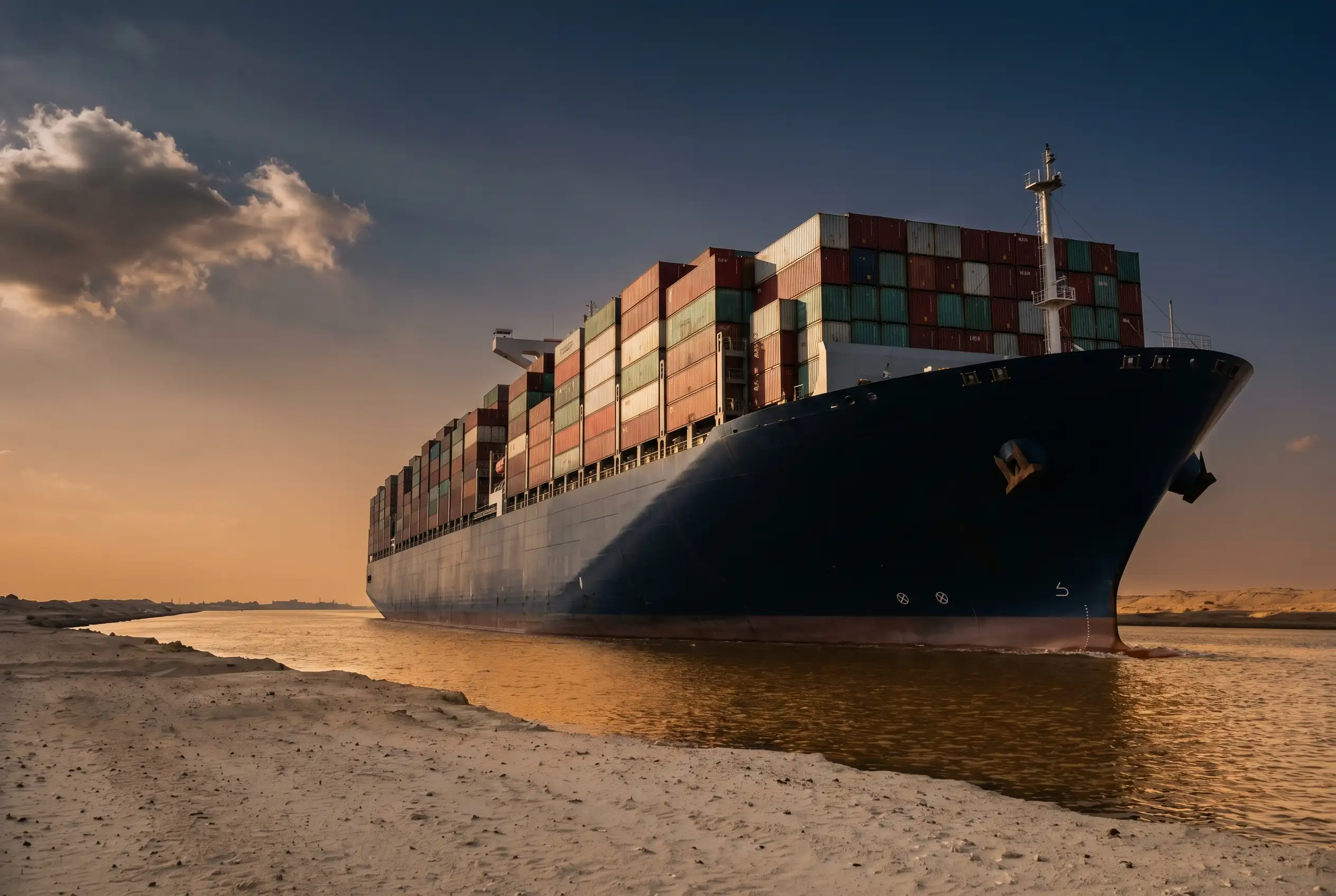
Suez Canal’s $10 Billion Revenue Gap
Before Yemen’s Houthi movement launched its first strikes on Red Sea shipping in late 2023, the Suez Canal Authority (SCA) was generating record income. Annual revenues reached $10.25 billion in 2023, transit fees running above $700 million a month. From 2019 to 2024, more than 121,000 ships had passed through the waterway, carrying over 7.1 billion tons of cargo and generating nearly $40 billion in cumulative revenue. Canal fees accounted for roughly 10 percent of Egypt’s government current revenues, per Coface country-risk analysis.
What followed was a collapse of more than 60 percent in a single year. Full-year 2024 revenues settled at $3.99 billion as Maersk, Hapag-Lloyd, and CMA CGM rerouted their fleets around Africa’s Cape of Good Hope rather than risk the Bab al-Mandab passage. Thousands of extra kilometers per voyage, higher freight premiums, and no Suez toll receipts. President Abdel Fattah al-Sisi, speaking in Cairo on May 4 during a meeting with OECD Secretary-General Mathias Cormann, put the cumulative shortfall since late 2023 at $10 billion.
The SCA offered fee discounts to attract shipping lines back. Canal Authority chairman Osama Rabie had forecast normal traffic by mid-2026; the regional escalation of early 2026 pushed that timeline further out. The canal remains operational but severely underutilized, carrying well below the capacity that once handled roughly 12 percent of global shipping traffic. Egypt’s government set up a national crisis operations room with hourly reporting to the Prime Minister on energy, food, and trade conditions.
Tourism, Remittances, and the Gulf Connection
Two of Egypt’s four AfDB-flagged channels are currently running well, which is where the forward risk sits. Tourism revenues reached $14.4 billion in fiscal year 2023/24, a more than 30 percent jump in a single year, and IMF projections put the figure near $19.9 billion for the current fiscal year; Egypt recorded 20 percent growth in international tourist arrivals in 2025, topping global rankings on that measure. Remittances outperformed even that: inflows hit a record $41.5 billion in 2025, driven largely by millions of Egyptians working in Gulf states. The exchange-rate unification of March 2024, which aligned Egypt’s official and parallel currency markets, shifted a large share of transfers back through formal banking channels and sharply boosted the officially measured total.
The IMF’s February 2026 review statement credited both channels (strong remittances and robust tourism receipts) with narrowing Egypt’s current account deficit to 4.2 percent of GDP in fiscal year 2024/25.
In early 2024, the UAE committed $35 billion to Ras el-Hekma, a tourism and economic zone on Egypt’s Mediterranean coast, the largest FDI inflow on record in the country. Gulf sovereign wealth funds have been Egypt’s most consistent source of external capital; any sustained contraction in Gulf oil revenues under regional conflict would pressure that investment pipeline alongside the remittance flow.
An Arab Reform Initiative analysis from April 2026 calculated that GCC-based remittances account for roughly 5 percent of Egypt’s GDP. If Gulf host economies contract, Egyptian workers face layoffs, reduced wages, and repatriation. Tourism faces a connected risk: sustained regional conflict reduces international travel confidence, including for destinations not directly in a war zone.
Oil Imports and Fiscal Constraints
Egypt is a net importer of energy. The IMF’s April 2026 Regional Economic Outlook for the Middle East and Central Asia estimated that Egypt draws a substantial share of its oil from Gulf states and relies on natural gas from Israel for just under 20 percent of its total oil and gas imports. Both supply lines sit within regions where the current conflict cycle has caused disruptions.
An Atlantic Council analysis from March 2026 estimated that each $10 rise in global oil prices worsens Egypt’s current account balance by approximately $2.5 billion. Under a severe geopolitical scenario, the same study projected the current account deficit widening from a baseline of $15 billion toward $24 billion, against approximately $59 billion in reserves and $27 billion in external debt service due in 2026.
The government raised retail fuel prices by an average of 17 percent in April 2026, citing exceptional geopolitical developments. It was the second fuel price adjustment in twelve months, following an earlier round linked to subsidy reform commitments under the IMF program. Around 30 percent of Egypt’s population of more than 108 million lives below the poverty line, per Egyptian government figures, making each adjustment politically sensitive alongside the fiscal rationale.
Egypt’s fiscal position limits the cushion available. Interest payments on public debt absorb more than half of total government expenditures, with debt near 90 percent of GDP. Foreign holdings of Egyptian government bonds and treasury bills ran between $45 billion and $50 billion as of early 2026, per analyst estimates. The sensitivity was visible in February 2026: roughly $1.12 billion exited Egyptian debt markets in the days following a regional military escalation, briefly pressing the pound toward 48 per US dollar before conditions partially stabilized.
The IMF Reform Score Card
Gains Since March 2024
Cairo’s macro trajectory since the March 2024 exchange-rate overhaul has been one of the stronger reform stories in the region. Real GDP grew 4.4 percent in fiscal year 2024/25, up from 2.4 percent the prior year, and accelerated to 5.3 percent year-on-year in the first quarter of fiscal 2025/26. Inflation fell to 11.9 percent in January 2026, down from above 35 percent at its 2023 peak. Tax revenues grew 36 percent in FY2024/25, driven by base-broadening measures and improved compliance; the primary fiscal surplus reached 3.5 percent of GDP. Gross foreign reserves rose to $59.2 billion by December 2025 from $54.9 billion a year earlier.
Completing Egypt’s combined fifth and sixth program reviews on February 26, the IMF released approximately $2.3 billion, split between the Extended Fund Facility (EFF, the 46-month rescue arrangement approved in December 2022) and the Resilience and Sustainability Facility (RSF, which funds climate and governance reforms). The fund credited Egypt with a “broad-based economic recovery.” Since 2016, Egypt has agreed to four successive IMF programs; the current EFF, expanded to $8 billion in March 2024, is the largest of those commitments. It has been extended through December 15, 2026.
The Review Calendar
Two disbursements remain under the program. The 7th review, scheduled for June 15, carries a potential $1.65 billion. The 8th and final review follows on November 15 with an equal amount, both contingent on meeting reform milestones.
| Review | Scheduled Date | Disbursement | Key Condition |
|---|---|---|---|
| 5th and 6th (combined) | February 26, 2026 | ~$2.3 billion | Exchange rate flexibility, disinflation |
| 7th | June 15, 2026 | $1.65 billion | Structural reforms, state divestment |
| 8th | November 15, 2026 | $1.65 billion | Continued reform momentum |
The IMF has been specific about where reform has lagged. In the February 2026 statement, the fund’s chair made clear where progress had stalled:
To foster resilience and support dynamic, inclusive, and export-led growth, decisive efforts to reduce the state’s footprint in the economy will be essential.
Nigel Clarke, IMF Deputy Managing Director and Chair, issued that statement at the conclusion of the February 26 review. The core complaint is divestment: selling state-owned enterprises and scaling back military-linked commercial activities has moved “slower than envisaged,” per the fund’s own assessment. Egypt’s tax revenue-to-GDP ratio runs below 13 percent, among the lowest for any middle-income economy. The state’s commercial footprint extends beyond public enterprises; military-affiliated businesses compete across sectors from food processing to construction, often outside the regulatory and tax framework that applies to private competitors. The divestment agenda and tax base expansion are the two structural conditions flagged for the June review.
Diversifying Financing Away From Transit Fees
AfDB’s prescription for Egypt in the AEO 2026 centers on building revenue sources that geopolitical disruption cannot interrupt overnight. The bank’s key recommendations:
- Broadening the tax base and strengthening domestic revenue mobilization
- Deepening capital market development to attract long-term institutional investors
- Expanding financial inclusion to channel more economic activity through formal systems
- Scaling public-private partnerships (PPPs) for infrastructure funding without adding to sovereign debt
- Issuing green bonds and diaspora bonds, the latter targeting Egyptians abroad as a direct source of foreign-currency investment
The AfDB has already backed at least one of those instruments in Egypt. The bank co-led a $476 million blended-finance package for a 1GW solar power plant in Egypt’s Nagaa Hammadi region, alongside the European Bank for Reconstruction and Development (EBRD) and British International Investment (BII), structured to draw private capital into infrastructure the sovereign balance sheet couldn’t carry alone.
Africa’s annual development financing gap exceeds $1.3 trillion, per the AEO 2026 findings, a shortfall the AfDB says demands a fundamental rethinking of how African countries mobilize capital. Egypt’s challenge is a concentrated version of that continental problem, with a reform program clock running down to December.
Egypt’s seventh IMF program review is scheduled this month; the EFF arrangement runs through December 15, with two disbursements remaining.
