
Sierra Nevada Gold (ASX:SNX) has cut high-grade copper mineralisation from surface to past 200 metres vertical depth in the first four holes of its maiden drill campaign at the As Safra copper-gold project in Saudi Arabia, confirming continuous mineralisation across the central target and validating the geological model the junior has promoted since the licence was awarded. The holes sit on a 5.5-kilometre mineralised corridor that the junior controls along the Arabian Shield, with Phase 1 covering just 400 metres of strike. The 28-hole program ran 5,400 metres total, including 12 diamond holes and 16 reverse-circulation holes (two with diamond tails).
The numbers landed as Saudi regulators work through one of the more deliberate mining framework overhauls in the region, putting copper and gold at the centre of an economic pivot that has run for almost a decade. For SNX, this campaign is the first hard test of a district-scale thesis the geologists laid out before the rigs arrived. The early intersections suggest the thesis is holding, though the company itself is firm about how much of the corridor sits untouched.
Four Holes, One Promising Confirmation
The four headline holes at As Safra Central returned continuous copper mineralisation, with each one running more than a dozen metres of better-than-1% copper. ASDD0002 cut 17 metres at 1.26% Cu from 25 metres, including 3 metres at 4.59% from 38 metres. ASDD0003 followed with 16 metres at 1.20% Cu from 75 metres, with a higher-grade section of 4.6 metres at 3.19% from 81 metres. ASDD0001, the deeper hole, hit 13 metres at 0.93% Cu from 211 metres, including 5 metres at 1.77% from 214 metres. ASRCD0001 intersected 16 metres at 0.90% Cu from 41 metres, including 5 metres at 1.51% from 43 metres.
Set side by side, the four holes tell a story of mineralisation that holds together both near surface and at depth.
| Hole ID | Main intersection | Including |
|---|---|---|
| ASDD0001 | 13m at 0.93% Cu from 211m | 5m at 1.77% Cu from 214m |
| ASDD0002 | 17m at 1.26% Cu from 25m | 3m at 4.59% Cu from 38m |
| ASDD0003 | 16m at 1.20% Cu from 75m | 4.6m at 3.19% Cu from 81m |
| ASRCD0001 | 16m at 0.90% Cu from 41m | 5m at 1.51% Cu from 43m |
The combination confirms mineralisation from the top of the bedrock to more than 200 metres below surface, and pushes the central target from a surface signature into a vertically continuous copper system. None of the four holes has closed off the mineralisation along strike or at depth, and the company says drilling to date has only touched the central part of a much longer target.
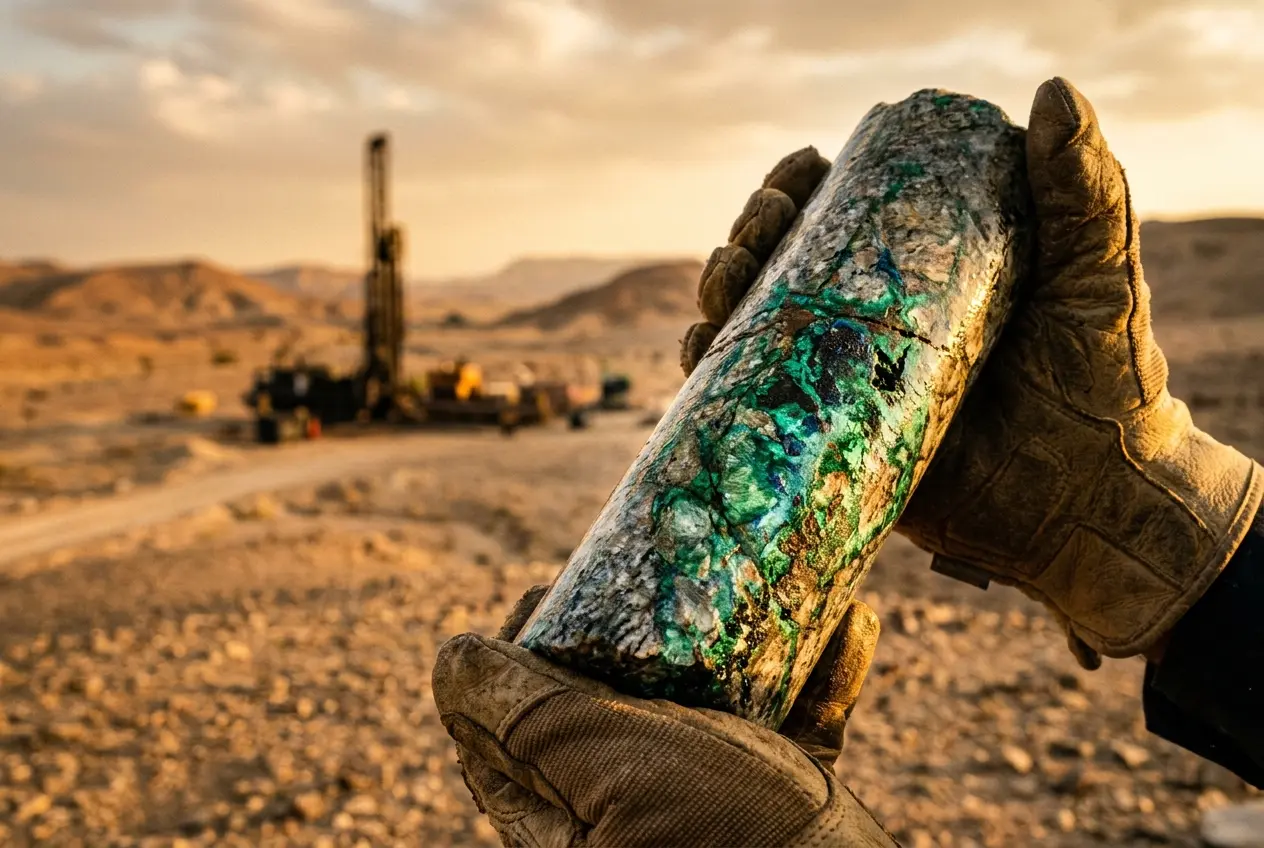
Copper and Silver, Read Together
The silver numbers are quietly important to the geological read. Hole ASDD0002 also returned 3 metres at 27.34 g/t silver from 38 metres, sitting directly alongside its copper intersection. SNX says that pairing supports the interpretation of a polymetallic system and points toward feeder-style mineralisation. Silver is one of the chemical vectors that flags intrusion-related copper systems, and the company is treating the silver signal as a clue worth following into the next round of drilling.
These initial results validate our geological model and confirm As Safra hosts a large, vertically continuous copper system. These initial results are only from 400m of mineralised strike of a 5.5-kilometre mineralised corridor, with drilling completed across less than a quarter of the currently mineralised trend. Combined with our recent geophysical datasets, we believe As Safra has the potential to evolve into a significant copper discovery.
The quote comes from SNX CEO Adam Oehlman, given alongside the assay release. His framing was deliberately narrow: he tied the polymetallic read to the gold and silver already in the system, then pointed to the geophysical datasets as the tool that decides what comes back from the lab in the coming weeks.
Sierra Nevada Gold’s As Safra project overview lays out the geological model behind the drill campaign. The system is interpreted as a large intrusion-related copper-gold deposit with metal zonation running from a central copper-gold core outward into silver-lead-zinc domains. High-grade surface sampling on the project has returned copper values above 11% and gold grades up to 244 g/t. The drill cores are now confirming that zonation, with copper near the centre, silver alongside it, and the wider polymetallic halo still to be tested.
That halo matters because the source of the copper in intrusion-related systems is a feeder pipe at depth. Silver, along with bismuth and tellurium associations in the rocks, is one of the chemical clues that point at the feeder. The four holes have given the technical team enough signal to keep chasing it. The next round of geophysics, including magnetics, gravity and induced polarisation, will tell the team where to point the drill bit.
The 5.5 Kilometres That Haven’t Been Touched
Phase 1 confirmed copper across the central target. Phase 1 did not come close to covering the corridor itself, and SNX has been clear on this point. The headline numbers make it stark: 400 metres of mineralised strike tested, 5.5 kilometres of mapped mineralised corridor, with most of the corridor still sitting in the data-collection stage. Within the central area, visible sub-cropping copper mineralisation and ancient workings have been sampled across a continuous northeast-trending corridor of more than 1,200 metres, and surface programs have confirmed copper-gold mineralisation over a 5.5 by 0.6-kilometre footprint.
The prior work on the same structures stretches back further than SNX’s tenure. Historic drilling by BRGM identified sulphide-rich mineralisation including 24.55 metres at 1.69% copper and 5 metres at 4.07% copper, intersections the company has cited as it built out its own drill plan. Historical rock chip assays earlier returned copper values above 11% and gold grades up to 244 g/t. SNX’s drill bit is the first systematic modern test of those signatures, and it has now hit them in four out of four holes at the central target.
- 400 metres of mineralised strike tested in Phase 1
- 5.5 kilometres of mapped mineralised corridor on the licence
- 5.5 by 0.6 kilometres continuous copper-gold surface footprint
- 5,400 metres drilled across the 28-hole first phase
- Historic BRGM drilling returned 24.55m at 1.69% Cu and 5m at 4.07% Cu
The rest of the corridor is still at the data-collection stage. Gravity, magnetic and induced-polarisation surveys are layering the picture beneath the surface samples. Historical induced-polarisation work has flagged multiple chargeability anomalies interpreted as potential sulphide accumulations at depth, and large portions of the project remain covered by thin transported material that may be hiding similar systems. The drill bit has not been near the deeper, wider targets those surveys are pointing at.
Why the Saudi Mining Pitch Has Sharpened
SNX moved into Saudi Arabia at a moment when the country’s mining pitch was being rebuilt from the rulebook up. The Saudi Vision 2030’s mining sector strategy puts mining as the third pillar of national industrial growth alongside oil and petrochemicals, with the explicit goal of unlocking the Kingdom’s vast mineral potential. The practical payload for explorers has been a modern mining framework with streamlined permitting, exploration incentives, and the geological datasets generated by the Saudi Geological Survey. SNX runs its Saudi work through a wholly owned local subsidiary, Arabian American Minerals, which puts an operating footprint on the ground the regulator recognises.
SNX has received strong support from key government agencies in the Kingdom of Saudi Arabia, speeding the As Safra project from award to full Exploration Licence grant.
The quoted statement came from SNX alongside the drill results, and it captures the operational signature of a jurisdiction that wants to be discovered. From licence award to drill results, the speed is the unusual part. The same reform backdrop is reshaping the wider junior-mining wave, and SNX’s As Safra sits inside it, as laid out in our companion write-up on SNX’s Saudi licences alongside the wider Ma’aden gold push across the Kingdom. The Saudi Geological Survey’s airborne and ground datasets, openly accessible through the National Geological Database, give incoming juniors a head start that most other frontier jurisdictions cannot match.
The numbers behind the Saudi pivot matter. SNX’s Exploration Licence was granted through Royal Decree, and the company has met with provincial and district governors whose jurisdictions include the As Safra Project area. Officials have publicly expressed support for the company’s investment and exploration activities within their regions, the kind of high-level engagement that a junior on a different side of the world would rarely see this early in a program. The combination of a deliberate top-down reform package and a junior-friendly licensing process has reshaped what an ASX-listed exploration company can expect from a country most Western investors still associate with hydrocarbons.
Phase Two and the Targets Still on the Drawing Board
SNX has been careful not to declare victory on a single phase. With first-phase drilling complete, the company says it will continue to process and interpret assay results as they are received in the coming weeks, and planning for a larger second phase is already underway. The Phase 1 program left most of the corridor untouched, so Phase 2 has to balance expansion of what the first holes found against the wider targets that haven’t been drilled yet.
The work breaks into five sequenced streams, each one anchored to a specific dataset or target type.
- Process and interpret the remaining assay results from Phase 1 as they arrive from the lab.
- Expand the mineralised footprints defined by the initial drilling along the central target.
- Test the remaining high-priority targets identified in the geological and geophysical datasets.
- Evaluate extensions to mineralisation along strike and at depth across the broader 5.5-kilometre corridor.
- Drill-test gold zones within the licence that have not been drilled to date.
The list reads like a phased exploration playbook more than a single set of targets. Of the 5.5-kilometre corridor mapped, only 400 metres has been drilled. The remaining kilometres carry the same surface signature that drew the drill rigs to the central target in the first place.
What the early hole data has not yet given up is the geometry of any potential feeder zone at depth. The polymetallic signature, copper with silver alongside, along with bismuth and tellurium associations in the rocks, gives the technical team something to point at once the next batch of assays arrives. The geophysics will narrow the list of targets. The drill bit will decide which one of them carries the real prize.
Geological context aside, the wider copper demand picture is part of why a junior with one flagship project is the operation being followed in this corner of the Saudi mining story. Saudi Arabia has put copper inside its critical-minerals framing, and As Safra is shaping up as one of the early test cases of how quickly that policy intent translates into drilled ounces. Whether the 5.5-kilometre corridor yields a single coherent deposit or several smaller ones is the question Phase 2 is built to answer.
Frequently Asked Questions
What is the As Safra copper-gold project?
As Safra is a copper-gold exploration project held by Sierra Nevada Gold (ASX:SNX) within a roughly 375-square-kilometre licence block on the Arabian Shield in Saudi Arabia. The project sits along a 5.5-kilometre mineralised corridor defined by ancient workings, modern geochemical sampling and geophysical surveys, and the maiden drill campaign finished in mid-2026.
What did the first drill holes at As Safra actually find?
All four holes at the central target cut continuous copper mineralisation, with the best intersection running 17 metres at 1.26% Cu from 25 metres in ASDD0002, including 3 metres at 4.59% Cu from 38 metres. Mineralisation was confirmed from surface to more than 200 metres vertical depth across the holes, with ASDD0001 alone hitting 13 metres at 0.93% Cu from 211 metres down-dip.
Why does the 5.5-kilometre corridor matter if only 400 metres was drilled?
The 5.5-kilometre figure is the mapped extent of the mineralised corridor at surface, while Phase 1 drilled across just 400 metres of it. The remaining kilometres carry the same signature at surface, including visible copper mineralisation, ancient workings and elevated copper and gold in rock chips, that drew the drill rigs to the central target first.
Why is Saudi Arabia an attractive jurisdiction for copper exploration?
Saudi Arabia has placed mining as the third pillar of Vision 2030 economic diversification, alongside oil and petrochemicals. The reform package includes a modern mining framework, streamlined permitting, exploration incentives and access to geological datasets produced by the Saudi Geological Survey and made available through the National Geological Database. SNX has credited these reforms with the speed of the As Safra project from licence award through to drilling.
What comes after Phase 1 at As Safra?
SNX will continue to receive assay results and interpret the Phase 1 data over the coming weeks, with planning for a larger Phase 2 program underway. The next campaign will expand the mineralised footprint defined by the initial drilling, test remaining high-priority geophysical targets across the corridor and drill-test gold zones within the licence that have not yet been tested.
Disclaimer: This article is for general informational purposes and does not constitute financial product advice. Exploration drilling results, including high-grade intersections, do not guarantee that an economic deposit will be defined or that mining will follow. Readers should consider obtaining independent professional advice from a licensed financial adviser before making any investment decisions related to mining exploration companies such as Sierra Nevada Gold (ASX:SNX). Figures and quoted statements are accurate as of publication.
