
Argentina meet Egypt at Mercedes-Benz Stadium in Atlanta on Tuesday for a place in the World Cup 2026 quarterfinals, less than a week after both teams went through 120 minutes of knockout football to escape the round of 32. The defending champions needed an extra-time own goal to edge Cape Verde 3-2 in Miami on Friday. Egypt needed a 4-2 penalty shootout to put away Australia in Texas after a 1-1 draw. Both sides now have four days to recover.
For Argentina, the bigger issue is the defensive shape. Cape Verde, ranked 67th in the world and making its World Cup debut from a 525,000-strong archipelago, pulled Lionel Scaloni’s side wider than any group-stage opponent and exposed the corners Egypt will have studied on the replay. For Egypt, the bigger issue is whether Mohamed Salah’s hamstring holds for another full match. Tuesday’s answer will land in front of a sellout in Atlanta.
Argentina’s Defense Cracked in Miami
Argentina arrived at Hard Rock Stadium on July 3 for a round-of-32 tie that was never supposed to go to extra time. Cape Verde, the World Cup debutants from a 525,000-strong archipelago, turned it into a test of survival and pushed the holders within a Borges deflection of the worst loss in their knockout-round history. Duarte leveled from the 59th minute with a low finish through the legs of Lisandro Martínez, his side’s first goal in regulation and a warning of what was to come.
The truth is, when people say there’s no such thing as an easy opponent, today [Cape Verde] proved they’re a great team.
Scaloni said that in Miami, conceding that his side had needed a 111th-minute own goal from another Messi corner to come through 3-2 in extra time. The eighth consecutive World Cup match with a goal for Messi brought up his record-extending 20th World Cup strike. Vozinha, Cape Verde’s 40-year-old goalkeeper playing in Portugal’s second division, kept the score within reach through 90 minutes with several saves against the Argentina captain. Cape Verde’s two goals came from the same patterns Egypt had used to beat Australia: set pieces and counter-attacks triggered by opponent turnovers.
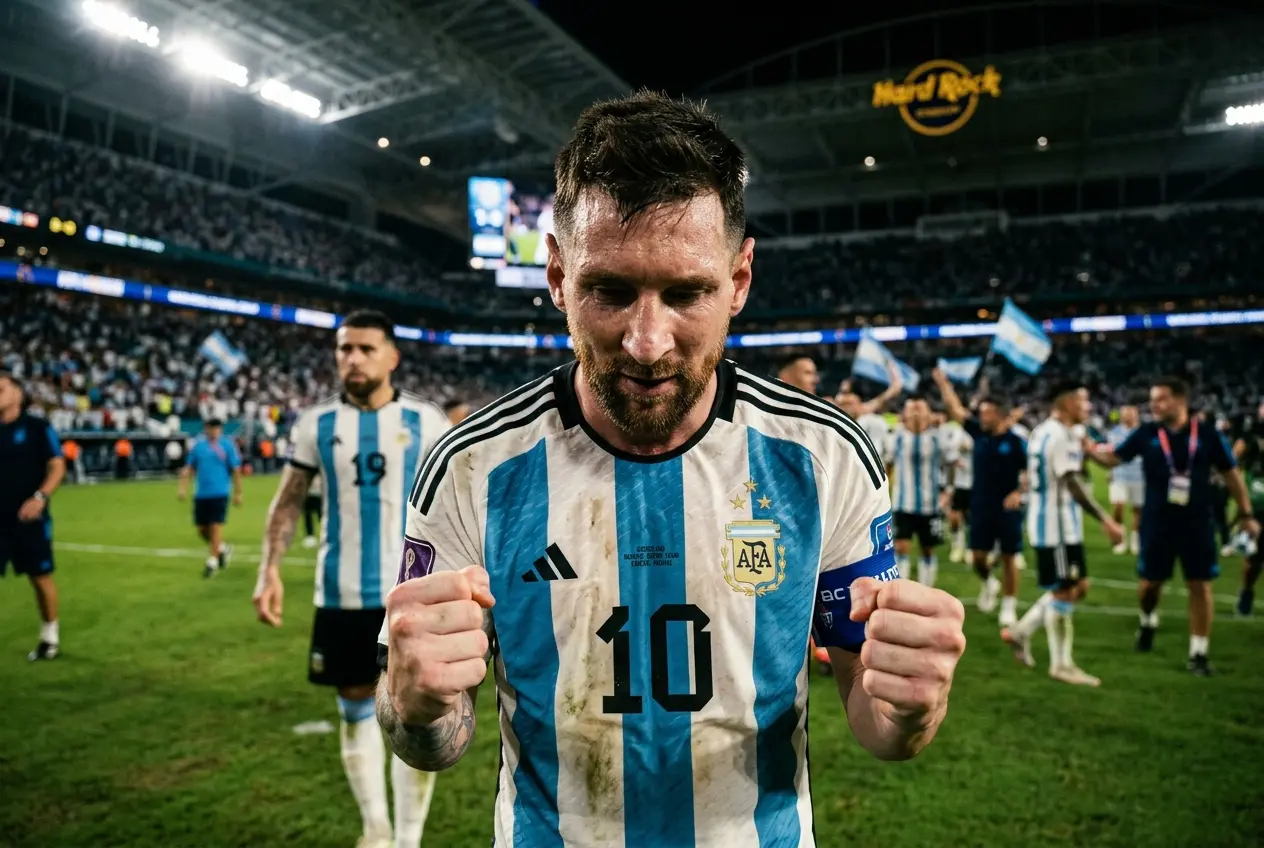
How the Five Goals Were Scored in Miami
The 3-2 result in Miami was the narrowest of escapes in a knockout round where Argentina had looked untouchable through the group stage. The extra-time thriller at Hard Rock Stadium had to be rebuilt from the tape after the final whistle, and Scaloni’s side spent most of the evening reacting rather than dictating.
| Minute | Team | Scorer | Score |
|---|---|---|---|
| 29′ | Argentina | Messi | 1-0 |
| 59′ | Cape Verde | Duarte | 1-1 |
| 92′ | Argentina | Lisandro Martínez | 2-1 |
| 103′ | Cape Verde | Cabral | 2-2 |
| 111′ | Argentina | Borges (own goal) | 3-2 |
The pattern is what Egypt’s staff will have circled in red. Cape Verde’s first equalizer came in the 59th minute after a ball was played into the space behind Argentina’s defense and Duarte finished through Lisandro Martínez’s legs. Messi put Argentina back in front in the 92nd minute with a finish from a corner, only for Cabral to answer in the 103rd minute with a solo run from the left channel and a finish into the top corner past Emiliano Martínez. Cape Verde absorbed pressure before bursting forward, and Borges inadvertently deflected a Messi corner past Vozinha at the other end in the 111th minute. Cape Verde coach Bubista told reporters after the game that his side “drew twice against the world champions” and “took it to extra time.”
The two Cape Verde goals pointed at the same defensive weakness. Duarte’s 59th-minute finish came after a through ball caught Argentina’s center-backs stepping up, and Cabral’s 103rd-minute strike was a solo run from the left channel that left Emiliano Martínez stranded near his near post. Both goals were technically preventable, and Scaloni’s post-match reaction left no room to spin either one as a tactical concession.
Argentina’s overall World Cup record through the round of 32 reads like a march, but the only metric that matters now is how they play at Mercedes-Benz Stadium on Tuesday. Egypt is exactly the kind of team that can punish a tired, fragile defending unit: organized, athletic, and willing to let the holders have the ball. The Argentine midfield will need to press higher than Scaloni said his tired players managed against Cape Verde. Salah’s hamstring permitting, Egypt’s pace on the counter gives them a route to a result that does not require them to dominate possession.
Egypt Made the History No Egyptian Side Had Made Before
Egypt have never won a knockout match at a World Cup, until Friday night in Texas. Hossam Abdelmaguid’s winning penalty in Dallas gave the Pharaohs a 4-2 shootout win over Australia and put them in the last 16 of the World Cup for the first time.
Emam Ashour headed Egypt in front from a Karim Hafez cross in the 13th minute, his second goal of the tournament, before a defensive misstep gave Australia the equalizer. Mohamed Hany, under pressure from an Australian set piece, headed the ball into his own net and became the first player to score two own goals in the same World Cup tournament. The match stayed 1-1 through 120 minutes, despite Australia coach Tony Popovic sending on goalkeeper Mathew Ryan specifically for the penalty shootout, in a shootout Egypt closed out in Dallas. Ryan watched Harry Souttar blast the first Australian penalty over the bar, and saw Salah score his with a panenka chip that even Ryan could not have read. Eighteen-year-old Lucas Herrington hit the crossbar with Australia’s fourth kick, and Abdelmaguid stepped up to send the Socceroos home.
It’s history. I told the boys before the game that this is the biggest stage you can play on. Enjoy it and don’t let the pressure get to you.
That was Salah on the field after the final penalty, still in his Egypt kit and visibly emotional at the sight of his country through to the last 16 of a World Cup for the first time. The captain entered the Australia match with a hamstring concern and at times appeared reluctant to sprint at full speed through 120 draining minutes. Egypt’s historic penalty win gave Hossam Hassan a side whose first World Cup knockout victory lands them straight into a quarterfinal shot in Atlanta.
Egypt’s Counter-Attack Blueprint Looks a Lot Like Friday’s Tape
The film Egypt showed against Australia looks a lot like the film Cape Verde showed against Argentina. Both sides collapsed into a low block after going a goal up, and both relied on wide players carrying the ball upfield in transition rather than controlling possession.
Salah and Omar Marmoush played the counter-attacker roles that Cabral and Mendes played for Cape Verde, with both African sides asking the same kind of workrate from their wide attackers. Egypt’s defensive shape against Australia was the same shape Cape Verde used: a back line that absorbed pressure and waited for the turnover. The differences come down to personnel, not shape.
- Defensive organisation: After Ashour opened the scoring from a Karim Hafez cross in the 13th minute, Egypt sat back and absorbed pressure for the remaining 107 minutes of the Texas tie. Cape Verde did the same against Argentina in Miami from the moment Duarte leveled in the 59th minute.
- Set-piece threat: Australia’s equalizer came from an in-swinging free kick that Mohamed Hany deflected into his own net. Borges’s 111th-minute own goal came from a Messi corner, the second corner-kick concession from Argentina in the same match.
- Counter-attack pace: Salah and Omar Marmoush sat in the channels for Egypt, with Marmoush sliding an effort off-target from close range inside the first minute after the restart. Cabral did the same for Cape Verde, curling a finish past Emiliano Martínez in the 103rd minute after cutting inside from the left.
Argentina’s defense has not faced a game like this in the group stage, where most opponents tried to play them open. Cape Verde’s willingness to sit back and counter was the first chance Scaloni’s defense had to absorb sustained pressure without the ball, and it wobbled. Egypt showed in Texas that they can take a more fancied opponent by letting them have possession.
Messi, after the Cape Verde match, acknowledged that he was tired and that Argentina had not been able to press their opponents high up the pitch. The eighth consecutive World Cup match with a goal kept his personal run alive but did not mask the wider problem: when Argentina do not have the ball, they look like a different team. Egypt will not need to dominate possession to take something from Atlanta. They will need to do what Cape Verde did for 110 minutes in Miami: stand their shape, win the second balls, and wait for the moment. Salah’s hamstring is the open question. If he is fit, Egypt’s blueprint has its best forward available.
Salah and Marmoush both finished 90-plus minutes against Australia, and the captain’s hamstring is the only fitness flag on either squad. Argentina’s bench looked thin by the end of the Cape Verde game, with Scaloni turning to Gonzalo Montiel for Nahuel Molina early in extra time to shore up the right channel. The holders’ margin for error in Atlanta is narrower than it was on Friday morning, when Egypt was still an unbeaten group-stage side without a knockout win to their name.
Four Days to Recover, and a Continent Watching
The compressed schedule is the headline going into Tuesday. Argentina played 120 minutes in Miami on Friday night, and Egypt played 120 minutes in Dallas on the same night, leaving both sides with the minimum recovery time between knockout rounds at a World Cup, as the Tuesday last-16 preview from Kansas City noted.
“What worries me now is that there are only four days to rest, travel, many players were suffering from cramps, and now you play Egypt, who are also a very physically strong team,” former Argentina striker Sergio Aguero said on ESPN Argentina. The toll showed up in the substitutions Scaloni made in extra time: Gonzalo Montiel on for Nahuel Molina at right-back, and the bench left visibly thin by the 110th minute. Egypt’s bench in Dallas was deeper, with Hossam Hassan able to throw on fresh legs in midfield without losing shape. Argentina’s 3-2 escape in Miami came at a cost Scaloni is still working through.
- 3-2 in extra time: Argentina’s narrow escape in Miami, decided by Borges’s 111th-minute own goal.
- 4-2 on penalties: Egypt’s shootout win over Australia, sealed by Abdelmaguid’s kick after Souttar skied his.
- 1-1 through 120 minutes: the regular-time result in Dallas after Ashour’s header and Hany’s own goal.
- 525,000: Cape Verde’s population, the World Cup’s smallest debutant knockout side.
- 20 World Cup finals goals: the latest mark for Messi, scored across 30 men’s tournament appearances.
Argentina have publicly held their line. “It will be a very difficult match,” midfielder Leandro Paredes said. “We are at the elite level of football and all national teams are very good and physical.” The holders will be expected to dictate the game, but Scaloni’s side had not looked this vulnerable at any other point in the tournament.
The Winner Goes to Kansas City on July 11
Argentina and Egypt play for a place in the World Cup 2026 quarterfinals on Tuesday at Mercedes-Benz Stadium, with kickoff set for 4 p.m. local time. The winner plays either Switzerland or Colombia in Kansas City on July 11, with the rest of the bracket still to be settled across Tuesday and Wednesday’s other round-of-16 ties.
Argentina are the defending world champions and have been favored in every game in this tournament. Egypt are playing their first knockout game at a World Cup and arrived in Atlanta on the back of a win no Egyptian team had pulled off before. The fixture has Argentina as favorite on paper, while Egypt’s blueprint looks tuned to the form Scaloni’s side just showed in Miami. The four-day rest favors whichever medical staff does the better job by Monday, with both benches tested by 120 minutes in Miami and Dallas.
Frequently Asked Questions
When does Argentina play Egypt at the 2026 World Cup?
The kickoff is Tuesday, July 7, 2026, at 4 p.m. local time, with Mercedes-Benz Stadium in Atlanta hosting the round-of-16 matchup.
Where will the Argentina-Egypt last-16 match be played?
Mercedes-Benz Stadium in Atlanta, a 68,239-seat venue that has hosted Atlanta United and the NFL’s Atlanta Falcons, is the site of Tuesday’s last-16 meeting.
Who scored for Egypt against Australia?
The 13th-minute opener from Emam Ashour via a Karim Hafez cross put Egypt ahead. Mohamed Hany’s own goal from an in-swinging free kick tied it at 1-1 through 120 minutes.
Did Egypt ever win a knockout match at the World Cup before 2026?
No. The 4-2 penalty shootout over Australia on July 3 was their first knockout victory at a World Cup, the result that put the Pharaohs into the last 16 of the tournament for the first time.
Who plays the Argentina-Egypt winner in the quarterfinals?
Either Switzerland or Colombia awaits the winner in Kansas City on July 11, 2026, depending on the result of the other round-of-16 meeting later this week.
