
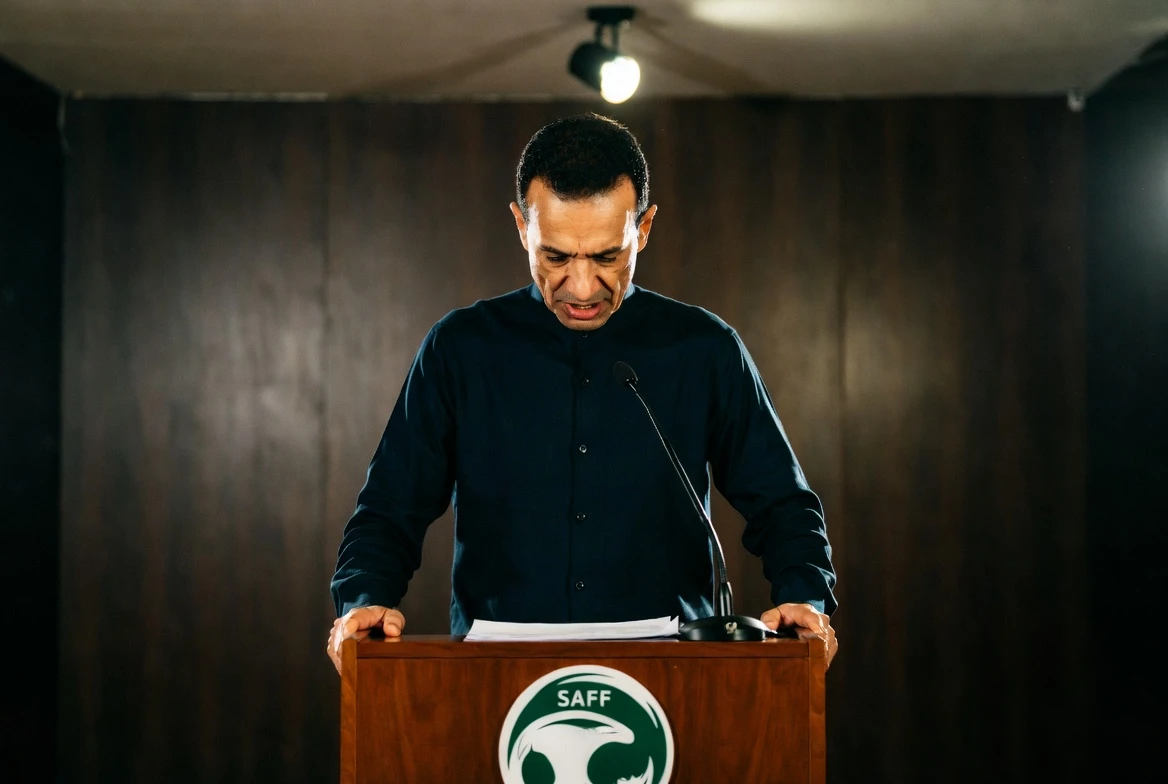
Saudi Arabia FA president Yasser Al-Misehal has resigned hours after the Green Falcons were knocked out of the 2026 World Cup in the group stage. Al-Misehal announced his decision on X late Sunday, accepting full responsibility for the team’s failure to reach the knockout round. Saudi Arabia finished bottom of Group H with two points from three matches, a result that exposed the gap between the kingdom’s lavish football investments and what its national team could deliver on the game’s biggest stage.
The decision ends a seven-year tenure that began in 2019 and produced both the kingdom’s successful bid to host the 2034 World Cup and the era of marquee signings that turned the Saudi Pro League into a global talking point. The federation is expected to begin electing a new board of directors in the coming weeks. Saudi Arabia have not reached the knockout stages of a World Cup since a round of 16 finish in 1994, a drought that now stretches across three tournaments.
Al-Misehal Steps Down Hours After the Final Whistle
On social media late Sunday, Al-Misehal framed the exit as a personal failure rather than a wider institutional problem. ‘The failure of the national team to qualify for the next round of the World Cup is a result that falls short of all our ambitions, and I bear full responsibility for it,’ he wrote. ‘I offer my apologies to everyone who hoped to see our team in a better position.’
He tied his exit to a wider handover at the federation. ‘A sense of responsibility requires giving the opportunity to open a new chapter, and I have decided not to continue until the end of my current term,’ he added, according to his resignation statement on X. The decision closes a tenure that began in 2019 and produced both the kingdom’s successful bid to host the 2034 World Cup and the era of marquee signings that turned the Saudi Pro League into a global talking point. The federation is expected to begin electing a new board of directors in the coming weeks through its standard procedure.
- Resigned: Late Sunday, announced on X
- Tenure: Seven years, since 2019
- Group finish: Fourth in Group H, two points
- World Cups under Al-Misehal: Qatar 2022 and Canada/Mexico/USA 2026
Three Matches, Two Points, Bottom of Group H
Group H of the 2026 World Cup was unforgiving, and Saudi Arabia played its way down it. The Green Falcons opened with a 1-1 draw against Uruguay, then ground out a 0-0 stalemate with Cape Verde, a tournament debutant ranked well below them on paper. The two points from those matches left Saudi Arabia needing at least a draw against Spain and producing nothing close.
Spain ran out 4-0 winners in Atlanta, sealing first place in the group and Saudi Arabia’s third consecutive group-stage exit from a World Cup. Cape Verde took second ahead of Uruguay on the final matchday, a turn of events that left the Saudis bottom of the pile and underlined how thin the margin between qualifying and going home had become. Saudi Arabia have not reached the knockout stages of a World Cup since a round of 16 finish in 1994.
Only Japan and Australia advanced from the seven Asian teams that started the 2026 World Cup. Cape Verde, a tournament debutant, qualified from Group H instead. The senior team’s next realistic chance to break the knockout-round drought is the 2034 World Cup Saudi Arabia has already been awarded. The federation now has to choose a successor with that tournament on the horizon and the Pro League still absorbing its marquee signings.
| Match | Result |
|---|---|
| Saudi Arabia vs Uruguay | 1-1 draw |
| Saudi Arabia vs Cape Verde | 0-0 draw |
| Spain vs Saudi Arabia | 4-0 Spain |
The Coaching Reset That Wasn’t
The squad that took the field in Atlanta had been rebuilt on the fly. Saudi Arabia dismissed Hervé Renard in April, less than two months before kickoff, after a March friendly window that included a 4-0 loss to Egypt and a 2-1 defeat to Serbia. The federation then appointed Georgios Donis to replace him, according to reporting on Saudi Arabia’s late coaching swap to Donis. The new coach inherited a roster in which 25 of 26 players competed in the domestic league, but only three World Cup warm-up matches to install his system.
Everything happened so fast. When we arrived and took over, this advantage was in place that I was familiar with the players. Being familiar with players is one thing, training them is another.
Donis, the Saudi Arabia head coach, had addressed the compressed handover at the team’s pre-tournament media day. He took over a squad that, on paper, already knew his system. The federation had hoped continuity with a domestic-league appointment would compensate for the late change. Renard’s first spell, by contrast, had produced Saudi Arabia’s famous 2-1 win over Argentina at Qatar 2022. The Saudi record under both coaches now spans three World Cups, three group-stage exits, and one upset over the eventual champions.
What the $2 Billion Bought, and Didn’t
The Pro League splurge was supposed to lift everything around it. Saudi Arabia has invested nearly two billion dollars in football over the past three years, pulling Cristiano Ronaldo, Neymar, Karim Benzema and a procession of other global names into the Saudi Pro League. The federation said the league had become ‘one of the most lucrative competitions in the world’ under that spending.
None of it reached the World Cup. The squad that travelled to North America drew almost entirely on local talent, with 25 of 26 players already competing in the Saudi Pro League. Critics had warned for years that a star-driven league would not, on its own, lift a national team short on competitive fixtures against elite opposition.
Investment in coaching, infrastructure and women’s football did follow the spending. Federation budgets, academy programmes and the women’s game all expanded under Al-Misehal, and the kingdom’s successful bid for the 2034 World Cup is the project he is most associated with. The Green Falcons’ group-stage exit leaves a thinner trophy case than the federation’s off-field portfolio would suggest. The 2034 build-out will now run alongside the senior team’s rebuild.
Seven Years On, a Federation at a Crossroads
Al-Misehal’s resignation closes a chapter that began in 2019. He led the federation through the kingdom’s hosting of major club and continental competitions, signed off on the early Saudi Pro League boom, and oversaw two World Cups in which the senior team never escaped the group. The seven-year stretch also brought the kingdom its 2034 World Cup bid as sole bidder, an effort that has drawn human-rights scrutiny even as it cleared the FIFA process. The handover from Al-Misehal to his successor will now run alongside the kingdom’s preparation for that tournament.
The federation now has to choose a successor before the next World Cup cycle begins. Saudi Arabia will be World Cup hosts in 2034, and the senior team’s group-stage record is now the comparison line for every new appointment. The federation will elect a new board through its standard procedure in the coming weeks. Cape Verde’s 26-place climb up the 2026 power rankings is the reminder of how quickly a debutant can overtake a project built on three years of top-table signings.
Frequently Asked Questions
Why did the Saudi Arabia FA president resign?
Yasser Al-Misehal said he bore full responsibility for the Green Falcons’ failure to reach the knockout round of the 2026 World Cup. Saudi Arabia finished bottom of Group H with two points from three matches and exited the tournament in the group stage.
What was Saudi Arabia’s record at the 2026 World Cup?
Saudi Arabia drew 1-1 with Uruguay, drew 0-0 with Cape Verde, and lost 4-0 to Spain. The two points left the Green Falcons bottom of Group H and eliminated at the group stage for the third consecutive World Cup.
Who is Yasser Al-Misehal?
Al-Misehal became president of the Saudi Arabian Football Federation in 2019 and served seven years in the role. He presided over the kingdom’s successful bid to host the 2034 World Cup and the era of marquee signings that reshaped the Saudi Pro League.
Why was Hervé Renard fired before the World Cup?
Saudi Arabia dismissed Renard in April 2026 after a March run of friendly defeats that included a 4-0 loss to Egypt and a 2-1 loss to Serbia. Georgios Donis, then manager of Al-Khaleej in the Saudi Pro League, was named his replacement less than two months before kickoff.
How much has Saudi Arabia spent on football?
Saudi Arabia has invested nearly two billion dollars in football over the past three years, with much of that spending on marquee signings such as Cristiano Ronaldo, Neymar, and Karim Benzema for clubs in the Saudi Pro League.
What happens next at the Saudi Arabian Football Federation?
The federation is expected to begin the process of electing a new board of directors. Saudi Arabia is also the confirmed host of the 2034 FIFA World Cup, leaving the new leadership a tournament build-out to manage alongside the senior team’s rebuild.
