
Jared Kushner sat down with Egyptian President Abdel Fattah El-Sisi in El Alamein on Sunday and, in a rarer move, with Hamas political chief Khalil al-Hayya, as the United States tried to force movement on President Donald Trump’s stalled Gaza roadmap. The same day the Israel Defense Forces struck targets it identified as Islamic Jihad and Hamas operatives in Khan Younis and Nuseirat.
Kushner traveled with Board of Peace Gaza envoy Nickolay Mladenov and former British prime minister Tony Blair. They leave for talks with Israeli Prime Minister Benjamin Netanyahu on Monday. The core problem they carry is not missing goodwill statements. It is the plan’s own design: disarmament and withdrawal are locked together in phases that let each side freeze the other.
That design problem traveled with the delegation into every room in El Alamein. Statements of support already exist on paper. What does not exist is an agreed first move both sides will treat as safe.
The Sunday Sessions in El Alamein
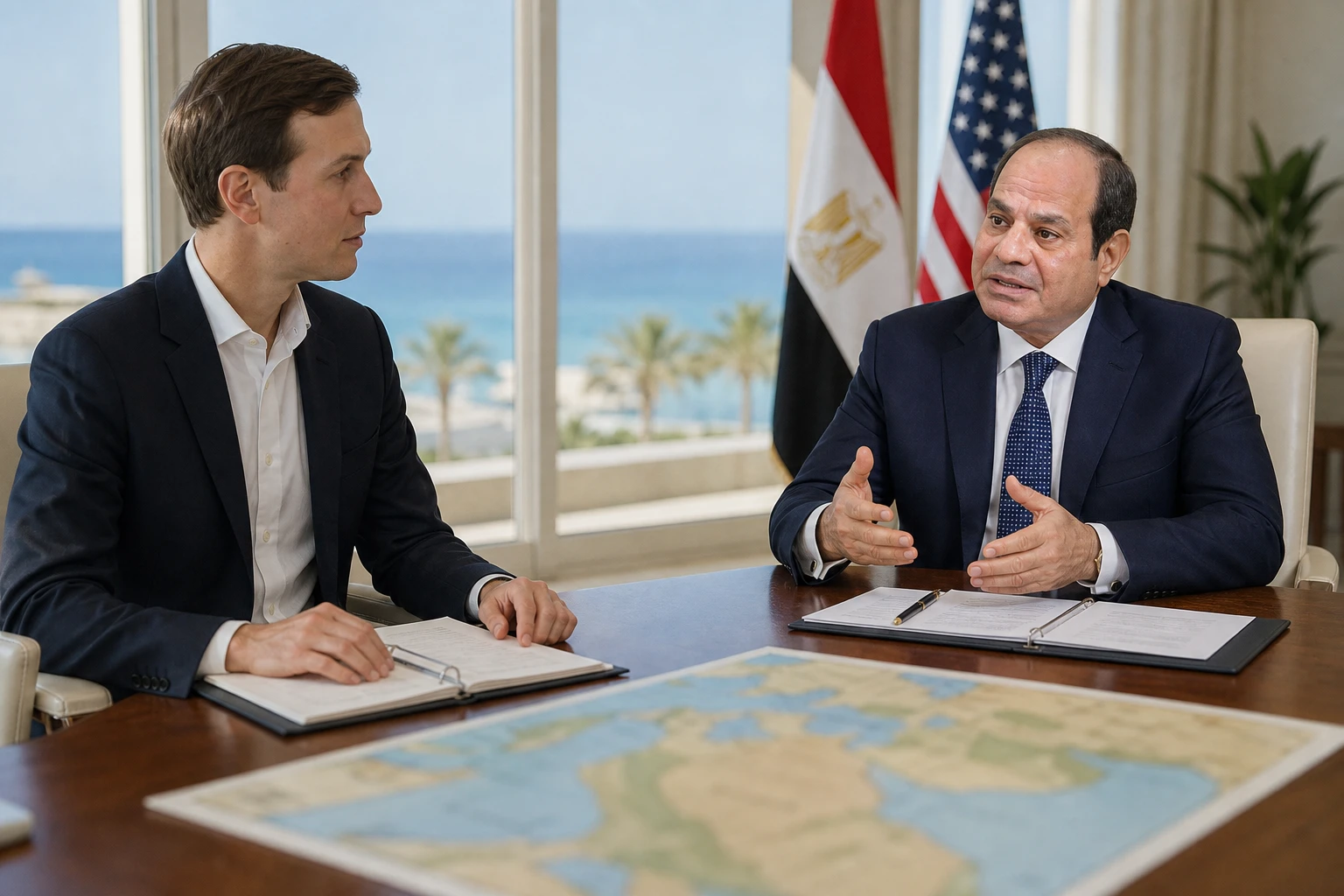
The Egyptian presidency said the Aug. 16 meeting in the Mediterranean city of El Alamein included Foreign Minister Badr Abdel-Atty and General Intelligence Service chief Hassan Rashad. Kushner conveyed greetings from Trump. El-Sisi stressed the strategic Egypt-US relationship and regional security cooperation. Both sides underlined “the need for all parties to fulfill their obligations under the agreement to stop the war in the Gaza Strip.”
Kushner and Mladenov also held sessions with Egyptian, Qatari and Turkish mediators. Hamas leaders attended some of those talks. A Palestinian source told Al Jazeera that the group briefed Kushner on what it called Israeli ceasefire violations and that Kushner rejected any plan to displace Gaza residents. Another official said the objective was “translating the roadmap’s obligations into concrete, verifiable steps.”
- Jared Kushner, Trump Middle East envoy
- Nickolay Mladenov, Board of Peace high representative for Gaza
- Tony Blair, Board of Peace member
- Khalil al-Hayya, Hamas political leader
- Hassan Rashad, Egyptian intelligence chief
- Qatari and Turkish senior mediators
Hamas later issued a statement saying it reaffirmed acceptance of the second-phase roadmap and called on mediators and the Board of Peace to “compel” Israel to implement first-phase obligations, end violations and approve a timetable. The United States has long refused direct contact with Hamas, which it designates a terrorist organization. The Trump team has loosened that practice to keep the file moving.
The mix of channels mattered as much as the messages. Cairo hosted the presidential track. The same mediators who have carried prior ceasefire rounds sat with Kushner and Mladenov. Hamas used the opening to press its violations file while restating acceptance of the second phase. The American side kept the focus on steps that can be checked, not on fresh pledges.
Roadmap Text That Locks Both Sides
Trump announced in late July that the Board of Peace had reached what he called a historic agreement for the complete disarmament of Hamas and other armed groups. The full text of the 15-point roadmap links that process to a phased Israeli withdrawal. A National Committee for the Administration of Gaza (NCAG) is to take civil control. An International Stabilization Force (ISF) is to separate forces and train new Palestinian police. An International Verification Committee certifies each step.
Heavy weapons, production sites, depots and tunnels are to be decommissioned and stored under NCAG authority, not handed to Israel. Personal weapons fall under Palestinian law. Progression from one phase to the next depends on verified completion of the previous one. Israel insists full disarmament must come first and must be genuine, not “fictitious.” Hamas says it will move only after Israel meets its own commitments, including withdrawal to agreed lines and a halt to attacks.
| Roadmap element | Israel position | Hamas position |
|---|---|---|
| Disarmament timing | Complete before any withdrawal | Phased with Israeli pullback |
| Weapons custody | Must be verifiable and permanent | Stored under NCAG, not Israel |
| Israeli forces | Stay until threat eliminated | Withdraw as decommissioning advances |
| Governance | No Hamas role | NCAG takes over, factions step aside |
Mladenov has described the process as sector-by-sector: once an area is certified weapon-free, Israel withdraws from it. The text itself gives 14 days after approval to set the detailed timetable, extendable by the verification body. That flexibility has become another point of friction. The original Sharm El-Sheikh Peace Summit framework from October 2025 still supplies the larger umbrella, yet the second-phase mechanics remain the bottleneck.
The institutions named in the text are meant to break the deadlock by inserting third parties between the two sides. In practice they also multiply veto points. Each body must perform before the next phase unlocks.
- NCAG takes civil control and holds decommissioned heavy weapons
- ISF separates forces and trains new Palestinian police
- International Verification Committee certifies completion of each step
- Board of Peace oversees the wider process and early logistics
Until those roles are staffed and trusted, the linkage between disarmament and withdrawal continues to favor whoever prefers delay.
Egypt Holds the Mediator Keys
Cairo’s role runs deeper than host. Egypt’s intelligence service has managed the Hamas channel for years. El-Sisi’s government controls the Rafah crossing and has repeatedly hosted the multi-party talks that produced the first-phase ceasefire. Kushner publicly praised Egypt as a key US partner and thanked El-Sisi for efforts on regional stability. The Egyptian side emphasized shared security interests and the strategic bilateral relationship.
That positioning gives Cairo leverage over both the Palestinian factions and the Arab capitals now lining up behind the roadmap. It also places Egyptian interests, including border security and reconstruction contracts, inside every negotiation. Egypt’s broader regional mediation role has expanded in parallel tracks with other Gulf and African partners, making El Alamein a natural stage.
Control of Rafah and the long intelligence channel mean Egypt can open or slow access that other mediators lack. When Kushner needs a room with Hamas figures, Cairo can supply it. When Arab capitals coordinate language on the roadmap, Egypt is already inside the draft. That dual function keeps Egyptian priorities on the table even when the agenda is written in Washington or Jerusalem.
Hamas Reaffirms While Strikes Hit
According to a source with direct knowledge cited by Axios correspondent Barak Ravid, Hamas leaders told Kushner they remain committed to demilitarizing Gaza and removing the group from future governance. Kushner pressed for concrete, verifiable steps rather than renewed promises. On the same day the IDF said it carried out precision strikes against an Islamic Jihad member in the Khan Younis area and a Hamas member in Nuseirat, both accused of planning attacks.
Medics reported at least five Palestinians wounded in a tent-camp strike in Khan Younis; one later died. A second strike hit an apartment in Nuseirat and wounded several more. Palestinian health authorities say Israeli fire has killed more than 1,250 people in Gaza since the October 2025 ceasefire took effect. Israel says it acts against immediate threats to its forces and civilians and that four soldiers have been killed by militants in the same period.
- Sunday targets: Islamic Jihad operative, Khan Younis; Hamas operative, Nuseirat
- Reported casualties that day: one death, multiple wounded in tent and apartment strikes
- Cumulative since Oct 2025 ceasefire: 1,250+ Palestinian deaths claimed; 4 Israeli soldiers killed
- Israeli control: roughly two-thirds of Gaza territory under IDF presence
The simultaneous diplomacy and kinetic action illustrate the second-order bind. Every strike Hamas cites as a violation becomes a reason to slow its own steps. Every incomplete disarmament step Israel cites becomes a reason to keep forces in place and continue targeting.
Sunday’s pattern was therefore familiar rather than exceptional. Talks produced a reaffirmation and a call to compel Israel. Strikes produced fresh casualty figures and a fresh violations brief. Neither track canceled the other. Both fed the same sequencing fight waiting in Jerusalem.
Netanyahu Meeting Sets the Immediate Test
A senior Israeli official confirmed Kushner and Mladenov are scheduled to see Netanyahu on Monday. Netanyahu on Aug. 9 called the latest Board of Peace plan “unacceptable” in its current form. He restated that Israeli forces will not withdraw until Hamas is fully disarmed and that some US proposals are acceptable while others are not. Israel has also pushed back against any US demand to end targeted operations against remaining militants.
The political calendar tightens the constraint. Israel faces an Oct. 27 national election. Netanyahu’s Likud has trailed in recent polling. The party responded to the joint Arab statement by accusing the eight capitals of trying to topple him so rivals would “give them everything that they want.” That framing turns every concession into potential campaign ammunition. The Netanyahu’s earlier rejection of the Board plan already set the public baseline; Monday’s meeting will show whether private language has shifted.
Recent public markers now stack tightly ahead of that session:
- October 2025: Sharm El-Sheikh framework set; ceasefire takes effect
- Late July: Trump announces the Board of Peace disarmament agreement
- Aug. 9: Netanyahu brands the latest plan unacceptable in its current form
- Aug. 16: Kushner holds El Alamein sessions; IDF strikes in Khan Younis and Nuseirat
- Monday: Kushner and Mladenov meet Netanyahu
- Oct. 27: Israel holds its national election
Each date narrows the room for quiet compromise. Campaign logic rewards firmness on withdrawal and operations. Diplomatic logic rewards movement on the phased text. Monday is where those logics collide.
Eight Capitals Push Back
Foreign ministers of Egypt, the United Arab Emirates, Qatar, Jordan, Indonesia, Pakistan, Turkey and Saudi Arabia issued a joint statement Sunday condemning Israel’s rejection of the roadmap. They called it a direct assault on US-led peace efforts and on Palestinian statehood prospects. They urged the United States and the Board of Peace to take immediate measures against obstruction and reiterated support for a two-state outcome on 1967 lines.
The need for all parties to fulfill their obligations under the agreement to stop the war in the Gaza Strip.
That language, repeated by the Egyptian presidency after the El-Sisi-Kushner session, is now the shared diplomatic refrain. It papers over the sequencing dispute without resolving who moves first on the ground. The Board of Peace has begun building a logistics base near Kerem Shalom for a future ISF, yet only Morocco and Uganda have pledged troops so far. Deployment remains months away by most diplomatic estimates.
The eight-capital statement raises the political cost of open rejection without supplying the verification tools the roadmap still lacks. Pressure without a working timetable leaves the United States holding both the persuasion brief and the enforcement gap.
How the Roadmap Is Supposed to Unlock
On paper the sequence is mechanical. Approval starts a clock. Within 14 days, extendable by the verification body, the parties are to set a detailed timetable. Decommissioning of heavy weapons, production sites, depots and tunnels proceeds under NCAG custody. Personal weapons shift under Palestinian law. The International Verification Committee certifies each tranche. The ISF separates forces and trains police as sectors clear.
Mladenov’s sector-by-sector description is the practical bridge. An area is certified weapon-free. Israeli forces then pull back from that area. Governance passes toward the NCAG as factions step aside. The design tries to replace a single leap of faith with many smaller, checked steps.
The freeze appears when either side treats an unchecked risk as fatal. Israel calls incomplete disarmament fictitious and keeps forces in place across roughly two-thirds of Gaza. Hamas treats continued strikes and delayed pullback as first-phase breaches and withholds the next move. The verification committee cannot certify what neither party will fully present. The 14-day timetable window then stretches, and the architecture that was meant to force progress becomes the argument for waiting.
What the Monday Talks Can Still Decide
Monday’s meeting will not rewrite the 15-point text in a single sitting. It can still decide whether Israel will accept any paired sequencing at all, or whether full disarmament remains a precondition with no parallel withdrawal. It can also test whether targeted operations stay outside any interim restraint the Board of Peace might seek.
Kushner arrives with a fresh Hamas reaffirmation, an Egyptian presidential endorsement of mutual obligations, and a joint Arab condemnation of rejection. Netanyahu holds the election calendar, the public “unacceptable” baseline from Aug. 9, and the security case built on ongoing threats. Blair and Mladenov carry the Board’s institutional brief, including the early Kerem Shalom logistics work and the thin troop pledge list from Morocco and Uganda only.
If private language softens, mediators gain a narrow path to a verifiable first sector. If it does not, the dual-track pattern seen Sunday in Egypt becomes the standing condition: talks in one city, strikes in another, and a roadmap that still requires simultaneous steps neither capital fully trusts.
Kushner’s dual-track day in Egypt therefore leaves the central tension untouched. Hamas can point to its reaffirmation and demand Israel be compelled. Israel can point to ongoing threats and demand complete disarmament first. Mediators can convene, issue statements and schedule the next bilateral. The roadmap’s own architecture still requires simultaneous, verified steps that neither capital fully trusts the other to take. Monday’s conversation in Jerusalem will test whether that architecture can bend or whether the vetoes remain absolute.
