
Sixteen Egyptian companies set up stalls at the residence of Egypt’s Ambassador to Finland, Mohamed Ghoneim, from August 12 to 14 and drew Finnish firms into talks on AI, renewables, agriculture and manufacturing. The Finnish-Egypt Trade Expo doubled as a national-day marker and left participants chasing orders and Finnpartnership funding.
The event stayed low-key, yet it lands on a bilateral track that Finnish diplomats themselves call under-used. Forest products still dominate the numbers. Services and technology sit mostly on the sidelines.
Stalls Filled the Ambassador’s Residence
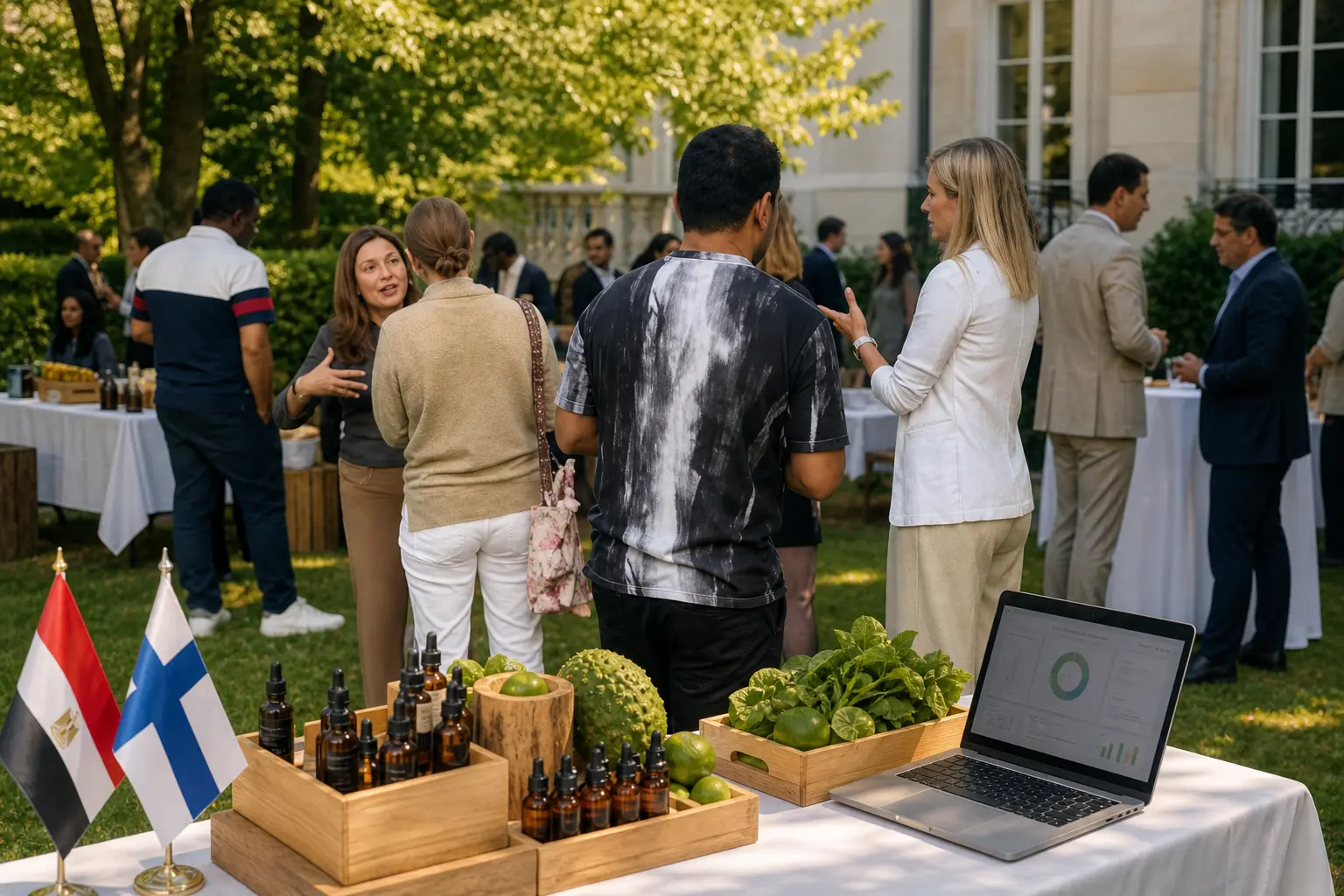
Organizers placed the three-day gathering inside the ambassador’s residence in Helsinki. Egyptian exhibitors came from artificial intelligence, technology, renewable energy, agriculture, manufacturing, tourism and consumer goods. They sought face-to-face meetings with Finnish companies, startups, investors and institutions.
Hany Abdel Wahab, Vice-Chairman and Chief Executive Officer of the United Group for Engineering and Investment (UGEI), said his main target was Finnish customers for a new premium agricultural line. That starts with essential oils from plants and extends to fresh vegetables and fruit. Finnish visitors responded well to the samples, he reported, and talks on forthcoming orders began at once.
Maged Rawash, Chief Executive Officer and founder of software and engineering firm Smarter Minds, came to map the Finnish tech scene and culture. “We had a very positive first impression and felt that companies were genuinely eager to explore potential synergies and collaboration opportunities. I would still like to spend more time engaging with the market before drawing a final conclusion,” Rawash said.
Ahmed Ghoneim, Chief Operation Officer of MARGH Investment & Consultancy, watched a couple of hundred visitors stop at his stall over the three days. He called the outcomes encouraging yet pointed to a persistent problem: many capable Egyptian manufacturers remain unknown in Finland even when they hold competitive products and technologies.
Trade Volumes Still Run Narrow and Forest-Heavy
Full-year 2024 figures released by Finland’s Ambassador to Egypt, Riikka Eela, in an April 2026 interview put the scale in plain view. Finnish exports to Egypt reached approximately €456 million. Goods made up 94 percent of that total. Nearly 80 percent of the goods were forest-based: timber, paper and pulp. Egypt ranks as Finland’s largest goods-export destination in Africa, ahead of GCC markets. Yet the whole corridor still accounts for less than 0.5 percent of Finland’s global exports, which stood near €111 billion.
Egyptian exports the other way totaled €88 million in 2024. Fertilisers, chemicals, textiles, glassware and agricultural products such as fruits and vegetables led the list. Services formed only 6 percent of Finnish sales to Egypt even though services make up roughly 35 percent of Finland’s worldwide exports. That gap is the one diplomats and exhibitors keep naming.
| Direction (2024) | Value | Main composition |
|---|---|---|
| Finland to Egypt | ~€456 million | 94% goods; ~80% forest products |
| Egypt to Finland | €88 million | Fertilisers, chemicals, textiles, glass, ag produce |
| Share of Finland total exports | <0.5% | Room flagged by both embassies |
Established Finnish names already operate on the ground. Huhtamäki runs manufacturing sites and holds a Golden Licence. HMD Global assembles mobile phones. Nokia maintains regional telecom operations and a refurbishment centre. KONE supplies vertical transport for construction projects. The expo aimed lower on the ladder: mid-sized Egyptian firms and Finnish SMEs that have not yet crossed the Mediterranean.
Awareness Gaps Meet a Ready Funding Channel
Ahmed Ghoneim of MARGH put the awareness problem bluntly. Capable Egyptian companies stay invisible in Finland while Finnish expertise and solutions could create real value inside Egypt. The expo’s job, he said, was to create a platform where the two sides meet, understand each other and lock in long-term cooperation rather than one-off sales.
Finnish businessperson Mari Moisio, CEO and founder of sustainability firm GloESDE Oy, attended mainly to reach Egyptian government contacts. She also collected practical information on Finnpartnership support that can extend to non-profit projects. Mohamed Abdrabou, CEO of the ARU Group, stated the core goal: establish and boost bilateral trade partnerships because both sides see huge prospects.
Suvi Pribilla, business partnership officer at Finnpartnership, underlined the funding angle on site. Many companies cannot secure capital for cross-border work. Finnpartnership steps in with grants and introductions. The programme is financed by Finland’s Ministry for Foreign Affairs and managed by Finnfund. It offers Finnish operators a Business Partnership Support grant and matchmaking service aimed at long-term, responsible business in developing markets. Services are free. The design deliberately shares early-stage risk so that sustainable jobs and development impacts can take root.
- Business Partnership Support: financial grant for launching or expanding operations in OECD DAC developing countries.
- B2B Matchmaking: database and facilitation linking Finnish firms with partners in those markets.
- Advice, training and Team Finland network access for market information and contacts.
Pribilla’s presence at the residence signalled that the tool is open for the very conversations the Egyptian stalls started.
Where the Sector Conversations Clustered
Agriculture and food ingredients drew concrete interest. UGEI’s essential oils and fresh produce samples moved Finnish buyers into order talks. That track sits beside broader Egyptian produce flows already visible in Europe, including Egyptian mangoes reaching European shelves this season.
Technology and AI formed a second cluster. Rawash of Smarter Minds used the days to test cultural fit and hunt synergies. Finnish digital public-service expertise, 6G work at Nokia and gaming strength (Supercell, Rovio) give Egyptian partners clear entry points. Healthcare innovation and women’s health hubs on the Finnish side add further lanes.
Renewables and circular economy rounded out the list. Finland backs resource-efficiency programmes in Egypt through UNIDO and circular-economy forums. Wärtsilä’s hydrogen-ready power technology and Nokia’s equipment-refurbishment centre already sit inside that conversation. Egyptian renewable exhibitors met Finnish counterparts who treat the green transition as both export and partnership terrain.
We want to build a bridge between the business communities of Finland and Egypt. We have organised the expo as a part of the efforts to mark our national day.
Ambassador Mohamed Ghoneim made that statement while inviting Finnish companies, startups, investors and entrepreneurs to meet the Egyptian delegates face to face. On the evening of August 14 the residence hosted a reception for several hundred guests: officials, diplomats, journalists, cultural figures and professionals. The ambassador used the gathering to stress the same commercial bridge.
A Relationship Measured in Decades, Not Days
The expo did not invent the corridor. Finland recognised Egypt in 1922 and signed a temporary trade agreement in 1930. The training ship Suomen Joutsen carried an export exhibition to Egypt in late 1933. Diplomatic relations paused during the Second World War and restarted in 1947. A full embassy opened in Cairo in 1959. Finnish peacekeepers later earned Egyptian thanks after the Suez Crisis.
- 1922: Finland recognises Egypt; honorary consulate in Alexandria.
- 1930: Temporary trade agreement signed.
- 1933: Suomen Joutsen export exhibition voyage.
- 1959: Embassy established in Cairo.
- 1960s-80s: Forest-product trade grows; development cooperation begins (electrification, agriculture, telecom).
- 2000s: Shift from grant aid toward commercial partnership as Egypt’s income level rises.
- 2026: Helsinki expo and renewed Trade Council work under both embassies.
The century of Finnish representation in Egypt shows long stretches of quiet continuity interrupted by political shocks, then steady commercial recovery. Forest products remain the ballast. The new work is to fill the services and technology holds.
Institutional Scaffolding Already in Place
Both ambassadors now talk openly about untapped potential. Eela in Cairo has pushed ICT, healthcare, green transition and logistics. Egypt’s location as a manufacturing and logistics hub for Africa and the Middle East, plus membership in the African Continental Free Trade Area, gives Finnish firms a platform they can share with Egyptian partners who already operate across the continent.
A Finnish-Egyptian Trade Council and its Egyptian counterpart have been established to keep the channel open between large events. The Helsinki residence expo and the Cairo-side business forums earlier in 2026 form matching halves of the same effort. Finnpartnership programme services for developing markets sit ready for the SMEs that lack the balance sheets of Nokia or Huhtamäki.
Challenges remain. Customs and administrative friction still slow Finnish firms, even as Egyptian reforms improve the climate. Visibility of Egyptian mid-tier manufacturers inside Finland is still low. Those frictions explain why a residence full of stalls and samples matters: it compresses the discovery phase into three days and attaches a funding officer to the conversations.
What the Follow-Through Looks Like
UGEI expects order talks to convert. Rawash plans deeper market immersion before locking commitments. MARGH and ARU Group treat the visitor traffic as proof of concept for longer cooperation. Moisio left with government contacts and Finnpartnership guidance for sustainability work. Pribilla’s team now holds a fresh list of Finnish and Egyptian names that know the grant process exists.
No final deal volumes were announced on site. The load-bearing result is simpler: Egyptian exhibitors and Finnish buyers spent three days in the same rooms, samples changed hands, and the public financing instrument that can underwrite next steps was present in person. For a trade lane that still measures under half a percent of Finnish exports and still leans so heavily on timber and pulp, that is the practical opening the sleeper corridor has been waiting for.
The national-day reception closed the week with hundreds of guests. The stalls had already done the quieter work of putting names, products and funding pathways on the same table.
