
Red Sea Global secured a SAR 6.5 billion credit facility for AMAALA in late October 2025 from three Saudi banks. Riyad Bank underwrote the deal; the Saudi Investment Bank and Bank AlBilad acted as arrangers. The paperwork mixed conventional and Islamic tranches under the company’s green-loan framework. For a developer owned outright by the Public Investment Fund, the choice of commercial lenders carried more weight than the headline number.
PIF has cut construction awards across its giga-project slate by roughly 60 percent since 2024. Against that backdrop the AMAALA facility is a live test of whether Saudi luxury tourism can raise and service private capital on its own terms.
Banks Back a Green Facility for AMAALA
The October 2025 close was the third partnership between Red Sea Global and Riyad Bank. It followed a 2021 green facility for The Red Sea destination and a separate SAR 2 billion deal tied to a Four Seasons joint venture. According to the company, the new facility adheres to RSG’s Green Loan Framework, aligned with ICMA Green Bond Principles and LMA Green Loan Principles.
Four years ago, we made history by securing the first-ever Riyal denominated green finance credit facility. Since then, we have built and opened nine hotels at The Red Sea destination as well as supporting infrastructure…. We have demonstrated that we are a developer who delivers and we’re proud that our financing partners recognize this and have faith to once again back our destinations, this time supporting AMAALA, which opens in the coming weeks.
John Pagano, Group CEO of Red Sea Global, said those words at the announcement. Nadir Al-Koraya, Riyad Bank’s president and CEO, called the destination ambitious and sustainability-driven. Gregory Djerejian, RSG’s group head of investments, thanked the banks for reinforcing a shared commitment to responsible development. An SPA report on the AMAALA financing confirmed the same structure and parties.
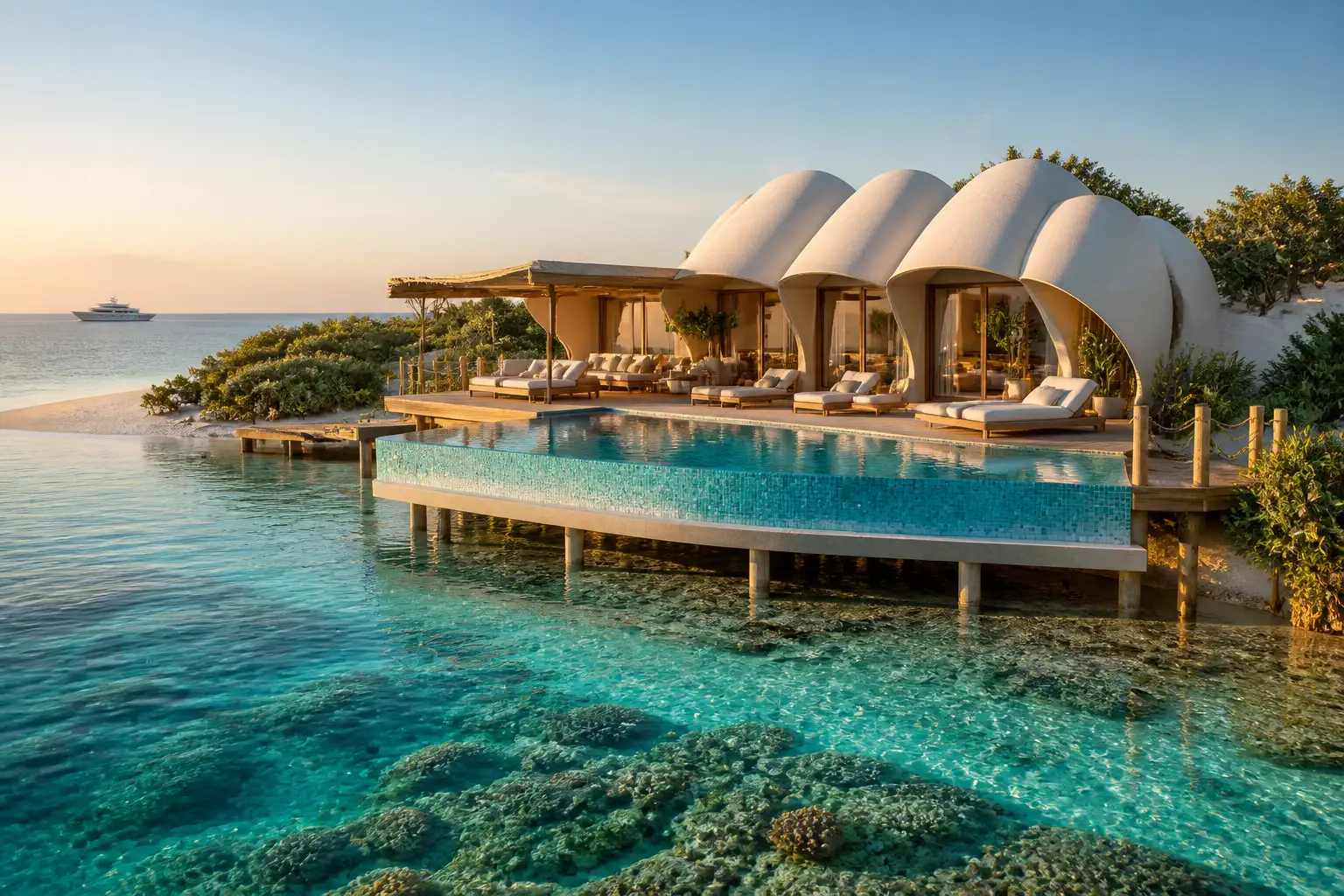
AMAALA sits at Triple Bay as an ultra-luxury wellness destination. Plans call for more than 1,400 hotel rooms across eight resorts, plus a Corallium Marine Life Institute and a yacht club. First guests arrived in 2026. The loan therefore funds a project already moving from renderings into operations.
Contract Awards Fell Nearly 60 Percent
The timing lines up with a sharp pullback in PIF-linked construction. Data from the Saudi Contractors Authority show total contracts issued across the kingdom in 2025 came in at less than $30 billion. That sits almost 60 percent below the $71 billion recorded in 2024. PIF’s own share dropped from more than 38 percent of the value in 2024 (around $27 billion) to just 14 percent last year.
| Metric | Earlier Period | Recent Figure |
|---|---|---|
| Kingdom construction contracts | $71 billion (2024) | Less than $30 billion (2025) |
| PIF share of contract value | Over 38% (~$27 bn) | 14% |
| PIF spending reductions | – | Minimum 20%, up to 60% on some projects |
| Aramco 2025 dividend | Prior higher level | $84.5 billion (cut by roughly one-third) |
| PIF cash reserves (late 2024/2025) | Higher | Around $15 billion |
| 2026 budget deficit projection | – | Near 3.3% of GDP (~$44 billion) |
Oil prices supplied the pressure. IMF estimates placed Saudi Arabia’s fiscal break-even above $90 a barrel in recent years; crude spent much of the period nearer $60-65. Lower Aramco distributions hit PIF’s 16 percent stake. An $8 billion writedown on the giga-project portfolio in 2025 further underlined the reset. Board decisions in late 2024 ordered minimum 20 percent spending cuts across more than 100 portfolio companies, with some budgets trimmed by as much as 60 percent.
Officials have signaled a pivot toward quicker-return areas such as data centers, AI infrastructure, logistics and World Cup or Expo-related work. Large trophy schemes lost priority. The PIF giga-projects portfolio page still lists the broader ambitions, yet capital allocation has grown selective.
Open Keys Separate the Portfolio
Red Sea Global entered this environment with assets already generating revenue. By mid-2026 the company reported roughly 14 resorts open across the Red Sea coast, with targets of 25 by late August and 27 by year-end across The Red Sea and AMAALA. Pagano told Arab News in late 2025 that nine properties were open at that point, twelve by year-end, seventeen by January and the full 27 by April or May 2026. Longer-term plans still speak of 80 hotels across the two destinations.
- Operators already live or committed: Six Senses, Rosewood, Ritz-Carlton, Four Seasons and others under management contracts, some with equity stakes.
- Staff and scale: Workforce grew from a skeleton team in 2017 to more than 11,000.
- Visitor ambition: Earlier targets spoke of 300,000 visitors in a given year once the base is established.
- Infrastructure: Al Wajh International Airport upgrades completed and reopened; new terminals support growing flight frequency.
The contrast with NEOM is sharp. The Line’s published 170-kilometre scope has been effectively narrowed for near-term delivery. Trojena ski and mountain works saw major contract terminations after the Asian Winter Games shifted away. Sindalah’s yacht island faced operational and completion questions that later drew Red Sea Global into a rescue assessment. Equinox commitment at the NEOM project still signals brand interest in parts of the wider site, yet the bulk of NEOM’s value still sits in future phases and ring-fenced PIF books. Red Sea Global has paying guests checking in. That difference shapes who can approach commercial banks.
Residences and Brands Share the Risk
The AMAALA loan is only one lever. Laheq Island, designed with Foster + Partners around an 800-metre ring of apartments and retail, marks RSG’s first major residential-led push. Rather than build solely to lease, the company is selling private residences outright. Buyer capital arrives years before full operations, a model Dubai developers refined earlier. Target opening sits around 2028.
Hotel operators form the third leg. Management contracts and selective equity stakes move construction and operating risk off the sovereign balance sheet. The RSG investment opportunities summary highlights the SAR 6.5 billion AMAALA facility alongside other joint ventures, including a SAR 2.6 billion Kingdom Holding partnership for Four Seasons Red Sea. Contracts signed across the portfolio have exceeded SAR 67.8 billion in total value at various points of reporting.
Pagano has framed the company as an exemplar that delivers. “We are one of the exemplar companies, we’ve delivered and we are delivering, so our funding is committed from the PIF,” he said in earlier comments. The bank facility shows the commitment now includes commercial co-funding. Even exemplar status sits inside a ranking, not an exemption. Reporting in 2025 and 2026 placed the wider Red Sea Destination among programmes absorbing some cuts as PIF tilted toward AI and digital infrastructure.
Relative Winners in the Rationing
Crowd discussion on X has tracked the divergence closely. Posts highlight NEOM contract cancellations (including a multi-billion-dollar dam package left partially complete) as evidence that ambition without near-term cash flow faces harder triage. Others note Red Sea Global’s continued openings and Pagano’s delivery record as reasons local banks remain willing to lend. One satellite-based observer flagged possible postponement of An-Numan island work inside AMAALA’s later phases, citing the sheer scale and funding weight. The pattern is consistent: projects with keys, operators and guest revenue keep momentum; pure-vision schemes absorb more of the pause.
Diriyah’s historic-quarter redevelopment has leaned into public-private partnerships rather than pure equity. That same logic now reaches hospitality. Saudi banks gain fee income and green-asset exposure on a project with visible progress. International operators gain flags in a new high-end destination without carrying full development risk. PIF preserves scarce cash for higher-priority or faster-return bets. The losers are the schemes whose timelines stretch furthest and whose revenues remain theoretical.
Fiscal arithmetic keeps the pressure on. A 2026 budget projecting a deficit near $44 billion (3.3 percent of GDP) leaves little room for open-ended giga spending. Every remaining project must make a clearer commercial case than a crown-prince announcement alone once provided.
Commercial Rates Become the Measure
Early demand for AMAALA villas has been solid enough that fill rates this winter are not the central question. The harder test is whether Red Sea Global can keep borrowing at commercial rates once the market stops treating unlimited sovereign backing as automatic. A kingdom that once funded ambition outright is now asking even its best-performing tourism developer to help fund itself.
- October 2025: SAR 6.5 billion AMAALA facility closes with Riyad Bank, SAIB and Bank AlBilad.
- Late 2025-early 2026: Phased resort openings accelerate; Pagano outlines path to 27 properties.
- 2025 full year: Kingdom construction awards drop nearly 60 percent; PIF share shrinks to 14 percent.
- 2026: AMAALA welcomes first guests; Laheq residential sales push continues toward 2028 target.
- Ongoing: PIF continues portfolio triage, favoring data centers, AI and event infrastructure over pure trophy urbanism.
Success would show that regenerative luxury tourism can stand on bankable cash flows and branded operators. Failure would confirm that even open doors cannot fully escape the oil-price squeeze. The bet is now priced by commercial lenders, not just by sovereign equity. Banks have already written one large cheque. The next facilities will reveal whether the model holds once the assumption of infinite backstop looks less absolute than it did in 2017.
