
Ukrainian drones struck Russia’s largest Wildberries logistics hub near Moscow overnight on 15-16 August, part of a wave Moscow Mayor Sergei Sobyanin put at roughly 600 craft aimed at the capital region. Russian forces answered with missiles and drones that hit Kyiv, Kryvyi Rih and other cities, killing at least three civilians according to Ukrainian officials.
The exchange fits a pattern of long-range attacks that has intensified through 2026. Ukraine has focused on Russian logistics and dual-use sites deep inside the country. Russia continues to strike Ukrainian cities and industrial plants.
Each side presents its overnight targets as military or dual-use. Each side also records civilian deaths, destroyed commercial stock and fresh pressure on air defenses already stretched thin. The pattern no longer pauses between waves.
Hundreds of Drones Reach the Moscow Region
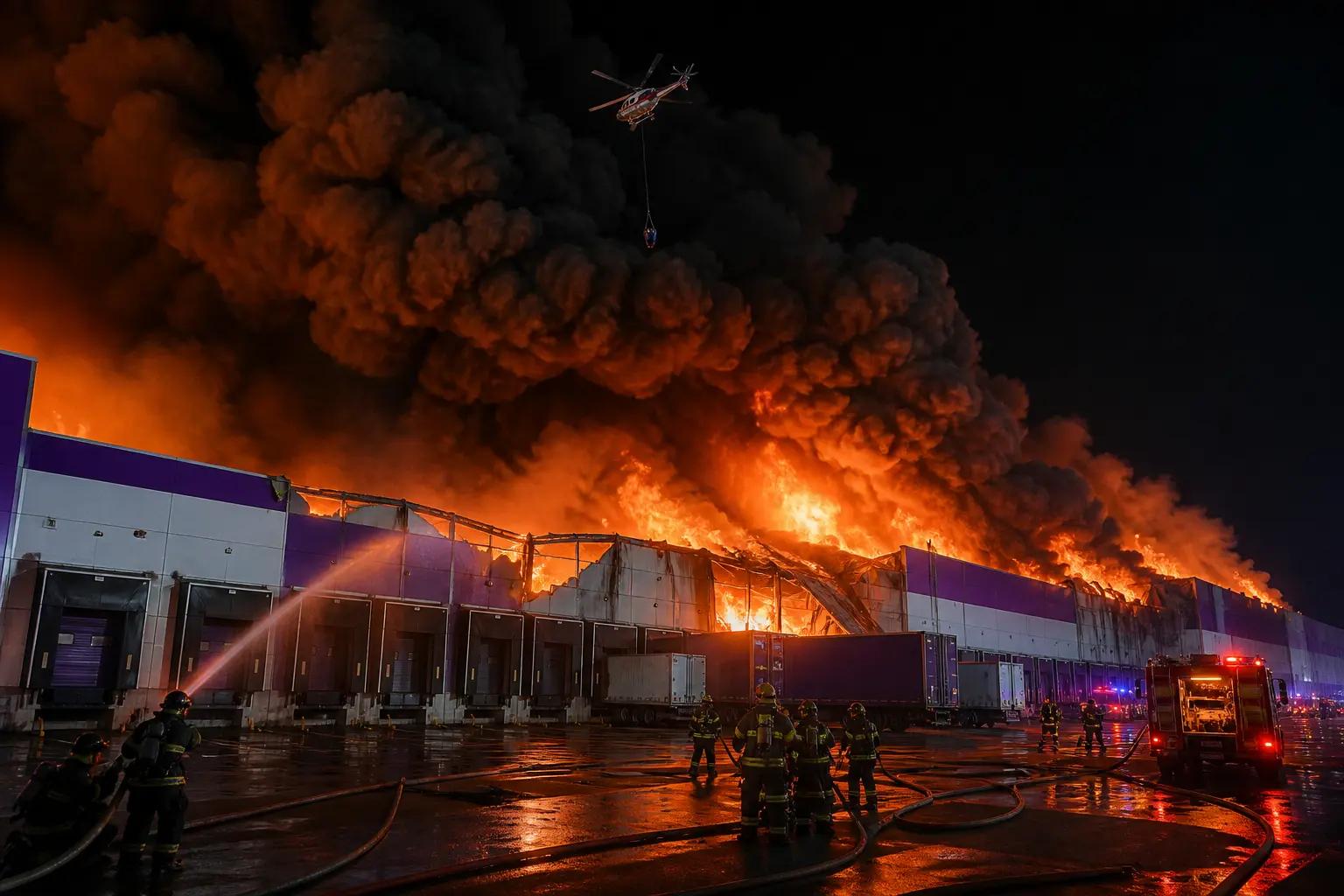
Sobyanin said air defenses destroyed more than 200 of the incoming drones. Debris and at least one successful strike still caused major damage. The main hit landed on the Wildberries facility in the Koledino industrial zone near Podolsk, a 250,000-square-meter hub roughly 420 kilometers from the Ukraine border.
Wildberries confirmed a large fire, evacuated staff and began redirecting operations to other sites. Moscow Oblast Governor Andrey Vorobyov called the assault one of the most massive drone attacks on the region in recent memory. Geolocated footage showed flames racing across the complex. Ukrainian forces also struck a warehouse at the Severnoye Domodedovo logistics complex the same night.
The combination of volume and reach mattered as much as any single impact. Hundreds of craft forced Russian batteries to engage across a wide arc around the capital. Even a high intercept rate left debris, fires and at least one major logistics node disabled by morning.
Russian authorities reported one death and several injuries in the Podolsk area, though exact civilian totals varied across statements. The Russian Defense Ministry claimed it destroyed far higher numbers of drones nationwide, figures Ukrainian analysts and some Western outlets treat as inflated.
- 600 drones detected heading toward Moscow region (Sobyanin)
- 201+ destroyed over the capital region
- 250,000 m² Koledino hub hit and disabled
- 1+ confirmed Russian civilian death near the fire
Ukraine’s Ministry of Defense described the operation as another blow against logistics supporting the Russian military. Redirecting stock from a hub of that size takes days. Sellers and military-linked supply lines both feel the delay.
Russia Strikes Back Across Multiple Oblasts
The Russian Defense Ministry said its forces targeted a Ukrainian facility producing unmanned boats west of Odesa along with other military-related sites. Strikes also reached Kyiv, where fires broke out in several districts. The Pochaina book market in the Obolonskyi district, near the metro station of the same name, suffered heavy damage. Several rows of stalls burned. Vendors lost large stocks of books and goods. Emergency crews contained the blaze despite flammable materials. It was at least the third time the market had been hit in recent months.
President Volodymyr Zelenskyy reported the human toll in a post on X. He said six people were injured in Kyiv and the surrounding region. Ballistic missiles struck Kremenchuk and Kryvyi Rih. In Kryvyi Rih two people were killed and 14 injured. One person was killed in Sumy. Air-raid alerts continued as another wave of Russian drones arrived.
Zelenskyy gave the week’s cumulative figures: more than 1,550 attack drones, nearly 1,560 guided aerial bombs and 62 missiles, most of them ballistic, against 13 Ukrainian regions. He thanked emergency services, police and medics and urged partners to supply more interceptor systems.
| Category | Weekly total (Zelenskyy) | Notes |
|---|---|---|
| Attack drones | More than 1,550 | Across 13 regions |
| Guided aerial bombs | Nearly 1,560 | Sustained volume |
| Missiles | 62 | Most ballistic |
The ArcelorMittal plant in Kryvyi Rih confirmed two workers killed and 13 injured, with partial production stoppage. ISW recorded Russian use of Onyx anti-ship missiles, Iskander-M and related ballistic missiles, Kh-59/69 cruise missiles and 106 Shahed-type and other drones overnight. Ukrainian air defenses downed many but impacts still registered at 13 locations.
- Kyiv and region: 6 injured, book market largely destroyed
- Kryvyi Rih: 2 killed, 14 injured, industrial facility hit
- Sumy: 1 killed
- Additional damage reported in Kremenchuk and Odesa direction
Both sides insist their targets are military or dual-use. Civilian sites keep absorbing damage. Markets, plants and housing blocks sit close enough to claimed military aims that the distinction collapses for people on the ground.
Why Wildberries Keeps Getting Hit
The overnight strike was not isolated. According to the Institute for the Study of War, Ukrainian forces have now struck seven of Wildberries’ 10 largest logistics centers since July 2026. The campaign aims to degrade Russia’s defense industrial base and dual-use logistics network.
Wildberries is Russia’s dominant online retailer, often called the country’s Amazon. It expanded rapidly after Western brands left following the 2022 full-scale invasion. Ukrainian officials say the company supplies the Russian army with drone components, navigation equipment, body armor and other dual-use goods. The firm’s own site has listed such items. Warehouses also provide storage capacity near the front that Russian security services have used.
That mix of civilian retail and military-linked inventory is why the hubs remain on target lists. A single large node can hold consumer goods beside components that move toward the front. Hitting the node disrupts both flows at once.
Reuters earlier estimated Ukrainian strikes had already destroyed at least 1.18 million square meters of Wildberries warehouse space, about one-fifth of total capacity at the time. Later tallies put the share of large hubs disabled still higher. Just before the campaign intensified, Wildberries updated terms so it would not be liable for goods destroyed in “force majeure” events including drone strikes. Roughly 80 percent of warehouse buildings and inventory were uninsured, according to Russian business media.
- 18 July 2026, First major wave hits Elektrostal, Kotovsk and other sites; multiple deaths reported.
- 20 July 2026, Koledino near Podolsk struck (first time for this hub).
- Late July-early August, Hits expand to Krasnodar, St. Petersburg area, Ryazan, Penza, Volgograd, Yekaterinburg, Vladimir Oblast and more.
- 15-16 August 2026, Koledino largest hub and Domodedovo struck again; seven of ten largest now affected.
Zelenskyy has framed the strikes as both military disruption and response to Russian attacks on Ukrainian cities. Secondary effects include pressure on Russia’s domestic economy and public support for the war. Independent sellers who stocked the warehouses have lost merchandise with little recourse.
The Scale of Lost Warehouse Space
Earlier assessments already showed severe capacity loss. The latest hits deepen it. ISW notes Russia’s inability to protect even its largest logistics hubs demonstrates insufficient air defenses for all rear infrastructure.
When seven of the ten largest hubs have taken damage in roughly a month, redundancy shrinks fast. Cargo shifts to smaller sites. Those sites then draw more attention. The cycle favors the side that can keep launching cheap long-range drones against fixed, high-value roofs.
| Facility | Location | Approx. Area | Key Strike Dates |
|---|---|---|---|
| Koledino / Podolsk hub | Moscow Oblast | 250,000 m² | 20 July, 28 July, 16 August |
| Domodedovo complex | Moscow Oblast | Large multimodal | 19 July, 16 August |
| Multiple other large hubs | Across Russia | Combined 1M+ m² earlier | July-August wave |
| Total large hubs affected | – | 7 of top 10 | Since mid-July 2026 |
Ukrainian sources also claimed a strike the same night on the Kamensky Plant in Rostov Oblast, which produces solid rocket fuel for MLRS and missiles. A fire was reported there.
Fuel plants and retail hubs are different targets. Both sit inside the same long-range envelope Ukraine is now able to work night after night.
Sellers, Supply Chains and Air Defense Choices
The direct military value is the disruption of dual-use flows. The second-order effects land on ordinary commerce. Small and medium sellers who used Wildberries lost stock they cannot easily replace or insure. Retail supply chains feel the shock. One vendor quoted after the Kyiv book market fire captured the civilian side of such attacks: “There is nothing. Nobody has anything left.” Similar language has appeared among Russian sellers after warehouse fires.
Everything burned down. I was selling foreign language textbooks for schoolchildren. We were waiting for September so that everyone would have textbooks.
Natalya, a bookstore owner at the Pochaina market, spoke to Ukrainian media after the fire. Parallel losses hit Russian side sellers who stocked the destroyed Wildberries depots.
Crowd discussion on X highlighted the compensation cutoff and the irony of a wartime retail giant absorbing repeated cheap drone hits while expensive air defenses remain stretched. Analysts note the Kremlin now faces repeated dilemmas over what to protect. Every successful deep strike forces trade-offs between front-line needs and rear infrastructure. ISW assesses the campaign puts additional pressure on Russia’s economy and already-overstretched air defenses.
- Force majeure terms shift loss onto independent sellers
- Roughly 80 percent of warehouse buildings and inventory uninsured
- Repeated fires erase stock ahead of peak retail seasons
- Air defense batteries cannot cover every large rear hub at once
Ukraine has paired the logistics campaign with energy and industrial hits, including an earlier deep strike on a Siberian oil refinery more than 2,700 km inside Russia. The cumulative effect is a form of long-range pressure that does not require matching Russia’s conventional mass.
Interceptor Gaps Shape The Next Exchanges
Zelenskyy’s call for more interceptor systems ties directly to the week’s totals. More than 1,550 attack drones and 62 missiles, most ballistic, leave little margin when Patriot stocks are limited. Each gap in coverage shows up as another fire in a city district or another industrial stoppage.
Russia faces a mirror problem at longer depth. ISW’s reading of the Wildberries campaign is that Moscow cannot shield every major logistics roof. Batteries committed to the capital region are batteries unavailable elsewhere. Cheap drones force expensive choices.
The overnight exchange made those trade-offs visible on both sides of the border. Kyiv’s book market, Kryvyi Rih’s steel plant and the Koledino hub all burned under the same logic of range, volume and imperfect defense.
Both Sides Keep Raising the Range
Ukraine’s growing inventory of FP-1 long-range drones and other systems has let it reach targets once considered safe. Russia retains ballistic missiles that Ukraine struggles to intercept in volume. Patriot stocks are limited. Zelenskyy explicitly linked new interceptor packages to lives saved.
Neither side made confirmed ground advances on 16 August according to ISW. The air and deep-strike contest continues independently of the front lines. Civilian infrastructure on both sides keeps paying part of the price. Wildberries warehouses and Kyiv book stalls are not equivalent in military value, yet both illustrate how the long-range campaign now routinely touches commercial and cultural life far from trenches.
The distance figures underline the shift. A hub roughly 420 kilometers from the border and a refinery more than 2,700 km inside Russia now fall inside the same operational conversation. Range alone no longer guarantees safety.
Russian officials maintain the Ukrainian strikes are terrorist acts against civilian commerce. Ukrainian officials maintain the hubs support the war machine. The fires keep burning either way.
Emergency crews on both sides extinguished the latest blazes. Air raid alerts faded. The next wave is already in planning.
