
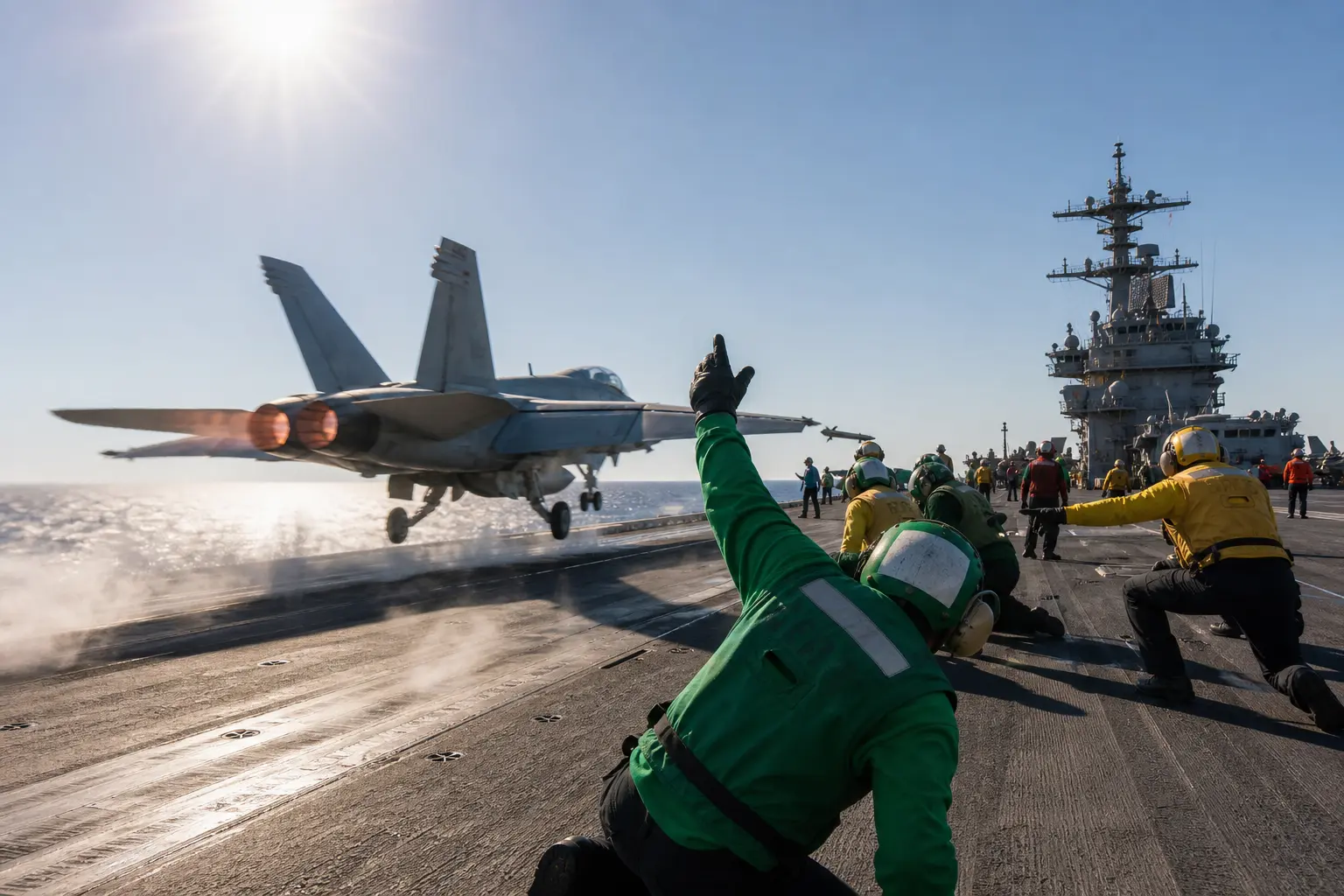
Adm. Brad Cooper, the U.S. Central Command chief, spent hours aboard the USS Abraham Lincoln in the Arabian Sea on Saturday and called the crew’s work “one of the most operationally intense and consequential of the modern era.” The carrier has logged 266 days deployed and more than 240 consecutive days at sea while flying combat sorties and enforcing the Iran blockade. Family reports of mental health strain, supply shortfalls and near-miss overboard attempts shadowed the visit.
Cooper’s stop capped a regional tour. It also forced the Navy’s public defense of a wartime deployment that stretched far past its original plan.
The Visit and the Numbers Cooper Put Forward
Cooper addressed the full Lincoln team, met junior sailors and Marines, and handed out awards. It was his second trip to the ship this year after a February visit with special envoys. The official release described a 10-day trip across six countries and the carrier, covering Bahrain, Iraq, Israel, Jordan, Saudi Arabia and the United Arab Emirates. More than 50,000 U.S. service members remain across the theater.
In a follow-up statement Sunday, Cooper said mental health and resilience had become a leadership priority on the Lincoln. He added that of the Navy’s 11 active carriers, the ship currently ranks among those with the lowest number of mental-health cases. “This doesn’t mean that all is perfect,” he said. Service at sea for long periods “isn’t for everyone.”
Acting Navy Secretary Hung Cao released harder metrics days earlier. The Lincoln recorded 266 days deployed and 10,000-plus sorties, 200 of those days inside a combat zone, and 1.5 million pounds of ordnance expended. Retention on the carrier sat among the highest of the force. A small number of mental-health cases were treated with no loss of life. One sailor who went overboard on Aug. 3 was recovered safely. Meals were adjusted when fresh resupply lagged, but none were missed.
- 266 days total deployed as of mid-August
- 10,000+ aircraft sorties and flights
- 1.5 million pounds of ordnance
- 84.4% reenlistment rate cited by CENTCOM for the crew
CENTCOM also pushed back on circulating claims of multiple deaths or a suicide spike, calling those reports false.
| Metric | Lincoln 2025-26 | Recent Comparables |
|---|---|---|
| Consecutive days at sea | 240+ | Record modern mark claimed by crew |
| Total deployment days | 266 | Ford 326 days (2025-26 return) |
| Combat sorties / ordnance | 10k+ / 1.5M lbs | Operation Epic Fury focus |
| Port calls after arrival | Limited (Oman July resupply) | Typical every 30-45 days peacetime |
The ship left San Diego in November 2025, reached the Middle East in January, and never returned to a normal port rhythm once combat and the blockade locked it in place.
What Families Told Navy Leaders in San Diego
About 200 spouses and family members packed a town hall at Naval Air Station North Island earlier in August. They faced Cao, Vice Adm. Douglas Verissimo of Naval Air Forces, and other senior officers. One spouse described a same-day message from her husband saying he hoped he would not wake up the next morning. Others spoke of exhaustion so deep that sailors talked about jumping for relief.
Independent accounts collected by Stars and Stripes described at least one prevented overboard attempt months earlier that produced a ship-wide announcement. Sailors and families listed concrete living-condition problems that peaked earlier in the cruise and then eased after a brief Oman stop in July:
- Food rationing and stretches limited to rice and tortillas
- Moldy showers, broken toilets, no hot water for weeks
- Water contamination fears and laundry outages lasting more than a week
- Mail and care-package delays measured in months
- Hygiene shortages including soap and deodorant
Many of those logistics issues improved once contested supply routes stabilized and the Oman call delivered fresh produce. Morale did not rebound the same way. Sailors told reporters they would skip any remaining port visits if it meant an earlier return date. “All we want is a date home,” one said.
The Navy answered that the ship operates in a highly contested environment where traditional Middle East hubs were disrupted. Leadership prioritized food, then hygiene, then mail. Current ship reports, the service said, show continuous clean water, working air conditioning and two protein options per meal. Mental-health assets include counselors, chaplains and doctors, with more professionals being sent.
The Senate Letter That Widened the Frame
Sen. Richard Blumenthal, a Connecticut Democrat on the Armed Services Committee, sent a detailed letter citing shortages, water issues and mental health to Defense Secretary Pete Hegseth and Cao on Aug. 12. He listed the same habitability complaints families raised and asked for the original deployment schedule, every extension authorization, fatigue metrics, safety-incident trends, and a 12-to-24-month plan for sustaining carrier presence in the region.
Blumenthal noted the Lincoln departed Nov. 21, 2025, on what was planned as a roughly seven-month cruise scheduled to end in May. It has not. He placed the ship inside a pattern: the USS Gerald R. Ford had just returned after 326 days, the longest modern carrier deployment since Vietnam. “Whether the Navy can sustain the operational tempo now being demanded of its carrier force” is the larger question, he wrote, especially when carriers underwrite conflicts of choice.
History will record this deployment as one of the most operationally intense and consequential of the modern era.
Cooper’s Saturday line, released by CENTCOM, set the official tone. Cao’s statement struck a harder note against media framing: “Unfortunately, the media are trying to paint our warriors as victims. Not only is that dishonest but it takes away the focus on the enemy.” He called the crew the “epitome of American strength and resilience” and promised a hero’s welcome when the ship finally pierside.
The gap between those statements and the town-hall testimony is the story’s open wound. Official metrics show low relative mental-health caseloads and high retention. Family and sailor voices describe cumulative fatigue that metrics have not fully captured.
How a Standard Deployment Became a Record
The Lincoln Carrier Strike Group began as a Pacific deployment. War with Iran changed the plan. U.S. and Israeli strikes began Feb. 28. Iran asserted control over the Strait of Hormuz. The Navy answered with a blockade of Iranian ports and sustained combat air operations under the name Operation Epic Fury. The earlier arrival of the Abraham Lincoln strike group had already placed the carrier in position; the shooting war locked it there.
- November 2025: Departs San Diego for scheduled deployment
- January 2026: Arrives Middle East waters
- February 28, 2026: Combat phase opens; Epic Fury flights begin
- Early July 2026: Brief Oman port call for resupply; limited liberty
- August 3, 2026: Sailor overboard, recovered
- August 15-16, 2026: Cooper visit and public statements
Consecutive days at sea passed 200 in June and kept climbing. Crew members claimed the modern record for uninterrupted time underway. Peacetime carriers normally see a port every 30 to 45 days for rest, maintenance and stores. Lincoln’s wartime tempo largely erased that rhythm. A short Guam stop in December and the Oman call were the main exceptions, and many sailors never left the pier in either case.
Talks with Iran have stalled. Oman continues discussions on managing the strait. The carrier’s presence remains part of the pressure campaign even as a relief group built around the USS Theodore Roosevelt prepares to deploy. No public return date has been set; Cao said only that the ship “will return home soon as part of a planned rotation.”
The Readiness Bill That Follows the Flight Hours
Every extra month on station consumes maintenance availabilities, delays other theater presence, and multiplies fatigue across a finite number of hulls and air wings. Blumenthal’s letter asked whether current demand already exceeds what the existing carrier force can generate without creating tomorrow’s readiness crisis. The Ford’s 326-day cruise and Lincoln’s ongoing stretch suggest the answer is already testing the model.
Junior sailors and their families carry the daily weight. Spouses described watching partners lose hope while senior-year milestones and ordinary home life continued without them. Sailors who once expected port visits now measure time only by the next launch cycle. Command points to chaplains, embedded mental-health providers and continuous assessments. Families answer that access does not equal relief when the mission clock never stops.
The same dynamic appears in the broader pattern of Middle East reinforcements that have flowed into the theater since the war opened. Carriers remain the visible instrument of sustained power. They are also among the most humanly expensive platforms to keep at that intensity.
CENTCOM’s own Aug. 13 post stressed resilience after more than 260 days, 10,000 flights and 1.5 million pounds of ordnance, with no deaths aboard. The one overboard sailor was recovered. That record is real. So are the town-hall tears and the unanswered demand for a firm homecoming date.
Homecoming Tension and What the Crew Still Faces
Cooper left the Lincoln calling the visit “awe-inspiring” and predicting Americans would “beam with pride.” Cao urged the country to stand ready with a grateful heart when the pier lines finally appear. The crew has flown thousands of combat sorties, enforced a blockade that redirected dozens of commercial vessels, and kept a nuclear carrier combat-ready for the better part of a year.
They have also lived through food adjustments, plumbing failures, mail blackouts and the psychological grind of indefinite extension. Official numbers say the mental-health caseload stayed comparatively low and retention stayed high. Family testimony and sailor accounts say the cumulative load still pushed some people to the rail.
The reckoning is not whether the Lincoln accomplished the mission. It did. The reckoning is whether the Navy’s force-generation model and the political appetite for open-ended carrier presence can keep asking the same ships and the same people for the same intensity without leaving deeper scars. The Theodore Roosevelt group is preparing. The Lincoln’s sailors are still counting days. The next rotation will test whether the lessons of this deployment were absorbed or simply endured.
When the carrier finally steams into home waters, the welcome will be loud. The quieter question will travel with it: how many more 266-day cruises the force can absorb before the metrics and the lived experience stop matching.
