
Goldman Sachs has put the Egyptian pound’s fair value at EGP 43 per US dollar, calling the currency 13-15% undervalued in a report carried by Arab Finance and dated June 30, 2026. The pound has climbed more than 4% against the dollar since the US-Iran ceasefire of June 14, 2026, and rebounded above 9% from its weakest levels recorded during the regional conflict. Goldman forecasts a path of EGP 49 in three months, EGP 48 in six months, and EGP 46 by the end of the 12-month window, with caveats about foreign capital flows, the IMF program that concludes in December 2026, and an interest-rate easing cycle the bank expects to begin in 2027.
The forecast sits inside a wider argument about what the post-ceasefire environment changes for the Egyptian pound. The bank ties its fair-value call to the real effective exchange rate, not to a moment in the dollar’s cycle. The 13-15% shortfall is measured against historical averages, and the trajectory back to EGP 43 is read as a closing of that gap, not as a move toward any specific bilateral level.
Goldman’s Call: Fair Value at EGP 43, Path to EGP 46
Goldman Sachs set the Egyptian pound’s fair value at EGP 43 per US dollar in the report, the first explicit fair-value anchor the bank has published in the current cycle. The investment bank said the pound remains undervalued by roughly 13-15% relative to its historical averages, using the real effective exchange rate as the benchmark. That gap, in Goldman’s framing, leaves room for further appreciation, and the bank has built the path into its report.
The forecast path runs through EGP 49 per dollar in three months, EGP 48 in six months, and EGP 46 by the end of the 12-month horizon. Each leg is described as a return toward the fair value the bank has now published. The forecast is a target, not a promise, and Goldman attaches each number on the path to a specific macro assumption.
The bank’s REER framework compares the pound’s real trade-weighted rate against its multi-year history. When REER sits below the historical average, the framework treats the currency as cheap relative to where it has tended to settle. The 13-15% shortfall is the headline finding, and EGP 46 in twelve months is the bank’s expression of how the gap closes.
- EGP 43 per dollar, fair value (Goldman Sachs, June 30, 2026).
- 13-15% undervaluation versus historical REER average.
- EGP 49 per dollar, three-month forecast.
- EGP 48 per dollar, six-month forecast.
- EGP 46 per dollar, twelve-month forecast.
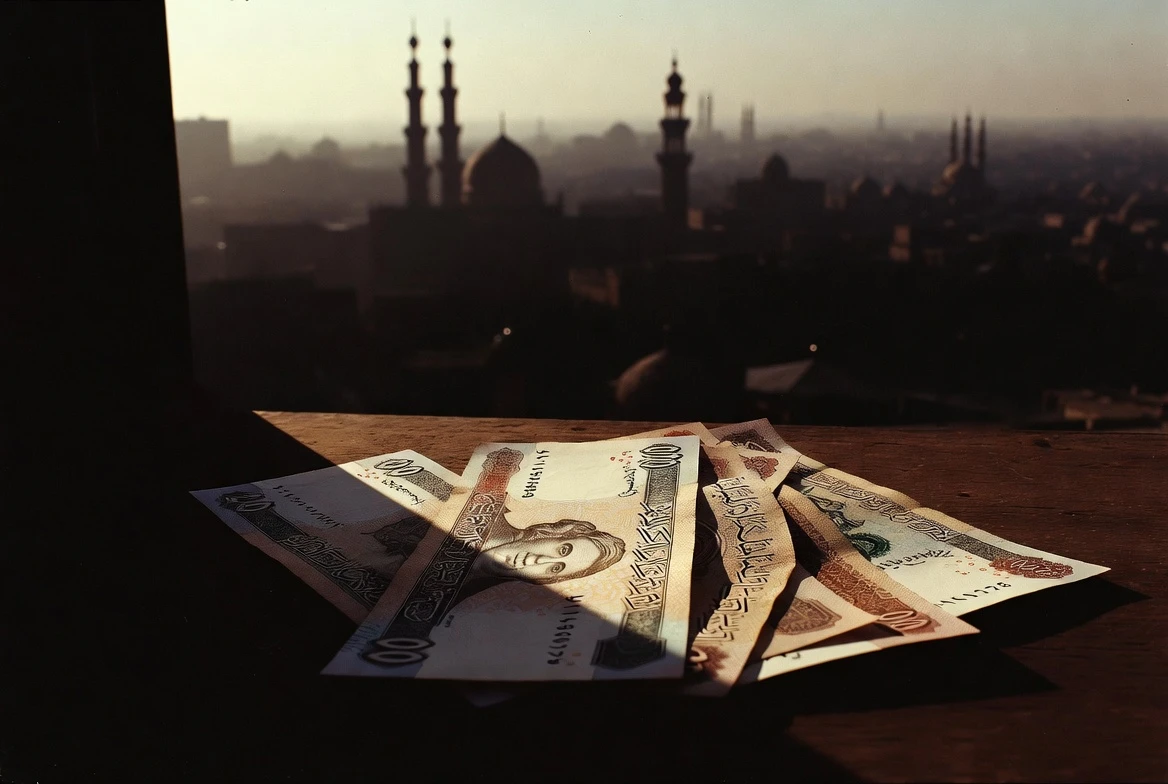
The Ceasefire That Did the Heavy Lifting
The June 14, 2026 ceasefire between the United States and Iran sits at the centre of Goldman’s call. The agreement reopened the Strait of Hormuz to commercial traffic and ended the US naval blockade on Iranian ports, according to a Christian Science Monitor report from the day it was signed. Oil prices dropped sharply on the announcement, and the currency reaction in Egypt followed within days. The pound has appreciated more than 4% against the dollar since the deal was announced, per Arab Finance’s write-up of the Goldman report.
Before the ceasefire, the pound had depreciated by roughly 10% in the first month of the US-Israeli conflict with Iran, bottoming out at about 55 per dollar, according to reporting cited by IndexBox on June 22, 2026. Oil prices spiked, speculative capital fled Egyptian local-debt markets, and Suez Canal revenues dropped. A US-Iran accord to reopen the Strait of Hormuz triggered the reversal, with portfolio investors returning to Egyptian treasury bills.
By the end of the week of June 22, 2026, the pound had climbed back above 50 per dollar for the first time since March 2026. Over the early-May to late-June window, the currency gained more than 7%, the top performance in global foreign exchange over that span, per Bloomberg figures cited in the same IndexBox report. On June 30, 2026, the spot rate stood at EGP 49.23 per dollar, a price that sits inside Goldman’s three-month forecast band of EGP 49 and that already prices a meaningful share of the trajectory Goldman is calling for.
The remaining vulnerability sits with the durability of the agreement itself. The US-Iran deal is described as a 60-day arrangement in coverage by the Christian Science Monitor and in subsequent reporting by CNN on June 27, 2026, and Houthi forces have not formally ceased operations in the region. A senior banking official quoted in the IndexBox report said there is scant confidence in the longevity of the accord. The ceasefire, in other words, has done the heavy lifting on the move Goldman now forecasts, but the path Goldman lays out assumes that lift does not reverse.
What ‘Undervalued’ Means in REER Terms
The real effective exchange rate is a trade-weighted measure that adjusts the nominal exchange rate for inflation differentials with trading partners. Goldman’s 13-15% gap is measured against the historical average of that measure, not against any single bilateral rate with the dollar. When REER sits below its long-run mean, the framework treats the currency as cheap relative to where it has tended to settle. The reading therefore ties the fair-value call to Egypt’s terms of trade and to the basket of trading partners that determine the REER, not to a moment in the dollar’s cycle.
The REER gap is not new; what changed in June 2026 is what fills it. Lower oil prices reduce Egypt’s energy import bill and improve the current account directly. Suez Canal revenues, while still well below their 2023 peak of $10.25 billion, are recovering as oil tanker traffic diverts from Hormuz, with April revenue climbing to $419 million, the highest monthly figure since early 2024, per LSEG data cited in the IndexBox report. Foreign direct investment, Goldman expects, will partially offset declining portfolio flows. That mix of lower import costs and recovering canal receipts is the bridge from a 13-15% REER shortfall to the EGP 46 number twelve months out, and the bank has named the inputs even if it has not published the elasticity.
The Macro Numbers Behind the Forecast
Goldman frames its forecast inside a wider projection for Egypt’s external accounts. The bank expects the current account deficit to retreat to around 2.5% of GDP by fiscal year 2027/2028. The drivers are lower energy import costs and the recovery of Suez Canal revenues. Both factors improve the supply of foreign currency that flows through the official market.
On the financing side, Goldman projects that foreign direct investment will partially offset declining portfolio investment and the reduced IMF-linked disbursements. The bank’s working assumption is that total external financing stays near $27 billion annually. That is the demand-side counterpart to the REER-led view on the currency. If external financing holds near that pace, the bank sees no pressure for a fresh devaluation, and the appreciation path can run on the REER closing.
Other desks place their forecasts inside the same window. Standard Chartered, per the IndexBox report from June 22, 2026, sees the pound finishing 2026 at EGP 49 to the dollar. Trading Economics’ own model, published June 30, 2026, places the currency at EGP 49.50 by quarter-end and EGP 48.33 twelve months out. The three calls share a destination in the high-40s, with Goldman at the lower end of that range. the Goldman Sachs report published via Arab Finance is the primary document behind the fair-value call, while Trading Economics’ USD/EGP historical data tracks the daily path the call is being benchmarked against.
| Forecast source | Headline call | Timeframe |
|---|---|---|
| Goldman Sachs | EGP 43 fair value; EGP 46 at 12 months | Through June 2027 |
| Standard Chartered | EGP 49 per dollar | Year-end 2026 |
| Trading Economics | EGP 49.50 (quarter-end); EGP 48.33 at 12 months | Q3 2026; June 2027 |
The Risks Goldman Lays Beside Its Forecast
Goldman does not write the forecast as a one-way call. The bank lists a set of conditions that, in its own framing, could limit the pound’s gain even with the REER gap in place. Foreign capital inflows may decline over the next twelve months as portfolio flows return to pre-war levels. Egypt is unlikely to pursue a new IMF program once the current one ends, in the bank’s view. Elevated inflation could constrain further currency gains by keeping real yields volatile. An anticipated interest-rate easing cycle from 2027 may reduce the attractiveness of Egyptian local debt to foreign investors. Each item chips away at the financing side of the balance that supports the appreciation thesis.
The IMF program question is the most consequential of the four. The fund’s seventh review is expected to be approved with a roughly $1.3 billion tranche to follow, per IndexBox’s June 22, 2026 reporting. That leaves just one more disbursement under the program, which concludes in December 2026. Egypt’s choice after that point will signal whether the external financing gap that powered the 2023-24 crisis has been closed structurally or merely postponed. Egypt’s seventh IMF review payout is the next data point on that question.
Goldman summarises the near-term constraints in five lines, each one a flag on the appreciation path:
- Potential decline in foreign capital inflows over the next twelve months.
- Foreign portfolio investments returning to pre-war levels.
- Egypt unlikely to pursue a new IMF program.
- Elevated inflation constraining further currency gains.
- Anticipated interest-rate easing cycle beginning in 2027.
Economist Moustafa Badra, in remarks carried by IndexBox on June 22, 2026, framed the question in plainer terms. He argued that the structural underpinnings of the exchange rate have not changed, and that the recent move is geopolitical, not fundamental. His preferred dollar range against the pound is 47 to 48, tighter than Goldman’s 46.
He would feel more at ease if the dollar traded nearer to 47 or 48 pounds, contending that the structural underpinnings of the exchange rate remain largely unchanged. He emphasized that geopolitics will dictate everything.
Moustafa Badra, economist, in remarks reported by IndexBox on June 22, 2026. The quote sits inside a wider argument the publication makes, that Egypt’s hard-currency model still leans on Suez Canal revenues, remittances, tourism, and portfolio flows rather than productive exports. A ceasefire does not change that structure.
Where the CBE Sits in the Picture
The Central Bank of Egypt is the other named actor in Goldman’s report. In a separate Goldman note cited by Arab Finance, the bank indicated that the CBE is likely to raise interest rates by 2% at its upcoming May and July meetings. The framing pairs the appreciation thesis with a tighter monetary stance, the standard recipe for a currency the bank views as undervalued.
The May 2026 meeting did not match that script. The CBE kept its overnight deposit rate at 19.00% on May 21, 2026, a hold that matched market expectations per Trading Economics. The bank’s current published rate is unchanged at 19.00%, with core inflation at 13.800% and headline inflation at 14.600%. The forecast for the July 9, 2026 meeting, per Goldman, is for a 2% hike, and that call is now the live one in the bank’s framework.
The divergence between Goldman’s May call and the actual hold matters for the appreciation path. A hold at 19% keeps real yields positive but does not steepen the carry that pulled foreign capital into Egyptian local debt earlier in the cycle. If Goldman’s July call does land, the financing side of the balance gets another leg of support. If it does not, the appreciation thesis leans harder on the REER closing alone.
What Other Forecasts See at the Same Horizon
The Goldman call is not an outlier on direction; it is one of the more aggressive calls on magnitude. Standard Chartered’s year-end target of EGP 49 implies less appreciation than Goldman’s EGP 46 twelve-month path. Trading Economics’ model implies EGP 48.33 in twelve months, between the two. Economist Moustafa Badra’s preferred range of 47 to 48 sits inside Goldman’s window. The Reuters May 21, 2026 report that Egypt’s central bank held key rates and the Trading Economics current-rate page sit in the same evidence base.
Where the calls diverge is on how durable the post-ceasefire environment will be. Goldman’s prior 2025 call on the pound framed the same REER gap in different market conditions. The June 2026 report updates that framework for the post-ceasefire input set.
The Structural Question That Outlasts the Forecast
Goldman’s forecast and the consensus of other desks both end in the high-40s. The gap between them and the broader Egyptian macro story is what happens to the external financing side of the balance once the IMF program ends in December 2026. Egypt’s hard-currency model continues to depend on a set of external, largely uncontrollable revenue sources, the Suez Canal, remittances, tourism, and portfolio investments, rather than on productive exports or domestic manufacturing. When any one of those pillars is disrupted, the external position quickly becomes strained, and the ceasefire does not change that structure.
The Suez Canal is the most vivid example of the fragility. Annual canal revenue has dropped from a peak of $10.25 billion in 2023 to between $3 billion and $4 billion in 2026, a roughly 70% decline, as reported by Egypt’s UN ambassador and cited in the IndexBox report. April saw a partial recovery, with revenue climbing to $419 million, mainly driven by oil tankers diverted from the Strait of Hormuz. Container traffic has not recovered, with net tonnage still about 89% below pre-crisis levels per LSEG data. The April rebound is energy-dependent and precarious.
On the positive side, Egypt’s foreign exchange reserves hit a record $52.8 billion during the Eid holiday, per the IndexBox report, and remittances from Egyptians abroad rose 33.2% year-on-year to $39.2 billion in the first ten months of the current fiscal year. Those inflows are the channels that kept the official market supplied through the worst of the conflict and that anchor the optimism in Goldman’s forecast.
Moustafa Badra estimates the war’s aftereffects on shipping confidence, oil prices, regional activity, and investor sentiment will take six months to a year to fully dissipate. The forecast path Goldman publishes today is, in effect, a bet that those aftereffects fade inside that window and that the structural underpinnings move with the macro reset.
He estimates that the war’s aftereffects on shipping confidence, oil prices, regional economic activity, and investor sentiment will take six months to a year to fully dissipate.
Moustafa Badra, economist, in remarks reported by IndexBox on June 22, 2026. The pound’s 16-month high on remittance inflows in late 2025 is the prior data point that links the remittance channel to the appreciation Goldman is now extending into 2027. The forward-looking statement in Goldman’s report is that the post-ceasefire environment lets those channels carry the pound through the IMF program end and into the EGP 46 the bank has set as the twelve-month anchor.
Disclaimer: This article is for informational purposes only and does not constitute financial or investment advice. Currency forecasts and economic projections are inherently uncertain and may change without notice. Readers should consult a qualified financial professional before making any investment decisions. Figures cited are accurate as of June 30, 2026.
