
Pakistan and seven other Muslim countries on Sunday condemned Israel’s rejection of the Board of Peace roadmap meant to complete US President Donald Trump’s comprehensive plan for Gaza, declaring that Israel now bears responsibility for obstructing peace.
The foreign ministers of Pakistan, Egypt, Türkiye, Indonesia, Jordan, Qatar, Saudi Arabia and the United Arab Emirates said the move amounted to a direct repudiation of the plan endorsed by UN Security Council Resolution 2803 implementation reports and of Palestinian statehood itself.
Eight Foreign Ministers Draw the Line
In a joint statement issued through Pakistan’s Foreign Office, the ministers called Israel’s declared rejection of the roadmap and of Palestinian statehood a fundamental undermining of collective efforts for just and lasting peace.
“Such rejection confirms that Israel now bears responsibility for obstructing the efforts to bring peace in Gaza and the rest of the occupied Palestinian territory,” the statement said.
They described the roadmap, already accepted by Palestinian factions, as the product of extensive mediator work by Egypt, Qatar, Türkiye, the United States, the high representative for Gaza and the Board of Peace. It was framed as a vital milestone for decommissioning weapons concurrently with Israeli force withdrawal, deployment of an International Stabilisation Force, transfer of administrative authority to the National Committee for the Administration of Gaza, and reconstruction.
- Rejecting the roadmap is an “explicit refusal” to implement the comprehensive plan and threatens to derail Trump’s efforts.
- Sustained and active US engagement is required to ensure and enforce Israel’s full compliance and prevent further obstruction.
- Israel bears “direct and full responsibility” for any consequences of continued rejection, obstruction, delay or non-compliance, including deterioration on the ground.
- Urgent full and immediate implementation is needed to address the grave humanitarian situation, ensure security and stability, enable reconstruction, and advance peace grounded in Palestinian self-determination and statehood under international law.
- Any attempt to deny or foreclose Palestinian statehood, including through unilateral actions, is categorically rejected.
- A just peace requires a two-state solution and an independent sovereign Palestinian state on the 1967 borders with East Jerusalem as capital.
- The Board of Peace must continue its role; all parties should support it, and the Board, with active US support, should take immediate concrete measures to uphold the plan’s integrity.
The language places the diplomatic weight of major US partners and Muslim-majority states squarely on enforcement rather than further negotiation of sequencing.
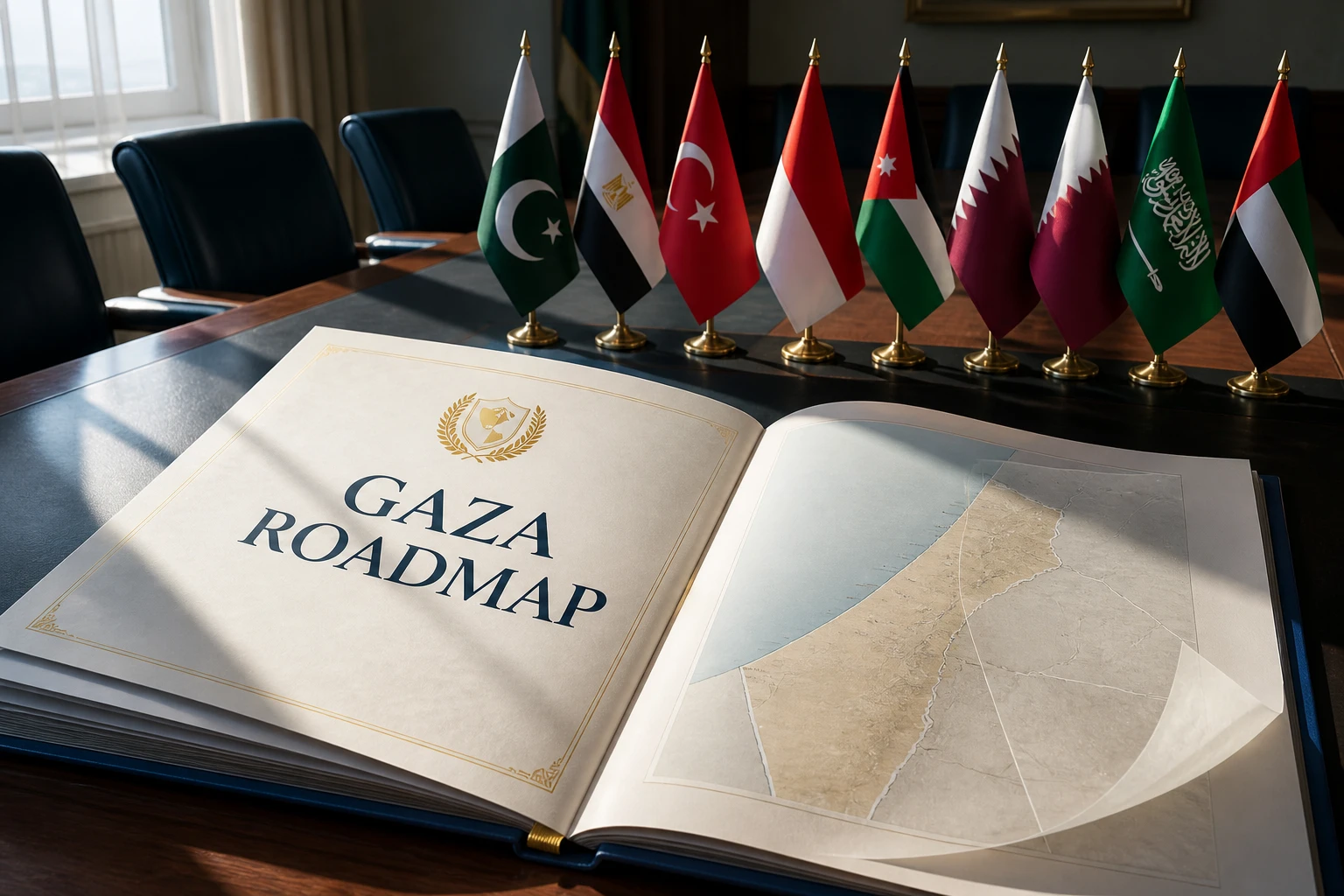
Netanyahu’s Cabinet Line and the Election Clock
Israeli Prime Minister Benjamin Netanyahu rejected the 15-point document at a cabinet meeting on 9 August. “Israel does not accept the 15-point document,” he said. The IDF “will not carry out any withdrawal until Hamas is genuinely disarmed and will continue to thwart threats against our forces and our citizens.”
He defined genuine disarmament as covering heavy weaponry, lighter weaponry and all weaponry, not fictitious steps. Netanyahu, Israel’s longest-serving leader and facing a tight race according to polls, has also stated that a Palestinian state will not be established while he is prime minister. Far-right allies have pressed for a new cabinet vote to end the Gaza plan.
The rejection followed more than a week of escalating criticism from the Israeli right. After Netanyahu met US counterparts, the Board of Peace adjusted language to say Israel would withdraw only after complete disarmament. That shift did not satisfy the original concurrent sequencing the Palestinian factions had accepted.
Crowd discussion on X quickly noted the domestic timing: Netanyahu needs to reassure his base ahead of elections while US midterms loom later in the year. The joint statement arrives as a public counterweight from states that have invested political capital in the process.
What the 15-Point Roadmap Requires
The 15-point Gaza Roadmap of 30 July 2026 is the operative document for completing Trump’s comprehensive plan under Resolution 2803. It is performance-based, not calendar-driven. Progress between phases requires verified completion of prior commitments by an International Verification Committee established by the Board of Peace.
| Roadmap element | Key requirement | Israeli stated position |
|---|---|---|
| Weapons decommissioning | Heavy weapons, production sites, depots, tunnels, militia arms and police weapons move to NCAG control in sequenced steps; no transfer to Israel or non-Palestinian parties; only NCAG holds weapons at end | Full genuine disarmament of all weaponry first, before any withdrawal |
| Israeli withdrawal | Phased, linked to verified decommissioning progress and Comprehensive Plan commitments; no forced displacement | No withdrawal until complete disarmament certified |
| Governance transfer | All civilian and security functions to independent National Committee for the Administration of Gaza; factions will not interfere | Focus remains on security first; statehood rejected under current leadership |
| International Stabilisation Force | Deploy to separate forces, monitor ceasefire, train police, protect aid; no policing of Palestinian society | Acceptance conditional on prior full Hamas disarmament |
| Verification | IVC certifies each phase before next begins | Insistence on unilateral determination of “genuine” status |
Core principles include “One Authority, One Law, One Weapon.” Hamas and factions accept the Trump plan and Resolution 2803 framework, including full demilitarization and deradicalization. A social peace agreement would end internal violence, reprisals and armed displays. Reconstruction funding and planning fall under Board of Peace and NCAG supervision to international standards.
The explanatory text stresses that the arrangement converts the earlier 20-point political declaration into a verifiable step-for-step exchange: Hamas relinquishment of armed rule for orderly reconstruction, civilian governance and withdrawal.
Security and Decommissioning Clauses
Clauses 6-11 lock the monopoly of force. Police weapons transfer early to NCAG after vetting. Heavy systems and tunnels are handled gradually after Sharm el-Sheikh commitments, NCAG entry and ISF deployment. Personal weapons fall under Palestinian law and NCAG licensing. Militia members are not integrated into police. The process is monitored by the IVC with ISF support.
Withdrawal and Force Roles
The temporary International Stabilisation Force separates Israeli forces from NCAG areas, monitors the ceasefire, trains Palestinian police and secures humanitarian delivery. It does not perform internal policing. Israeli forces complete phased withdrawal consistent with the decommissioning link and the commitment that no one is forced to leave Gaza. NCAG handles internal security incidents.
The US Partners Inside the Statement
The signatories are not a uniform bloc. Egypt, Jordan, Qatar, Saudi Arabia and the UAE maintain deep security and economic ties with Washington and have played direct mediator or host roles. Türkiye and Indonesia add broader Organisation of Islamic Cooperation weight. Pakistan’s participation continues a pattern of Muslim diplomatic coordination seen in earlier Muslim ministerial coordination on Jerusalem.
That mix matters for second-order effects. States that host US forces, buy US weapons, or underwrite reconstruction expectations are now on record that Israel obstructs the very plan Trump champions. The statement also sits alongside tighter Pakistan Turkey Saudi defense alignment discussions that have redrawn regional security calculations.
By naming the United States as the party that must enforce compliance, the ministers convert private mediation channels into a public accountability demand.
Humanitarian Clock and Board of Peace Mandate
The ministers tied implementation urgency to the grave humanitarian situation in Gaza. Post-ceasefire Israeli strikes have continued; one recent tally cited at least 1,252 additional deaths after the October arrangement, with overall Palestinian deaths since October 2023 reported above 73,000 by Gaza health authorities. Most of the population remains displaced. Aid restrictions and rubble covering thousands of bodies compound the pressure for reconstruction to begin under NCAG priorities.
Resolution 2803 gave the Board of Peace transitional administration functions and international legal personality to set the framework and coordinate funding until the Palestinian Authority completes reforms and can take control. The ISF carries a temporary stabilisation mandate. The roadmap is the mechanism meant to move from the initial ceasefire and hostage arrangements into that second phase.
When the Board of Peace adjusted sequencing language after Netanyahu’s meeting, it underscored the tension between Israeli security demands and the concurrent model Palestinian factions accepted. The joint statement insists the original roadmap integrity must be upheld.
- 29 September 2025, Trump Comprehensive Plan to End the Gaza Conflict issued.
- 17 November 2025, UNSC Resolution 2803 endorses the plan, establishes Board of Peace and authorises International Stabilisation Force.
- January 2026, Board of Peace charter and formal steps; NCAG formation welcomed.
- 30 July 2026, 15-point Roadmap for completing implementation published by Board of Peace.
- Early August 2026, Gradual Israeli criticism escalates; Board adjusts some language after Netanyahu contact.
- 9 August 2026, Netanyahu tells cabinet Israel rejects the 15-point document; no withdrawal until genuine full disarmament.
- 16 August 2026, Eight foreign ministers issue joint condemnation and call for US enforcement.
Each date tightens the political bind rather than resolving sequencing.
Kushner Shuttle and the Enforcement Question
On the same weekend as the statement, Jared Kushner met Hamas leaders in Egypt for more than two hours, with Egyptian, Qatari and Turkish officials present. According to sources with direct knowledge reported by multiple outlets, Hamas reaffirmed commitment to disarmament and demilitarization. Kushner reportedly told them there is no room to negotiate the principle of disarmament but that real steps would prompt US efforts to secure reciprocal Israeli moves. He was expected to meet Netanyahu next.
That shuttle illustrates the second-order bind. Mediators and the Board continue operational work. Palestinian factions remain on the record accepting the roadmap. Israel’s prime minister, under domestic pressure, has drawn a hard public line against concurrent withdrawal. The eight ministers have now made clear they will attribute any collapse or further deterioration to Israeli obstruction and expect Washington to compel compliance.
White House tolerance of Netanyahu’s public messaging for electoral reasons has been described by former officials as a familiar two-step, provided attacks continue to ease and core elements move. The joint statement raises the cost of that tolerance. If strikes resume at scale or the NCAG and ISF cannot enter, the same partners who endorsed the plan become witnesses to its failure.
Trump’s personal investment in the Board of Peace as a signature achievement sits against Netanyahu’s survival calculus. The ministers’ call for the Board, backed by the United States, to take immediate concrete measures inside its mandate leaves little diplomatic cover for indefinite delay.
The roadmap’s own text ties Palestinian self-determination pathway language to successful implementation. The eight states have restated that a two-state outcome on 1967 lines with East Jerusalem as capital remains the only route to regional security and stability. Israel’s rejection of both the sequencing and the statehood horizon therefore lands as a dual repudiation in their framing.
Whether the US uses leverage on aid, diplomatic cover or Board decisions to force movement, or whether the process freezes while elections play out, will determine if the second phase ever begins. The statement has made the choice public and collective.
