
Magos Systems, an Israeli developer of AI-driven radar technology, announced an NIS 21 million ($7 million) deal on Monday, June 29, to supply the Israeli army with hundreds of compact drone-detection units. The contract, reported Tuesday, came after eight Magos radars had already entered Israel Defense Forces service.
Magos did not name the customer. The Jerusalem Post identified the buyer as Israel's Ministry of Defense and the deployment area as the Lebanese border. The deal expands a working pilot: the eight units already in service had been showing what the radar can do on the northern front.
The Drone Strike That Made the Order Urgent
Magos confirmed the contract Monday, June 29. The Jerusalem Post, publishing the news Tuesday, reported the customer as Israel's Ministry of Defense and the destination as the Lebanese border area.
An IDF probe concluded that a Hezbollah attack on June 19 killed four soldiers, including a tank battalion commander, when an explosive-laden drone struck their vehicle. Drones are slower than rockets and usually less destructive, but they are difficult to detect because they often fly at low altitude. Intercepting them typically requires several different assets working together. Israel has been fighting on multiple fronts for more than two and a half years, with unmanned aerial incursions a constant, closer-range threat on the northern front.
Fiber-optic drones make that problem harder still. Tethered to their operators by a fiber-optic spool, they have no radio signal for jammers to lock onto, no electronic emission for radar to detect. Hezbollah released the first video of a fiber-optic drone strike on an Israeli tank in late March 2026, according to a report on fiber-optic drones arriving in southern Lebanon. The craft appear to be manufactured locally using 3D printing technology, with widely available civilian electronic components, Defense News reported. Each aircraft costs $300 to $400, Ali Jazini, a military expert close to the group, told the outlet. That is the threat the new Magos order is built to address.
- Late March 2026: Hezbollah released the first video of a fiber-optic drone attack on an Israeli tank in southern Lebanon.
- June 19, 2026: An IDF probe found a Hezbollah drone strike killed a tank battalion commander and three soldiers in southern Lebanon.
- June 29, 2026: Magos Systems announced an NIS 21 million deal to supply hundreds of drone-detection radar units to the Israeli army.
Eight Magos radars were already in IDF hands when Monday's announcement landed. The new order, Ynet reported, was placed following their operational performance. The expansion scales an eight-unit pilot to hundreds of units. The procurement process compressed sharply, given the active battlefield threat.
How Magos Detects Drones Jammers Cannot
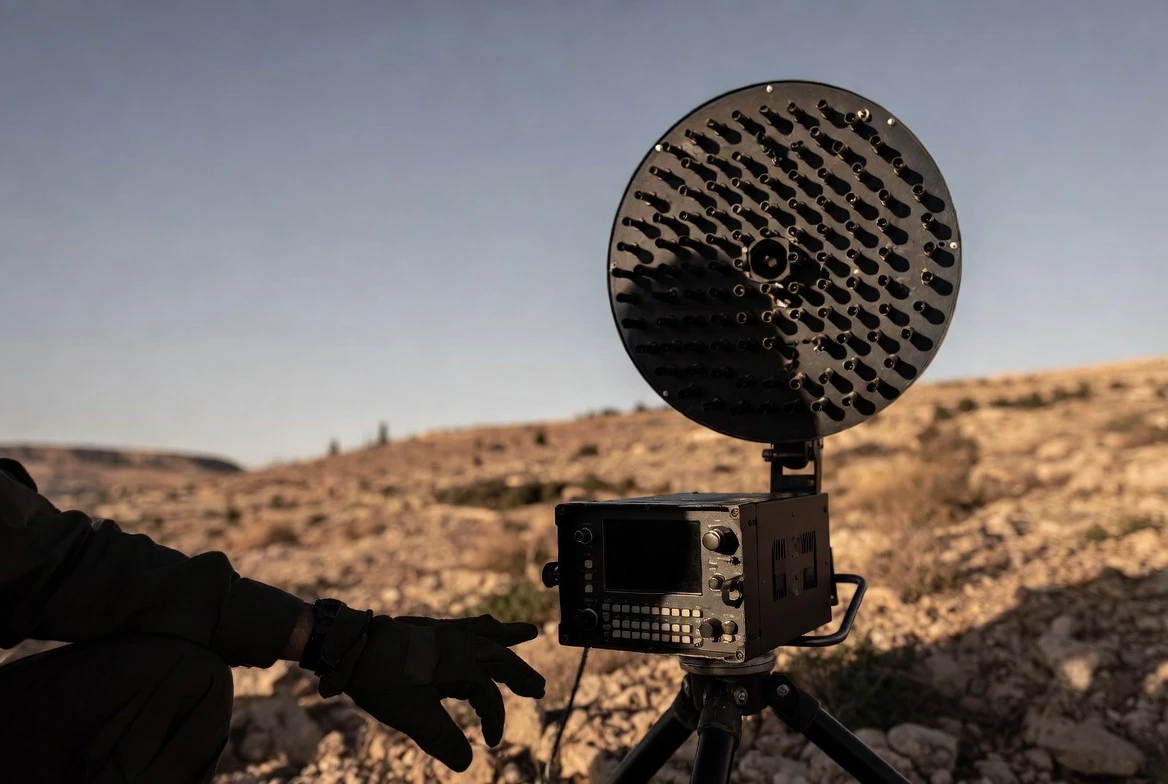
Magos' radar runs on MIMO (multiple-input multiple-output) beamforming, an architecture that multiplexes many signals across a small antenna array. The unit reads moving objects at low altitude and filters out birds, windblown debris, and other false positives. The hardware is lightweight, draws little power, and was designed to be carried by ground forces. The Jerusalem Post described it as compact and easy to deploy, suited for tactical use in remote terrain. Magos runs an artificial intelligence classification algorithm in real time, sorting moving objects into people, vehicles, animals, or drones. Most false alarms are eliminated, the company says, before they reach a human operator.
The harder problem is a fiber-optic drone. With no radio signature to jam, no electronic emission for radar to lock on, conventional counter-drone suites miss the aircraft entirely. Magos' system reads the rotors, which turn the same way on a tether or on radio control. That approach catches drones that the radio-based detectors miss.
By fusing radar detection data with information from cameras deployed in the field, the system delivers real-time, multi-dimensional situational awareness of both ground and aerial threats.
That was Magos chief executive Aviel Kisliansky, in remarks the Times of Israel published alongside the deal. The original announcement of the deal ran with those comments. The system, the company said, classifies people, vehicles, and drones at once and runs in poor weather. False alarms, which have plagued earlier drone detectors, are filtered out almost to zero.
Why a Cheaper Radar Beat Costlier Counter-Drone Suites
The rotor-signature approach also carries a price advantage. Each Magos unit costs several tens of thousands of shekels, roughly several thousand dollars per the company's stated pricing. Larger counter-drone radars run hundreds of thousands of shekels, or tens of thousands of dollars per unit. The gap shows up most in coverage: more units, more places.
- About $7 million: The Magos Systems contract with the Israeli army.
- Several thousand dollars: The cost of one Magos radar, per Ynet.
- Tens of thousands of dollars: The cost of larger counter-drone radars.
- $300 to $400 each: The estimated cost of a Hezbollah fiber-optic drone, per Ali Jazini.
- Eight units: The Magos radars already in IDF service before the new order.
In the field, the practical gain is lead time. Magos says its detector gives troops at least 60 seconds of warning before a drone reaches them, regardless of whether they hear the aircraft. That window is enough to take cover, reposition, or to let an accompanying jammer or kinetic system react.
The compact form also matters on a border with many dispersed positions. Each Magos unit is light enough for a small team to carry. A heavier counter-drone rig may need vehicle transport and dedicated power. The portability gap shapes where the radar can actually be deployed. A single high-end suite cannot be everywhere at once.
Magos says its AI classification algorithm has passed rigorous evaluations in Israel and abroad. The company described strong results against competing systems that are significantly more expensive. Those tests matter because the same drone-threat scenario would otherwise call for the heavier radar. Detection parity at one-tenth the unit cost changes the procurement math.
On the procurement side, the math favors distributed coverage. One heavyweight radar covers a single fixed position. Multiple Magos units at lower per-unit cost can cover a dispersed line of forces. Defense planners buy the same threat awareness at a fraction of the per-position capital cost. The cheaper radar fills positions a heavyweight system cannot.
A Perimeter Startup Sells to a Battlefield Buyer
Magos was founded in 2010 by electrical engineers Aviel Kisliansky, the chief executive and a former captain in the IDF radar division, and Amit Isseroff, the vice president of research and development and a former Intel employee, according to the company's leadership page. The company started in perimeter security for private facilities, with its original customer base in industrial and commercial sites. The Israeli army contract joins a customer list that already included defense sites, government agencies, ports, energy installations, and solar farms. It is, the company said, the largest single-customer deployment the startup has signed to date.
Magos has raised $5 million to date, Ynet reported. The company's largest shareholder is Afcon, controlled by the Schmelzer family, and another major investor is the international firm Johnson Controls. Annual sales, across operations in 70+ countries, range from $20 million to $30 million.
Beyond Israel, Magos sells into North America, South America, and Europe, the company says. The footprint already includes more than 50 third-party integrations across energy sites, ports, and data centers. Magos is preparing a broader push into India. The radar sales infrastructure was already in place when the army call came. So was the per-unit cost advantage the army contract now exploits at scale.
The Drone Threat Is Still Pressing In
Magos' deal supplies detectors. Interceptors remain a separate layer of counter-drone hardware that the radar does not replace. A full suite pairs detection with kinetic or electronic kill mechanisms, and the Magos radar covers only the early-warning half of that chain. Fiber-optic drones are also still getting cheaper: the $300 to $400 per-aircraft figure cited by Defense News makes mass operations affordable. The threat is also widening in scope: Ynet reported that conventional drone-detection methods cannot identify fiber-optic drones, a gap Magos claims to close with the rotor-signature approach.
Israel's military has been caught flat-footed by the fiber-optic drone shift, Defense News reported, with solutions still limited for larger armies. Magos will next deploy hundreds of radars to the Lebanese border. Eight units went into IDF hands before Monday; hundreds will follow.
