
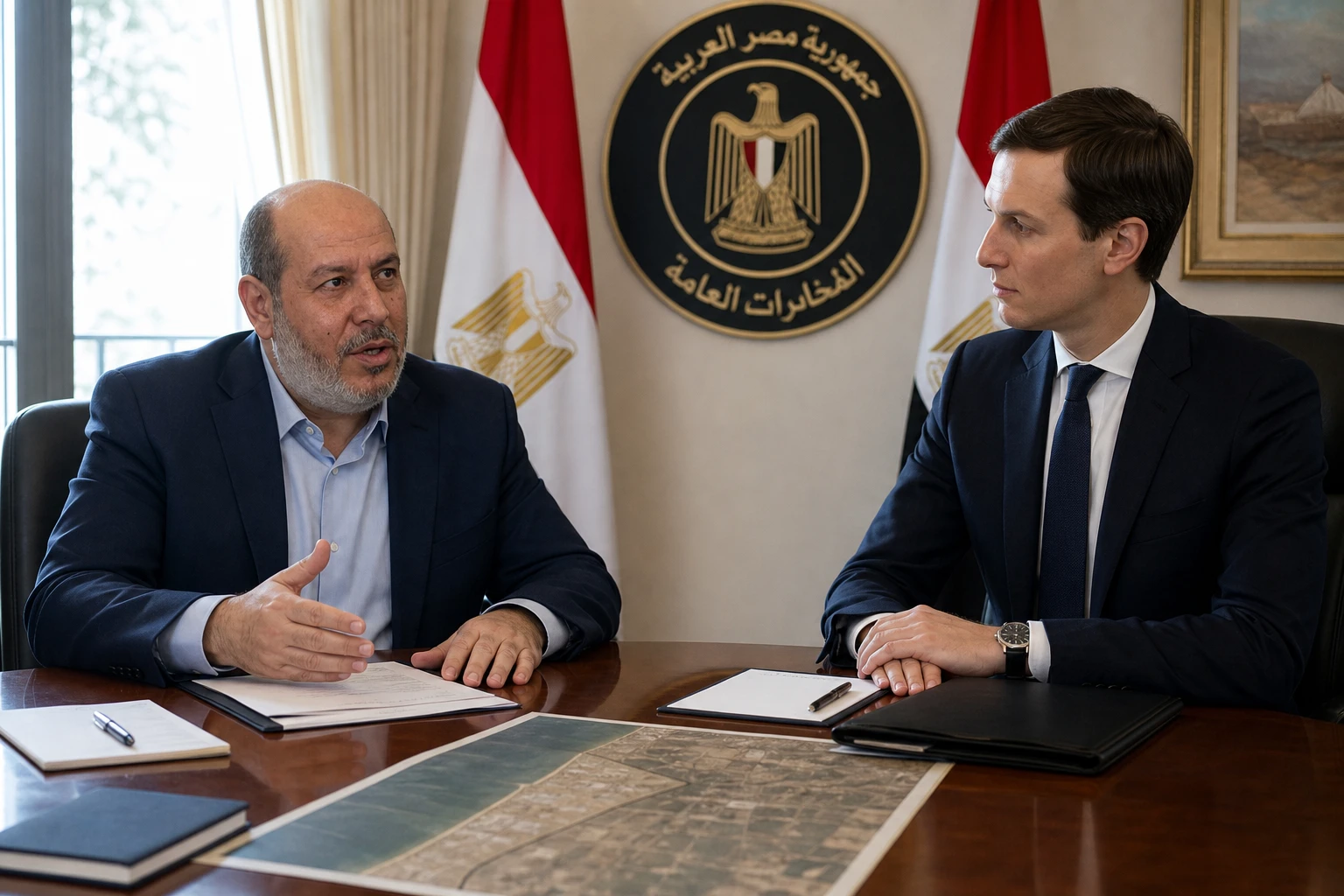
A senior Hamas delegation led by political chief Khalil al-Hayya met Egyptian General Intelligence chief Hassan Rashad in Cairo on Sunday, then sat with Jared Kushner and Board of Peace envoys to demand Israel implement the 15-point Gaza roadmap. The talks followed Netanyahu’s rejection of any withdrawal before genuine Hamas disarmament.
Hamas framed the sessions as a push to compel compliance after what it called Israeli violations of the existing ceasefire. Kushner heads next to Israel for talks with the prime minister.
Al-Hayya’s Team Reaches Cairo
The delegation arrived from Istanbul and went straight into discussions with Rashad. According to Palestinian sources and mediators, the group included Shura Council chief Mohammed Darwish, external leader Khaled Meshaal, West Bank chief Zaher Jabarin and Arab-Islamic relations head Basem Naim.
- Khalil al-Hayya as political leader and chief negotiator
- Zaher Jabarin heading the core negotiating track
- Khaled Meshaal and Mohammed Darwish for senior political weight
- Basem Naim for external messaging
An official had told Asharq earlier that the visit would brief Egypt on Israeli actions and restate Hamas readiness once Israel meets its side. Anadolu Agency confirmation of the Rashad session put the meeting on Sunday itself. Al-Hayya’s first Egypt trip since taking the top political post in late July carried extra weight for the mediators who have hosted repeated rounds.
The mix of roles was deliberate. Political leadership, the West Bank track, Shura Council authority and external messaging all arrived in one room. That lineup let the group brief Egypt on the ground picture and restated conditions in a single session rather than staggered contacts.
Mediators treat such full-slate visits as a signal that Hamas wants the message carried intact to other capitals. The Istanbul departure and immediate Rashad meeting kept the day tightly sequenced before the later Alamein round.
Kushner Joins the Table in Alamein
Later the same day the Hamas team met Kushner, Board of Peace Director-General Nikolay Mladenov and former British prime minister Tony Blair. Egyptian, Qatari and Turkish officials sat in. The setting was Alamein. One source described the aim as turning roadmap obligations into concrete, verifiable steps that keep the ceasefire, hand governing powers to the National Committee for the Administration of Gaza, and leave Hamas with no future administrative role.
A separate source familiar with the talks said there can be no ambiguity: Hamas must relinquish governing authority and all weapons and military infrastructure, and Gaza can never again be a source of terror for Israel. Hamas publicly reaffirmed acceptance of the phase-two roadmap while conditioning full moves on Israel completing phase-one duties.
Hamas and the resistance fully adhered to the first phase of the ceasefire agreement. Israel, however, failed to implement this phase, escalating its military operations on the ground and deepening the humanitarian catastrophe, and has explicitly rejected the roadmap.
The group called on mediators and the Board of Peace to compel Israel to end violations, halt killings and incursions, accept the roadmap and set a timetable. Kushner also met President Abdel Fattah el-Sisi afterward. The Egyptian presidency said the two discussed Gaza and bilateral ties. Kushner is due in Israel Monday with Mladenov and Blair to see Netanyahu.
Hosting Egyptian, Qatari and Turkish officials beside the Board of Peace team gave the Alamein session a wider witness circle. The same day link from Rashad to Kushner to el-Sisi kept Cairo at the center of logistics while the American channel opened directly onto Hamas leadership.
What the 15 Points Require
The Board of Peace issued the roadmap on July 31 as the path to implement President Trump’s broader comprehensive plan and UN Security Council Resolution 2803. It rests on sequential verification by an International Verification Committee. Progression depends on certified completion of each stage.
| Focus area | Core requirement | Link to next step |
|---|---|---|
| Governance | Full handover of civilian and security functions to NCAG; factions stay out | NCAG enters after timetable set (14 days post-approval, extendable) |
| Weapons | Decommission and store heavy weapons, production sites, depots, tunnels under NCAG; personal arms under Palestinian law | Tied to phased Israeli withdrawal; only NCAG holds weapons at end |
| Forces | Temporary International Stabilization Force deploys to separate sides, monitor, train police, secure aid | Israeli phased pullout per agreed timetable and Trump plan |
| Verification | IVC certifies commitments before each advance; enhanced monitoring of violations | No automatic move without certification |
Principles open with reaffirmation of the Trump plan and the goal of complete Israeli withdrawal, Palestinian governance, reconstruction and a political path to self-determination. Security language is blunt: One Authority, One Law, One Weapon. Police get vetted; militia members stay out of security forces. A social peace agreement ends internal violence and shows of force. Reconstruction falls to the Board of Peace and NCAG under a supervised plan. The full 15-point Board of Peace roadmap text makes the sequencing explicit: weapons process begins after remaining Sharm el-Sheikh commitments, NCAG entry and ISF deployment, then links directly to Israeli withdrawals.
Ali Shaath as NCAG chief commissioner is the named technocratic lead expected to restore services, audit finances and manage public assets once the body enters Gaza. Informed sources had earlier flagged possible Kushner-Mladenov-Blair contact with Shaath as well.
Under that design, no stage advances on trust alone. The IVC must certify before the next gate opens. Heavy weapons, production sites, depots and tunnels move under NCAG control; personal arms fall under Palestinian law; only NCAG holds weapons at the end state. The Temporary International Stabilization Force separates sides, monitors, trains police and secures aid while Israeli pullout follows the agreed timetable and the Trump plan.
Netanyahu’s Red Line Meets Arab Pushback
Netanyahu told his cabinet Israel rejects the 15-point document. The IDF will carry out no withdrawal until Hamas is genuinely and completely disarmed. Israeli officials have argued Hamas used any pause in targeted killings to rebuild capabilities rather than prepare for decommissioning. Strikes resumed in recent days. Palestinian sources put the death toll since the October 2025 ceasefire above 1,250, with the overall figure since October 2023 past 73,300.
On Sunday the foreign ministers of Egypt, the UAE, Qatar, Jordan, Indonesia, Pakistan, Turkey and Saudi Arabia issued a joint condemnation of Israel’s rejection. They called it a direct assault on US-led efforts and Palestinian statehood, urged Washington to enforce compliance, and pressed the Board of Peace to move against obstruction. The timing landed just as Kushner’s meetings began.
That public front sits against earlier friction. The same mediators have watched previous Cairo tracks stall when domestic Israeli coalition politics hardened. One earlier episode saw the earlier freeze on Cairo mediators meeting when coalition stakes rose. The new round adds direct American contact with Hamas leadership, a step the US had long avoided.
- Egypt, the UAE, Qatar and Jordan from the core mediation neighborhood
- Turkey as a long-running Hamas contact channel
- Saudi Arabia, Indonesia and Pakistan widening the Islamic diplomatic front
Eight foreign ministries speaking together raised the diplomatic price of open rejection on the same day the envoys sat down. The statement cast the 15-point text as the US-led path and tied obstruction to damage against Palestinian statehood goals.
Sequencing Becomes the Real Fight
Hamas insists it accepted the roadmap and remains ready once Israel finishes phase-one duties and stops what it calls violations. Israeli positions reverse the order: verified full disarmament first, then any pullout. Kushner’s side has stressed concrete, verifiable actions rather than promises. Sources close to the Board of Peace say the United States and Israel agree on the end state of a demilitarized Gaza free of Hamas governance, and that gaps can be closed.
| Actor | Stated order of steps | Condition attached |
|---|---|---|
| Hamas | Israel finishes phase-one duties, then Hamas full moves | End of alleged violations and killings first |
| Israel | Genuine complete disarmament, then any withdrawal | No pullout while Hamas retains capability |
| Board of Peace envoys | Concrete verifiable actions on a certified sequence | IVC sign-off before each advance |
Yet the second-order effect of Sunday’s sessions is already visible. By meeting Hamas directly and extracting a fresh public recommitment, the US and Board of Peace envoys have raised the cost of continued rejection. Arab and Islamic capitals have lined up behind the text. Continued Israeli operations supply Hamas with daily talking points on violations. At the same time, any Hamas backsliding on weapons or governance handover would undercut its own claim of readiness. The Board of Peace link of pullout to full disarm remains the binding structure both sides now talk past each other about.
Crowd reaction on X tracked the same tension. Barak Ravid of Axios reported sources saying Hamas leaders reaffirmed their commitment to disarm and demilitarize in the Kushner meeting. Other posts noted Kushner’s reported insistence on tangible proof over mere storage of weapons, and the recovery of deceased hostage bodies as a side deliverable Hamas offered to convey to Trump. Skeptics replied that past patterns show Hamas never fully disarms while regional patrons keep options open. Those takes sharpen the stake: the meetings did not invent the deadlock, but they made the next Israeli choice harder to delay without visible political cost.
Pressure Shifts Toward Jerusalem
Kushner’s Monday schedule with Netanyahu now carries the weight of the Cairo recommitments and the eight-nation statement. Israeli officials have flagged concern over any demand to end targeted killings of Hamas fighters. The Board of Peace maintains there are no significant gaps and that progress toward disarmament is reachable. Hamas has used the platform to praise Trump’s role in the original ceasefire while blaming Israel for the current stall.
Strikes continued even as the diplomats talked. Medics reported injuries from a tent strike in Khan Younis and an apartment hit in Nuseirat on Sunday. The ceasefire that began in October 2025 has frayed into a pattern of limited operations and accusations. Whether the rare US-Hamas channel produces a verified timetable or simply another round of statements will show in the days after the Netanyahu meeting. For now the roadmap sits between two clear public positions, and the mediators have chosen to sit with both sides in the same 24-hour window.
The Calendar That Built This Round
The Sunday meetings did not appear from nowhere. A short chain of public markers already on the record framed the pressure each side carried into Cairo and Alamein.
- Late July: Al-Hayya takes the top Hamas political post, giving his first Egypt trip added weight.
- July 31: The Board of Peace issues the 15-point roadmap tied to the Trump plan and Resolution 2803.
- October 2025: The ceasefire begins; Palestinian sources later put deaths since that date above 1,250.
- Recent days: Strikes resume; Israel restates no withdrawal before full disarmament.
- Sunday: Rashad session, Alamein talks with Kushner, Mladenov and Blair, eight-nation condemnation, and reported strikes in Khan Younis and Nuseirat.
- Monday: Kushner, Mladenov and Blair are due in Israel to see Netanyahu.
Read in order, the list shows why sequencing hardened into the main fight. The roadmap set certified stages; the ceasefire frayed; rejection and recommitment landed in the same news cycle. Monday’s Netanyahu meeting now sits at the end of that chain.
Where the End State Still Aligns
Sources close to the Board of Peace say the United States and Israel already share the destination: a demilitarized Gaza with no Hamas governing role. The quarrel is the path and the proof required at each gate.
Hamas publicly reaffirmed the phase-two roadmap and, according to the Axios reporting on the Kushner meeting, a commitment to disarm and demilitarize. Envoys want tangible proof, not storage promises alone. Israel wants genuine complete disarmament before any IDF pullout. The NCAG handover, ISF deployment and IVC certificates are the tools written to bridge those demands without relying on trust.
Ali Shaath’s expected brief as NCAG chief commissioner, restoring services, auditing finances and managing public assets, is the civilian half of that bridge once entry is approved. The weapons half still turns on whether decommissioning is verified before territory changes hands, or tied in phases as the roadmap text describes.
The Cairo sessions leave Israel holding the next visible move while the Board of Peace, Arab capitals and a direct American channel keep the text alive.
