
European falcon breeders from France, Austria, Britain, Germany and Slovakia have expanded their stands at the International Falcon Breeders Auction 2026 in Riyadh after the National Center for Falcons reserved every juvenile-category round in Al-Melwah racing for birds sold through the event. The three-week sale runs August 5 to 25 at the center’s headquarters in Malham, north of the capital.
That single eligibility rule turns a purchase into a competitive asset with access to prize pools that organizers put as high as 50 million Saudi riyals. Farms that once treated the Gulf as a secondary market now ship hundreds of birds because the racing calendar rewards auction stock.
How Racing Eligibility Changed the Stakes
The National Center for Falcons announced that all local and international chick-racing categories would be open only to falcons bought at the auction. Buyers now weigh pedigree against racing potential. Melwah Race dates sit in early October, weeks after the sale closes, so a bird purchased in August can step straight onto the course.
Organizers link the rule to last year’s numbers: more than 13 million riyals in sales, 1,103 falcons moved by 67 farms from 23 countries, and more than 20,000 visitors. The 23 percent sales jump recorded last year already showed rising demand. The racing lock-in aims to keep that momentum.
Portuguese breeder Henrique Cania, whose farm selects gyrfalcon and peregrine lines from Canadian, Finnish and Scottish stock, put the requirement simply: success depends on quality bloodlines, not last-minute preparation. The rule rewards farms that have spent years building racing hybrids.
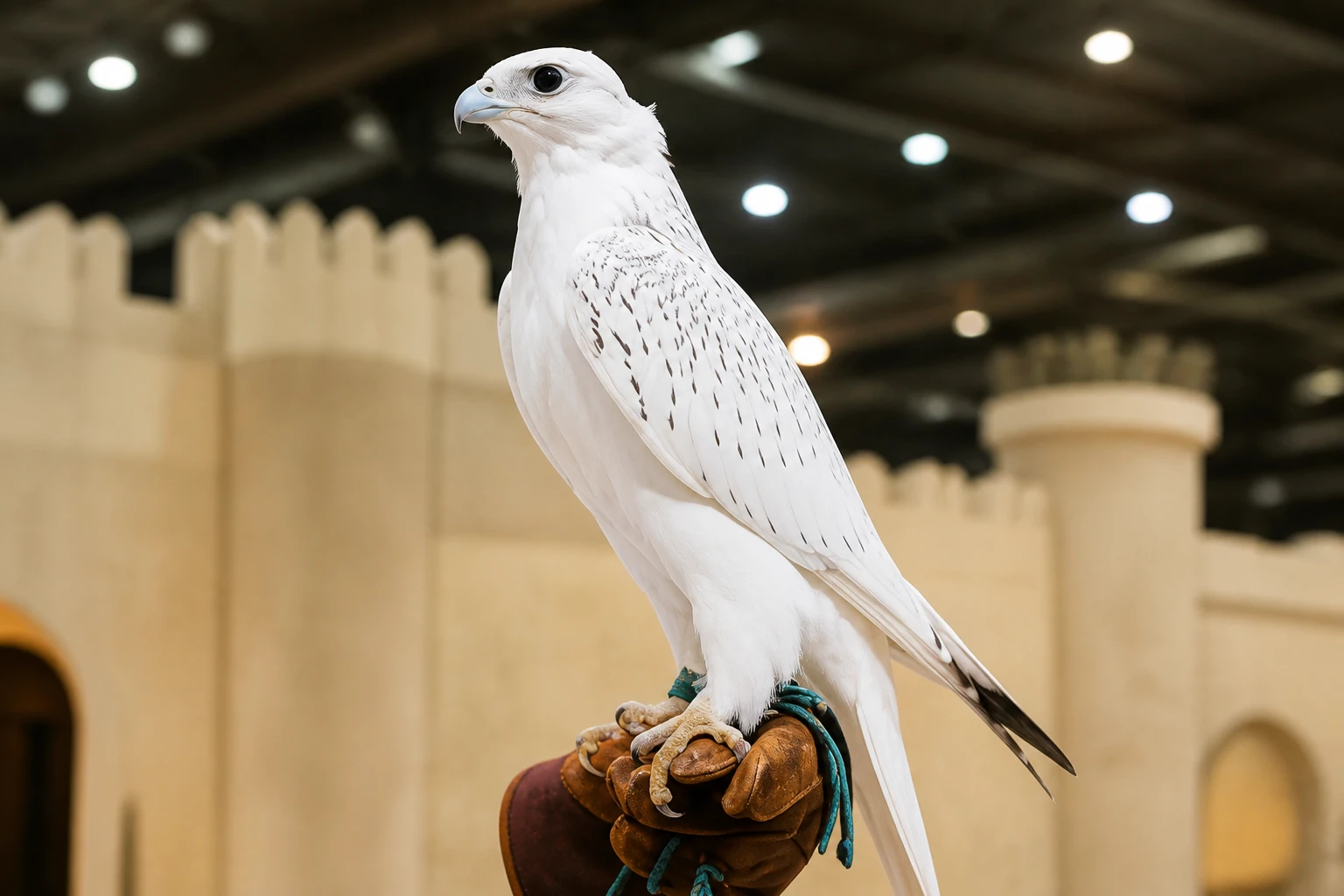
The Europeans Who Showed Up With Birds
Sandra Baum of France-based SB Falcons invited enthusiasts to treat the trip as both market and cultural visit, noting Saudi Arabia’s mix of organization and falconry heritage. Austrian falconer Ali Mughal of Valley Club Falcon brought 100 birds this year after a strong 2025 result; he called the auction a safe and reliable channel for captive-bred stock.
A Scottish family operation arrived with gyr-peregrine hybrids fitted with GPS trackers for training and free-flight work. French owner Philippe Hertel is on his sixth edition. Irish and Slovenian farms also appeared in early sales nights. On the sixth night alone, five birds from Germany, Slovenia, Romania and Ireland fetched a combined 348,000 riyals.
- France, SB Falcons (Sandra Baum) and multi-year participant Philippe Hertel
- Austria, Valley Club Falcon, 100 birds after prior success
- Portugal, Henrique Cania farm, Canadian/Finnish/Scottish gyr and peregrine lines
- Scotland, family farm focused on racing hybrids with GPS monitoring
- Germany, Ireland, Slovenia, Romania, Slovakia, Britain, birds already through the ring on early nights
The mix broadens the bloodline pool available to Gulf falconers who once relied more heavily on local or regional supply.
Sales Climb Since the First Ring
The auction’s first edition launched in 2021 under the Saudi Falcons Club. Early top price was a Triple Pure Gyr Ultra White at 1.75 million riyals. Numbers have grown steadily even through a quieter 2022.
| Year | Sales (SAR) | Falcons sold | Notes |
|---|---|---|---|
| 2021 | more than 8 million | 443 | record 1.75 million top sale |
| 2022 | more than 2.5 million | 371 | 40-plus farms, 17 countries |
| 2023 | more than 8 million | 642 | rebound year |
| 2024 | more than 10 million | 872 | 56 farms, 19 countries |
| 2025 | more than 13 million | 1,103 | +23% sales, +27% birds, 67 farms, 23 countries; Pure Gyr Super White at 1.2 million |
The top 2025 sale of 1.2 million riyals set the recent ceiling until this year’s Canadian Super White mottled gyrfalcon chick reached 1.3 million riyals (about $346,000) on the seventh night, the second-highest price in auction history. Two birds from that Canadian farm together brought 1.45 million riyals.
From Club to National Center
The Saudi Falcons Club founded in 2017 was the first government body focused on falcons. It sits under Crown Prince Mohammed bin Salman’s supervision and organizes the King Abdulaziz International Falconry Festival. Falconry itself sits on the UNESCO living human heritage list, a multi-nation inscription that includes Saudi Arabia and more than twenty other states.
The National Center for Falcons now hosts the breeders auction as its opening major event of the season. Later calendar stops include the International Saudi Falcons and Hunting Exhibition, Melwah Race, a longer National Falcon Center Auction, and the King Abdulaziz Festival itself. The structure turns one sale into the gateway for the full racing and festival year.
What Happens After the Hammer Falls
Saudi Falcons Club procedures run through fixed steps once a bid is accepted. A classification committee checks category and measurements. A legal committee records signatures from both sides. Finance moves payment from buyer to breeder. The bird receives a leg band, enters the racing registry, and leaves with an approved exit permit.
Waleed Al-Taweel, club spokesperson, has described the sequence as the guarantee of transparency that lets international farms ship with confidence. Live television and social streams carry the bidding to audiences far outside the hall. Equipment and medical-supply stands sit beside the breeder pavilions, so a new owner can kit a bird on the same day.
Success at the auction depended on producing high-quality falcons. Breeding quality was not determined by preparation alone.
Henrique Cania made that point after selecting his gyr and peregrine lines over a decade of work. The same logic appears in the Scottish farm’s GPS training data and Mughal’s decision to scale to 100 birds.
Why the European Turn Matters for Buyers
Gulf falconers gain wider access to Finnish, Scottish, Canadian and Central European genetics already race-proven in Europe. Captive-bred birds arrive with documentation and health checks that simplify import and competition entry. Local Saudi farms still hold a large share of the stands (19 in 2025), so the auction remains a national showcase even as the foreign contingent grows.
The economic ring extends past the hammer price. Hotels, transport, veterinary services and equipment vendors around Malham and Riyadh see the same three-week surge that produced the visitor crowds that filled earlier editions. Breeders leave with hard currency and a clear sales calendar for the next season.
Fourteen new farms joined this year’s edition, according to organizers, further widening the map. Early nights already moved European and North American birds at six-figure totals. The auction continues through August 25, with more nights of live bidding still ahead and the Melwah Race waiting in October for every juvenile that clears the ring.
High-ticket Canadian and European lots keep circulating on Gulf social feeds, while breeders quietly treat Malham as a primary export destination rather than a side trip. The racing rule did that work.
