
Ford has rehired 350 veteran engineers, internally called “gray beards,” after AI-powered quality systems failed to match the expertise of the workers they were meant to replace. Charles Poon, Ford’s vice president of vehicle hardware engineering, said the company “mistakenly” believed that introducing artificial intelligence and feeding it Ford’s design requirements would by itself produce a high-quality product.
The admission came the same week Ford reclaimed the top spot among mainstream brands in the JD Power Initial Quality Study, a ranking it had not held since 2010. The two announcements came at the same press briefing on Wednesday.
The Admission From Ford’s Engineering Chief
Poon put the reversal in plain words. “Mistakenly, we thought that by just introducing artificial intelligence and ingesting the design requirements that we had, that that would produce a high-quality product,” he told reporters, per Bloomberg, in remarks first published on June 28. The mistake was years in the making. “Over prior years, we didn’t pay as much attention as we should have to the experience of our most knowledgeable engineers that have been with us through many product cycles,” Poon added.
Ford has rebuilt around the people it had let go. The 350 veteran engineers, drawn from former Ford staff and from suppliers, now lead the work the cameras could not. Poon summed up the lesson: “Artificial intelligence is a fantastic tool, but it’s only as good as the information you use to train it.”
Inside the 900-Camera Bet That Fell Short
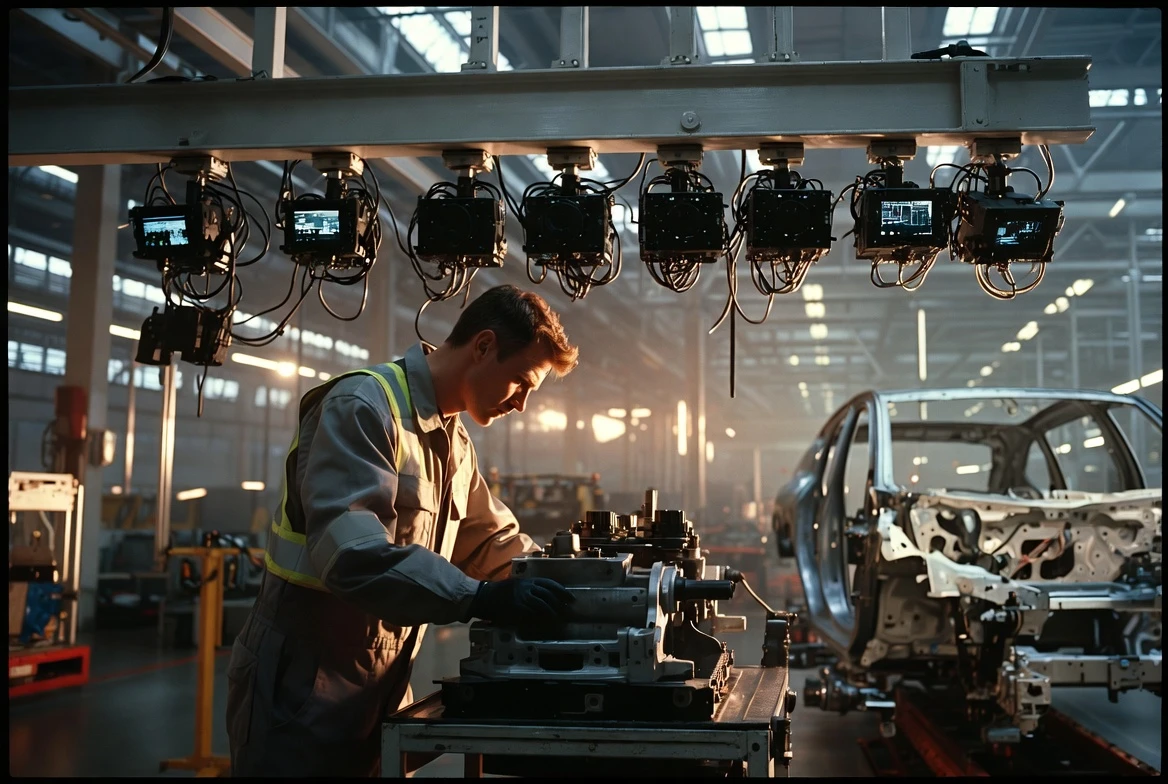
The push to automate quality checks was ambitious on paper. In an October earnings call, chief operating officer Kumar Galhotra told investors Ford was “deploying AI across the entire industrial system.” That included the rollout of 900 AI-powered cameras in its plants, Galhotra said, “to detect quality issues at the source and help us mitigate supply disruptions.”
The cameras caught what they were trained to catch. They missed the rest. Many of Ford’s most experienced technicians had already left the company before their knowledge could be folded back into the AI tools, Poon said, so the systems kept refining themselves on incomplete data. The gap showed up in warranty and recall costs. “We recognized that for us to enhance some of our automation and machine learning and artificial intelligence tools, we needed to ensure that they were trained by the most experienced individuals,” Poon told reporters, per Bloomberg.
The two workforces now share the job. The split runs along the line between what the cameras were trained to catch and what only experience can.
From Last Place to First, by Human Design
The quality climb Ford is now selling runs through some grim recent numbers. Recalls were costing Ford $4.8 billion per year by mid-2024, and 2025 became the most-recalled year in the company’s history. That year, Ford ranked 10th among mainstream brands in the JD Power Initial Quality Study and trailed the industry average. The automaker took 90 recalls in 2025, the most any automaker had ever issued in a single year, including an estimated $570 million charge tied to nearly 700,000 crossover vehicles.
Twelve months later, the picture has flipped. Ford finished first among mass-market brands in the 2026 Initial Quality Study results, released June 25. It is Ford’s first time at the top of the mainstream ranking since 2010. The F-150, the Mustang, and the Super Duty each led their segments for the second straight year. Seven of Ford’s top 10 models placed in the top three of their categories.
Ford is putting a number on the dividend. Lower warranty and recall spending is contributing to “literally hundreds and hundreds of millions of dollars of a tailwind for Ford on cost,” CEO Jim Farley said. The gains, Farley said, came from a place he called old-fashioned hard work:
We have AI tools for vision systems. But most of all, it’s just old-fashioned hard work of our team members all working together to pay attention to the very small details that will make a difference between a perfectly built Ford and an OK-built Toyota.
Jim Farley, Ford’s CEO, made the remarks on Bloomberg TV. The scoreboard, in one frame:
- $4.8 billion per year in recall costs by mid-2024
- 90 recalls in 2025, the most any automaker had issued in a single year
- $570 million charge tied to nearly 700,000 crossover vehicles in 2025
- 152 problems per 100 vehicles in the 2026 study, first place among mainstream brands
- First time at the top of the mainstream ranking since 2010
Farley’s Earlier Warning Comes Back Around
Last year, in an interview with author Walter Isaacson, Ford’s CEO drew a stark line on AI and white-collar work. “AI will leave a lot of white collar people behind,” Farley said. The veteran engineers now back on Ford’s payroll are a specific case of that prediction in reverse.
Farley has been arguing the same case from another angle for years. He has warned of a crisis in the “essential economy,” saying the United States is short 600,000 factory workers and 500,000 construction workers. “On the surface, this looks like a people problem, and most are,” Farley told Axios last year. “But it’s actually not that simple. It’s an awareness problem. It’s a societal problem.” A contested 2025 MIT study found that only five percent of companies were seeing a meaningful return on investment from generative AI pilots.
Auto workers, organized and watching, are pressing the same case. At the UAW’s conference earlier this month, union president Shawn Fain drew the same line on AI: “We need to be clear about this: We are in a fight for humanity. The fruits of our labor have multiplied like never before, but workers aren’t reaping the harvest. And if AI continues to be used as an accessory to that crime, it has to be stopped.”
The Veterans Who Came Back, and What They Do Now
The “gray beard” label, used inside Ford and now in headlines, covers both former Ford employees and engineers Ford pulled in from suppliers.
- Run mandatory weekly design reviews
- Audit production before parts reach the factory floor
- Lead troubleshooting sessions with the AI tools
- Retrain the machine-learning systems with new data
- Mentor junior engineers
Their work now sits in every layer of the quality system. COO Kumar Galhotra told Bloomberg the specialists are central to the effort to fix production quality before it reaches the customer. Ford’s own message, from the executive who had to say it out loud, is that the company was wrong to bet on cameras alone.
Frequently Asked Questions
How many engineers has Ford rehired?
Ford has hired 350 veteran engineers over the last three years, drawn from both former Ford staff and supplier workforces, the company told reporters this week. The New York Post and the BBC describe the same wave of rehiring as “more than 300,” the rounded figure Bloomberg used in its initial report.
Why did Ford replace its engineers with AI?
Ford did not replace its engineers in one decision. It pared back veteran staff as it leaned more heavily on automated quality systems, including 900 AI-powered cameras in its plants that COO Kumar Galhotra said were rolled out “to detect quality issues at the source and help us mitigate supply disruptions.” The AI tools were not enough on their own, Poon told reporters, because many of the company’s most experienced technicians had left before their knowledge could be folded into the systems.
What did Ford’s quality ranking become?
Ford finished first among mainstream brands in the 2026 JD Power U.S. Initial Quality Study with a score of 152 problems per 100 vehicles, ahead of Nissan at 156 PP100 and Buick at 162 PP100, per the study’s release. It is the first time Ford has held the top mainstream spot since 2010. A year earlier, Ford had been 10th.
Is Ford abandoning AI?
No. Ford says AI remains central to its operations, and the rehired engineers are now rebuilding the machine-learning systems. AI stays in place. Per Ford’s own release, the engineers’ work is to act as internal auditors, run mandatory weekly design reviews, train junior staff, and reprogram the AI tools with better data.
Who are the “gray beard” engineers?
The “gray beard” label, used inside Ford and picked up by TechCrunch, Fortune, and the BBC, refers to veteran quality and safety engineers with multiple vehicle programs on their resume. Some came back to Ford directly. Others were hired in from suppliers. Ford’s own description of the group: engineers “who carry the hard-earned wisdom of decades of design.”
