
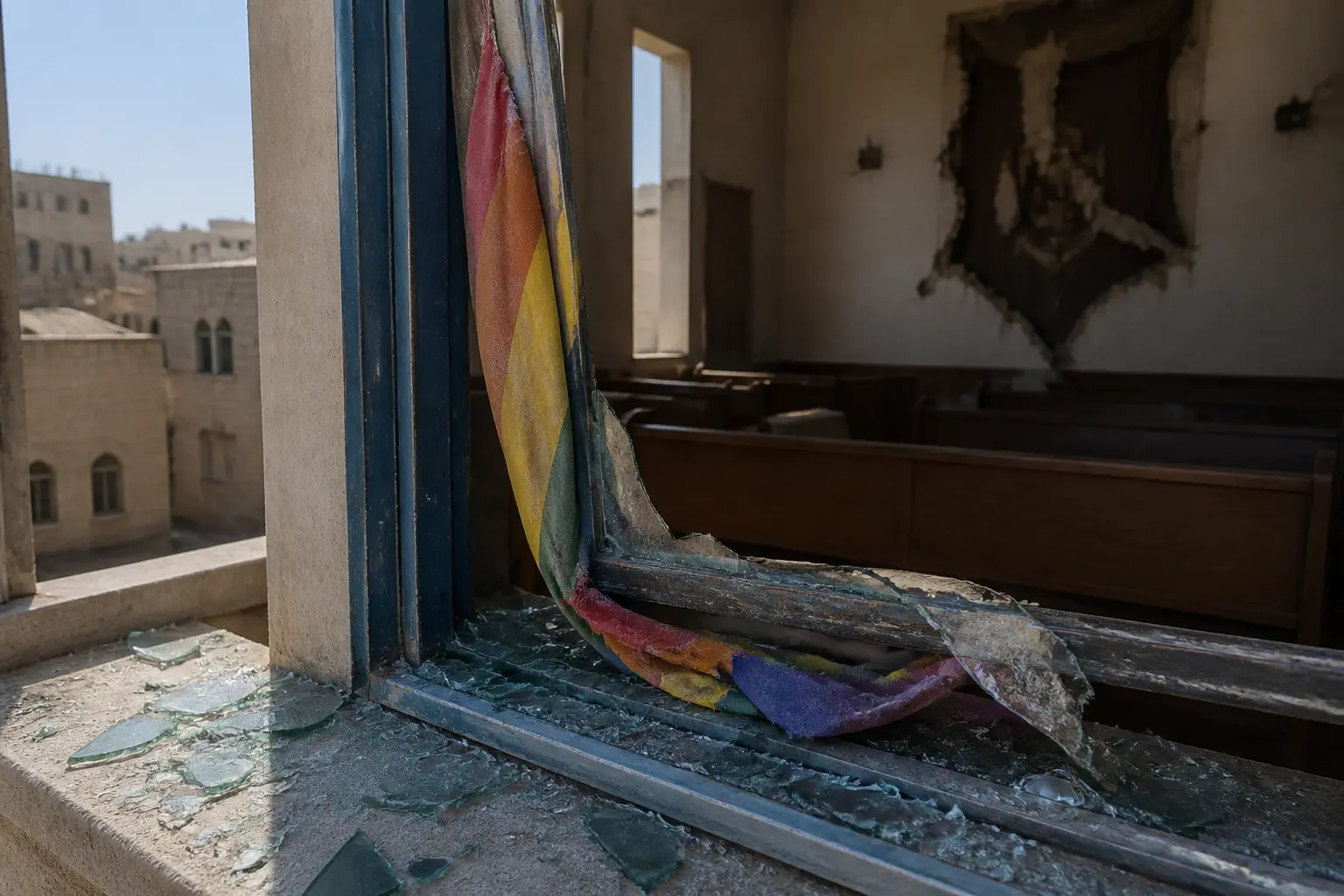
Youths smashed a window at Jerusalem’s Kol HaNeshama Reform synagogue around half past midnight early Saturday, entered the main sanctuary, tore down a Pride flag and damaged a work of art hanging there. No congregants were present. The congregation filed a police complaint the same day; detectives lifted prints and reviewed security camera footage that shows at least three people on the grounds.
The attack lands on a familiar target. The same Baka neighborhood shul saw two nearly identical break-ins in June 2023 that also focused on its Pride flag.
What the Cameras Caught Overnight
Kol HaNeshama’s Rabbi Debi Shoua-Haim told The Times of Israel the breach occurred with the building empty. Assailants broke glass, climbed through and went straight for the Pride flag in the sanctuary while also harming artwork. A still frame released by the Israel Movement for Reform and Progressive Judaism confirms multiple figures inside the perimeter.
Police said they opened an investigation “in which several actions are being carried out and all lines of inquiry are being examined.” They declined further detail. The congregation’s public line stayed short and firm: “Vandalism and violence won’t dim our light. We hope enforcement authorities quickly find the criminals and bring them to justice.”
A smashed-window photograph circulated with the first reports, dated to the night of the attack. The building itself sits in southern Jerusalem’s Baka area and has long served as a visible progressive Jewish address.
Same Flag, Same Building, Three Years On
In late June 2023 the synagogue reported two break-ins within weeks. On both occasions the Pride flag hung for Pride Month was torn down. In one case the intruders also entered the sanctuary. Then-Rabbi Oded Mazor described two unfamiliar youths who climbed through a kitchen window, walked the complex and “did not behave with respect due to a holy place.” Complaints went to police both times.
| Incident | Date window | Entry method | Main target | Other damage |
|---|---|---|---|---|
| 2023 first break-in | June 2023 | Kitchen window | Pride flag torn | Sanctuary entered, items kicked |
| 2023 second break-in | June 2023 | Window | Pride flag torn | Yard/complex walk-through |
| 2026 attack | Early Saturday mid-August | Broken window | Pride flag torn in sanctuary | Artwork damaged, pictures vandalized |
The pattern is narrow and consistent: nighttime entry, focus on the rainbow flag that signals inclusion, and minimal theft. Kol HaNeshama is one of the better-known progressive communities in the country. Its own site states it advocates pluralism equality and Zionism values through prayer, study and social action.
Kariv Names the Climate Around the Attack
Democrats MK Gilad Kariv, himself a Reform rabbi and former director of the progressive movement, posted within hours. He tied the Jerusalem breach to the same night’s disruption at Manhattan’s Central Synagogue and called the local attackers “incited hooligans.”
In the dead of night they smashed the glass, entered the prayer hall, vandalized pictures, and tore down the pride flag that was hanging in the entrance hall. This is not the first time this community has suffered vandalism and sabotage.
Kariv wrote that other Reform and Conservative communities across Israel face similar attacks on a weekly basis. He urged Jerusalem’s mayor to visit in solidarity and said he expects nothing from a government whose ministers have publicly demeaned liberal denominations. His full statement on the night’s attacks also warned that if police fail to move quickly the “evil spirit” of the minister he labels the minister of hatred will again prevail over professional policing. The post drew hundreds of likes and replies that split between demands for deterrence and distrust of current force leadership.
That political layer sits against broader religious-power fights visible in recent Jerusalem ultra-Orthodox draft rally tensions and repeated Haredi coalition leverage over reforms. Progressive leaders have long argued that public delegitimization of non-Orthodox streams lowers the social cost of street-level hostility.
Two Reform Houses Hit the Same Night
Kariv’s post opened with the coincidence. While the Jerusalem youths struck Kol HaNeshama, a man later identified as Larry Montes, 46, of the Bronx, burst into Friday night services at Manhattan’s Central Synagogue, one of the largest Reform congregations in the world. Security escorted him out; he struck a congregant, damaged property, spat at and head-butted a guard, and faced multiple hate-crime charges. No serious injuries were reported. NYPD called it a hate crime. Mental-health history was noted by officials.
- Jerusalem: empty building, forced entry, Pride flag and art targeted, three or more suspects on camera, police investigation opened.
- Manhattan: occupied service disrupted, physical assault on congregant and security, property damage, immediate arrest and hate-crime charges.
- Shared timing: both incidents unfolded on the same Friday-into-Saturday window in mid-August 2026.
- Shared stream: both targets are prominent Reform institutions that display progressive symbols and practice egalitarian Judaism.
The two events are not organizationally linked. They landed in the same news cycle and gave Israeli progressive voices a ready parallel when describing vulnerability.
Progressive Judaism’s Israeli Footprint
Kol HaNeshama is not an outlier. The IMPJ lists more than 54 congregations across Israel, spanning cities, regional councils, kibbutzim and new start-ups. Older communities date back decades; newer ones have formed in the last ten years. Services include lifecycle events, education, social justice work and open prayer. Roughly a dozen years ago a JPPI study already found 13 percent of Israelis identifying with Reform or Conservative streams for identity or lifecycle needs, even as Orthodox institutions retain legal monopoly over marriage, conversion and many public religious services.
Key markers of the footprint:
- 54-plus affiliated congregations and regional frameworks listed by IMPJ.
- Active rabbis and educators serving both immigrant and native-born Israelis.
- Visible symbols such as Pride flags that mark inclusion and repeatedly draw vandalism.
- Legal and advocacy arm (Israel Religious Action Center) that litigates religion-and-state issues.
Growth has been real. Acceptance by the Orthodox establishment and by successive governing coalitions has not kept pace. Attacks on buildings and symbols function as low-cost enforcement of that rejection.
The Light They Refuse to Dim
Kol HaNeshama’s statement after the latest breach was almost identical in tone to its 2023 messages: file the complaint, trust the process, refuse to darken the lamps. Rabbi Shoua-Haim confirmed the security response and the empty-building detail that at least prevented injury. Kariv’s closing line in Hebrew matched the congregation’s English: the hooligans will not deter promotion of an Israeli Judaism that loves people, pursues social justice, practices religious tolerance and seeks peace.
Whether police produce arrests in days or weeks will test the “all lines of inquiry” claim. The physical damage is repairable. The repeated choice of the Pride flag as the object of rage is the detail that keeps resurfacing across three years and two continents. Progressive communities continue to hang the flag, hold services and invite the public. The pattern of who shows up after midnight to tear it down has not yet broken.
