
Israel’s Knesset shelved a transportation reform three decades in the making this week, trading it away to keep ultra-Orthodox coalition partners on side. The Metropolitan Authorities Law would have shifted control of buses, trains, bike lanes and traffic signals in the Tel Aviv, Haifa and Jerusalem regions away from a single ministry in Jerusalem and into the hands of local officials. Coalition whip Ofir Katz pulled the bill from the plenum’s voting agenda under pressure from Haredi lawmakers demanding priority for their own legislative wishlist, and it is now expected to sit dead until the next Knesset convenes.
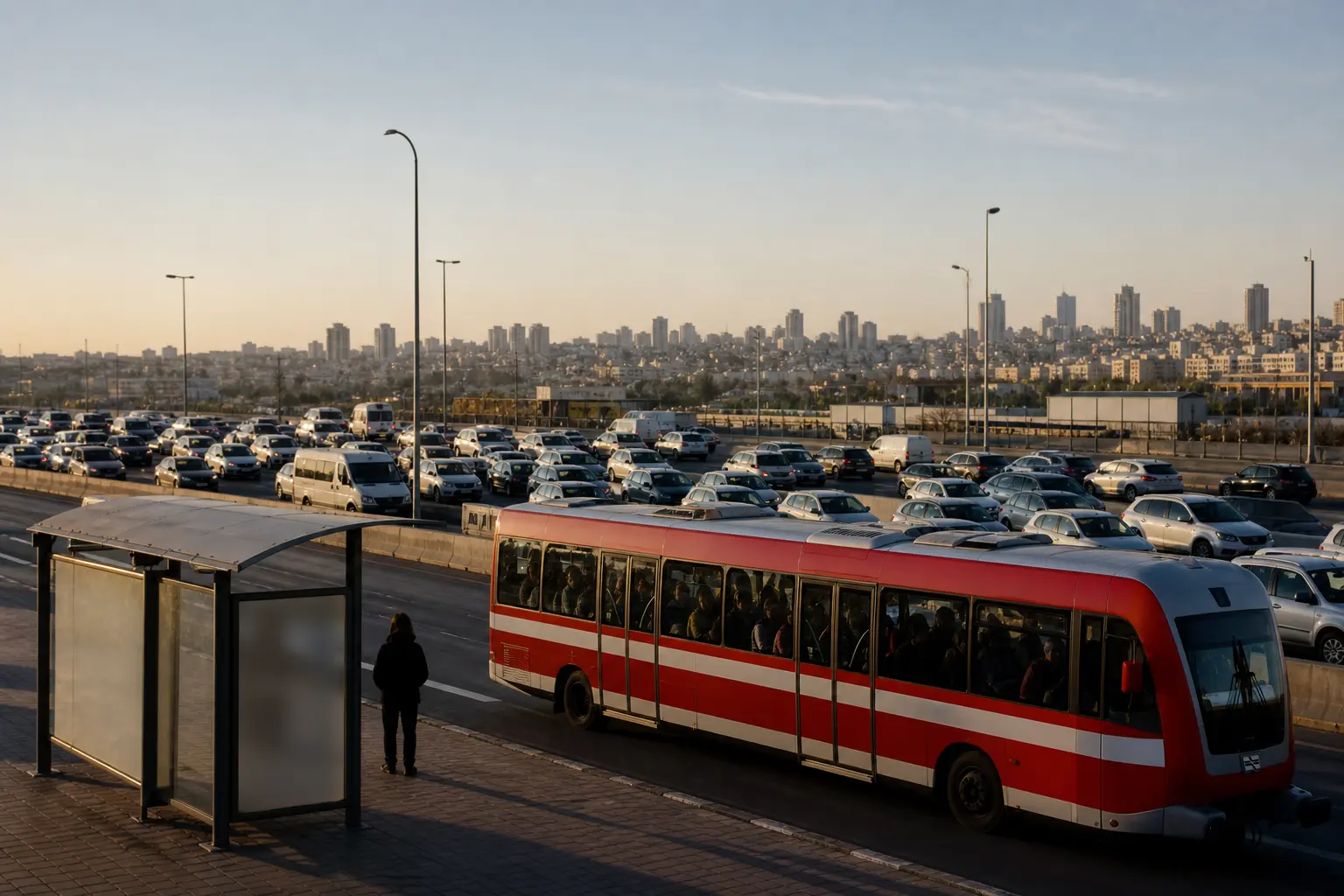
“The commute to work is a daily nightmare of two hours each way,” said Sharon Betzalel, a Pardes Hanna resident who commutes daily to Airport City in central Israel. “In many cases, buses simply arrive completely packed and the driver continues driving without stopping at the station.”
What the Metropolitan Authorities Law Would Have Fixed
The bill would have created three independent metropolitan transportation authorities, covering the greater Tel Aviv area known as Gush Dan, plus Haifa and Jerusalem. Planning and coordination powers would move from the Transportation Ministry to the municipalities that actually run the streets.
Transportation Minister Miri Regev called it a “historic reform” that would strengthen cooperation between government and local authorities. Finance Minister Bezalel Smotrich said the new bodies would allow “faster implementation of solutions designed to improve public transit and save commuters valuable time.”
On paper, the reform targeted problems Israeli commuters have complained about for years:
- Bus-train coordination – shared scheduling between buses, light rail and Israel Railways instead of separate timetables set in Jerusalem.
- Protected bike lanes – continuous cycling routes that would not vanish at municipal boundaries.
- Regional traffic signals – coordinated light timing instead of each city managing its own, sometimes contradictory, signals.
- Parking pricing – aligned rates across municipal lots and curbside zones to discourage car trips into congested centers.
Under the version the Knesset Economic Affairs Committee approved, the Gush Dan authority would fold in Tel Aviv, Bnei Brak, Ramat Gan, Holon, Bat Yam, Givatayim, Herzliya and Ramat Hasharon, with Rishon LeZion and Kiryat Ono joining later. Beit Shemesh and Mevaseret Zion opted out of the Jerusalem authority over fears of being outvoted, while Tzur Hadassah joined it and Rechasim joined Haifa’s.
| Metropolitan Authority | Core Members | Sticking Point |
|---|---|---|
| Gush Dan (Tel Aviv area) | Tel Aviv, Bnei Brak, Ramat Gan, Holon, Bat Yam, Givatayim, Herzliya, Ramat Hasharon | The Transportation Ministry wanted its national authority’s director to run it for three years; municipalities negotiated an 18-month transition instead |
| Jerusalem | Jerusalem plus Tzur Hadassah | Beit Shemesh and Mevaseret Zion withdrew, fearing Jerusalem would dominate the vote |
| Haifa | Haifa plus Rechasim | Drew the fewest objections during committee negotiations |
Supporters said the model, common across developed countries, was designed to expand to more metropolitan areas over time. None of that expansion will happen soon.
How the Haredi Deal Buried the Bill
The committee approved the transportation bill for final readings roughly two weeks before this week’s vote, placing it among the last bills scheduled ahead of the Knesset’s pre-election recess. Then Haredi, or ultra-Orthodox, lawmakers intervened.
Ultra-Orthodox parties pressured Katz to prioritize their own bills instead, including a measure shielding Haredi draft dodgers from arrest, a kashrut reform and expanded gender segregation in academia. Some ultra-Orthodox lawmakers also worried the transit law would eventually let secular municipalities expand public transportation on Shabbat, even though its backers insisted it would not change existing Sabbath rules. Behind the pressure was an instruction from Haredi spiritual leader Rabbi Dov Lando, telling ultra-Orthodox lawmakers not to trust Prime Minister Benjamin Netanyahu “until the last moment.”
The Knesset instead passed the arrest-freeze bill for Haredi draft evaders by a vote of 58 to 54, part of a wider package Netanyahu negotiated with United Torah Judaism and Shas in exchange for their backing on judicial overhaul legislation. Likud lawmakers Yuli Edelstein and Dan Illouz voted against it, along with Sharren Haskel and Moshe Solomon. Netanyahu himself was absent from the chamber when his name was called for the vote.
Haskel resigned as deputy foreign minister immediately afterward. “I stand before you with a heavy heart because the law exempting defectors passed the Knesset plenum,” she told reporters.
The standoff fits a wider pattern this year. Ultra-Orthodox protesters have clashed with police before, including a demonstration that turned violent on the Sabbath, while a former chief rabbi recently branded a bereaved father a heretic over his push for equal enlistment. Polling suggests religious Zionist frustration with Haredi service exemptions is rising, even inside the coalition’s own base.
It is a small piece of a fight that has pushed Netanyahu’s government toward the coalition’s slow-motion collapse, with elections already on the calendar.
The stalling of the Metropolitan Authorities Law is the dangerous result of political games and extortion that harms every citizen in Israel. We have been waiting for this reform for 30 years, and during those years, the transportation crisis has only worsened.
Sivan Shmuelovich, CEO of the public transportation advocacy group 15 Minutes, said the delay reflects a crisis lawmakers do not grasp, adding that planning and construction timelines mean “every day of delay on this law is another day in which our ability to get out of traffic jams moves further away.”
Who Feels the Delay First?
Commuters without cars feel it hardest and soonest. Riders on packed, poorly coordinated buses, cyclists dodging parked cars on blocked lanes, and drivers who say congestion has pushed them onto motorcycles all describe a system that one reform was supposed to untangle, now stuck for at least another year.
Vered Klein, who commutes from Petah Tikva to Tel Aviv by public transportation, said poor coordination between bus and rail schedules already wastes hours of her week. “This law could have improved the situation, including bus traffic, by creating continuous public transportation lanes between municipalities and coordinating the schedules of different modes of transportation,” she said.
In Jerusalem, cyclist Rei Hillel Solberg said he risks his life every time he rides. “When I ride in the afternoon, the bike path on Elazar Hamoda’i Street is regularly blocked by parked cars, forcing me onto the road and putting my life at risk,” he said. A request for a crosswalk on Brody Street was denied, he said, because it would have eliminated parking spaces.
Dori Rachmilov, a Tel Aviv resident who commutes to Rishon Lezion and Haifa, said unreliable transit forces him back onto a motorcycle a decade after a crash left his body full of metal implants. “These traffic jams are genuinely dangerous,” he said. “They push people onto motorcycles and scooters even when there is no suitable infrastructure.”
A 2011 Decision That Never Took Hold
The idea of handing transit planning to metropolitan bodies instead of one national ministry is not new. Israel’s government approved a decision to establish a national public transportation authority alongside metropolitan authorities back in 2011, and the concept has drawn support from transportation professionals for decades since. Despite that support, previous attempts to implement the model stalled repeatedly for political and bureaucratic reasons.
This is not the first time transit policy has bent to ultra-Orthodox pressure, either. In 2023, Regev’s own fare overhaul handed steeper discounts to Haredi and Arab neighborhoods while other residents faced increases, a plan then-Labor chief Merav Michaeli called a “corrupt deal.” A monthly pass in lower-income Bat Yam cost NIS 305 (about $82) under that plan, while one in nearby Givatayim cost NIS 610 (about $165), a gap of roughly $975 a year.
Every bus line in the country still technically needs sign-off from the National Public Transport Authority in Jerusalem, a level of centralization uncommon among wealthy nations. That is exactly the structure this week’s bill was written to dismantle.
The Traffic Numbers Behind the Anger
Israel’s roads keep filling faster than any single fix has offset. The country now counts more than 3.5 million private cars on the road, with a motorization rate above 360 vehicles for every 1,000 residents. Israel’s Central Bureau of Statistics projects the population will nearly double to 15 million by the country’s 2048 centennial, growth roughly four times the OECD average. It already ranks third among OECD members for population density, behind only South Korea and the Netherlands.
Yet public transportation use is climbing too. The Transportation Ministry recorded 912 million bus, light rail and train trips in 2025, up from 904 million the year before and a new annual record. “The public is increasingly choosing public transportation,” Regev said. “This is clear proof that the policy we are leading is changing the reality on the roads.”
That is precisely the growth the shelved law was meant to manage. More riders without better coordination between cities just means more crowded platforms and more buses that sail past full stops, the exact complaint Betzalel raised about her own commute.
The Knesset’s Last Chance Before Recess
The Knesset is scheduled to disperse Friday for its pre-election recess, and the transportation bill is not on the agenda for what remains of the week. Barring a last-minute reversal, its backers say, the reform is dead until whichever Knesset convenes after the next election.
Haim Bibas, chairman of the Federation of Local Authorities in Israel and mayor of Modi’in-Maccabim-Reut, sent an urgent letter to Regev, Katz and Knesset Economy Committee Chairman David Bitan demanding the bill be brought back for a final vote. “The attempt to manage a complex public transportation network in a centralized and remote manner has failed, and the time has come to transfer authority to those who know the local reality up close,” he wrote.
What we know:
- The bill is off this week’s agenda, and the Knesset disperses Friday for recess.
- Israel must hold national elections by October 27 at the latest.
- Haim Bibas has formally demanded lawmakers restore the bill before recess.
What’s unconfirmed:
- Whether coalition whip Ofir Katz will restore the bill under pressure before Friday.
- Whether a future Knesset would restart the process from scratch or use a continuity mechanism to resume where this one left off.
Meanwhile, the government’s other lever for congestion keeps turning regardless. Netivei Israel, the state company that builds highways, issued 17 new tenders worth up to $2.4 billion in January to widen choke points like Highway 44, where morning speeds already drop to about 5 kph near the Beit Dagan interchange. None of that touches the coordination problem the metropolitan law was built to solve.
For Sharon Betzalel, none of this changes Monday morning. The bus to Airport City will still skip her stop when it is full, and the ride will still take two hours each way.
Frequently Asked Questions
What is the Metropolitan Authorities Law?
The Metropolitan Authorities Law would create three regional bodies, covering Gush Dan, Haifa and Jerusalem, to take over public transportation planning, coordination and bike-lane policy from Israel’s national Transportation Ministry. Backers say the model, common in other developed countries, was designed to eventually expand to more metropolitan areas beyond the first three.
Why do Haredi parties oppose the transportation reform?
Ultra-Orthodox lawmakers said they feared handing planning power to local authorities could eventually let secular municipalities expand public transportation on Shabbat, the Jewish day of rest observed from Friday sundown to Saturday night, even though the bill’s supporters insisted it would not change existing Shabbat rules. Haredi parties also wanted the week’s final Knesset session reserved for their own bills, including a kashrut reform and expanded gender segregation in academia.
What happened to the arrest-freeze bill for Haredi draft evaders?
The Knesset passed it 58 to 54 the same week the transportation bill was pulled, temporarily shielding Haredi yeshiva students who ignored military draft orders from arrest, investigation or enforcement proceedings. Prime Minister Benjamin Netanyahu was absent from the chamber during the vote, and Deputy Foreign Minister Sharren Haskel resigned immediately after voting against it.
Did anything related to transportation actually pass this week?
Yes. The Knesset Economic Affairs Committee separately approved a repeal of Parking Law amendments, allowing private parking lots to again charge by the full hour and then in 15-minute increments, a change set to take effect four months after publication.
Is the Metropolitan Authorities Law the same as Tel Aviv’s planned metro?
No. The metro is a separate underground rail project planned for the Gush Dan area, with construction and financing handled through entirely different legislation and no passengers expected before the 2030s. The Metropolitan Authorities Law only concerns who manages and coordinates the buses, trains and bike infrastructure that already exist.
