
Nearly 44 percent of male labourers buried near the Giza pyramids carried fractures, yet 90 percent of those breaks healed with good alignment. Ancient Egyptian pain relief paired traction and linen splints with massage, dental drainage and spoken spells that modern neurology now reads as placebo machinery.
The dual system treated bone and belief together. Skeletal numbers and the Edwin Smith Surgical Papyrus show the physical half worked at scale; the magical half kept patients inside the care that made recovery possible. Neither half alone explains the clean unions recorded in worker cemeteries. Together they formed a single loop of treatment, trust and return to labour.
Pyramid Workers Broke Bones and Got Them Set
Fractures struck common people hard. Frederic Wood Jones found 200 healed breaks among 6,000 Aswan burials, a 3.3 percent rate. At Giza the figure jumped. Anthropologist Fawzia Hussein reported almost 44 percent of male labourers fractured at least once. Artisans at Deir el-Medina sat near 10 percent. Semi-elite graves at Saqqara dropped to about 2 percent. Most healed clean.
| Site / group | Fracture rate | Healing note |
|---|---|---|
| Giza pyramid labourers | ~44% | 90% complete, good alignment |
| Aswan general burials | 3.3% | Healed examples common |
| Deir el-Medina artisans | ~10% | Most well healed |
| Saqqara semi-elite | ~2% | Mostly good alignment |
The spread itself tells a labour story. Giza men hauled stone; their bones took the load. Deir el-Medina artisans and Saqqara semi-elites faced lighter strain and show lower rates. Alignment quality, not just survival of the break, marks skilled reduction. A poorly set femur ends a hauler’s career. A cleanly set one returns him to the gang.
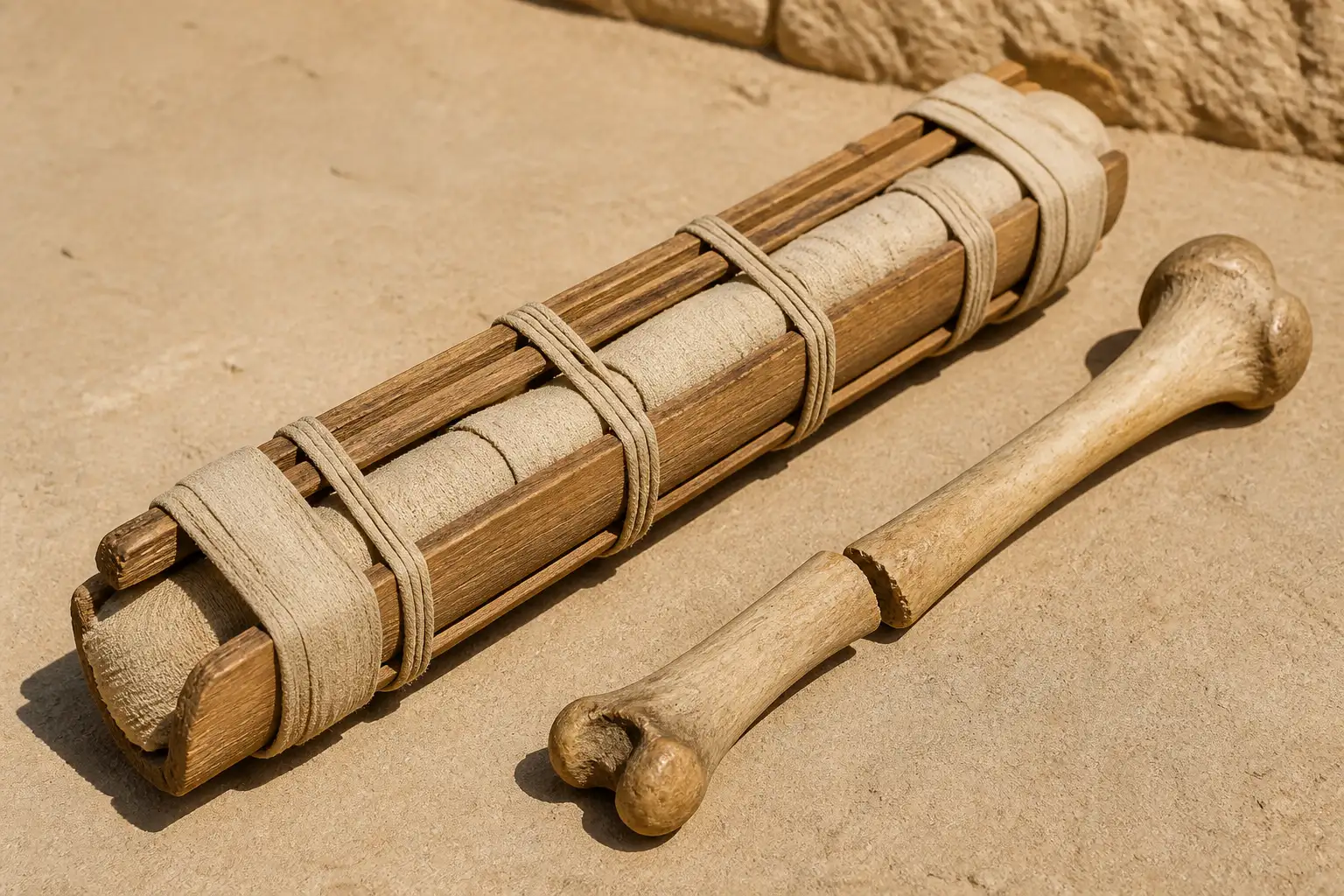
The Edwin Smith Papyrus, a Second Intermediate Period copy of older Old Kingdom knowledge, walks through the method. Case 35 on a broken collarbone orders the patient laid on his back with padding between the shoulder blades. The physician spreads the shoulders until the break falls into place, then applies two splints of linen and honey every day until recovery. Cases 36-38 cover upper-arm fractures the same way: traction then bandaging with alum and honey. Rib fractures (Case 44) list pain on breathing; the treatment section is damaged, yet chest binding was the logical step.
Archaeology matches the text. Fifth Dynasty femur splints of linen-wrapped palm bark still sit in place around broken bone. Naga ed-Der specimens show open fractures packed with blood-stained fibre. At the workers’ cemetery, Zahi Hawass’s team recorded healed fractures set with a splint and even successful amputations. Reducing and immobilising cut pain and restored function. The numbers prove it reached ordinary builders, not only elites.
Daily redressing with honey and alum kept the wound under watch. Traction first, then rigid linen, then repeated dressing: the sequence is short enough to teach and stable enough to repeat across a workforce. That repeatability is why the 90 percent good-alignment figure at Giza is not an accident of soft ground or chance.
Do Not Let It Be Painful
Massage appears in papyri and tomb walls as everyday therapy. Ebers 119 rubs fat, plants, salt and mussels over a fevered body. Ebers 735 massages a haematoma with mud, sand, myrrh, date juice and an unidentified drug. The Kahun Gynaecological Papyrus treats calf cramps with mud massage to clear clogged metu channels.
- Rubbing and kneading alone or with oils and heat
- Anointing with unguents and poultices
- Targeted work on legs, feet and hands shown in elite tombs
Vizier Ptahhotep receives a leg massage in his Saqqara tomb. The Sixth Dynasty ka-priest Ankhmahor’s mastaba, the so-called Tomb of the Physician, shows foot massage beside the famous circumcision scene. The inscription reads “Do not let it be painful.” Khentika’s nearby tomb repeats hand and foot work. Pharaoh Niuserra enjoys a foot wash and massage in his Sun Temple, possibly with ritual weight. The physical act eased muscle pain; the setting added authority.
The same scenes run from private mastabas to a royal sun temple. That range shows massage was not a luxury afterthought. It sat inside ordinary care for cramp, bruise and post-exertion ache, the very complaints a pyramid gang would bring after a shift.
Drill Tracks in a Lady’s Cheekbone
Dentists (ibH.i) appear from the Old Kingdom. Hesyre of the Third Dynasty is the earliest named. Sand in the diet wore teeth and seeded abscesses. Practical steps included cumin applications for tooth pain and gum ulcers (Ebers 742), extraction, gold-wire stabilisation and drainage.
- Cumin applications for tooth pain and gum ulcers (Ebers 742)
- Extraction of hopeless teeth
- Gold-wire stabilisation of loose teeth
- Drainage aimed at bony abscesses
Earnest Hooton and J. H. Breasted described an Old Kingdom jaw with two holes into a bony abscess under a molar; they may be natural sinuses or deliberate drills. The New Kingdom mummy of Djedmaatesankh, now in the Royal Ontario Museum, shows a large maxillary abscess and five nearby drill tracks on CT. The attempt failed and may have contributed to her death. A Ptolemaic mummy named Sekhem in Athens may hold an early cavity filling. These interventions aimed straight at the source of dental agony even when outcomes stayed uncertain.
Failure in one famous case does not erase the intent. The tracks and the wire work show operators chasing the pain source rather than only covering it with paste. Uncertain results still count as evidence of a dental craft that treated abscess and mobility as mechanical problems.
Did the Nile Catfish Numb Pain?
No papyrus spells out electrical treatment, yet the electric catfish Malapterurus electricus lives in the Nile and appears in tomb art of Kagemni and Rekhmira. Anyone who steps on one feels sharp pain then numbness. Egyptologist and physician Paul Ghalioungui noted the possibility without claiming proof. Later Roman sources credit Egyptians with using such shocks for joint pain and migraine. Scribonius Largus in the first century AD described live torpedo rays for headache and gout. The empirical jump from observation to therapy fits Egyptian habits. Whether they applied live fish for something like modern TENS remains open, but the animal was known and the numbness was real.
Depictions and later Mediterranean use keep the idea alive. A bas-relief tradition stretching from Saqqara to Roman writers shows how Nile catfish shocks for joint pain entered the wider medical conversation.
The pattern matches other Egyptian moves from field observation to clinic. Honey on linen, mud on a bruise, traction on a clavicle: each begins with something seen and ends as a named step. A numbing fish fits that habit even without a surviving prescription.
Spells Recited a Million Times
Pain often traced to gods, demons or the dead. Physicians and priests shared authority delegated from the pharaoh. Spells expelled hostile forces or invited helpful ones. The Ebers Papyrus opens every treatment with an incantation:
I have utterances that the Lord of the Universe has composed to eliminate the doings of a god, a goddess, a dead man, a dead woman etc, that are in my head, in my spine, in my shoulders, in my flesh, in my members\u2026 I am the one whom God wishes to keep alive.
The text calls it “really excellent [proved] a million times.” Ebers 2 invokes Isis to loosen pain and drive out evil. The verso of Edwin Smith banishes “knife demons” and claims protection as Horus and son of Bastet. These words rode on cultural expectation. Today that expectation is measured as placebo: dopamine, endorphins, lowered anxiety and reframed symptoms. The Egyptians did not need the neurotransmitters named; they had the mechanism working.
Opening every recipe with the same claim of divine authorship fixed the patient’s role before the first bandage went on. The spell did not replace traction. It framed traction as care the universe itself endorsed, which is how anxious patients stay still long enough for a collarbone to seat.
Lion Goddesses and Ivory Wands
Amulets and household statues fought the spiritual side of pain. Bes and Taweret eased childbirth. The Eye of Horus covered general healing. Lion-headed Sekhmet and Bastet warded disease. Some amulets were rubbed with salve to double the power. Apotropaic wands of hippopotamus ivory drove demons out. Water poured over the Metternich Stela became a potion against snake and scorpion stings.
Kom Ombo linked Sekhmet to healing temples. The objects did not block prostaglandins the way willow bark did, yet they kept the patient inside a coherent system of care. That system is what recent archaeology still uncovers, from worker cemeteries to the painted tomb of Paser near Luxor.
Salve on an amulet joined pharmacology to protection in one gesture. The patient left with both a drug film on the skin and a lion at the throat. Continuity of that paired gesture is why household finds and temple links matter as much as the surgical cases.
Splints and Spells Ran on Parallel Tracks
The physical and ritual halves used different tools yet aimed at the same return to function. One track reduced and held bone. The other held the patient inside the course of visits, dressings and rest that reduction required.
- Traction, linen splints, honey and alum for breaks and open wounds
- Massage with mud, oils and heat for cramp, bruise and fever
- Drainage, cumin pastes and gold wire for dental agony
- Incantations, amulets and wands for hostile forces and fear
Willow, opium and myrrh already supplied chemical relief. The spells and lion figures did not compete with those resins. They supplied the expectation layer that modern clinics now measure as placebo response. A labourer who trusts the full package returns for the next dressing. A labourer who trusts only the stick of wood may not.
Giza’s 90 percent good alignment is therefore a social number as well as a surgical one. Clean unions need days of stillness and repeated bandaging. Belief paid for those days in a workforce that could not afford long idleness without confidence in recovery.
Why the Mix Still Matters in Clinics
Incidence fell with status while method stayed shared. Labourers broke far more bones than Saqqara semi-elites, yet the same papyrus logic of traction and linen appears in both the text and the worker cemetery finds. Elite tombs advertise massage; worker bones advertise set fractures. The craft crossed the ranks even when risk did not.
- Old Kingdom core: named dentists such as Hesyre, femur splints in place, massage scenes in mastabas and sun temples
- Second Intermediate copy: Edwin Smith cases 35-38 and 44 preserve the fracture sequence for later readers
- New Kingdom to Ptolemaic: Djedmaatesankh’s drill tracks and Sekhem’s possible filling show dental work still chasing abscess and decay
That long copy chain is why the dual model feels familiar in a modern pain clinic. The clinic still sets bone, still drains infection, still uses touch and still leans on expectation. Only the names of the neurotransmitters have changed.
The Model Medicine Keeps Circling Back
Egyptians already used willow (natural aspirin), opium and myrrh resins. They reduced fractures, drained abscesses and massaged clogged channels. They also spoke spells and wore lions. The combination matches the biopsychosocial model now taught in pain clinics. As opioid prescriptions fall, psychological therapies and acknowledged placebo effects rise. The second-order result of the Egyptian mix is not a museum curiosity. It is a reminder that pain lives in bone and belief at once, and that treating only one half leaves patients short.
Their records remain the oldest surgical triage we possess and one of the clearest early proofs that mind and body heal together. The Giza percentages, the daily linen-and-honey order, and the million-times claim on the Ebers spells all point the same way: recovery scaled when both halves stayed in the room.
Frequently Asked Questions
What fracture treatments appear in the Edwin Smith Papyrus?
Cases 35-38 detail clavicle and upper-arm breaks reduced by traction with the patient supine and padding between the shoulder blades, then immobilised with linen splints bound and dressed daily with alum and honey; rib pain on breathing is noted in Case 44 though the treatment lines are lost.
How common were healed fractures among pyramid builders?
At the Giza workers’ cemetery nearly 44 percent of male labourers showed fractures and 90 percent of those were fully healed in good alignment, far higher incidence than the 2-10 percent range seen in artisan and elite samples.
Did ancient Egyptians use electric catfish for pain?
No contemporary text describes the practice; the fish appears in tomb art, delivers a numbing shock, and later Greco-Roman writers credit Egyptians with similar electrotherapy, so the idea stays plausible but unproven.
Which amulets targeted pain or disease?
Bes and Taweret figures eased childbirth pain, Eye of Horus amulets served general healing, and lion-headed Sekhmet or Bastet pieces were worn or placed to repel disease-causing forces, sometimes anointed with medicinal salves.
What does the Ankhmahor tomb inscription say about massage?
Beside the foot-massage scene the text simply reads “Do not let it be painful,” confirming that the goal of the depicted manipulation was pain relief during the procedure itself.
