
Kenya and Saudi Arabia signed four agreements in Riyadh on Sunday, closing the first-ever session of their new political consultations committee. Prime Cabinet Secretary Musalia Mudavadi co-chaired the talks with Saudi Foreign Minister Prince Faisal bin Farhan, framing the day as a milestone in bilateral relations.
Three of the documents are intergovernmental memorandums of understanding; the fourth is a separate labour agreement on the recruitment and employment of Kenyan domestic workers. The labour track is the one with the most direct domestic stakes: Saudi Arabia hosts more than 300,000 Kenyans, and Nairobi travelled to Riyadh with a checklist of protections, dispute-resolution reforms, and recruitment changes. The package closes a three-day visit by Mudavadi that the Prime Cabinet Secretary’s office had framed around labour mobility, trade, and investment.
The First Political Consultations in Riyadh
The meeting was held at the Saudi Ministry of Foreign Affairs in Riyadh on Sunday, July 5, 2026, the final day of Mudavadi’s three-day official visit to the Kingdom. The visit’s stated aim was to strengthen labour mobility, trade, investment, and broader strategic cooperation. Mudavadi was accompanied by Cabinet Secretary for Labour and Social Protection Alfred Mutua, Principal Secretary for Science, Research and Innovation Prof. Shaukat Abdulrazak, Kenya’s envoy to the Kingdom Amb. Joseph Masila, and a wider government and private-sector delegation.
It was the inaugural session of the Saudi-Kenyan Political Consultations Committee, a structure both governments expect to meet on a regular basis going forward. The Saudi side was led by Prince Faisal and included Vice Minister of Foreign Affairs Waleed Elkhereiji, Undersecretary for Political Affairs Ambassador Saud Al-Sati, and Saudi Ambassador to Kenya Saad Al-Nafie.
A new chapter in Kenya-Saudi Arabia relations was written today with the successful conclusion of the first-ever Kenya-Saudi Arabia Political Consultations, marking a significant milestone in our growing strategic partnership.
Both governments “reaffirmed their commitment to expanding cooperation in labour mobility, trade and investment, peace and security, technical education, and information and communications technology,” Mudavadi said after the meeting. Saudi Arabia “expressed strong interest in public-private partnerships in renewable energy, infrastructure and logistics,” he added, framing those sectors as ones that “will create jobs, attract investment and accelerate Kenya’s economic transformation.” The two sides also discussed cooperation in agriculture, food security, tourism, health, education, digital technology, and regional security, according to Mudavadi’s readout.
The two sides also framed the new committee as a regional-security mechanism, characterising it as serving “mutual interests” and contributing to “regional security and stability” in the Saudi readout. The institutional track is new, but the engagement has a longer history, with Kenya’s study of Saudi Vision 2030 reforms as part of the older context.
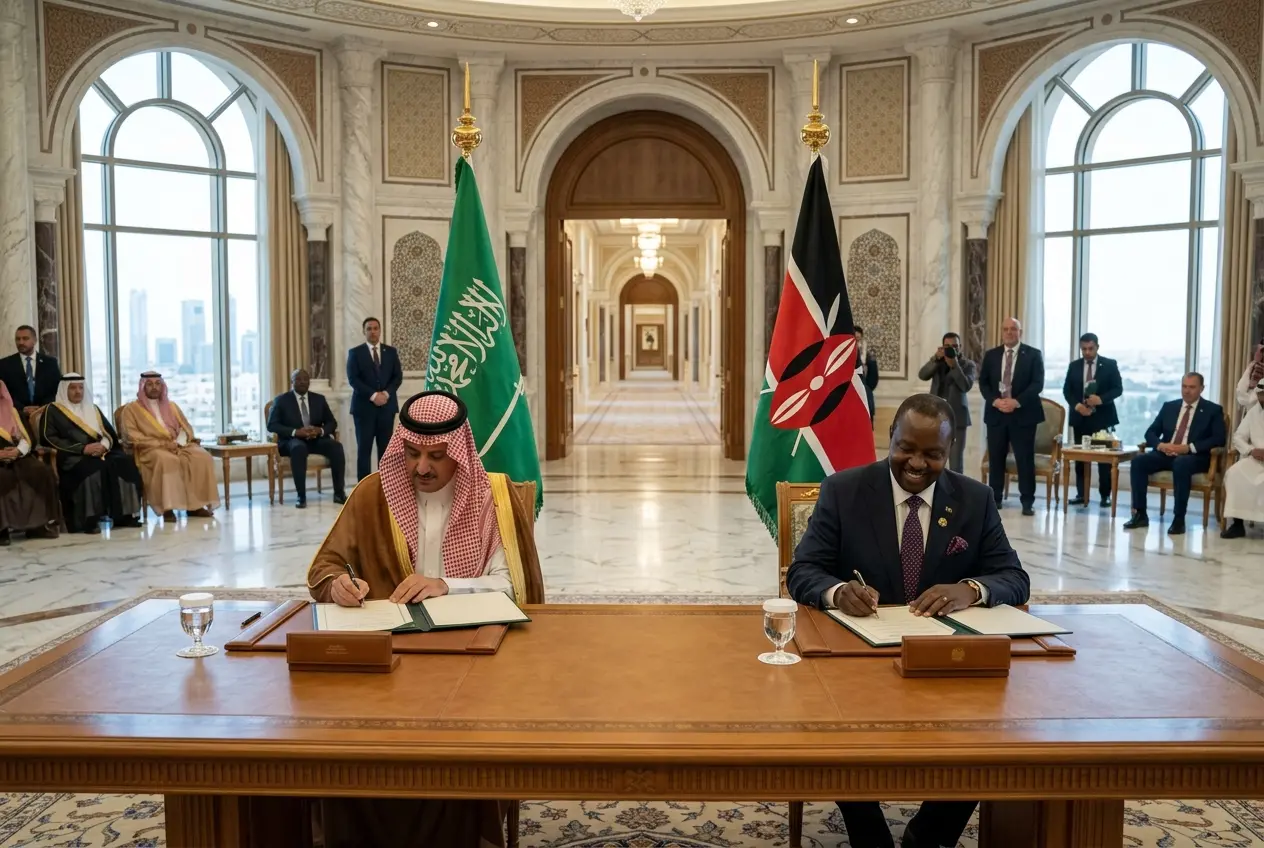
Four Agreements Signed on Sunday
Four documents were signed at the close of the meeting. Three are intergovernmental memorandums of understanding, and the fourth is a labour agreement signed separately by the two labour ministries.
| Agreement | Signed for Saudi Arabia | Signed for Kenya | Subject |
|---|---|---|---|
| Direct investment promotion | Minister of Investment Fahad bin Abduljalil Al-Saif | Musalia Mudavadi | Encourage direct investment |
| Customs cooperation and mutual assistance | ZATCA Governor Suhail Abanmi | Musalia Mudavadi | Align customs procedures |
| Saudi EXIM Bank and Kenya Development Corporation cooperation | Saudi EXIM Bank CEO Saad Al-Khalb | KDC Managing Director Nora Ratemo | Exports, investment, knowledge exchange |
| Recruitment and employment of domestic workers | Vice Minister of Human Resources and Social Development for Labor Abdullah Abuthnain | CS for Labour and Social Protection Alfred Mutua | Regulated recruitment of domestic workers |
The investment and customs MoUs were both signed by Mudavadi, alongside Saudi Minister of Investment Fahad bin Abduljalil Al-Saif and ZATCA Governor Suhail Abanmi respectively. The financial-institution MoU links the Saudi Export-Import Bank, led by CEO Saad Al-Khalb, with the Kenya Development Corporation, led by Managing Director Nora Ratemo, naming exports, investment, and knowledge exchange as its three deliverables. The labour agreement sits outside the three MoUs and governs the recruitment of Kenyan domestic workers, a majority of the Kenyan community in the Kingdom; the Saudi labour ministry’s official text of the recruitment agreement describes its purpose as “to establish the necessary mechanisms for the effective and regulated recruitment of domestic workers from Kenya to the Kingdom, while safeguarding the rights of both employers and workers and regulating the contractual relationship between them.”
The 300,000 Kenyans the Headlines Don’t Name
The labour document is the most consequential of the four for individual Kenyans. Saudi Arabia hosts more than 300,000 Kenyan workers, a population the Kenyan delegation put at the top of its Riyadh agenda. Before the talks, the Kenyan side had stated its priorities as improved labour standards, stronger protection of workers’ rights, ethical recruitment practices, enhanced dispute resolution, and better working conditions for Kenyan migrant workers. The official text of the agreement does not name every one of those priorities; it is forward-looking, focused on regulating the recruitment pipeline rather than on retrospective remedy for cases that have piled up in recent years.
Mudavadi, speaking at a diaspora engagement forum held alongside the political consultations, framed the wider objective: to “protect the rights and dignity of Kenyans working overseas through regular and safe labour mobility pathways.” Diaspora Affairs Principal Secretary Roseline K. Njogu made the practical case more sharply. She urged Kenyans to “use official labour mobility channels to avoid exploitation by rogue recruitment agents,” a phrasing that puts the regulated route and the unregulated one in direct competition.
The pattern the new agreement does not address is the death toll. The African regional body ITUC-Africa has reported that 89 Kenyan migrant workers, the majority of them domestic workers, died in Saudi Arabia between 2020 and 2021 under what the union called “suspicious” circumstances. The new labour agreement is structured around new contracts; past cases sit outside its text. ITUC-Africa’s flagged cases, and individual exploitation cases covered in Kenyan domestic press, are not part of the agreement.
The Investment Track Beyond Labour
The three MoUs broaden the relationship beyond labour. The direct-investment MoU creates a formal channel for Saudi capital into Kenyan projects. The customs MoU aligns procedures between the Saudi Zakat, Tax and Customs Authority and its Kenyan counterparts. The third MoU is a bank-to-bank cooperation between the Saudi EXIM Bank and the Kenya Development Corporation, signed by Saudi EXIM Bank CEO Saad Al-Khalb and KDC Managing Director Nora Ratemo, naming exports, investment, and knowledge exchange as its three deliverables.
On the demand side, Mudavadi said Saudi Arabia “expressed strong interest” in PPPs across three specific sectors. The PPP lanes line up with the export categories Kenya brought to the table, including tea, fresh produce, flowers, and other horticultural products.
- Renewable energy
- Infrastructure
- Logistics
A Diaspora Infrastructure Built Around the Riyadh Talks
Mudavadi’s diaspora engagement remarks in Riyadh came with new support machinery the government was using the occasion to unveil. Diaspora Affairs Principal Secretary Roseline K. Njogu pointed to “an expanded consular reach and the introduction of a 24-hour emergency response centre” as the operational upgrades announced at the forum. The 24-hour emergency response centre and the expanded consular footprint are the practical complement to the regulatory text signed at the Ministry of Foreign Affairs.
Mudavadi used the session to lay out a different framing of the diaspora’s role. He argued that Kenyans abroad should be regarded as development partners in their own right, with capital that could plug into Kenya’s investment vehicles in affordable housing, healthcare, education, technology, renewable energy, and the digital economy. He called them “active, high-value investors” in his own phrasing, and that framing is the part of the Riyadh package that goes furthest beyond the four signed documents.
The forum was attended by Mutua, Prof. Shaukat Abdulrazak, Amb. Joseph Masila, and Amb. Isaiya Kabira, the Secretary for Diaspora Skills, Investment and Entrepreneurship. An open discourse segment let attendees share “lived experiences, concerns and recommendations,” a format the government said would continue in future engagements.
The Limits of the Riyadh Framework
The four documents signed in Riyadh are bilateral instruments. They set out what both sides have agreed to do and stop there. The 89 deaths ITUC-Africa flagged for 2020 and 2021, and the individual exploitation cases covered in Kenyan domestic press, are not addressed in the text.
What the package does, in practice, is create a registration pathway for Kenyans placed with Saudi employers under the new arrangement. Njogu’s warning to “avoid exploitation by rogue recruitment agents” is the practical corollary. The regulated route is presented as the safer one. Whether the new framework produces fewer of the cases that have made the unregulated route a domestic political issue in Kenya is the question the four documents, on their own, cannot answer.
Why the ‘First-Ever’ Status Matters
Both governments billed the Riyadh session as the “first-ever” political consultations between the two countries, a phrasing Mudavadi used in his post-meeting statement. The committee structure gives the relationship a fixed venue to revisit commitments, raise new issues, and resolve disputes. The signing agenda reflects that standing remit: one structured committee, four signed documents, and a diaspora engagement session run on the same day.
The Saudi readout of the meeting added a regional-security framing that Mudavadi’s statement did not echo in full. The Saudi side characterised the new committee as serving “mutual interests” and contributing to “regional security and stability.” Both governments expect to meet on a regular basis through the new structure. The new committee gives them a built-in venue to revisit the labour agreement and the three MoUs as the framework is implemented.
The four agreements, the diaspora infrastructure, and the PPP interest statements are the working list the next session will be measured against. The Riyadh meeting set the bilateral relationship on a fixed institutional track, the first of its kind between the two governments.
Frequently Asked Questions
What agreements did Kenya and Saudi Arabia sign in Riyadh?
Three memorandums of understanding and one separate labour agreement. The MoUs cover direct investment promotion, customs cooperation, and cooperation between the Saudi EXIM Bank and the Kenya Development Corporation. The labour agreement was signed separately and covers the regulated recruitment of Kenyan domestic workers into the Kingdom.
How many Kenyans work in Saudi Arabia?
More than 300,000, according to Kenya’s Foreign and Diaspora Affairs ministry and the readouts from the Riyadh talks. They are the largest Kenyan migrant community in a single country and the primary audience for the labour agreement signed on Sunday.
Who signed each agreement?
For Saudi Arabia, the signatories were Minister of Investment Fahad bin Abduljalil Al-Saif, ZATCA Governor Suhail Abanmi, Saudi EXIM Bank CEO Saad Al-Khalb, and Vice Minister of Human Resources and Social Development for Labor Abdullah Abuthnain. For Kenya, the signatories were Prime Cabinet Secretary Musalia Mudavadi, Kenya Development Corporation Managing Director Nora Ratemo, and Cabinet Secretary for Labour and Social Protection Alfred Mutua.
What does the new labour agreement actually do?
It aims, in the official text, “to establish the necessary mechanisms for the effective and regulated recruitment of domestic workers from Kenya to the Kingdom,” while “safeguarding the rights of both employers and workers and regulating the contractual relationship between them.” It does not create a remediation channel for past cases, and it does not name the worker death toll that the ITUC-Africa regional body has flagged.
