
Georgia and Turkey have moved their cross-border road freight permits from paper to a single electronic platform, the Land Transport Agency of Georgia announced on July 6, 2026. Carriers operating between the two countries can now obtain and exchange international permits in a fully digital format, replacing paper documents that previously had to travel between the two countries by post or courier.
The change also seeds a wider plan. A working group at the Land Transport Agency now manages the rollout. The agency’s stated goal is to convert its bilateral permit systems with other partner countries to a digital format. The conversion will be carried out in phases.
Georgia and Turkey Move Paper Permits Online for Road Freight
The Land Transport Agency of Georgia announced the launch on July 6, 2026. The agency said the procedure for issuing and exchanging digital permit documents for international road freight transportation with Turkey is now live. The switch is the first time a bilateral freight permit exchange between Georgia and another country has moved fully online.
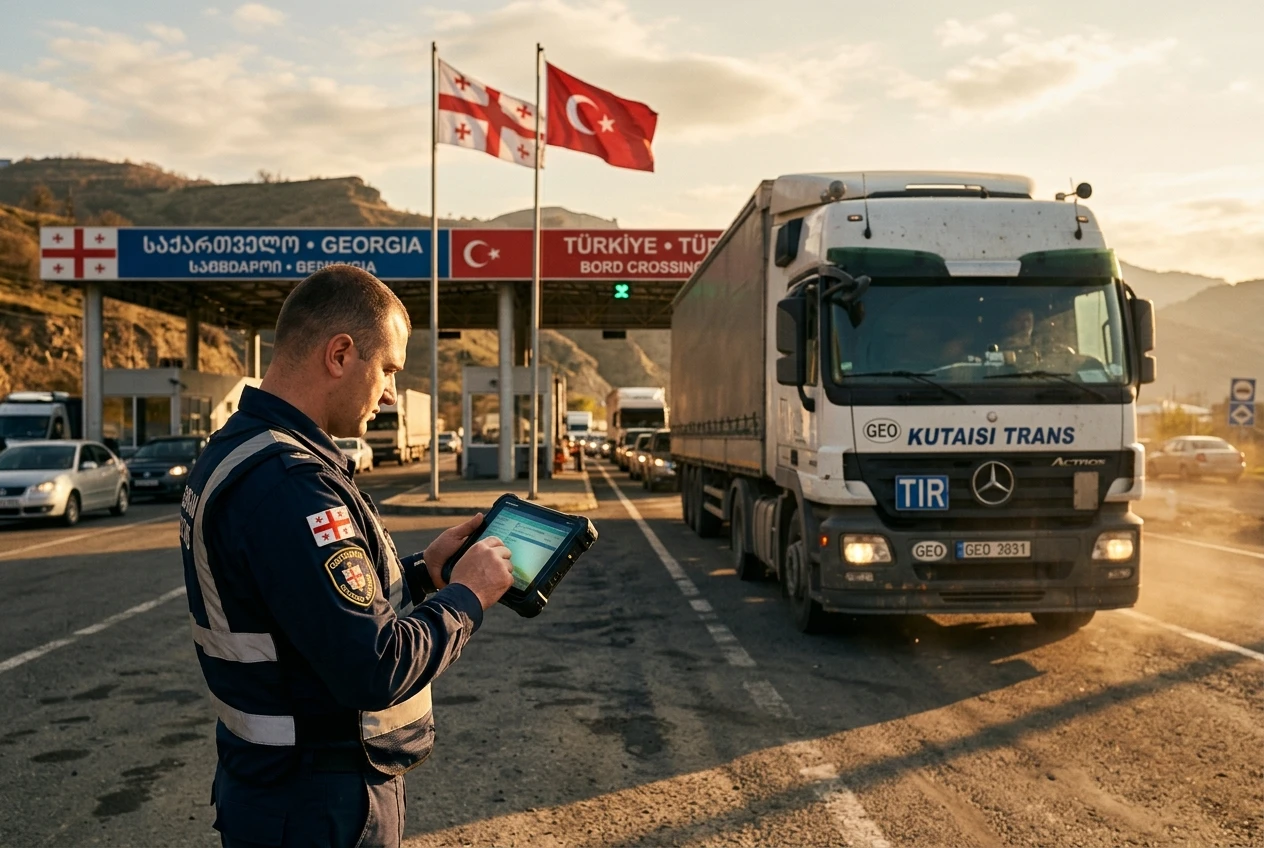
For carriers, the change means an end to the paper-based process that has handled Georgia-Turkey permits for years. The agency’s statement says the move will “significantly simplify administrative procedures, reduce the need for processing physical (paper) documents, speed up the process of issuing permits and control, and increase the efficiency of the sector.” For Turkish and Georgian customs officers at the main border crossing between the two countries, permit data is now in the system before a truck arrives. No more physical documents travel between the two countries by post or courier.
The agency frames the rollout as the first step in a broader plan to digitize every bilateral permit exchange. Bakur Mikadze, the agency’s director, said a working group has been created to manage a phased rollout to other partner countries. The announcement that Georgia-Turkey freight permits are now digital appeared in English on the Georgian Business Chronicle, with details carried the same day by regional outlets.
- Date: July 6, 2026
- Parties: Georgia and Turkey
- Mechanism: Two-way ECMT electronic platform
- Coverage: Bilateral road freight permits
- Next step: Phased rollout to other partner countries
How the Two-Way Digital Exchange Works
The new system operates on a two-way principle, Mikadze said. Both countries use a single electronic platform, so a permit issued in Tbilisi is immediately visible to regulators in Turkey, and vice versa. The design cuts out the postal and courier delays that the old paper exchange depended on.
Permit status can now be checked in real time by either side, according to the agency. That, the agency says, is where carriers and regulators will feel the gains on the ground. How the two countries will exchange permits electronically was first set out in a July 6 announcement from the Land Transport Agency.
- Document processing becomes faster as electronic submissions replace paper filings.
- Bureaucratic procedures and errors fall, since digital data entry replaces handwritten forms.
- Border control moves quicker, with permit information already in the system before trucks reach the crossing.
The Multilateral Permit System Behind the Switch
The system sits on top of the ECMT, the European Conference of Ministers of Transport multilateral permit system. The multilateral design is what lets a single electronic exchange reach multiple country corridors.
ECMT permits let carriers operate international routes across several member countries with a single document, without the need for a separate bilateral permit for each trip. Georgia, Turkey and dozens of other states participate, which is why a single electronic platform between two of them can, in principle, extend to many more. The framework has governed multilateral road freight between ECMT members for decades.
The electronic version of the ECMT system had been introduced previously, the agency noted, but the bilateral digital exchange with Turkey is the first time a country-specific permit flow has run through the same online system. That distinction matters: paper permits still circulate on other ECMT corridors, and the bilateral exchange is the proof point. The phased rollout Mikadze described tracks the same logic. If Georgia and Turkey can run on a single platform, the working group can test the model before extending it to other bilateral flows. Each new partner adds the same advantage that the Georgia-Turkey border crossing just gained.
The Land Transport Agency Driving the Rollout
The Land Transport Agency sits inside Georgia’s Ministry of Economy and Sustainable Development. It is the only competent authority in the country for issuing international road freight and passenger permits. Its remit also covers drafting technical regulations for road transport. What Georgia’s permit-issuing authority actually does includes running the country’s professional qualification center for truck and bus drivers.
Mikadze took the role after Economy Minister Mariam Kvrivishvili appointed him. The Economy Ministry’s introduction of the new agency head noted his prior experience in public-sector leadership posts and academic roles.
The agency says the electronic platform will strengthen Georgia’s position as a regional transit hub. The director puts the platform inside a wider regional play. It is described as a foundation for further expansion.
This mechanism ensures fast and secure data exchange, reduces technical and administrative delays, and creates a more transparent and modern system for administering international road freight transport.
Mikadze, the LTA director, said this in the agency’s July 6 statement on the new digital exchange. The release also confirms the working group he described, set up to run the phased rollout to other partner countries.
Putting Every Partner’s Permits on a Single Platform
The second-order effect of the Georgia-Turkey switch is that it establishes a working model the agency can now copy. A working group has been created, the agency says, and its first job is to draw up the order in which other bilateral permit flows get digitized. Each new country added to the platform reduces the paperwork load on carriers by one more bilateral channel. The rollout will be tested in stages, with each new partner stress-testing the same platform before the next joins. The pace at which new partners come on board will shape how fast the regional paper trail shrinks.
Georgia’s role in regional logistics gives the agency a particular reason to push for the expansion. The agency says the digital reform will “contribute to the development of the transport and logistics sector, the simplification of international trade and the further strengthening of Georgia’s role as a regional transit hub.” For a country positioned between Turkey, Armenia, Azerbaijan and the Black Sea, every bilateral permit that goes digital is also a small efficiency gain for the corridor it sits on. The corridor runs through the main road crossing between Georgia and Turkey.
What Still Runs on Paper
The Turkey switch is bilateral only. Permit exchanges with other partner countries still run on the old paper process. The working group’s brief is to plot the order in which those get converted.
No specific rollout dates have been announced. The agency has described the schedule only as “in phases.”
Each new digital partner will require coordination with its own national agency to integrate with the same platform. Data exchange protocols will need to be tested, and bilateral quota rules will need to be mapped onto the system. The Georgia-Turkey launch is the proof that the model works. The work of scaling it now begins.
